
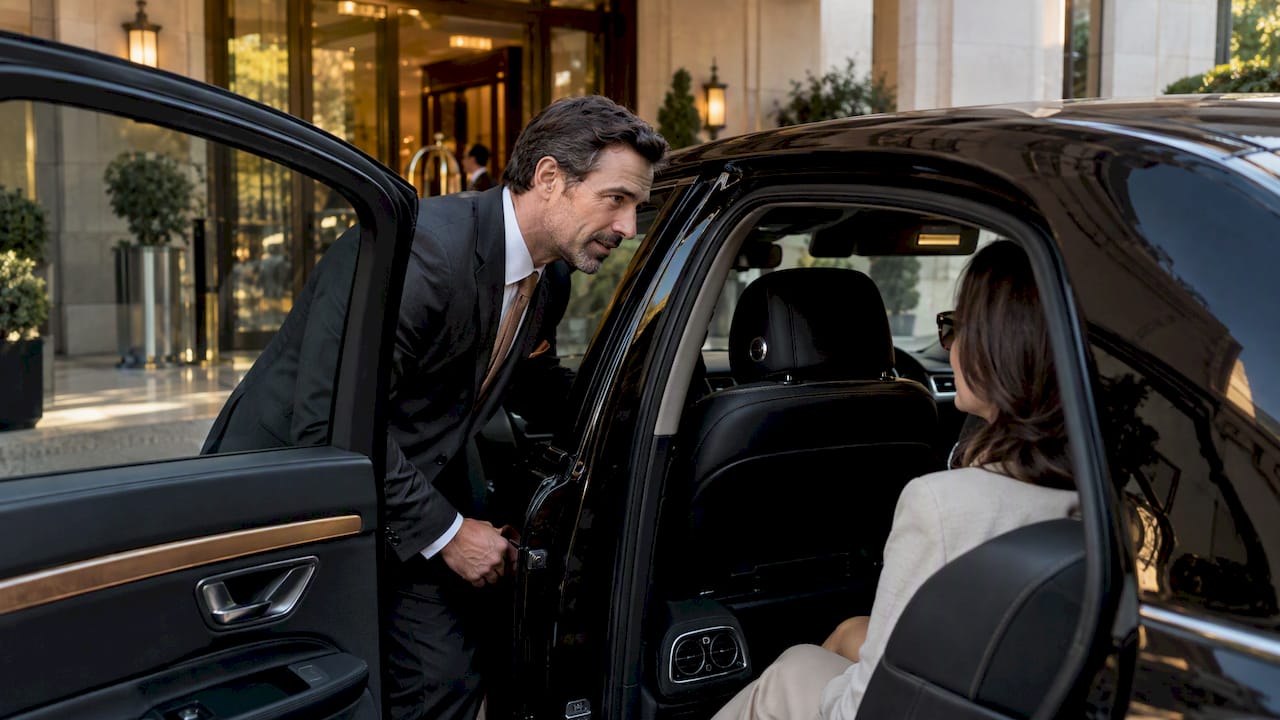
Chauffeur etiquette is a short list of behaviors: greeting by name, punctual staging, polished appearance, discreet communication, and safe driving that define professional service. A chauffeur who gets these five right turns a routine transfer into a smooth, private experience, while missing even one can unravel the rest of the trip. This guide breaks down how each behavior works in practice, from the first greeting to the final drop-off.
TL;DR:
- Most chauffeurs should confirm the passenger’s name and destination with minimal communication, avoiding repeated checks unless plans change.
- Appearance is crucial; chauffeurs must wear appropriate attire and grooming standards matching the booking’s formality, with strict attention to detail.
- Discretion extends to handling client information, limiting verbal and digital data sharing, and respecting cultural or personal preferences regarding communication and conduct.
- Safety is the foundation of etiquette, requiring defensive driving, compliance with laws, and proactive communication during delays or emergencies.
- Tipping is often bundled into the fare or optional, but drivers should accept gratuity graciously without pressuring clients, respecting local customs.
Table of Contents
- Core etiquette checklist for chauffeurs
- Appearance, uniform, and grooming standards
- Communication, privacy, and handling sensitive client preferences
- Safety and driving standards for professional chauffeurs
- Pickup, staging, and logistics at airports and cruise terminals
- Tipping and gratuity: expectations and handling bundled fees
- Practitioner best practices and the chauffeur comfort kit
- Handling difficult or special passenger requests
- Managing unexpected situations or delays
- Cultural etiquette variations and sensitivities
- Confidentiality and data security protocols
- Use of technology and devices during service
- What good chauffeur etiquette really protects
- Why Hidden Door Travel handles your transfer details
- Sources
- FAQ
Core etiquette checklist for chauffeurs
Good chauffeur etiquette shows up in small, repeatable actions rather than grand gestures. A professional driver greets passengers by name, confirms the destination without fuss, and handles logistics so the client never has to think about them. Industry guidance from the Houston Limousine Association lists specific behaviors that separate a trained chauffeur from a rideshare driver, including luggage handling and destination confirmation done quietly.
- Greet the passenger by name, with a brief introduction and direct eye contact, before discussing logistics.
- Open and close doors, and offer luggage assistance, while checking that bags are secured and nothing blocks mirrors or sightlines.
- Arrive within the agreed staging window and wait in a way that does not draw attention to the vehicle or the client.
- Keep conversation minimal and never solicit personal details, follow requests for a destination change, or pitch other services.
- Confirm the destination and route once, quietly, then proceed without repeated check-ins unless plans change.
These habits matter more on repeat business, where passengers notice when a driver remembers preferences from a prior trip.
Appearance, uniform, and grooming standards
A chauffeur’s appearance is the first signal of service quality, and it should match the formality of the booking. Corporate transfers typically call for a dark business suit, while formal events or branded fleets often require a company uniform with a tie or chauffeur cap. Grooming expectations are strict because small details are the ones clients notice up close.
- Hair neatly trimmed or tied back, nails clean, and shoes polished with no visible scuffs.
- Minimal cologne or perfume, since enclosed vehicle space amplifies scent.
- Visible ID badge or company signage when a venue, hotel, or cruise terminal requires it for security clearance.
- Attire adjusted on request for private clients who prefer a plainer look or a specific dress code for the occasion.
Uniform standards referenced by industry sources, including Chauffeur Driven, tie presentation directly to perceived professionalism, which is one reason agencies treat grooming as non-negotiable rather than optional polish.
Communication, privacy, and handling sensitive client preferences
Professional chauffeurs confirm identity and itinerary with the lightest touch possible: a name check at pickup, a one-line destination confirmation, and nothing more unless the passenger asks for it. The default posture is quiet. A chauffeur lets the client set the tone for conversation rather than filling silence with small talk.
Discretion extends beyond manners into data handling. Chauffeurs should never record, photograph, or share a passenger’s conversations, documents, or itinerary details, and any bags or devices left in the vehicle should stay secured and out of sight of other staff or passersby. When a client has standing preferences, such as a preferred route, temperature, or music choice, that information should be logged and handed off cleanly between shifts so the passenger never has to repeat themselves.
Safety and driving standards for professional chauffeurs
Safe driving is the baseline that every other courtesy sits on top of. Defensive driving means smooth acceleration and braking, generous following distance, and strict adherence to posted limits and local traffic laws, not just avoiding collisions. National safety bodies that study driver training programs point to defensive techniques and ongoing evaluation as central to reducing risk on the road.
Device use behind the wheel is a hard line. Phones and navigation devices should be mounted, pre-set, or handled hands-free before the car moves, with any adjustments made only while stopped. Before a pickup, a chauffeur checks tire condition, fluid levels, and cabin cleanliness, and during longer routes, a brief stop to verify the client’s comfort or recheck the route is normal rather than intrusive.

When conditions turn genuinely unsafe, whether from weather, mechanical trouble, or a medical concern, the chauffeur’s job is to make the call to pull over, reroute, or contact dispatch rather than push through. Passenger safety overrides schedule every time.
Pickup, staging, and logistics at airports and cruise terminals
Airport and cruise pickups fail or succeed on timing and signage. TSA guidance on terminal procedures is a useful reference point, since pickup zones and waiting rules vary by airport and chauffeurs who check them in advance avoid last-minute scrambling.
- Confirm the flight or ship arrival time the morning of pickup and track it for delays or early arrivals.
- Stage the vehicle within the agreed window, using a clearly visible name sign at the terminal or designated meeting point.
- Assist with luggage promptly, directing passengers toward the vehicle without crowding the walkway or holding up other travelers.
- Note any terminal-specific restrictions on waiting time or curbside access and adjust the staging plan ahead of arrival rather than on the fly.
A related resource on cruise shuttle pickup points breaks down how terminal layouts affect where a driver should park and wait.
Tipping and gratuity: expectations and handling bundled fees
Tipping norms for chauffeurs align with general expectations for premium personal services, varying with trip length and complexity rather than fixed amounts. Many luxury transfer quotes already bundle gratuity into the total fare, in which case additional tipping becomes optional and is usually reserved for exceptional service rather than expected as routine.
A professional chauffeur accepts an offered cash or card tip graciously, without hinting that more is expected, and never asks directly. When a client is unsure whether gratuity is included, a quick glance at the billing details in the original quote usually clears up the confusion before it becomes awkward. International norms vary, so travelers crossing borders should check local custom rather than assume their home country’s tipping rate applies.
Practitioner best practices and the chauffeur comfort kit
Experienced chauffeurs often carry a discreet comfort kit: phone chargers, tissues, bottled water, an umbrella, mints, and a basic first-aid kit, all stored out of sight and offered only when it fits the moment. Industry benchmarking ties this kind of preparation directly to how passengers rate their experience.
- Keep chargers for multiple device types within easy reach but never displayed unprompted.
- Offer water or tissues once, early in the ride, rather than repeatedly.
- Record standing preferences such as temperature, route, or music in a shared note so the next driver on a multi-leg trip can pick up seamlessly.
- Anticipate small frictions, like a delayed flight or a sudden weather shift, before the passenger has to mention them.
Pro Tip: Keep a charging cable visible only on request, and never glance at a passenger’s device screen, even by accident, while handing it over.
This kind of anticipatory service is what separates a transfer that feels managed from one that feels merely completed.
Handling difficult or special passenger requests
Special requests come in two flavors: logistical and personal, and a trained chauffeur handles both without making the client feel like they’ve asked for too much. A route change, an extra stop, or a request to wait longer than planned should be met with a calm “of course” and a quick mental recalculation, not a visible sigh or a comment about the schedule.
Personal requests require more judgment. A passenger who wants silence the entire ride, prefers a specific temperature, or asks the chauffeur to avoid a particular road because of traffic memories from a past trip should have that preference honored without follow-up questions. When a request falls outside what’s reasonable, such as unsafe speed or an illegal maneuver, the chauffeur declines politely and offers the safest alternative rather than refusing outright and leaving the client stuck.
Difficult passengers, whether anxious, rushed, or simply curt, are handled with the same even tone throughout the ride. Raising a voice, matching irritation, or over-explaining a delay rarely helps and often escalates tension. The better approach is a brief, factual update (“we’re about six minutes out due to traffic on the bridge”) followed by silence unless the passenger wants more detail. Chauffeurs who work events or weddings also encounter requests tied to timing pressure, like a bride needing an extra ten minutes before departure, and the right response is flexibility within the bounds of the schedule, communicated clearly to dispatch so the rest of the day’s bookings stay on track.
Managing unexpected situations or delays
Delays are inevitable in ground transportation, and how a chauffeur handles them matters more than whether they happen at all. A flight lands late, a cruise ship holds at anchor longer than planned, or traffic closes the planned route: in each case, the chauffeur’s first move is to update the client or dispatch with a clear, brief status rather than letting the silence create anxiety.
Mechanical issues require a different kind of composure. If a vehicle develops a problem mid-route, the priority is pulling over safely, assessing whether the car can continue, and arranging a replacement vehicle if needed, all while keeping the passenger informed without alarming language. A chauffeur who says “we have a small mechanical issue and I’m arranging a backup car now” sounds in control, while vague or panicked language undermines the client’s confidence in the whole service.
Weather delays, especially around airports, call for proactive communication. Rather than waiting at the curb for a flight that’s visibly delayed on the tracking app, a well-trained chauffeur adjusts the staging time and lets the client know in advance, which avoids both a wasted wait and a rushed scramble. The same logic applies to cruise terminals, where disembarkation can run long due to customs processing. Flexibility paired with clear updates turns a potential frustration into a non-event, and it’s often the moments where something goes wrong, not the moments where everything goes right, that passengers remember most.
Cultural etiquette variations and sensitivities
Chauffeur etiquette isn’t identical everywhere, and a driver working with international clients needs to read cues rather than apply a single script. Expectations around eye contact, physical distance, and conversational warmth vary by culture: some passengers expect a warm, personable greeting, while others consider any unsolicited conversation intrusive. The safest default is a brief, respectful greeting followed by silence, letting the passenger set the tone from there.

Gender norms also shape appropriate conduct. In some cultural contexts, physical assistance such as offering an arm or standing close while opening a door may be unwelcome, particularly between a male chauffeur and a female passenger traveling alone. Observing the passenger’s body language on approach, rather than defaulting to a fixed routine, avoids missteps.
Religious and dietary considerations sometimes surface indirectly, such as a request to avoid certain routes during prayer times or to accommodate a stop for a specific reason. Chauffeurs who’ve worked internationally learn to treat these requests as routine logistics rather than unusual demands. Language barriers are another common variable. A chauffeur who can offer a few polite phrases in a client’s language, or who simply slows down and confirms understanding clearly, reduces friction without needing fluency. None of this requires memorizing every custom. It requires paying attention, asking rather than assuming when unsure, and treating every passenger’s preference as valid rather than unusual.
Confidentiality and data security protocols
Privacy is part of the job description, not an afterthought. Chauffeurs regularly overhear business calls, see travel documents, and learn details about a client’s schedule or relationships, and professional conduct means none of that information leaves the vehicle. No photographs of passengers, no mentions of who was in the car, and no discussion of a client’s itinerary with other staff beyond what’s operationally necessary.
Digital habits matter just as much as verbal discretion. If a chauffeur uses an app or device to track bookings, any passenger information stored there should be handled the way sensitive personal data is handled anywhere: limited access, no unsecured sharing, and deletion once it’s no longer needed for the booking. When a chauffeur or service handles payment information directly, card data security standards set the baseline for how that information should be processed and stored.
Handover notes between shifts should include only what the next driver needs, like a preferred route or a standing request, never unrelated personal details picked up along the way. Clients traveling for business or personal reasons that require discretion often choose a service based on this kind of quiet reliability more than any other factor.
Use of technology and devices during service
Technology in a chauffeured vehicle should work in the background, not in the passenger’s face. GPS and routing apps are standard, but a professional driver pre-sets the destination and keeps the device mounted and silent rather than fumbling with it mid-route. Any adjustment to navigation happens while stopped, never while driving.
In-car Wi-Fi or charging setups are a convenience, offered once and left alone afterward. A chauffeur should never ask to connect a personal device to a client’s hotspot or vice versa without a clear reason, and if a client needs secure connectivity on the road, guidance on avoiding public Wi-Fi risks is a useful reference for staying protected between pickup points.
Dashcams and tracking apps, where used, should be disclosed to passengers rather than run invisibly, since undisclosed recording undermines the trust that discretion is built on. The overall rule is simple: technology should solve a logistics problem quietly, never become a distraction or a privacy concern for the person in the back seat.
What good chauffeur etiquette really protects
The standards above aren’t about formality for its own sake. They exist because a transfer is often the first and last impression of an entire trip, and a driver who handles the small details well signals that everything else, the hotel, the itinerary, the event access, has been planned with the same care. What gets underestimated is how much a single awkward pickup or overly chatty ride can color a client’s mood for hours afterward, regardless of how well the rest of the day is organized. A chauffeur recently held a client’s preferred jazz playlist from a prior booking and had it queued before the door even closed, a small detail that said more about the service than the car itself ever could. For transfers planned as part of a larger itinerary, working with Hidden Door Travel means someone has already thought through these details before the car arrives.
— Michael
Why Hidden Door Travel handles your transfer details
Booking a chauffeur directly often means guessing at quality until the car shows up. A professional travel agency typically integrates ground transportation into the bespoke planning process used for the rest of a trip, drawing on industry experience to vet vendors and set clear expectations for punctuality, presentation, and discretion before a client ever gets in the car.

That oversight means fewer surprises at the curb and a consistent standard across airport runs, event transfers, and multi-day itineraries alike. To arrange managed transfers as part of a custom trip, explore vacation planning and concierge services with Hidden Door Travel.
Sources
- Chauffeur Professional Standards – Houston Limousine Association
- Benchmark best practices — uniform guidelines (Chauffeur Driven)
- TSA — Frequently asked questions
FAQ
Why do chauffeurs walk around the front of the car?
Walking around the front of the vehicle, rather than behind it, keeps the chauffeur visible to oncoming traffic and lets them maintain sight of the passenger door while approaching. It’s a safety habit rooted in staying visible and avoiding blind spots near moving traffic.
Am I supposed to tip my chauffeur?
Tipping is common but often optional, especially when gratuity is already bundled into the quoted fare. When a tip isn’t included, a cash or card tip reflecting the quality of service is appreciated but rarely demanded outright.
What is proper attire for a chauffeur?
Standard attire is a dark business suit or a company uniform, paired with polished shoes and neat grooming, with the exact requirement depending on the booking’s formality. Private clients can often request a plainer look for low-key transfers.
Should I tip my limo driver if gratuity is included?
If a quote clearly states gratuity is included, an additional tip is optional and generally reserved for exceptional service rather than expected as standard practice. Checking the fare breakdown before the ride clears up any confusion about what’s already covered.