
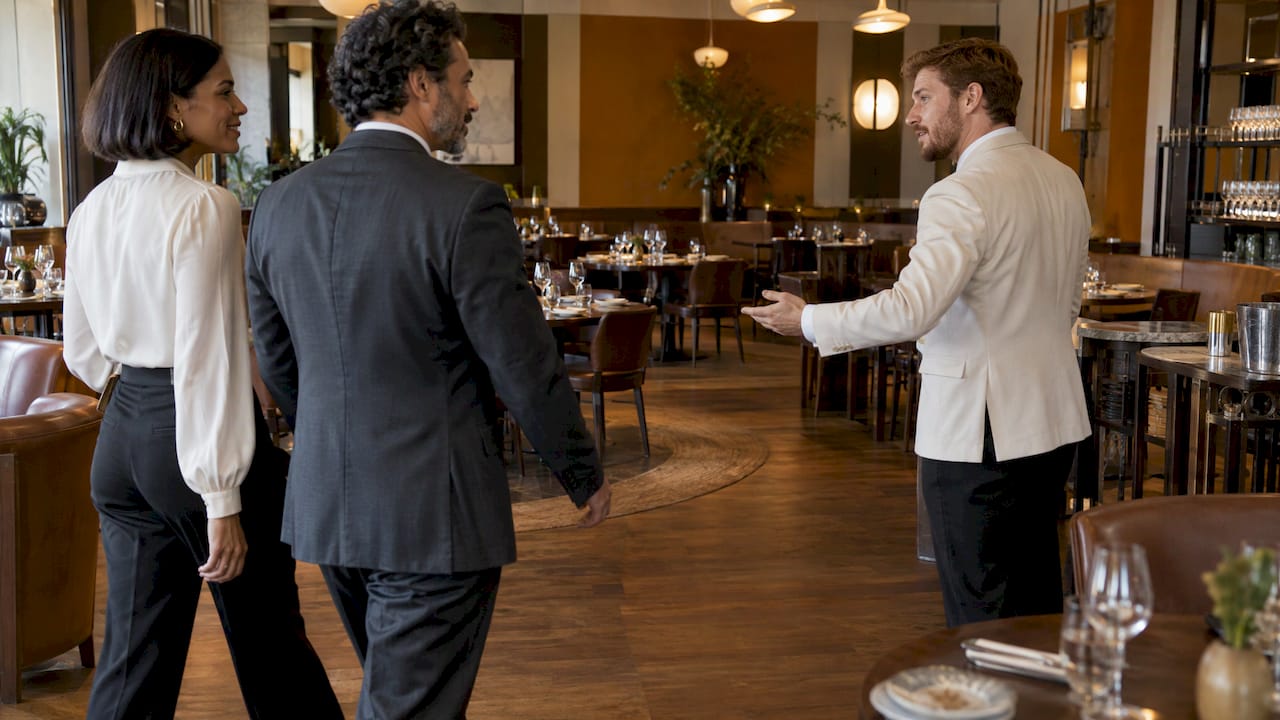
A restaurant buyout means you reserve the whole restaurant, or an agreed part of it, for your event, and no other diners are seated. In the US you pay for it with a food-and-beverage minimum, usually plus fees, service charge and tax, and you book it months ahead. The sections below cover what is included, what it really costs, which terms to check in the contract and when a buyout beats a private room.
TL;DR
- A buyout closes the restaurant to the public for your event. A private dining room leaves the rest of the restaurant open.
- Most buyouts are priced as a food-and-beverage minimum. One marketplace reports a $5,000 median minimum across 248 restaurants, with a range of $25 to $60,000.
- Budget for the minimum plus room fees, service charge, tax, gratuity and extras. The headline number is never the final bill.
- Plan 4 to 6 months ahead for most private events and 9 to 12 months for weddings, longer for peak dates.
- Read the written scope: which spaces are included, the headcount guarantee, and the cancellation terms.
Table of Contents
- What a restaurant buyout is
- How many guests a buyout holds
- What a restaurant buyout costs in the US
- What a buyout typically includes
- What to check in the contract
- How far ahead to book
- Buyout or private room: how to choose
- A buyout when the guests are traveling
- Our perspective
- Planning a celebration beyond one dinner
- FAQ
- Sources
What a restaurant buyout is
In a buyout, one client books the entire restaurant or a defined part of it, and the space is closed to the public. You get the room, the kitchen and the staff. You also get control of music, layout, décor and guest flow.
That last point is why hosts choose it. A buyout is a single-client agreement. The restaurant is not running table-by-table service for strangers while you toast.
Full, partial and private room
There are three common formats:
| Format | What you reserve | Rest of the restaurant | Typical fit |
|---|---|---|---|
| Full buyout | Entire restaurant, often bar and patio too | Closed to the public | Large parties, receptions, launches |
| Partial buyout | A defined area such as a patio, mezzanine or bar | Usually open | Mid-size groups, lower minimums |
| Private dining room | One designated room | Open | Smaller seated dinners |
Partial buyouts typically carry lower minimums than full ones. The boundary between these formats is set by each venue, so the contract matters more than the label.
A “full” buyout does not always mean every square foot. The agreement has to name the actual spaces, because a separate bar, terrace or upstairs room might sit outside it. Ask whether restrooms, entrances or coat check are shared with anyone else.
How many guests a buyout holds
Capacity varies enormously, so check the seated and standing numbers separately.
- Ernest in San Francisco lists up to 62 seated or 120 standing, using the bar, lounge, dining room and garden patio.
- Cinghiale in Baltimore advertises full buyouts for up to 245 guests, while its private spaces hold 26 to 130.
- Catalyst advertises cocktail parties of up to 400 and says a buyout can cover ceremony, reception, dinner and dancing.
A simple rule of thumb: a buyout starts to make sense when the largest private room is smaller than your RSVP list. One NYC guide points out that Gramercy Tavern’s private room holds 20 against 120 seats for a buyout, six times as many.
Buyouts suit corporate events, wedding receptions, holiday parties, product launches and larger celebrations. A private room is often more practical for a small seated meal.

What a restaurant buyout costs in the US
There is no single price. The number depends on the city, the venue’s level, the day of the week and the time of year.
Real published figures
The marketplace figure above is a median, so half of the venues with published minimums sit above $5,000. Fine dining in big cities sits well higher. Individual restaurants show how wide the spread is:
| Venue | Published terms |
|---|---|
| The Cellar, San Clemente | $12,000 full-buyout minimum, including a $5,000 space fee, with the rest applied to food and beverage |
| Ernest, San Francisco | $16,000 F&B minimum from January 1 to November 15, $18,000 from November 16 to December 31, plus a $2,500 room-rental fee |
| Fig Tree, via a venue price guide | $12,000 on weekdays, $15,000 on weekends; varies by date, season and guest count |
For fine-dining venues in major US cities, one guide puts full buyouts at $15,000 to $50,000 or more in food and beverage, with a possible facility fee. Treat that as an orientation range, not a quote.
How the minimum works
The most common model is a food-and-beverage minimum: you commit to spend a set amount on food and drink, and any shortfall is charged to you. Most published minimums are before tax and service charge, according to the SpotPrivate data.
Other structures exist: a room or venue fee, a fixed per-person package, or a hybrid of a per-person price with a minimum guest count or spend.
The extras that change the total
Your real budget is the minimum plus everything the contract adds:
- Room or venue fee
- Service charge, tax and gratuity
- Rentals, audio-visual and entertainment
- Corkage, cakeage and overtime
The service charge deserves attention. Ernest’s policies list 8.625% sales tax, 7% taxable mandates, a 5% coordination fee and a taxable 25% service charge for buyouts. Elsewhere, one guide says most restaurants add 20% to 24% to private event bills. That charge is not automatically a tip. The same guide cites the Emily Post Institute, which suggests 15% to 20% on top of any service charge that does not go directly to servers.
A worked example makes the gap visible. Say a venue lists a $12,000 minimum, a $2,500 room fee, a 25% service charge and 8.625% tax. If the service charge and tax apply to the full amount, the bill lands far above $14,500. Always ask which items each percentage applies to.
Ways to lower the number
Minimums rise for peak weekend evenings. A San Diego guide notes there is more negotiating room for weeknight or off-peak events. If your date is flexible, a Tuesday lunch or a Sunday evening can change the quote. A partial buyout is the other lever.
What a buyout typically includes
A package generally covers exclusive use of the space, dedicated event staff, on-site catering or a minimum food and beverage spend, and audio-visual setup. Get the specifics in writing: food, bar service, staff, furniture, linens, tableware, setup and cleanup.
The operating document is usually the Banquet Event Order. It lists date, start and end time, room, guaranteed and final headcount, menu by course with allergens, beverage package and minimum, setup, timeline, contacts, billing and signature lines. Read it line by line, and make sure it matches the proposal.
What to check in the contract
Use this list before you sign.
- Scope. Spaces included, hours, exclusivity, seated capacity, and whether a ceremony can happen on site.
- Itemized quote. Eligible food and beverage, any shortfall, venue fees, service charge, tax and gratuity, with the base each percentage applies to.
- Headcount guarantee. When it locks. One San Diego guide says final headcount is typically locked 72 hours before, with menus and dietary needs finalized 10 to 30 days before.
- Menu-price lock. Whether prices hold between signing and the event.
- Cancellation and postponement. What happens to your deposit, and whether it is credited to a new date.
- Spending authority. Who on your side can approve extra drinks or add-ons on the night.
- Outside vendors. Written approval for photographers, florists, musicians, outside food or alcohol, plus insurance, loading access, sound limits, storage, corkage and cake-cutting charges.
- Overtime. The hourly rate and when the clock starts.
The label matters less than the written scope. A private room may be fine for a birthday toast, while a company presentation could need stronger sound separation and dedicated equipment.
How far ahead to book

Lead time depends on the occasion and the date. Bonnie Rae suggests 9 to 12 months for weddings and 4 to 6 months for corporate or private events, with more time for peak dates. Some venues are tighter: Atelier Crenn says a buyout may be available if you inquire 60 to 90 days ahead.
The usual sequence runs like this:
- Inquire with your date, group size and budget.
- Receive availability and the minimum.
- Review the proposal and ask for specific inclusions.
- Review the revised proposal.
- Sign and pay the deposit.
- Finalize menu, dietary needs and headcount on the venue’s deadlines.
For the hardest rooms, a full buyout of a small restaurant can need three months or more, while a private room for ten to thirty guests books one to three months out.
Buyout or private room: how to choose
Choose a buyout when privacy, layout control or headcount drive the decision. Choose a private room when your group is small and the meal is the point.
- Group size. If your list outgrows the biggest private room, buy out.
- Programming. Speeches, music, a cocktail format or a product reveal all need freedom to move. A buyout provides it.
- Budget. A private dining room is often lower in cost, while a full buyout gives more exclusivity and customization.
- Date. Flexible dates favor a buyout negotiation.
A buyout when the guests are traveling
The hardest buyouts are not in your home city. A celebration dinner for 40 guests flying in means arranging the restaurant, hotel blocks, ground transport and a plan B at once. If part of the guest list is flying privately, event travel by private jet has its own booking logic worth understanding early.
For destinations where a restaurant will not scale, look at the alternatives we cover: a private villa buyout with its three pricing models, or a hotel buyout when you need sleeping rooms and dining under one contract. If the table itself is the challenge, our guide to Michelin reservation strategies covers how to land it. For chef-led meals at home base, see in-villa dining.
Our perspective
A restaurant buyout looks simple on paper: one room, one date, one number. In practice it is a contract with a dozen moving parts, and the people who enjoy their evening are the ones who settled those parts months earlier.
Our approach, built on more than 20 years of industry experience, is to treat the dinner as one piece of a larger trip. We think about who is arriving from where, where they sleep, how they get to the door and what happens if the weather turns. That is what a personalized concierge service is for.
We also lean on direct destination knowledge and relationships with partners to reach experiences that are hard to find. When a hosting plan is complex, that is where we aim to deliver while others give up.
Michael
Planning a celebration beyond one dinner
If your buyout is part of a bigger gathering, such as a destination wedding, a milestone birthday or a group trip, we can plan the whole thing with you. Hidden Door Travel designs bespoke luxury trips, including custom itineraries, hotel and cruise bookings, destination weddings, transportation and concierge services.
See how we work on our vacation planning and destination wedding services, or start with our guide to private group trip planning. For wedding hosts, our destination wedding timeline shows when each vendor should be locked.
FAQ
Is a restaurant buyout the same as renting a private room?
No. A buyout reserves the whole restaurant or an agreed broad area for your event alone. A private room reserves one space while the rest of the restaurant may stay open. The exact boundary is set by each venue, so confirm it in writing.
How much is a typical buyout minimum?
One marketplace reports a $5,000 median among restaurants with published minimums. Fine-dining venues in large cities can run far higher, and tax, service charge and fees usually come on top.
Do I have to pay the minimum if my guests eat less?
Usually yes. With a food-and-beverage minimum, any shortfall is charged. Ask whether the room fee counts toward the minimum, as it does in some venues’ terms.
Can I bring my own photographer, florist or band?
Often, but only with the venue’s written approval. Ask about insurance, loading access, sound limits and storage before you book vendors.
How early should I inquire?
For most private events, 4 to 6 months ahead is a sound starting point, and 9 to 12 months for weddings. Peak dates and popular rooms need more time.
Sources
- Restaurant Buyouts | SpotPrivate
- Restaurant Buyout Guide for Operators | Harvest
- NYC Restaurant Buyouts: What Groups Need to Know
- Ernest | Private Dining & Private Events
- Private Dining in Baltimore | Cinghiale
- Restaurant Buyout | Catalyst
- Restaurant Buyout NYC: What It Means and Who Offers One
- Private Dining vs. Restaurant Buyout: How to Choose
- Host Your Private Event at The Cellar
- What a Private Event Costs: Real Venue Prices
- Private Dining Room Cost and Minimum Spends Explained
- Restaurant Buyout San Diego | Full Venue Booking Guide
- How much does it cost to hire an entire venue for an event?
- Restaurant Private Events for Operators 2026: Buyer’s Guide
- U.S. Wedding Restaurant Buyout Cost | Bonnie Rae
- Private Dining & Events | Atelier Crenn
- Large-Party Fine Dining Reservations: How to Book 2026
- How Event Travel Works on Private Jets in 2026