

A travel curator is a specialist who designs fully personalized travel experiences by building custom itineraries that reflect a traveler’s unique interests, priorities, and lifestyle. Unlike a traditional travel agent who books pre-packaged trips, a travel curator acts as a personal travel architect, sourcing exclusive access, private guides, and bespoke logistics that simply cannot be found in a standard catalog. The industry term for this work is bespoke travel design, and it sits at the intersection of deep destination knowledge, client psychology, and supplier relationships. This guide breaks down what the role actually involves, how it differs from conventional travel planning, and why demand for this expertise is accelerating in 2026.
What is the role of a travel curator?
The role of a travel curator is to translate a client’s vision into a fully realized, end-to-end travel experience. That sounds simple. The execution is anything but.
A curator begins every engagement with a deep client consultation. This is not a form asking for your preferred airline. It is a conversation about how you like to spend a Tuesday afternoon, whether you prefer markets or museums, and what made your last trip fall short. From that conversation, the curator builds a framework before a single booking is made.
The core responsibilities of a travel curator include:
- Client discovery: Understanding preferences, travel history, budget, and the emotional outcome the client wants from the trip
- Itinerary design: Building a day-by-day plan that incorporates exclusive experiences, local insights, and flexible scheduling
- Supplier coordination: Negotiating with hotels, private aviation providers, ground transport companies, and specialist guides
- Booking and confirmation management: Handling every reservation, deposit, and confirmation so the client never touches a spreadsheet
- On-trip support: Staying available for real-time adjustments, emergencies, and last-minute changes
Effective travel curation requires a seamless client journey managed through specialized itinerary technology. This allows real-time updates, coordination, and personalized communication throughout the trip, which is something a standard booking platform cannot replicate.
Pro Tip: Ask any curator you are considering working with how they handle a supplier failure mid-trip. Their answer tells you everything about whether they are a true curator or just a sophisticated booking agent.

Pricing models in this space typically combine flat service fees with supplier commissions, reflecting value beyond bookings rather than just transaction volume. That structure matters because it aligns the curator’s incentives with your experience, not with the highest-margin hotel.
How do travel curators differ from traditional travel agents?
The distinction between a travel curator and a traditional travel agent is not just about price. It is about scope, depth, and what happens when things go wrong.
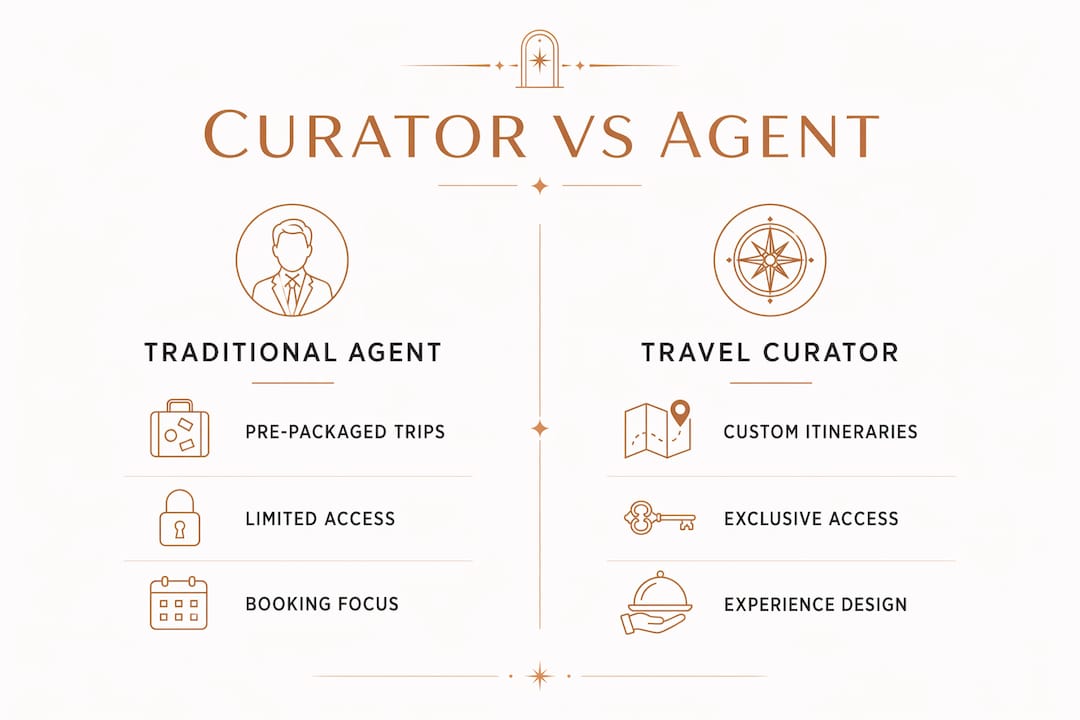
| Factor | Traditional Travel Agent | Travel Curator |
|---|---|---|
| Trip design | Pre-packaged itineraries | Fully custom, built from scratch |
| Supplier access | Standard hotel and airline inventory | Private tours, exclusive events, private aviation |
| Client interaction | Transactional, form-based | Consultative, relationship-driven |
| On-trip support | Limited or none | Active crisis management and real-time adjustments |
| Pricing model | Commission on bookings | Flat fee plus curated supplier relationships |
| Lead time | Days to weeks | 60–120 days recommended, hours possible via private jet |
Travel curators blend private aviation, hotels, ground transport, guides, and exclusive experiences into a single tailored journey. That integration is the defining difference. A traditional agent books components. A curator builds a system where every component serves the overall experience.
The access gap is equally significant. Travel curators secure private tours, exclusive experiences, and custom routing that are simply not available through regular agents. That exclusivity is what drives both the premium charge and the traveler satisfaction that follows.
Pro Tip: If a travel professional cannot name three specific suppliers they work with in your destination of choice, they are working from a generic database, not a curated network.
Crisis management is where the gap becomes most visible. When a flight cancels, a hotel floods, or a border closes, a traditional agent hands you a phone number. A curator has already called the private aviation provider and rebooked your ground transport before you finish reading the alert.
What are the real benefits of using a travel curator?
The benefits of a travel curator go well beyond convenience. They change the quality of the experience itself.
-
Time recovery. Customized travel itineraries save clients time and reduce stress by providing expertly organized journeys tailored to their preferences. For a high-net-worth traveler, the hours spent researching, cross-referencing, and confirming are worth more than the curator’s fee.
-
Access that money alone cannot buy. Private dinners at closed museums, after-hours access to archaeological sites, and introductions to local families who do not advertise online. These experiences exist because curators have spent years building the relationships that unlock them.
-
Personalization at the mood level. A skilled curator does not just match your interests. They read your energy. If you arrive exhausted from a transatlantic flight, your first day should not be a six-hour walking tour. The itinerary bends to you, not the other way around.
-
Flexible logistics, including private aviation. Luxury curators handle urgent travel by leveraging private jet availabilities and flexible supplier relationships, reducing lead time from months to hours in some cases. That flexibility is not a luxury add-on. For many clients, it is the entire point.
-
A single point of accountability. When you book independently, you manage ten vendors. When you work with a curator, you manage one relationship. That simplicity has real value when something goes sideways.
“The best curated trips feel effortless to the traveler precisely because the curator has absorbed all the complexity behind the scenes.”
The personalized travel service benefits extend beyond the trip itself. Clients who work with curators consistently report higher satisfaction and a greater sense of meaning from their travel. That outcome is not accidental. It is designed.
How is the travel curator role evolving in 2026?
The travel experience designer role is changing faster in 2026 than at any point in the past decade. Three forces are driving that shift: technology, niche specialization, and compressed timelines.
Digital travel curation increasingly incorporates AI and advanced itinerary tools to personalize and refine trip planning. This tech-driven customization is reshaping the market in 2026 by giving curators the ability to process client preference data at scale while still delivering a handcrafted result. The best curators use AI to handle logistics and research, freeing their own time for the human judgment that software cannot replicate.
Niche specialization is the second major shift. Focusing on cultural journeys or adventure tours helps travel curators market effectively and convert leads into loyal clients. A curator who specializes in sub-Saharan Africa wildlife experiences or Japanese culinary travel carries a credibility that a generalist cannot match. Clients seeking that depth are willing to pay for it.
The third shift is timeline compression. Luxury travel curators recommend starting bespoke trip planning 60–120 days ahead to secure private access, vetted guides, and custom routing. But late-stage curated trips anchored around private jet logistics can now be arranged on as little as 4 hours’ notice. That capability has created a new category of client: the spontaneous luxury traveler who expects world-class curation on demand.
| Trend | Impact on Curation |
|---|---|
| AI itinerary tools | Faster personalization, more data-driven client matching |
| Niche specialization | Deeper expertise, stronger client loyalty |
| Private aviation integration | Same-day and next-day curated trips now viable |
| Flexible itinerary demand | Curators building adaptable frameworks, not fixed schedules |
For anyone exploring how to become a travel curator, the 2026 market rewards specialists who combine genuine destination expertise with strong supplier networks and a clear niche. Generalists are being squeezed from both ends: by technology on the low end and by deep specialists on the high end.
Key takeaways
A travel curator’s core value is not booking trips. It is designing experiences that a traveler could not create alone, then managing every detail so the client only experiences the result.
| Point | Details |
|---|---|
| Curator vs. agent | Curators build custom itineraries from scratch; agents book from existing packages. |
| Supplier access | Curators unlock private tours, exclusive events, and private aviation not available to the public. |
| Technology in 2026 | AI tools handle logistics research, freeing curators to focus on human judgment and client relationships. |
| Timeline flexibility | Expert planning typically starts 60–120 days out, but private jet logistics can compress that to hours. |
| Niche specialization | Curators who focus on a specific region or travel style build stronger credibility and client loyalty. |
Why the human element still wins
After 15 years of watching the travel industry shift, I keep coming back to the same observation: the curators who thrive are not the ones with the best software. They are the ones who ask the best questions.
I have seen clients hand over a detailed brief listing every preference imaginable, and still end up with a trip that felt generic. The brief was technically correct. The curator never pushed back, never asked why, never challenged the assumptions buried in the request. That is the gap technology cannot close.
The most memorable curated trips I have encountered share one trait. The curator made a call the client would not have made themselves. They booked the smaller, quieter hotel over the famous one. They cut a day in Paris and added a night in a village the client had never heard of. They trusted their knowledge over the client’s comfort zone. That takes confidence, and it takes a relationship built on trust.
For travelers considering working with a curator, my honest advice is this: give them room to surprise you. If you micromanage every decision, you are paying for execution, not curation. The value lives in the judgment calls you did not know needed to be made.
For anyone exploring how to build a career in this space, specialize early and build your supplier relationships before you need them. A curator with three deep regional networks will outperform a generalist with a hundred surface-level contacts every time.
— Michael
Experience bespoke travel with Hiddendoortravel
Hiddendoortravel has spent years building the supplier relationships, destination knowledge, and client consultation process that define genuine travel curation. Every itinerary starts with a real conversation, not a form.
Whether you want a private cultural immersion in Japan, a last-minute safari anchored by private aviation, or a multi-week European journey built around your exact pace and interests, Hiddendoortravel’s luxury travel experts handle every detail. From exclusive access experiences to real-time on-trip support, the team operates as your single point of accountability from first call to final transfer. If you are ready to stop booking trips and start experiencing them, explore what bespoke travel planning looks like when it is done properly.
FAQ
What does a travel curator actually do?
A travel curator designs fully personalized itineraries by consulting with clients, coordinating suppliers, and managing every logistical detail from booking to on-trip support. The role goes well beyond booking flights and hotels to include securing exclusive access and providing real-time crisis management.
How is a travel curator different from a travel agent?
A travel agent typically books from pre-packaged inventory, while a travel curator builds a custom itinerary from scratch using private suppliers, exclusive experiences, and bespoke logistics. The curator also provides active on-trip support, which most agents do not offer.
How far in advance should i contact a travel curator?
Luxury travel curators recommend starting the planning process 60–120 days before departure to secure private access and vetted guides. For urgent requests, curators with private aviation relationships can arrange curated trips on as little as 4 hours’ notice.
What types of experiences can a travel curator access that i cannot book myself?
Travel curators secure private tours, after-hours venue access, exclusive cultural events, and custom routing through supplier relationships built over years. These experiences are not listed on public booking platforms and require direct industry connections to arrange.
How do travel curators charge for their services?
Most travel curators use a pricing model that combines a flat service fee with supplier commissions, reflecting the value of their expertise rather than just the transaction. This structure aligns the curator’s incentives with delivering the best possible experience for the client.