
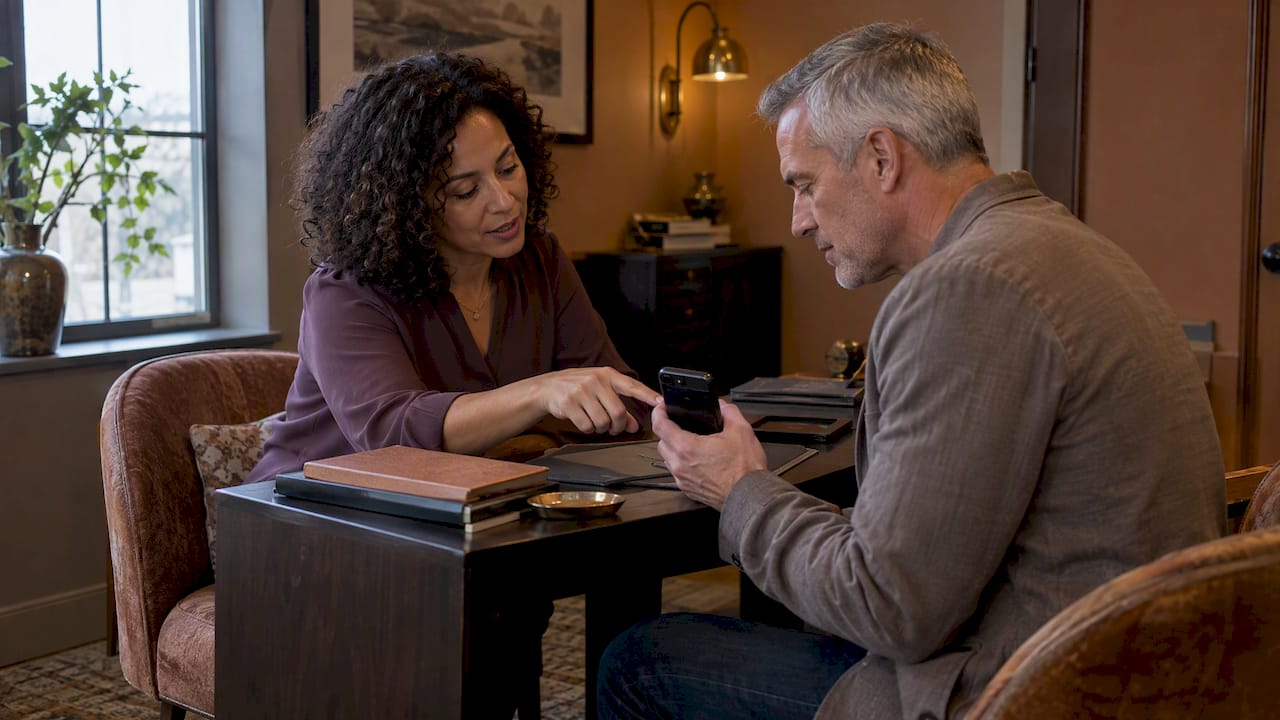
Celebrity-level travel privacy comes down to controlling who knows where you are, when, and under what name. That means fewer parties holding your itinerary, a booking trail that is deliberately short, tight digital habits, and hotels, drivers and cruise lines briefed before you arrive. No arrangement is a guarantee, and the best ones are honest about that. Below is how it works in practice, drawn from government guidance, provider policies and our own planning experience.
TL;DR
- Privacy is built at booking: route reservations through one trusted advisor instead of many consumer sites, and limit who sees the full itinerary.
- Your phone is the biggest leak. Turn off geotagging, skip public Wi-Fi, and post only after you are home.
- Hotels and cruise lines collect names, payment details and sometimes ID, and use cameras. Ask what they keep, who sees it and how staff are briefed.
- Remote villas and private transport reduce exposure but add their own trade-offs, such as staff, drivers and vendors who each know your plans.
- Treat every measure as risk reduction, not a promise.
Table of Contents
- Where a trip first becomes visible
- What hotels and providers collect about you
- What to ask a luxury hotel before you arrive
- Your phone and accounts
- Cruises: privacy at sea has its own rules
- Remote stays, private transport and the trade-offs
- Security layers without a false sense of safety
- Our perspective
- Plan a quieter trip with us
- FAQ
- Sources
Where a trip first becomes visible
Most people picture a photographer outside a hotel. The exposure usually starts earlier: a flight search, a booking on a consumer site, a loyalty number, a confirmation email forwarded to six people. Each one is a place your name and dates sit in someone else’s system.
Security writers who work with executives describe the same fix. One 2026 guide says corporate travel desks should route reservations through dedicated agents and direct carrier portals rather than consumer-facing online agencies, which shrinks the surface for scrapers and data brokers. The same guide suggests asking about ghost or no-show passenger handling on group bookings and about suppressing name visibility on public manifests where regulations allow. Availability varies by carrier and country, so ask your advisor what is actually possible on your route.
Keep the circle small
A useful rule: every person who knows the full plan should have a reason to. That includes assistants, family, drivers and venue managers. Share the parts each one needs. The U.S. National Counterintelligence and Security Center advises a proportionate risk assessment before travel, and sharing your itinerary with one trusted person back home, ideally a manager, with agreed check-in times.
What hotels and providers collect about you
A privacy policy is the quickest way to learn what a property holds. The ones we reviewed are broad:
- IHG says it may collect names, contact and payment details, loyalty numbers and, for some reservations, passport or national ID information. It shares reservation information with hotels and service providers and, where permitted, for marketing, with a preference center for opt-outs.
- Viceroy lists booking dates, room numbers, approximate geolocation, security video and government identifiers among the data it may collect.
- Airbnb may collect government-issued ID and payment information, and may require background screening consistent with applicable law.
The risk is not only snooping. It is also breach. The FTC’s order against Marriott and Starwood requires a comprehensive information security program protecting data such as names, addresses and payment-card numbers, a reminder that even large chains hold data that can leak.
Ways to limit what is shared
- Opt out of marketing sharing through the brand’s preference center before you stay.
- Ask whether ID can be verified once, privately, rather than at a busy front desk.
- Have your advisor pass details to the property so you are not entering them on public booking pages.
- Use payment methods and account names agreed with the property’s reservations team.
What to ask a luxury hotel before you arrive
Discretion at the best properties is a set of procedures, and you can request them. Aman New York’s published policies are a good model: guests should inform the hotel of joining guests, visitors must show photo ID, security arrangements are coordinated with the Director of Security before arrival, and photography or videography on property needs prior written consent.
A short pre-arrival list:
- Who on staff will know the reservation is yours, and under what name is it held?
- How are visitors handled, and where do meetings happen?
- Can arrival happen through a service entrance or private drop-off?
- Who has room access during your stay, and how are housekeeping times set?
- What is the policy on photography by guests and staff?
Expect polite refusals to some questions. AAA notes that hotels rarely disclose room occupancy for guest safety, and that confirming past stays can violate hotel policy or celebrity nondisclosure agreements. That works in your favor: a property that refuses to confirm you stayed is the one you want.
Room-level habits
The U.S. Department of State’s lodging safety guidance, last updated August 11, 2025, recommends booking in advance with a backup option, meeting visitors in the public lobby instead of the room, checking locks and curtains, reporting unusual electronics, and keeping the room key apart from the packet showing your room number. The NCSC adds a caution many travelers miss: do not store sensitive information in hotel safes, since capable actors may gain access to rooms and safes.

Your phone and accounts
The most common leak is voluntary. CISA warns that posting vacation plans, real-time photos or geotagged information can be used by criminals to target people, homes or belongings. Its tip sheet also advises updating operating systems, backing up data, and enabling multi-factor authentication on all accounts, including banking and social media.
A practical setup
- Location: Yale’s security team recommends turning off GPS tracking in social apps, keeping itineraries private and posting photos after you return, plus private accounts and declining requests from strangers.
- Permissions: CISA suggests disabling advertising identifiers and denying apps location data they do not need.
- Connections: CISA says mobile network connections are generally more secure than public Wi-Fi, hotel hotspots included.
- Bluetooth and Wi-Fi: Wells Fargo advises turning off automatic connections, reviewing location, camera and microphone permissions, setting account alerts and a USPS mail hold while away.
- Devices: Some security firms recommend a dedicated hardened device and an always-on VPN for high-profile travelers, along with neutral ride-share pickup points.
The point is consistency. One security firm describes effective protection as habits and technical controls that stay active from the first search to post-trip cleanup. Cleanup matters: delete saved itineraries, old confirmations and shared calendar entries once the trip is over.
Cruises: privacy at sea has its own rules
A ship is a semi-public space with cameras, shared decks and tight logistics. Royal Caribbean’s policy states it uses CCTV and body-worn cameras on security staff and checks booking details against law-enforcement registers for customer safety. Other lines publish their own versions, so read before you book.
Practical points for cabins and decks:
- Balconies are open to sound and sometimes sight lines from neighboring cabins and upper decks. Ask your advisor about cabin location, not just category.
- Ask how tender and embarkation procedures work and whether priority or private boarding exists.
- Public areas are where photos get taken. Decide in advance which venues you will use and when.
- Small-ship and yacht-style itineraries reduce crowds but concentrate your exposure among fewer crew and guests who see you daily.
We cover the planning side in our guides to selecting a luxury cruise itinerary and luxury cruise travel insurance.
Remote stays, private transport and the trade-offs
Private does not automatically mean invisible. A remote villa removes the lobby and the neighboring guests, but it adds housekeepers, chefs, caretakers, boat captains and the owner or management company, each of whom knows you are there. A far-flung address can also be harder to staff and harder to reach in an emergency. Our overview of luxury remote destination examples shows what each setting offers.
A simple way to weigh options:
| Choice | Privacy gain | What to watch |
|---|---|---|
| Private villa or buyout | No shared public areas | More staff and vendors who know your plans; ask for confidentiality terms |
| Remote resort | Fewer passersby and cameras from outside | Limited transport options, often a single arrival route |
| Private terminal or charter | Skips the commercial concourse | Ground crew and manifests still exist; see our note on the LAX private terminal |
| Chauffeured transport | Controlled pickup and drop-off | Driver and dispatch know your movements; vet the company |
| Big-name hotel with a buyout floor | Strong procedures and security teams | Brand data policies still apply |
Ground transport deserves the same scrutiny as the hotel. Before you hire a driver, check the car service for licensing and how it handles trip details. For options we arrange, see agency VIP drivers and helicopter transfers.
Security layers without a false sense of safety
Privacy and security overlap but are not the same. Privacy hides your plans. Security protects you if they leak. High-profile travelers often use both: discreet booking, then trained protection on the ground. Our article on three-layer private security travel explains how we think about that mix.
Be wary of anyone who promises absolute secrecy. Staff talk, devices fail, and a fan with a phone needs no access to your records. The honest goal is to make you harder to find, harder to predict and less rewarding to follow.
Our perspective

In our experience, most privacy failures are ordinary. A confirmation goes to the wrong inbox. A driver is told too much. A host posts a photo from the terrace. The people who travel most quietly are not the ones with the most elaborate tactics. They decide early who needs to know what, and they hold everyone, including their own circle, to it.
That is why we keep reservations in one set of hands and brief hotels, drivers and cruise teams on discretion before arrival. We also say no to plans that look private on paper but spread your details across five vendors. With more than 20 years of industry experience and direct destination knowledge, we know which properties handle quiet arrivals well and which only advertise it. Complex trips are where this matters most, and where we do our best work.
— Michael
Plan a quieter trip with us
If you want a single advisor managing hotels, cruises, flights, ground transport and special events with discretion in mind, that is what we do. Our vacation planning, tour and cruise packages and air, hotel and car bookings are built around your preferences, including how visible you want to be. Learn more about how we select the right partners or start a conversation on our home page.

FAQ
Do celebrities book hotels under their own names?
Often they do not, but practice varies by property and by what ID rules require. Hotels commonly need real identification at check-in, as Aman’s policy shows, so the discretion comes from how staff handle the record. Ask your advisor to arrange the reservation name and the arrival procedure with the property in advance.
Can a hotel tell me who else is staying?
Generally not. AAA notes hotels rarely disclose room occupancy for guest safety. That same policy protects you, so do not expect exceptions in either direction.
What is the single biggest digital privacy mistake when traveling?
Posting in real time. CISA warns that live posts and geotagged photos can help criminals target travelers and their homes. Wait until you are back, and turn off location tagging in your apps before you leave.
Is a private villa more private than a luxury hotel?
Usually from the public, but not always from staff and vendors. A villa has fewer strangers around and more people on your payroll or the owner’s. Choose based on who must be on site and what confidentiality terms they sign.
Is public Wi-Fi at a hotel safe enough?
CISA says mobile network connections are generally more secure than public Wi-Fi, including hotel hotspots. Use your cellular connection for banking and sensitive accounts, and consider a VPN on anything else.
Sources
- CISA: Cybersecurity When Traveling tip sheet
- NCSC: Travel Security Guidance
- GalaxyWarden: Travel Privacy and Itinerary Protection Protocols
- TryMTP: Managing sensitive booking data in 2026
- IHG Privacy Statement
- FTC: Marriott Final Decision and Order
- Airbnb Help: Privacy and ID information
- Viceroy Hotels & Resorts Privacy Policy
- Aman New York Policies
- U.S. Department of State: Lodging Safety
- AAA: 5 Hotel Questions to Avoid
- Royal Caribbean Privacy Policy
- Yale: Summer travel and social media
- CISA: Mobile Security one-pager
- CISA: Limit Your Digital Footprint
- Wells Fargo: Money and Account Safety Tips for Traveling
- NoirFleet: How to choose a Chicago car service