
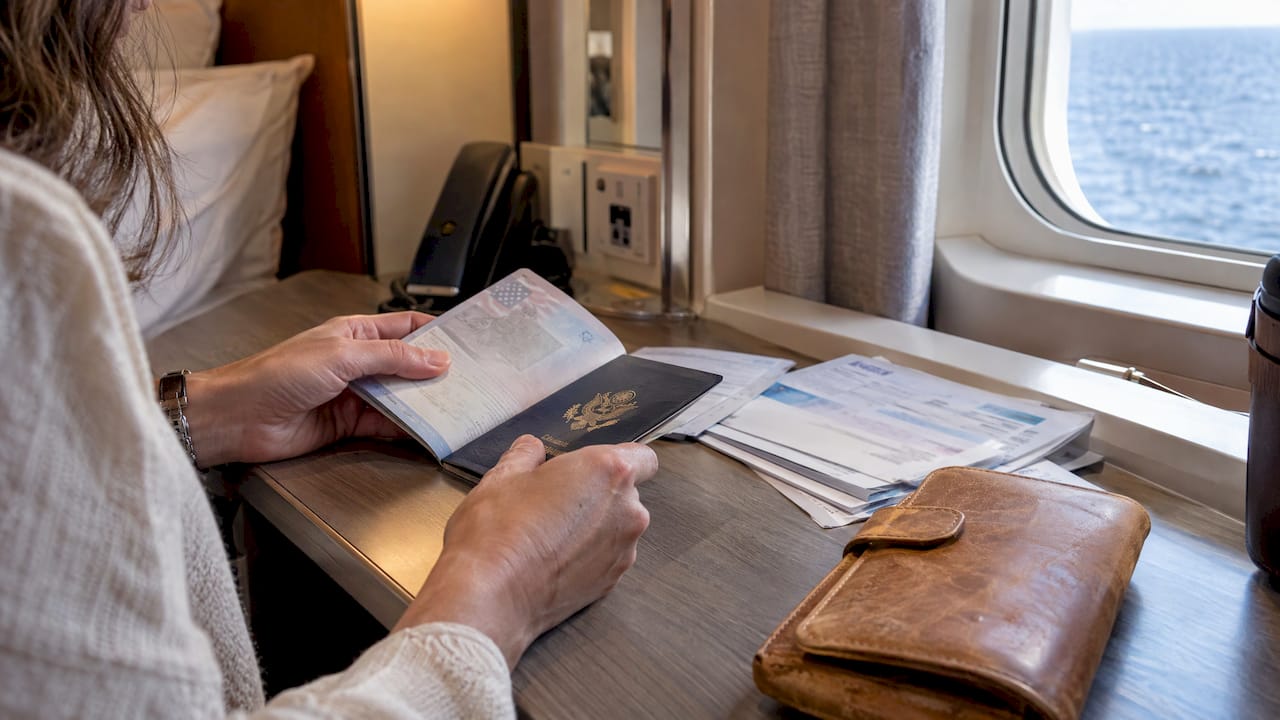
Whether you need a visa for a cruise depends on two things: your nationality and the countries on the itinerary. There is no single cruise rule. A U.S. passport holder may need no visa for one sailing and several for another, and the cruise line will not carry that legal responsibility for you. The safest method is to list every port, check each country’s entry rules before you pay the final balance, and confirm the result with your cruise line’s document guidance.
This guide walks through how to do that, what passports and other documents you need, how visas on board work, and where complex itineraries trip people up.
TL;DR
- Visa rules depend on your nationality and each country on the route. Cruise lines state that requirements vary by destination and traveler nationality.
- The U.S. Department of State says to have the right foreign visas for all cruise stops, if required, even if you do not plan to go ashore.
- Carry a passport book. The State Department strongly recommends one for every cruise passenger, in case an emergency means flying home.
- Some visas can be arranged on board, but you remain responsible for having the right documents before you leave.
- Start with the port list, not the brochure. Build your document plan early, especially for multi-country or long itineraries.
Table of Contents
- What decides whether you need a visa
- How to check every country on your itinerary
- Passports: what you actually need to board
- Do you need a visa if you stay on the ship?
- Visas on board, eVisas and other options
- What the typical itineraries look like
- A document checklist before you pay the final balance
- Our perspective
- Let us handle the paperwork and the planning
- FAQ
- Sources
What decides whether you need a visa
A visa is permission from a country to enter, and every country sets its own conditions. On a cruise, the ship may touch five or six countries in a week, so the rules multiply. Three factors decide what you need:
- Your passport. Entry rules are written by nationality. A U.S. citizen, a Canadian citizen and a green card holder from another country can sail on the same ship and need different paperwork. If you are not a U.S. citizen, check the rules for your own passport, not the rules for Americans.
- Each port of call. Every country on the itinerary has its own policy, including countries where you only stop for a few hours.
- What you do there. Staying aboard, joining an organized tour and exploring independently can be treated differently by some countries.
Cruise lines say the same thing in their own guidance: requirements vary by destination and traveler nationality. That is why generic advice such as “no visa needed for the Caribbean” is a starting point at best, not a plan.
How to check every country on your itinerary
Use a repeatable process. It takes less than an hour for a simple sailing and is worth doing for every trip.
Step 1: Write down every country, including embarkation and disembarkation
Pull the final itinerary and list each country, not just each port. Add the country where you board, the country where you disembark, and any country where you connect by air. Overnight hotel stays before or after the sailing count too.
Step 2: Check each country’s official entry page
The State Department’s guidance is direct: check the country information pages for each country you will visit. Each page covers entry requirements, passport validity and any special conditions. Cross-check with the embassy or consulate of the country in question when anything is unclear. Rules change, so confirm close to departure, not only when you book.
Step 3: Compare with your cruise line’s document page
Cruise lines publish their own document requirements. These do not replace government rules. They can be stricter, and the line may deny boarding if your documents do not meet its policy. Read both.
Step 4: Decide who will apply, and when
Some entry permissions are applied for online, some at an embassy, some at a port. Work backward from sailing day and leave a margin for processing and for passport pages to be stamped or replaced.
Step 5: Build a document folder
Keep passports, any visa or electronic authorization printouts, cruise documents, travel insurance details and emergency contacts together, with digital copies stored separately. Our luxury travel document preparation guide covers how we organize this for clients.
Passports: what you actually need to board
Do you need a passport to cruise?
It depends on the route and your citizenship, but the practical answer for almost everyone is yes, get one. Under the Western Hemisphere Travel Initiative, U.S. and Canadian citizens aged 16 and older entering the United States by land or sea must present an approved travel document, such as a passport or an enhanced driver’s license. That rule is about re-entering the U.S., and it is separate from what foreign countries and the cruise line demand.
The State Department goes further. It strongly recommends that all cruise passengers travel with a passport book, so that you can fly home if an emergency forces you to leave the ship in a foreign port. A medical event, a missed departure or a hurricane diversion can all put you in a country where you cannot simply rejoin the ship at home. Without a passport, the fix is slow and stressful.

Validity and blank pages
The same State Department page advises that your passport should have at least six months of validity remaining beyond your travel dates and two or more blank pages for entry and exit stamps. Some countries enforce this strictly. If your passport is close to the six-month mark, renew it before you book flights and shore excursions, not afterward.
Cruise line rules versus government rules
A cruise company may require a passport book even where U.S. Customs and Border Protection or a foreign border agency would not. Treat the stricter of the two as your rule. The cruise line’s page tells you what gets you on the ship; the government pages tell you what gets you into each country.
Do you need a visa if you stay on the ship?
This is the question that catches the most travelers. The official guidance says to have the right foreign visas for all cruise stops, if required, even if you do not plan to disembark. Passengers sometimes assume that staying on board means no entry formalities. In practice, the ship clears each port, and a country’s rules can apply to anyone aboard.
Many destinations make this easy for short visits, and your cruise line often handles the clearance. But the legal responsibility sits with you. One legal explainer notes that cruise lines often give guidance while the passenger holds the responsibility for having all necessary entry documents. Treat the line’s help as a courtesy, not a guarantee.

Organized tours and shore excursions
Some countries relax entry rules for cruise passengers who go ashore with an organized tour, because the cruise line coordinates group permits. The same explainer points out that these transit exemptions are often conditional on joining an organized tour. If you plan to wander independently in a port where the exemption depends on a group tour, you may need a visa you would not otherwise need. Ask before you book, not at the gangway.
If you want the freedom of a private day ashore, plan it with time to spare. Our guide to private shore excursions and a 60 to 90 minute buffer explains how to keep an independent day from becoming a missed ship.
Visas on board, eVisas and other options
There is no single “cruise visa.” What you may meet are these routes:
| Route | How it works | What to confirm |
|---|---|---|
| Visa handled before departure | You apply to the embassy, consulate or an official online system ahead of sailing | Processing time, passport validity, whether a single entry is enough |
| Electronic authorization or eVisa | An online application tied to your passport | That you used the official government site, and that the approval is saved |
| Visa arranged by the cruise line | Some lines can obtain visas on board for certain countries | Which countries, what fee, and whether you still must prepare documents |
| Multiple-entry need | Itineraries that leave and re-enter a country may need more than one entry | Whether the visa you hold allows re-entry during the voyage |
It helps to know that some visas can be issued on board. One cruise line’s visa guidance says some visas may be obtained onboard, but travelers are responsible for having proper travel documents. Another says it can obtain visas onboard for certain countries, while passengers must verify requirements and obtain necessary documents before the trip. Both point to the same practical rule: the on-board service is a convenience for specific ports, not a reason to skip your own research.
Multi-country and long voyages
A world cruise or a long repositioning voyage can cross many borders. Plan for several entries, possible fees, and stretches of the trip where processing time will be tight. Spread applications out and keep a clear list of which approvals cover which ports.
Embarkation abroad
If you join a ship in another country, your visa questions start with that country’s entry rules, then continue with the ports ahead. Think through the ground leg too. If your sailing leaves from Singapore, for example, arranging cruise day transport in Singapore in advance means your passport, visa printouts and luggage get to the terminal without a scramble, which is when documents most often get left behind.
What the typical itineraries look like
Avoid assuming that an itinerary type tells you the answer. Routes differ in how many countries they cover and how much time you spend in each.
- Short Caribbean or Bahamas sailings. These often involve several small countries in a week, each with its own entry rules. The fact that many U.S. citizens enter such places without a visa for short stays does not remove the need to check each one and to carry a passport.
- Mediterranean and Northern Europe. Multiple countries in quick succession, sometimes with non-European ports, such as in North Africa or the Middle East, mixed in. Those add-on ports are where a visa surprise usually hides.
- Alaska and Canada. The route often includes Canadian ports, so you are entering a foreign country even though the cruise starts and ends in the U.S.
- Expedition and polar voyages. Gateway cities, charter flights and remote landings add documents and permits beyond the ordinary entry rules. Our guide to luxury expedition cruise destinations shows where these trips go.
- World and grand voyages. The highest document load: many countries, several entries, and long timelines.
If you are still choosing a route, our piece on selecting a luxury cruise itinerary that fits you helps you weigh the paperwork alongside the experience.
A document checklist before you pay the final balance
- A passport book valid beyond your trip dates, with blank pages.
- A country-by-country list of entry rules, with the date you checked each.
- Any visas or electronic authorizations, printed and saved offline.
- Your cruise line’s required documents and boarding paperwork.
- Flight details that match the embarkation and disembarkation ports.
- Travel insurance information, including medical evacuation. See our luxury cruise travel insurance guide.
- Children’s documents, including any consent letters the destination countries ask for.
- Contact details for the nearest U.S. embassy or consulate for each country.
If you fly in ahead, the air side matters too. Our explanation of cruise air programs and when to use one covers what to confirm with the airline and the line.
Our perspective
Over more than 20 years in this business, the visa problems we see are rarely about a hard rule. They are about a late discovery: a port added to the itinerary, a passport a few weeks short of the validity window, a family member on a different passport. Each one is simple to fix early and expensive to fix at the airport.
That is why we treat documents as part of the design of a trip, not an afterthought. When we plan a sailing, we map every country on the route, check requirements against each traveler’s passport, and build a timeline so nothing depends on luck. For complex itineraries, where other people give up, this is the work that keeps the holiday calm.
If you travel with a planner, ask for exactly this: a written list of countries, requirements and deadlines, tied to your passport. It is the clearest sign that someone is looking after the details you would rather not think about.
Michael
Let us handle the paperwork and the planning
If you would rather not chase embassy pages and cruise line fine print, that is precisely what a bespoke planner is for. We design luxury cruise and tour itineraries, book hotels, air and cars, and coordinate the document steps for each traveler so that you board knowing everything is in order.

See how our tour and cruise planning services work, or read why many luxury travelers choose an agency for bespoke trips. You can also start from our home page to tell us where you want to sail.
FAQ
How do I get a visa for a cruise ship?
There is no visa issued for the cruise itself. You get entry permission from each country that requires it, through its embassy, consulate or official online system. Some cruise lines can arrange visas on board for certain countries, but you must still verify requirements and prepare documents before departure.
Can I go on a cruise without a passport?
Some itineraries that begin and end in the U.S. allow other approved documents for U.S. citizens re-entering, such as an enhanced driver’s license where accepted. However, the State Department strongly recommends a passport book for every cruise passenger, because you may need to fly home from a foreign port. The cruise line may also require one.
Do I need a visa if I never leave the ship?
Possibly. The State Department advises having the right visas for all stops, if required, even if you do not plan to disembark. Check each country’s entry page and your cruise line’s guidance rather than assuming a port you skip carries no requirement.
Do cruise lines check immigration status?
Cruise lines review passports and travel documents at check-in and boarding, and ports clear the ship with immigration authorities. If your documents do not meet the line’s policy or a destination’s rules, you can be refused boarding. Keep your passport, visas and any proof of status ready at the terminal.
When should I start checking visa requirements?
As soon as you choose an itinerary, and again close to departure. Early checking leaves time to renew a passport or complete an application, and a second check catches changes in entry rules.
Sources
- Cruise Ships, U.S. Department of State
- Travel Documents, Passports, Visas and IDs, Norwegian Cruise Line
- CBP Advises on Summer Travel to the US Caribbean, U.S. Customs and Border Protection
- Visa Guidance, Holland America Line
- Global Visa Process FAQ, Crystal Cruises
- Do Cruise Ship Passengers Need Visas? Ports and Exceptions, LegalClarity
- Cruise Day Transport in Singapore: Getting to Your Ship