
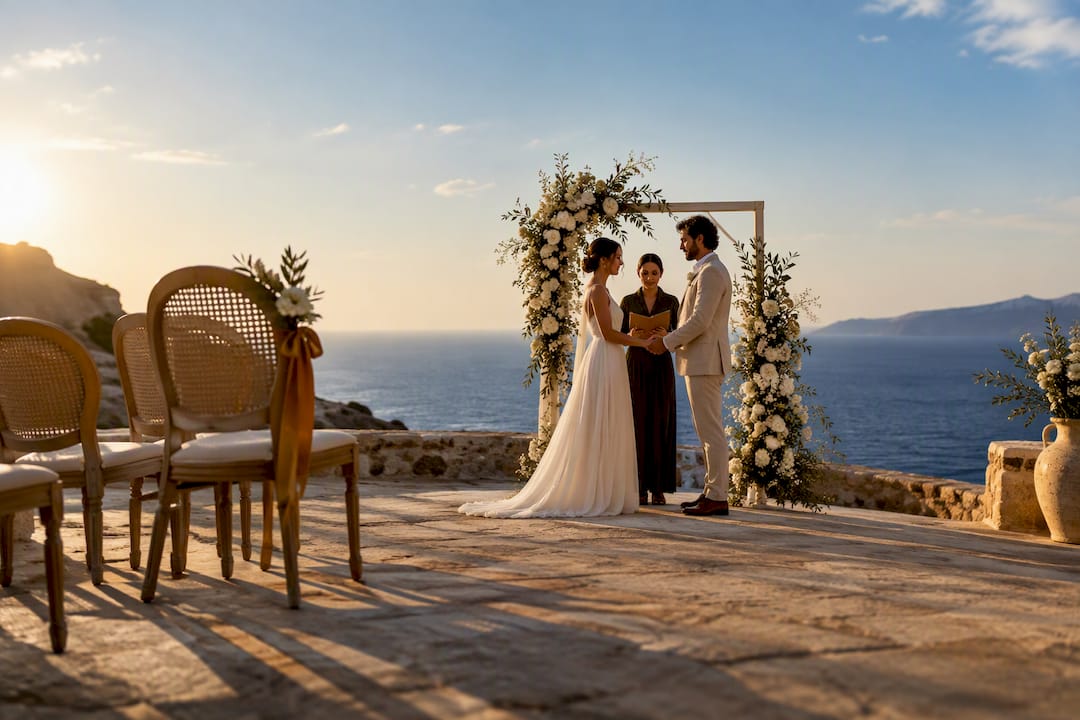
A destination wedding typically runs from $4,000 for a bare-bones elopement to $300,000 or more for a multi-day luxury event, according to real booking data from DreamWed, and guest count is the single biggest lever on that number.
TL;DR:
- Guest count is the primary driver of destination wedding costs, with most budgets scaling significantly as the number of guests increases.
- Venue and catering expenses typically consume 40 to 50 percent of the total budget, whether you choose an all-inclusive package or a customized setup.
- Outside vendor fees and legal costs frequently add several thousand dollars to the initial quote, so confirming all line items in writing is essential.
- Booking early, negotiating room-block concessions, and sticking to a set package tier can prevent budget creep and unexpected expenses.
- For most couples, a small elopement or petite ceremony remains the most affordable option, with costs around $4,000 to $10,000 if the guest list stays minimal.
Table of Contents
- Average Cost Ranges and What Your Total Actually Covers
- How to Split Your Budget Across Venue, Vendors, and Guests
- Guest Costs, Room Blocks, and What to Expect From Attendees
- Sample Budgets by Wedding Size You Can Adapt
- Hidden Costs and Contract Surprises to Watch For
- Budgeting Strategies That Actually Cut Costs
- When to Book and How to Manage Payment Risk
- When a Bespoke Planner Actually Saves You Money
- What Most Wedding Budget Advice Gets Wrong
- How Hidden Door Travel Handles Destination Wedding Budgets
- Sources
- FAQ
Average Cost Ranges and What Your Total Actually Covers
Destination wedding budgets fall into a few clear tiers, and knowing which one matches your vision helps you avoid sticker shock later. Real contract data compiled by DreamWed breaks these down by scale, and the ranges hold up across most popular destinations.
An elopement or petite ceremony, typically two people plus a photographer and officiant, runs $4,000 to $10,000. That usually covers a basic wedding package, a short stay, and minimal decor, but not flights or extended lodging.

A small wedding with 20 to 40 guests lands between $15,000 and $35,000, assuming a room-block arrangement where guest room nights count toward complimentary upgrades. A mid-size wedding with 50 to 80 guests typically costs $30,000 to $70,000, factoring in a larger venue, a full catering package, and more elaborate florals and music. Luxury and multi-day celebrations with 100 or more guests start around $60,000 and can climb past $300,000 depending on the property, private events, and add-ons layered onto the base package.
These figures generally exclude a few costly items:
- Guest airfare, which each traveler covers individually in most cases.
- Vendor travel fees for photographers, hairstylists, or musicians flown in from outside the destination.
- Outside vendor fees charged by the resort for anyone not on its approved list.
- Marriage license, translation, and officiant fees specific to the destination’s legal requirements.
Knowing what a quoted total leaves out matters as much as the number itself. A $35,000 small wedding quote that excludes vendor travel and legal fees can quietly grow by several thousand dollars before the first guest checks in.
How to Split Your Budget Across Venue, Vendors, and Guests
Once you have a total figure in mind, allocating it correctly keeps any one category from eating the rest. The Aisle budget breakdown offers a percentage framework that applies whether you are working with $15,000 or $150,000.
Venue and catering typically consume 40 to 50% of a total wedding budget, according to Aisle’s guide, making it by far the largest single category. That share covers the ceremony and reception space, food, beverage, and often the resort’s service fees bundled into a package price.
The remaining 15 to 20% goes toward guest logistics, transportation, and a contingency reserve for the fees that surface after signing.
A rough split looks like this:
- Venue and catering: 40 to 50% of total budget.
- Planning, photography, florals, and music: 30 to 40%.
- Guest logistics and contingency: 15 to 20%.
All-inclusive resort packages tend to compress these lines together, since venue, catering, and even some decor arrive bundled into one price. A bespoke, à la carte build spreads costs across more individual vendor contracts, which gives couples more control but also more line items to track. Neither approach changes the underlying math, it just changes how many invoices you’re reconciling against it.
Guest Costs, Room Blocks, and What to Expect From Attendees
Your guests carry a real cost burden too, and understanding it helps you set expectations early. Industry data compiled by Brides places affordable destination weddings around $350 to $600 per guest, with luxury versions running $1,000 or more per person once travel and lodging are factored in. Separate resort pricing data cited by the Destination Weddings Blog puts average resort costs near $1,495 per person for a five-night stay, with airfare adding another $320 to $700 depending on departure city and destination.

Room blocks are where couples can actually save. Most resorts set a minimum number of room nights, often 10 to 25, that unlocks complimentary perks: a free ceremony venue, an upgraded suite for the couple, or discounted catering. Hitting that threshold changes the math on your entire package, so it’s worth confirming the exact trigger number before finalizing your guest list.
A few things to sort out with guests early:
- Clarify whether guests book their own rooms and flights or whether the couple is subsidizing anything.
- Confirm the room-block deadline, since rooms released after that date often revert to standard resort pricing.
- Decide who covers local transfers between the airport and resort, since this is rarely included by default.
Most etiquette guides suggest guests cover their own travel and lodging, while couples handle the wedding-specific costs. Some couples choose to subsidize a portion of guest rooms as a gesture, but that’s a personal call, not an obligation.
Sample Budgets by Wedding Size You Can Adapt
Real numbers make this easier to plan around than percentages alone. These four examples, built from the cost ranges reported by DreamWed and per-guest data from Brides, show how the math plays out at each scale.
- Elopement, two guests, three nights. A $6,000 total might break down as $2,500 for a resort wedding package, $2,000 for a three-night stay, $1,000 for photography, and $500 for a small dinner. No room block needed.
- Small wedding, 30 guests. At $25,000 total, expect roughly $10,000 for venue and catering package, $6,000 for a 15-room block hitting the complimentary-perk threshold, $5,000 for photography and music, and $4,000 for florals, decor, and contingency.
- Mid-size wedding, 65 guests. A $50,000 budget might allocate $22,000 to a mid-tier all-inclusive package, $10,000 to upgraded catering and bar service, $8,000 to photography and videography, $6,000 to music and florals, and $4,000 held back for outside vendor fees and legal costs.
- Luxury multi-day event, 120 guests. At $150,000, a private villa or resort buyout might run $70,000, with $30,000 for a welcome dinner and farewell brunch, $25,000 for vendor travel and premium photography, $15,000 for florals and design, and $10,000 in contingency for the extras that always appear.
The pattern across all four: guest count and room-night commitments set the floor, and everything else scales up from there.
Hidden Costs and Contract Surprises to Watch For
The fees that blow up a carefully built budget rarely show up in the headline package price. Outside vendor fees are the most common surprise: resorts often charge $500 to $1,500 per outside vendor per day for anyone not on their preferred list, according to TravelingEars, and some properties add separate day-pass charges on top.
Additional venue fees for events beyond the main ceremony and reception, a welcome dinner or farewell brunch, for example, typically run $1,000 to $3,000 per event according to the same TravelingEars breakdown. Resort taxes, service charges, and gratuities can add another meaningful percentage on top of the quoted package price, and some destinations levy departure or ecological fees that catch couples off guard at checkout.
A few line items worth confirming before signing anything:
- Outside vendor fees and whether your preferred photographer or stylist is even permitted on-site.
- Wedding-pass fees charged to guests who attend the ceremony but are not staying at the resort.
- Legal and registry fees, including marriage license costs and any required document translations.
- Vendor travel and shipping charges for anyone flown in from outside the destination.
Pro Tip: Request the full fee schedule in writing before signing, not just the package price, and reconcile every line item against your actual guest count and vendor list.
Currency exchange adds one more layer of risk for international weddings. Planners cited by Brides recommend setting aside roughly 3% of your total budget specifically to hedge exchange-rate swings between booking and final payment.
Budgeting Strategies That Actually Cut Costs
Most savings tactics fall flat because they nibble at small line items instead of the categories that actually move the total. These, in order of impact, make the real difference.
- Set your guest count first, before anything else. Every dollar in a destination wedding scales with headcount, so locking this number early prevents budget creep later.
- Choose shoulder-season or mid-week dates. Resorts often price ceremonies lower outside peak weeks, and availability improves too.
- Pick a package tier and stick with it. Swapping included items for costly upgrades quietly erases the value of an all-inclusive bundle, a point the Destination Weddings Blog makes clearly.
- Negotiate room-block concessions directly. Ask what threshold unlocks free upgrades or a complimentary venue, and whether that number can move.
- Request vendor-fee waivers in writing. Some resorts will waive outside-vendor charges for larger room blocks or multi-night bookings.
- Bundle events under one vendor where possible. A single florist or band covering both the welcome dinner and reception often costs less than hiring separately.
Couples who want more control over catering costs specifically can also look at self-catering approaches for smaller pre- or post-wedding gatherings, which shifts some spending away from resort catering minimums.
Pro Tip: Ask every vendor and resort contact the same question in writing: “What is not included in this price?” The answer reveals more than the quote itself.
When to Book and How to Manage Payment Risk
Timing affects both price and availability. Popular resorts and top vendors often book out a year or more in advance, and locking dates early protects both your rate and your preferred venue. Hidden Door Travel’s own destination wedding timeline breaks this into seven planning windows, starting with vendor and venue holds roughly 12 to 18 months out.
Individual vendors, photographers and florists especially, often follow a similar structure with a smaller deposit and a final payment closer to the date.
A few things to lock in early:
- Vendor and venue holds, typically 12 to 18 months before the wedding date.
- Room-block deadlines, usually 60 to 90 days before travel.
- Final payment due dates for the resort and any independent vendors.
- Travel insurance, purchased early enough to cover pre-existing plans against cancellation.
For international weddings, currency volatility between your deposit and final payment can shift your real cost, which is another reason the 3% currency buffer mentioned earlier is worth building in from the start.
When a Bespoke Planner Actually Saves You Money
Professional planning pays off most clearly in a few specific situations: villa or property buyouts with complex sleeping-capacity math, multi-vendor events spanning several days, and any wedding where outside-vendor fees and contract fine print are stacking up faster than you can track them. A poorly negotiated villa buyout, for instance, can trap couples into paying for capacity they don’t need, a pitfall covered in Hidden Door Travel’s villa buyout guide.
For smaller weddings, the calculation is different, and Hidden Door Travel’s breakdown of when a bespoke planner pays off for small destination weddings walks through where the fee is worth it and where it isn’t. In general, a bespoke planner’s tangible deliverables include a reconciled master contract across every vendor, negotiated room-block terms, and a single point of contact managing deposits and deadlines across time zones and currencies.
For couples juggling multiple vendors, a resort in one country, and guests flying in from several others, that coordination often prevents costlier mistakes than it costs.
What Most Wedding Budget Advice Gets Wrong
Most budgeting advice treats guest count as one line item among many. It isn’t. It’s the multiplier sitting underneath almost every other number in this article, from room-block minimums to per-guest catering to vendor day-pass fees. Couples who nail down their guest list before choosing a venue consistently end up with a budget that holds, while couples who chase a dream destination first and count heads later almost always blow past their target.
The other place conventional advice falls short is contract literacy. Package price and total cost are not the same thing, and the gap between them is exactly where outside vendor fees, resort service charges, and legal costs hide. Reading a contract line by line isn’t glamorous work, but it’s the difference between a $35,000 wedding and a $42,000 one you didn’t see coming.
If you take one thing from this: build your guest list first, read every contract line before you sign, and treat your contingency fund as mandatory, not optional.
— Michael
How Hidden Door Travel Handles Destination Wedding Budgets
Building a destination wedding budget from scratch means chasing resort quotes, vendor contracts, and room-block terms across multiple countries at once, often while trying to hold a full-time job. Professional planners handle that coordination directly, drawing on industry relationships to negotiate room-block concessions and flag outside-vendor fees before they land on your final invoice.

Services that apply directly to a destination wedding budget include:
- Bespoke destination wedding planning, from venue selection through final vendor contracts.
- Villa and resort buyout negotiation, including sleeping-capacity and room-block strategy.
- Vendor coordination and fee negotiation across photography, catering, and event logistics.
If you’re working through your own numbers and want a second set of eyes on a resort quote or contract, request a tailored consultation with Hidden Door Travel and get a clearer read on what your total will actually look like before you sign anything.
Sources
- Aisle — Budget breakdown
- Brides — How much does a destination wedding cost?
- DreamWed — Real 2026 numbers for destination weddings
FAQ
What is a realistic budget for a destination wedding?
A realistic budget ranges from $4,000 for a small elopement to $70,000 for a mid-size event with 50 to 80 guests, according to real booking data from DreamWed. Larger, multi-day luxury weddings can exceed $60,000 and climb well beyond that depending on the property and add-ons.
How much does it cost to attend a destination wedding?
Guests typically spend $350 to $600 for an affordable destination wedding and $1,000 or more per person for a luxury event, based on industry estimates from Brides. That figure usually covers travel, lodging, and incidental costs, since guests generally book their own flights and rooms.
What is the average cost of an all-inclusive destination wedding?
All-inclusive resort weddings often average around $1,495 per guest for a five-night stay, with airfare adding another $320 to $700 per person depending on the destination, according to the Destination Weddings Blog. The final total still depends heavily on guest count and which package tier the couple chooses.
What is the cheapest way to have a destination wedding?
The most affordable route is a small elopement or petite ceremony, which can run $4,000 to $10,000 based on real contract data from DreamWed. Keeping the guest list small, choosing shoulder-season dates, and sticking to an included package tier without upgrades all help hold costs at that lower end.