
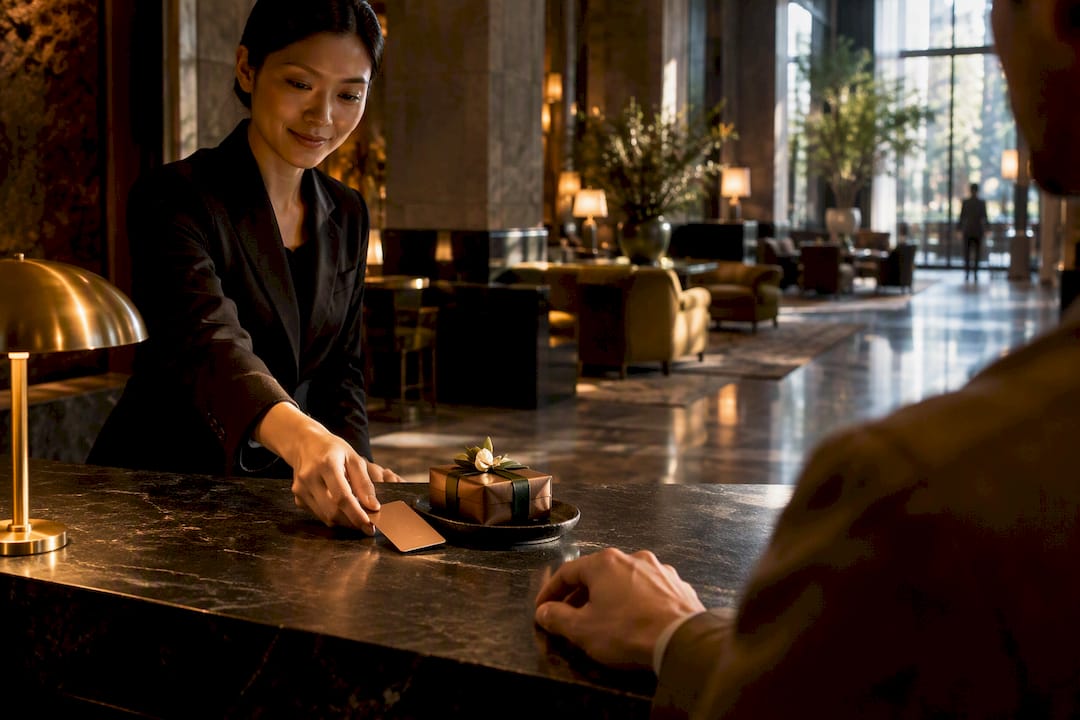
Hotel VIP programs, in the context that matters for bespoke travel clients, are agency-negotiated benefit packages, not chain loyalty tiers. Booked through a consortia-affiliated advisor, they typically include a room upgrade on arrival, daily breakfast for two, a property credit, early check-in, and late checkout. These perks arrive at no added cost to the traveler when booked at the property’s standard flexible rate through a participating agency.
TL;DR:
- Most VIP amenities are conditioned on booking the standard flexible rate through a qualified advisor with direct hotel relationships, not on discounted rates or third-party channels.
- The typical amenity package exceeds $500 per stay, including upgrades, property credits, and breakfast, with suites and villas often unlocking additional benefits like private transfers or in-villa dining.
- Reliability depends on proper registration, pre-arrival confirmation, and direct communication with hotel GMs, not just consortium membership or generic booking processes.
- A high-quality advisor actively manages client registration and escalation protocols, ensuring perks are honored and issues quickly resolved during the stay.
- Qualified VIP access is instantly available through any advisor with active consortium membership, but the quality of benefits depends on the advisor’s relationship with the property, not just the agreement.
Table of Contents
- What Are Agency-Negotiated Hotel VIP Programs?
- What’s in the Standard VIP Amenity Package?
- How Do Agencies Actually Deliver on These Perks?
- How to Evaluate an Agency’s VIP Access Before You Book
- What Are These Perks Actually Worth on a Real Trip?
- What Limits Should You Expect From These Perks?
- How Do You Qualify for Agency-Negotiated VIP Access?
- Which Consortia and Hotel Brands Offer the Strongest VIP Benefits?
- Beyond the Perks: What Changes About the Actual Stay?
- What Do Agencies Do Behind the Scenes to Keep Perks Reliable?
- The Gap Between What VIP Programs Promise and What Advisors Actually Deliver
- Ready for VIP Hotel Access That Actually Shows Up on Arrival?
- Sources
- FAQ
What Are Agency-Negotiated Hotel VIP Programs?
A hotel VIP program in this sense has nothing to do with points, status tiers, or app check-ins. It is a negotiated agreement between a hotel and a travel consortium that guarantees a specific amenity package to any client booked through a member advisor, provided the reservation is made at the hotel’s standard flexible rate.
That distinction matters because chain loyalty programs reward frequency. Agency-negotiated programs reward the relationship between the advisor, the consortium, and the property. Groups like Virtuoso, Signature Travel Network, and Ensemble act as the connective layer, vetting hotels for service quality and negotiating standardized perks across hundreds of properties worldwide.
Rate parity is the mechanism that makes this work for everyone. The traveler pays the same rate they would booking directly, so there is no discount to chase. Instead, the hotel builds in an amenity package as the incentive to book through a consortium member rather than the hotel’s own website. That arrangement typically includes:
- A guaranteed amenity package tied to the flexible rate, not a discounted or prepaid one
- Consistent benefits across a hotel’s global portfolio, not property-by-property guesswork
- An advisor relationship that stands behind the booking if something is not honored on arrival
The advisor’s consortium membership is what unlocks the door. Without it, a traveler booking the identical room at the identical rate gets none of it.
What’s in the Standard VIP Amenity Package?
The core package is consistent enough across Virtuoso, Signature, and Ensemble properties that experienced advisors can quote it from memory. It includes:
- A room or suite upgrade on arrival, subject to availability at check-in
- Daily breakfast for two, typically for the length of stay
- A property credit, often applied toward spa services, dining, or resort activities
- Early check-in whenever the room is ready
- Late checkout, usually to 2:00 PM or 4:00 PM depending on the property
Pro Tip: Always ask your advisor whether the property credit is a flat amount or scales with room category. On suite bookings, some hotels double it automatically.
The average amenity value on these bookings often exceeds $500 per stay, and Virtuoso-specific bookings frequently push the average added value past $550.
Suites and villas often unlock more than the base package. Signature Travel Network runs dedicated Suite and Villa Privileges across its network of more than 1,300 properties, where higher categories can add private airport transfers, complimentary spa credits, or in-villa dining setups on top of the standard perks. For a family booking a two-bedroom villa at a five-star resort, that difference can be the gap between a nice breakfast and a private chef’s table on the terrace.
How Do Agencies Actually Deliver on These Perks?
The amenity package is only as good as the paperwork behind it, and this is where most travelers underestimate what a competent advisor is doing on their behalf.
Consortia negotiate the master agreements, but individual advisors have to activate them for each booking. That happens through hotel desks, dedicated teams within Signature, Ensemble, and similar networks that specialize in specific brands or regions. Ensemble launched a dedicated hotel group desk specifically to handle complex multi-room and multi-property bookings, where the risk of a perk falling through the cracks is highest.
The operational steps that separate a reliable booking from a hopeful one:
- Registering the stay in the consortium’s advisor portal so the hotel’s system flags the reservation before arrival
- Notifying the property’s general manager directly, not just submitting a form
- Confirming the amenity package in writing before the trip, not assuming it applies
- Maintaining direct hotel desk contacts who can intervene if something is missed at check-in
Forbes Travel Guide’s advisor portal formalizes part of this, letting registered advisors flag client stays and connect directly with GMs at rated properties. That pre-arrival notification is what makes the difference between a front desk agent scrambling to find an upgrade and a room already blocked with a welcome note waiting.
Pro Tip: Ask your advisor whether they personally visit the properties they book through FAM trips. An advisor who has stayed at a hotel knows which suite categories are worth requesting and which GM actually answers a pre-arrival email.
Commission is the other half of the equation. Hotels pay advisors roughly 10% commission on these bookings rather than discounting the room rate, which is exactly why hotels prefer handing out amenities instead of cutting prices. It keeps their rate integrity intact while still rewarding the channel that brought them a reliable, vetted client.
How to Evaluate an Agency’s VIP Access Before You Book
Not every agency claiming “VIP access” actually has it. Before committing, ask direct questions:
- Which consortia does the agency hold membership in, and can they name the specific hotel programs?
- Will they register the stay in an advisor portal and confirm it in writing?
- Who is the on-property escalation contact if a perk is missing at check-in?
- Can they provide a documented example of the amenity package for the specific property you’re booking?
Watch for these warning signs:
- Vague language like “VIP treatment” with no named consortium or specific benefit list
- No direct hotel contacts or GM relationships the advisor can point to
- Reluctance to put the amenity package in writing before you pay a deposit
- No track record or examples of past bookings at the property you’re considering
Request written confirmation of the exact amenity package, tied to the specific reservation dates, before final payment. A serious advisor will have this ready without prompting. Hiddendoortravel’s own elite agency selection checklist walks through these same questions in more depth if you want a longer reference before a first consultation.
What Are These Perks Actually Worth on a Real Trip?
The numbers add up faster than most first-time consortia travelers expect. Average amenity value on these bookings often exceeds $500 per stay, and that is before accounting for an upgrade the property might not have sold otherwise.
Picture a four-night stay at a five-star resort. Breakfast for two runs $60 to $90 a day, easily $300 for the trip. Add a $100 property credit and a one-category upgrade that would have cost $150 a night to book outright, and the package clears $700 without anyone opening a wallet twice. The upgrade alone often exceeds the entire amenity value on shorter stays.

What doesn’t show up on a receipt matters just as much: a GM who already knows your arrival time, a room ready hours before standard check-in, and priority access when a restaurant or spa slot is otherwise booked solid.
What Limits Should You Expect From These Perks?
Agency-negotiated VIP programs are generous, but they are not unconditional. The most common limitation is availability. A room upgrade is always framed as “subject to availability at check-in,” which means a fully booked property on a peak weekend may honor the credit and breakfast but not the upgrade.
Rate dependency is another real constraint. The amenity package applies to bookings made at the hotel’s standard flexible rate, not to prepaid, discounted, or third-party package rates. Book a promotional rate through a separate channel and the perks typically disappear, even at the same hotel on the same dates.
Property participation varies too. Not every hotel in a consortium’s portfolio offers the identical amenity package. Some properties enhance it for suites, others cap the property credit lower than a sister property two cities away. An advisor who has actually worked with the specific hotel will know these variations; one who has not may be quoting a generic package that does not hold up at check-in.
Group bookings and long stays sometimes see amenities prorated or adjusted, since a $100 credit applied once per stay behaves differently on a two-night visit versus a ten-night one. And because these are advisor-driven benefits, switching to a different booking channel mid-relationship (say, calling the hotel directly for a date change) can break the registration that ties the perks to your reservation.
None of this makes the programs unreliable. It means the value depends heavily on choosing an advisor who understands a given property’s actual practice, not just the consortium’s marketing language.

How Do You Qualify for Agency-Negotiated VIP Access?
There’s no application, credit check, or minimum spend required to access these benefits, which surprises people used to airline or hotel status tiers. Qualification is entirely about the booking channel.
You gain access the moment you book through an advisor who holds active membership in a qualifying consortium, at a participating property, at the hotel’s standard flexible rate. That’s the whole requirement. There is no tier to climb and no history to build.
What actually varies is the quality of access, and that comes down to the advisor, not the traveler. An advisor with deep relationships at a specific property, someone who has sent past clients there, visited on a FAM trip, or maintains a direct line to the GM, will consistently deliver a stronger version of the same nominal package than an advisor who has never worked with that hotel before.
This is also why first-time clients sometimes get better treatment than expected: hotels want the relationship with the advisor and the consortium to continue, so they tend to err generous rather than technical about “subject to availability.” A first booking with the right advisor at the right property is often the strongest version of these perks a traveler will ever see, precisely because everyone involved is trying to earn the next one.
Which Consortia and Hotel Brands Offer the Strongest VIP Benefits?
Three networks dominate this space, each with a slightly different flavor. Virtuoso is the largest and most globally recognized, with amenity value on its bookings regularly exceeding $550 per stay across its luxury hotel portfolio. Signature Travel Network runs its Suite and Villa Privileges tier across more than 1,300 properties, with enhanced perks for higher room categories. Ensemble rounds out the group and recently built a specialized hotel desk for complex, multi-property bookings that the other two handle less formally.
Individual hotel brands layer their own preferred-partner programs on top of consortia membership. Four Seasons Preferred Partner status, for example, typically adds a $100 to $200 property credit on top of the standard consortium package, along with the same upgrade and breakfast benefits. Properties carrying a Forbes Travel Guide rating add another layer of assurance, since FTG’s own inspection standards give advisors an objective benchmark for service quality before they even recommend the hotel.
The exclusive benefits worth naming specifically: guaranteed suite upgrades on qualifying bookings, spa or dining credits that stack with the base amenity package, private airport transfers at select villa properties, and GM-level recognition that shows up as a handwritten welcome note rather than a form letter.
Beyond the Perks: What Changes About the Actual Stay?
The amenity package is the measurable part. The bigger shift is how the property treats you once the front desk sees an advisor-registered VIP arrival flagged in their system.
Staff tend to handle small requests differently for a registered advisor booking. A dinner reservation that shows “fully booked” online often has room when the concierge knows the GM has already been briefed. A late flight delay gets a room held rather than released. A recurring dietary request follows you through housekeeping and room service without repeating it at every meal.
This is the part that rarely gets quantified but matters most on a complex trip: a multi-generational family booking, a destination wedding block, or a stay where something inevitably needs fixing on day two. An advisor with a direct GM relationship can resolve a problem with one phone call that would otherwise mean forty minutes at the front desk. That responsiveness is the actual product being sold, and the breakfast and upgrade are just the visible proof it exists.
What Do Agencies Do Behind the Scenes to Keep Perks Reliable?
Reliability is not automatic just because a hotel belongs to a consortium. It depends on three specific habits, and this is where you can tell a well-run agency apart from one coasting on a membership logo.
First, registering every stay in the consortium’s advisor portal immediately after booking, not the week before travel. Second, direct GM notification through tools like the Forbes Travel Guide advisor portal, which formally connects an advisor’s client roster to a property’s leadership rather than routing everything through a generic reservations inbox. Third, maintaining actual hotel desk relationships, the specialized teams inside networks like Ensemble and Signature that exist specifically to intervene when a property under-delivers on a promised package.
That third habit is easy to underestimate until it’s needed. A dedicated hotel group desk built for complex multi-room bookings reduces exactly the kind of risk that turns into a ruined arrival, a missing upgrade, a credit nobody can locate, a GM who was never told you were coming. Front-desk staff also lean on structured pre-arrival workflows, the same check-in process discipline hotel operations teams document internally, to make sure a flagged VIP arrival actually gets treated as one. An advisor who registers the stay, confirms in writing, and has a hotel desk to call if something slips is doing the actual work that makes a $500 amenity package show up in reality instead of just in a quote.
The Gap Between What VIP Programs Promise and What Advisors Actually Deliver
Most articles on this topic treat the amenity package as the whole story: list the upgrade, the breakfast, the credit, done. That framing misses where the real value actually sits.
The package itself is close to standardized across Virtuoso, Signature, and Ensemble. Any advisor with active membership can quote you the same breakfast-for-two and early check-in language. What varies enormously, and what almost nobody discusses honestly, is whether that advisor has ever actually stayed at the property, knows the GM by name, or has a hotel desk they can call when a promised upgrade evaporates on a sold-out weekend.
This is the uncomfortable truth: two clients can book the identical room, at the identical rate, through two different advisors carrying the identical consortium membership, and get meaningfully different treatment. One gets a pre-arrival note from the GM and a suite upgrade waiting. The other gets “we’ll see what’s available” at the front desk. The consortium agreement is the floor, not the ceiling.
That’s precisely why we built our process around registering every stay, confirming amenity packages in writing, and maintaining direct relationships at the properties we book most often, like our Four Seasons Preferred Partner arrangements. A membership card gets you eligibility. It does not get you a GM who already knows your travel dates. Choose an agency for the relationships behind the membership.
— Michael
Ready for VIP Hotel Access That Actually Shows Up on Arrival?
Hiddendoortravel builds every stay around the same operational discipline covered above: registering your reservation with the consortium, confirming the amenity package in writing, and keeping direct GM relationships at the properties we book most, including Four Seasons Preferred Partner hotels and Virtuoso member resorts. That’s the difference between hoping a hotel honors a vague “VIP” promise and having someone on record who already told the GM you’re coming.
Our team handles the registration, the written confirmation, and the on-property follow-through so you never have to negotiate at a front desk. If you’re planning a stay where the amenity package, the upgrade, and the escalation contact actually need to hold up, start with a consultation on our main planning page and tell us the property and dates you have in mind.
Sources
- On Site: Forbes Travel Guide doubles down on advisor outreach | Luxury Travel Advisor
- Hospitality
- Travel Advisors Portal | Forbes Travel Guide
- What Consortia Hotel Programs Do for Travel Advisors | Travel Market Report
FAQ
Do I Pay Extra for Hotel VIP Program Perks?
No. These perks apply at the hotel’s standard flexible rate booked through a participating advisor, so you pay the same rate a direct booking would cost while receiving the added amenity package.
Are Hotel VIP Programs the Same as Hotel Chain Loyalty Points?
No. Chain loyalty programs reward repeat stays and points accumulation, while agency-negotiated VIP programs come from consortium relationships like Virtuoso and apply on your very first booking through a member advisor.
What Happens if a Hotel Doesn’t Honor the Promised Amenities?
A qualified advisor registers your stay in advance and has a direct hotel desk or GM contact to escalate to if something is missed at check-in. Ask for this contact before booking, since agencies without one have little recourse if a property under-delivers.
How Much Is the Typical VIP Amenity Package Worth?
Average amenity value on these bookings often exceeds $500 per stay, and Virtuoso bookings frequently push past $550 once the upgrade, breakfast, and credit are combined, the value can be significant.
Does Hiddendoortravel Charge a Fee for Arranging These Perks?
Pricing depends on the trip and service level, so current pricing details are available directly through Hiddendoortravel’s planning team rather than a fixed published rate.