
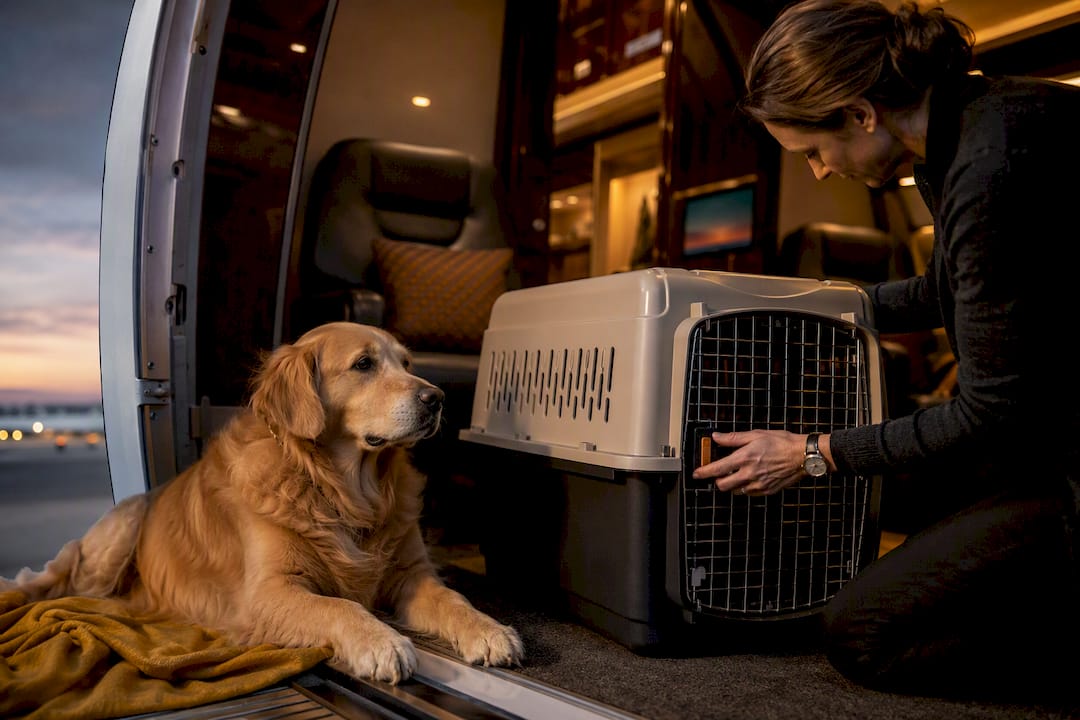
Yes, pets can fly in the cabin on a private jet, right next to you, with no crate in a cargo hold and no airline weight cutoffs to fight. The three booking formats are full charter, pay-by-seat pet charters, and empty-leg seats, and the right pick depends on your pet’s size, your schedule, and how much lead time you have for paperwork. Start there: confirm documentation timelines first, then match the flight format to your dog or cat’s needs.
TL;DR:
- Full charter flights are ideal for large breeds, multiple pets, or routes requiring customized arrangements, with prices starting in the low thousands per hour.
- Pay-by-seat charters cost roughly $775 to several thousand dollars per seat, suitable for solo travelers on popular routes seeking more affordable options.
- Empty-leg flights offer significant discounts but require flexible schedules, as departure times and routes are fixed and can change with short notice.
- International travel demands extensive documentation, including USDA-endorsed health certificates and timely microchip and rabies compliance, often requiring six months of planning.
- Private cabin travel minimizes health risks for pets by avoiding cargo holds and allows owners to manage temperature, water, and observation throughout the flight.
Table of Contents
- Private Jet Pets: Which Booking Format Fits Your Trip?
- What Does It Actually Cost to Fly Privately With a Dog?
- Documentation and Timing: What US Owners Must Sort Out First
- In-Cabin Safety: Breeds, Crates, and Crew Protocols
- Booking Checklist: What to Confirm in Writing Before You Pay
- How an Elite Travel Agency Handles Private Jet Pet Logistics
- What Happens If Your Pet Needs a Vet Mid-Flight?
- Do You Need Pet Insurance for a Private Charter?
- Real Trips, Real Lessons: What Pet Owners Actually Run Into
- Why Private Cabin Travel Usually Wins for Pet Welfare
- Let Hiddendoortravel Handle Your Pet’s Private Jet Trip
- Sources
- FAQ
Private Jet Pets: Which Booking Format Fits Your Trip?
A full charter means you book the whole aircraft. Nobody else is on it, the departure time is yours to set, and the cabin layout can flex around a large dog’s crate or a nervous cat’s carrier. It’s the only format that works reliably for giant breeds, multiple animals, or a routing no shared operator flies.
Pay-by-seat pet charters are the newer model. Operators sell individual seats on scheduled routes that specifically welcome pets in the cabin, splitting the aircraft cost across several unrelated travelers. It’s dramatically cheaper per person, but you’re locked into someone else’s schedule and route map.
Empty-leg seats are discounted one-way flights that happen when a jet needs to reposition after dropping off a client. Pricing on these can be steep bargains, but the trade-off is real: fixed departure times, fixed routing, and offers that can appear or vanish within hours. Empty legs reward owners with flexible schedules far more than owners with a fixed wedding, surgery, or closing date to hit.
- Full charter: best for large dogs, multiple pets, or custom routing.
- Pay-by-seat: best for solo travelers on popular routes wanting to cut costs.
- Empty-leg: best when your dates can bend to the aircraft’s schedule, not the other way around.
Aircraft size matters here too. A light jet fits a Labrador comfortably; a Great Dane or two mastiffs may push you toward a midsize or super midsize cabin regardless of which booking format you choose.
What Does It Actually Cost to Fly Privately With a Dog?
Pricing swings hard depending on format and aircraft class. Domestic light-jet charters typically run in the low thousands per flight hour, while midsize and heavy jets climb from there depending on range and cabin size. Pay-by-seat pet charter pricing runs roughly $775 to several thousand dollars per seat depending on route length and demand, which is why it’s become the entry point for owners who don’t need a whole aircraft.
What actually moves your invoice:
- Repositioning fees when the jet has to fly empty to reach your departure airport
- FBO handling charges at private terminals
- Post-flight cleaning fees, often specifically for pet-related messes or fur
- Pet handling surcharges some operators tack on regardless of size
- Tech-stop costs on longer international routes where the aircraft needs a fuel stop
Pro Tip: Ask every operator for an itemized, written quote before you commit. A quote that only lists a flat “all-in” number is hiding something, and it’s usually a cleaning or handling fee that shows up after the flight.
Treat empty-leg deals as a bonus, not a plan. They’re genuinely good value, but only if you can book your travel dates around the aircraft rather than the reverse.
Documentation and Timing: What US Owners Must Sort Out First
Paperwork, not cabin policy, is where private jet pet plans usually fall apart. Get this piece wrong and no amount of aircraft flexibility saves your trip.
For domestic US travel, requirements are lighter: proof of rabies vaccination and a general health certificate from your vet usually covers it, though individual operators may ask for more. International travel is a different animal entirely.
- Get a USDA-endorsed health certificate. Export from the United States requires working with a USDA-accredited veterinarian who can issue and get the certificate endorsed through APHIS.
- Check the timing window. Health certificates are frequently only valid if completed within a specific window before departure, often within 10 days of travel, so book your vet appointment around your flight date, not the other way around.
- Confirm your pet’s ISO microchip and rabies status. Most destinations require a scannable ISO-standard microchip plus a current rabies vaccination on file.
- If you’re returning to the US with a dog, check CDC rules. The CDC requires air carriers to generate an air waybill for every imported dog unless a waiver applies, and carriers can deny boarding if paperwork isn’t confirmed in advance.
- Research destination-specific steps early. Some countries require titre tests, tapeworm treatment within a set window before arrival, or formal quarantine. Complex routes to places like Japan, Australia, or Singapore can demand three to six months of lead time that no private jet can compress.
Pro Tip: Contact your USDA-accredited veterinarian the moment you start planning, even before you’ve picked a flight. APHIS guidance makes clear that documentation timelines, not aircraft availability, are the real bottleneck on international pet travel.
In-Cabin Safety: Breeds, Crates, and Crew Protocols
Not every pet is an equally good candidate for flying, private jet or not. Brachygenic breeds, brachycephalic dogs like Bulldogs, Pugs, and Boston Terriers, carry real breathing risk under stress or altitude changes because of their shortened airways. Any preflight vet check for these breeds should specifically address respiratory tolerance, not just general fitness.
Typical in-cabin protocols on pet-friendly operators include:
- Pets secured on a leash or in a carrier during taxi, takeoff, and landing
- Limited movement allowed once the aircraft reaches cruising altitude
- Kennels meeting airline-grade construction standards with leak-proof flooring and clear “Live Animal” labeling, per APHIS air travel prep guidance
- Feeding and watering schedules documented and attached to the crate for longer flights
Sedation is a frequent question, and the honest answer is: be careful. Veterinary organizations generally caution against sedating pets for air travel because it can affect breathing and blood pressure at altitude, especially in brachycephalic breeds. Talk to your vet about calming alternatives instead of defaulting to medication.
Cabin temperature control matters more on the ground than in the air. Aircraft sitting on a tarmac in summer heat or winter cold is where most pet stress and risk actually happens, not mid-flight.

Pro Tip: Operators like VistaJet train cabin hosts in pet first aid as part of their VistaPet program. Ask any operator directly whether crew have any pet-specific first-aid training before you book.
Booking Checklist: What to Confirm in Writing Before You Pay
- Ask for the operator’s safety audit. ARGUS or Wyvern ratings are the industry standard for third-party safety vetting, and a legitimate operator will have one on hand.
- Get their in-cabin pet policy in writing, including any weight or breed restrictions and whether large dogs are accommodated on the aircraft class you’re booking.
- Request the full fee schedule up front, covering cleaning, pet handling, and any tech-stop costs on longer routes.
- Confirm who manages the documentation. Some operators offer paperwork support; others expect you to handle it entirely.
- Ask about emergency veterinary access at any waypoint or tech-stop airports on your route.
- Confirm crew pet training, if any, and what the aircraft’s pet-related first-aid protocol actually covers.
Red flags worth walking away from: an operator who never asks about your pet’s documentation at booking, refuses to put fees in writing, or can’t produce any safety-audit evidence. Treat an unwritten paperwork promise as a red flag, not a courtesy.
How an Elite Travel Agency Handles Private Jet Pet Logistics
Coordinating all of this alone eats hours: vet scheduling, operator vetting, ground transfers, and matching every document to the destination’s specific rules. An experienced agency absorbs that work.
A well-run travel agency handling pet-inclusive private jet trips typically manages:
- Vet coordination with USDA-accredited veterinarians on your timeline, not the operator’s
- Operator vetting against safety audits like ARGUS or Wyvern before you ever see a quote
- Tech-stop and routing planning for longer international pet moves
- Door-to-door ground transfers and pet-friendly accommodations at both ends
- A consolidated documentation package instead of a scattered folder of certificates
This kind of coordination earns its cost most clearly on complex international moves, rare or oversized breeds, or trips booked on a tight timeline where a single documentation delay can unravel the whole itinerary. Hiddendoortravel’s approach draws on more than 20 years of luxury travel planning to manage exactly these moving pieces for clients who’d rather not track five agencies and a vet’s office simultaneously.
What Happens If Your Pet Needs a Vet Mid-Flight?
Private jets don’t carry a veterinarian on board, and no operator promises one. What separates a well-prepared trip from a risky one is what happens on the ground during a tech stop or diversion, not in the air.
Before departure, ask your operator or agency to identify emergency veterinary clinics near any planned tech-stop or waypoint airports on your route. This matters most on longer international legs where a fuel stop puts you in an unfamiliar city for an hour or more. A pet showing signs of distress during that window needs a known clinic address, not a scramble on a phone.
Crew training is the other half of this picture. Programs like VistaJet’s VistaPet specifically train cabin hosts in pet first aid, covering basic stabilization and behavioral warning signs before a situation becomes a medical emergency. That’s meaningfully different from a standard flight attendant who has never handled an anxious or unwell animal at altitude.
Bring your vet’s direct contact information and a copy of your pet’s recent medical history on the flight itself, not just in an email somewhere. If your pet has a known condition, heart issues, seizure history, or breathing sensitivity, tell the crew before boarding, not after a problem starts. A short verbal briefing takes thirty seconds and gives crew a real head start if something goes wrong at 35,000 feet.
Do You Need Pet Insurance for a Private Charter?
Standard pet health insurance, the kind covering vet bills for illness or injury, still applies during private jet travel exactly as it would at home. That coverage doesn’t change because your pet is on a charter instead of in your car.
What’s different is liability. Most operators carry general liability coverage for the aircraft and passengers, but that policy is not designed to cover your pet’s veterinary costs if something happens in flight. Ask directly whether the charter agreement includes any pet-specific liability language, and don’t assume silence means coverage exists.
Some pet insurance providers offer travel-specific riders or endorsements that extend coverage during transport, worth a call to your provider before an international trip specifically. If your pet’s health certificate and rabies documentation are current, most standard veterinary coverage should apply seamlessly wherever the flight lands.
For trips involving import into a country with quarantine requirements, ask your insurer directly whether quarantine-related costs are covered. This is a gap many owners discover only after landing, and it’s avoidable with one phone call before departure.
Real Trips, Real Lessons: What Pet Owners Actually Run Into
The recurring pattern in private jet pet travel isn’t cabin comfort or aircraft choice. It’s documentation timing catching owners off guard, exactly as APHIS guidance repeatedly flags as the most common cause of disrupted pet travel plans.
A common scenario: an owner books a full charter for a family trip to Europe two weeks out, only to learn the destination requires a titre test that takes weeks to process. The aircraft was never the problem. The paperwork was.
Another recurring situation involves brachycephalic breeds. Owners sometimes assume that because a private jet skips airline cargo-hold restrictions, breed-related risk disappears too. It doesn’t. A Bulldog or Frenchie still faces the same respiratory strain at altitude regardless of whether it’s flying commercial cargo or lounging in a private cabin, which is why a preflight vet check matters just as much either way.
The success stories share a pattern too: owners who started the vet and paperwork process the moment they picked a destination, not the week before departure. Booking the aircraft was the easy part. Coordinating a USDA-accredited veterinarian, confirming the operator’s documentation policy, and locking in ground transfers ahead of time is what actually determined whether the trip went smoothly.

Why Private Cabin Travel Usually Wins for Pet Welfare
Cargo holds carry real risk: temperature swings, handling by people who never meet your pet, zero ability to check on them mid-flight. Private cabin travel removes all of that in one move. You watch your dog the entire flight. You control the crate, the water schedule, the temperature.
For owners who prioritize certainty over saving money, agency-managed private travel effectively trades a premium price for a lower operational risk profile. That trade is rarely close once you’ve watched a nervous pet handle a commercial cargo hold versus a quiet cabin seat next to you.
— Michael
Let Hiddendoortravel Handle Your Pet’s Private Jet Trip
Some travel agencies offer an alternative to piecing together vets, operators, and paperwork on your own for a pet-inclusive private jet trip: a single point of contact to handle documentation coordination, airport concierge, vetted operator selection, and door-to-door logistics on both ends of your route.

A consultation request works best when you come prepared with a few specifics: your pet’s breed and weight, your target dates and destination, and whether the trip is domestic or international. That last detail changes everything about the paperwork runway needed, and an experienced agency team will flag it immediately if your timeline needs adjusting.
From there, expect a personalized itinerary that treats your pet’s arrangements as a core part of the trip, not an afterthought bolted onto a standard booking. Explore Hiddendoortravel’s customized travel experiences and start a consultation to get your pet’s next private flight properly coordinated from the first phone call.
Sources
- Take a Pet From the United States to Another Country (Export) — APHIS
- Preparing pets for air travel — APHIS
- Dog importation and airlines — CDC
- Flying with a pet — U.S. Department of Transportation
- Flying with Your Pet on a Private Jet: 2026 Guide — Pet Holiday Club
FAQ
Can I bring a 70-pound dog on a private jet?
Yes. Private jets typically don’t enforce the strict weight caps that commercial airlines apply to in-cabin pets, though a very large dog may require a midsize or larger aircraft for comfortable weight-and-balance. Confirm cabin size with your operator before booking.
Can I buy my 50-pound dog a seat on a plane?
On commercial airlines, generally no. Most carriers cap in-cabin pets around 20 pounds including the carrier. Private jets solve this entirely, since most operators allow larger dogs in-cabin regardless of size, subject to aircraft capacity.
What airlines allow pets to fly alone?
Some major commercial carriers offer unaccompanied pet cargo programs, but policies vary widely by airline and route, and rules change often. Check the DOT’s carrier-specific pet guidance directly rather than relying on general assumptions, since private charters generally require an accompanying owner or handler.
How much does it cost to fly privately with a dog?
Pay-by-seat pet charters run roughly $775 to several thousand dollars per seat depending on route and demand, while a full charter can run into the thousands per flight hour depending on aircraft class. A specialized travel agency can provide a tailored quote once it knows your pet’s size, route, and dates.
How far in advance should I start the paperwork?
For domestic trips, a couple of weeks is usually enough. For international routes, especially to countries requiring titre tests or quarantine, start three to six months ahead, since some steps simply can’t be rushed regardless of aircraft availability.