

Personalized travel experiences convert at 10–12x higher rates than generic offers. That single figure captures why the role of personalization in travel has moved from a nice differentiator to the defining standard of luxury trip planning. When an itinerary is built around who you actually are, not a demographic average, the entire experience shifts.
What separates true personalization from a standard upgrade:
- Preference mapping: dietary needs, pace, cultural interests, wellness priorities
- History integration: past destinations, preferred accommodation styles, loyalty patterns
- Privacy alignment: how much data you share, with whom, and under what conditions
- Transparency: clear communication about how your information shapes recommendations
- Bespoke service delivery: human consultants who translate all of the above into a trip no algorithm could fully design alone
AI-powered tools and CRM systems now make it possible to act on these inputs at scale. But the emotional and experiential payoff still depends on a consultant who knows the difference between what you said you wanted and what you actually need.
Table of Contents
- What personalization in luxury travel really means for affluent clients
- Why the psychology of bespoke travel runs deeper than leisure
- How personalization builds the trust that actually drives satisfaction
- What expert travel consultants do that technology alone cannot
- Hiddendoortravel brings bespoke personalization to every trip you take
- Key Takeaways
What personalization in luxury travel really means for affluent clients
Most travelers have encountered “personalization” as a first-name email or a hotel room upgrade. For affluent clients, the bar is categorically different. Bespoke travel design means the entire structure of a trip, from routing logic to dining reservations to guide selection, reflects your specific lifestyle, not a template.
The scope of genuine customization covers several distinct layers:
- Lifestyle and cultural alignment: a client who collects contemporary art gets museum access before public hours, not a gallery brochure
- Wellness integration: sleep schedules, dietary protocols, and fitness preferences woven into the daily itinerary
- Privacy preferences: some clients want total anonymity at properties; others want to be known and welcomed by name
- Flexibility architecture: adjustable itineraries with built-in optionality rather than a rigid day-by-day schedule
Technology enables the infrastructure. AI processes preference signals, CRM systems retain client history across trips, and data analytics surface patterns a human consultant might miss across hundreds of interactions. The challenge is that data collection creates ethical obligations. Clients expect their information to be used to serve them, not to be monetized or shared without consent. Transparent data practices are not a legal formality in luxury travel; they are a trust signal that directly affects whether a client returns.

Why the psychology of bespoke travel runs deeper than leisure
The shift away from package tourism is not purely about comfort. Experience-driven travel that reflects personal values and lifestyles is outpacing traditional tourism because travelers increasingly treat a trip as an expression of identity, not a break from it.
Affluent travelers, particularly those in their 30s and 40s, view a well-designed journey as a form of personal development. A private expedition to a remote archaeological site is not just interesting; it is congruent with how they see themselves. That alignment between experience and self-concept is what creates the emotional resonance that generic travel simply cannot replicate.
Trust is the psychological mechanism underneath all of this. When a consultant or platform demonstrates genuine knowledge of your preferences, you extend trust, and that trust amplifies how much you value the experience before you even board the plane. Research analyzing AI-driven personalization confirms this sequence: personalization builds trust in the planning system, which raises perceived trip value, which drives satisfaction.
There is a complication worth naming directly. A 2026 study of 488 high-involvement travelers found that algorithmic personalization increases engagement for most users, but those with strong privacy concerns experience psychological friction when they feel their data is being used without sufficient transparency or control. The personalization paradox is real: the same data that enables a perfectly tailored itinerary can feel intrusive if the client does not understand how it is being used. Autonomy-supportive design, meaning systems and consultants that give clients clear control over their own information, resolves most of that friction.
Generational patterns matter here too. Younger affluent travelers tend to be both more receptive to AI-assisted personalization and more sensitive to how their data is handled. They want the benefit without the surveillance feeling.
How personalization builds the trust that actually drives satisfaction
The mechanism is sequential, and the research is specific. Survey data from 347 tourists, analyzed using structural equation modeling, shows that AI-driven personalization raises trust in planning systems, which then raises perceived trip value, which is the primary driver of overall traveler satisfaction. Perceived value is the linchpin; it is not enough to deliver a good experience if the client does not feel the trip was built for them specifically.
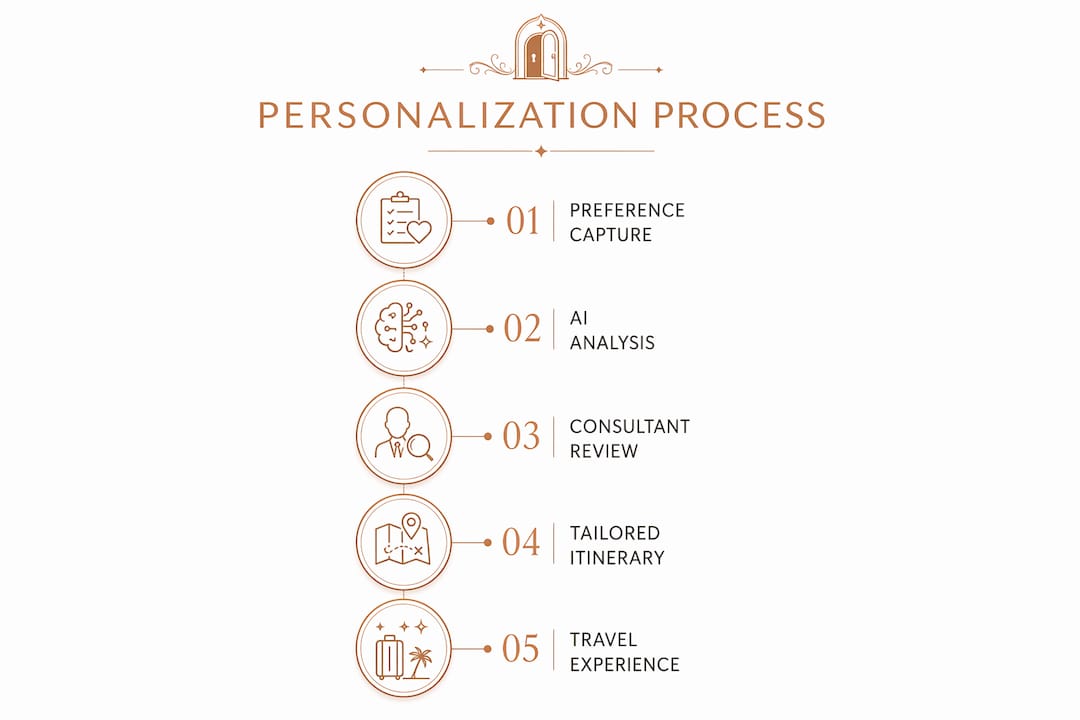
Technology readiness matters too. Clients who are comfortable with digital tools and AI-assisted recommendations tend to extract more satisfaction from personalized offerings, because they engage with the recommendations rather than second-guessing the process. For clients who are less comfortable, a human consultant who explains the reasoning behind each recommendation closes that gap.
Precision in preference alignment is where the practical work happens. A recommendation that is 80% right but misses a critical preference, say, a client who cannot tolerate high altitude but receives a Himalayan trekking itinerary, does more damage to trust than a generic suggestion would have. The benefits of personalized travel compound when every detail is accurate, and erode quickly when a key preference is ignored.
Pro Tip: Ask your travel consultant to walk you through exactly how your stated preferences shaped each element of the proposed itinerary. That conversation reveals whether the personalization is genuine or cosmetic, and it gives you the chance to correct misalignments before you travel.
What expert travel consultants do that technology alone cannot
Automation handles volume. A consultant handles nuance. The distinction matters most at the edges of a trip, the moments that define whether a journey becomes a story you tell for years or a competent but forgettable experience.
Exclusive access to off-the-beaten-path experiences typically requires vetted local networks built over years of relationship management. No booking platform surfaces the private vineyard owner who will open his cellar for a single table dinner, or the marine biologist who leads a night dive for a group of four. Those connections exist in a consultant’s network, not in an algorithm’s training data. Private guided experiences of that caliber are the clearest expression of what bespoke travel actually delivers.
Consultants also carry the ethical weight of data stewardship. They know which preferences a client has shared, which they have implied, and which they have explicitly asked to keep private. That judgment cannot be automated. The culinary dimension of a stay, for example, involves dietary restrictions, cultural preferences, and experiential goals that intersect in ways a consultant reads from context, not from a form field.
The relationship-driven nature of elite travel means that the best consultants are not trip planners in the transactional sense. They are advisors who accumulate knowledge across multiple trips, refining their understanding of a client’s preferences with each engagement. That accumulated knowledge is what allows them to anticipate needs rather than just respond to stated requests. Luxury travelers who work with agencies consistently cite this anticipatory quality as the single most valued aspect of the relationship.
Hiddendoortravel brings bespoke personalization to every trip you take
Most travel services offer customization as an add-on. Hiddendoortravel builds it in from the first conversation. The agency’s consultants combine deep destination knowledge with a genuine understanding of each client’s lifestyle, privacy expectations, and experiential goals, producing itineraries that reflect who you are rather than what a package tour assumes you want.
The difference shows up in the details: a pre-arranged private access to a site that does not appear on any public itinerary, a property that knows your preferences before you arrive, a pace that matches how you actually travel rather than how most people do. Hiddendoortravel’s luxury travel experts handle the full scope of bespoke planning, from initial preference mapping through post-trip follow-up, so nothing falls through the gaps that automated platforms routinely miss.
If you are ready to travel in a way that actually fits your life, contact Hiddendoortravel to start planning your next trip.
Key Takeaways
Personalization in luxury travel works because it builds trust, raises perceived value, and delivers experiences that reflect who the traveler actually is, not who a package assumes them to be.
| Point | Details |
|---|---|
| Conversion impact | Personalized travel offers convert at 10–12x higher rates than generic marketing. |
| Trust drives satisfaction | AI-driven personalization raises trust in planning systems, which raises perceived trip value, the primary driver of traveler satisfaction. |
| Privacy is non-optional | Clients with strong privacy concerns experience friction without transparency; autonomy-supportive design resolves it. |
| Consultants fill the gaps | Expert consultants access vetted local networks and accumulate client knowledge across trips in ways no automated platform replicates. |
| Hiddendoortravel’s approach | Hiddendoortravel builds personalization into every engagement, from preference mapping to post-trip follow-up, for genuinely bespoke luxury travel. |