

A cruise travel agent is a dedicated expert who matches you with the right ship, itinerary, and stateroom while managing every detail of your voyage from first inquiry to final disembarkation. The role of cruise travel agents extends far beyond clicking “book now” on a cruise line website. These professionals serve as advisors, advocates, and concierges who monitor pricing, manage time-sensitive add-ons, and resolve disruptions that would leave a solo traveler stranded on hold. Organizations like AAA and resources like the Royal Caribbean Blog consistently confirm that travelers who use agents get more value, fewer surprises, and better outcomes than those who book direct.
What does the role of cruise travel agents actually involve?
Cruise travel agents function as specialized travel consultants who combine product knowledge, supplier relationships, and client advocacy into a single service. The industry term for this professional is “travel advisor,” a title that better reflects the consultative depth of the work. You are not hiring someone to fill out a form. You are engaging someone who knows the difference between a Norwegian Cruise Line Haven suite and a Celebrity Cruises Retreat, and who understands exactly which one fits your travel style.
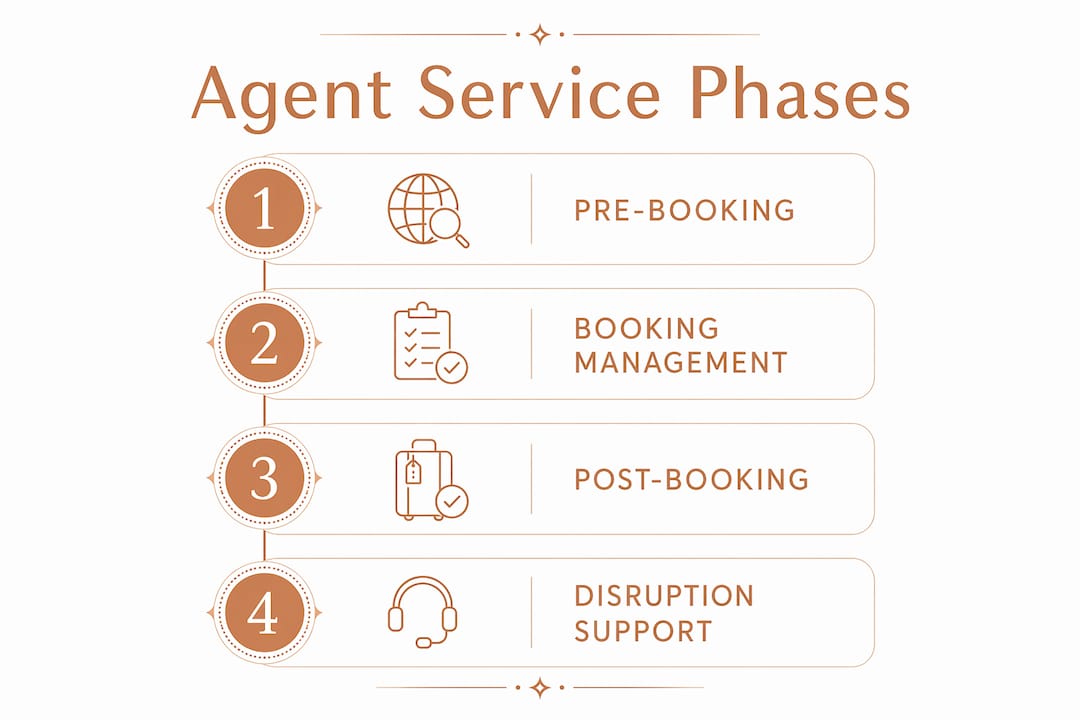
The advisory role covers three distinct phases: pre-booking consultation, active booking management, and post-booking support. Each phase requires different skills and tools. Most travelers only see the first phase and underestimate the value delivered in the other two.
Agents also handle logistics that most travelers do not anticipate. Visa requirements for port stops, pre-cruise hotel coordination, and transfer arrangements between airports and embarkation ports all fall within their scope. This breadth of service is what separates a capable travel advisor from a basic order-taker.

How do agents match you with the right ship and itinerary?
Cruise matching is one of the most skill-intensive parts of the job, and AAA identifies it as a core agent competency. The options are genuinely complex: ocean versus river cruises, mega-ships versus boutique expedition vessels, Caribbean loops versus Mediterranean port-intensive routes, inside cabins versus aft-facing balconies. A skilled agent listens to your preferences and translates them into specific recommendations.
Here is what a thorough matching process covers:
- Travel style: A family with teenagers has different needs than a couple celebrating a 30th anniversary. Agents distinguish between lines like Disney Cruise Line, which orients everything around families, and Seabourn, which delivers an adults-only ultra-luxury experience.
- Activity level: Expedition cruises with Hurtigruten or Silversea Expeditions attract active travelers who want zodiac landings in Antarctica. Caribbean itineraries on Royal Caribbean attract guests who want beach days and onboard waterparks.
- Cabin selection: Deck placement, proximity to elevators, and cabin category directly affect your experience. An agent who knows a ship’s deck plans can steer you away from cabins above the nightclub or below the pool deck.
- Itinerary depth: Some travelers want to maximize port time. Others prefer sea days for relaxation. Agents match itinerary structure to your actual priorities, not just your stated destination.
Pro Tip: The cabin you choose affects your entire cruise more than most travelers realize. Ask your agent specifically about noise exposure, motion sensitivity, and proximity to high-traffic areas before confirming any stateroom.
Agents who specialize in luxury cruises carry knowledge of ship-within-a-ship concepts like the Haven on Norwegian or The Retreat on Celebrity, which offer private dining, dedicated concierges, and exclusive sun decks. That level of product knowledge is not available on any booking website.
What services do cruise agents provide after booking?
Post-booking is where the real value of cruise travel agent services becomes visible. Most travelers assume the work ends at confirmation. Agents know it is just beginning.
The most financially significant post-booking service is price monitoring. Agents monitor repricing opportunities before final payment deadlines and act within that window to capture savings. Cruise lines regularly adjust pricing, and an agent with the right tools and internal contacts can rebook you at a lower rate or secure a cabin upgrade when prices shift. A solo traveler checking a website once a week will miss most of these windows.
| Post-booking task | Timing consideration |
|---|---|
| Price drop repricing | Must occur before final payment deadline, typically 60 to 90 days before sailing |
| Final payment submission | Agents track due dates and alert you before penalties apply |
| Specialty dining reservations | Opens 120 to 90 days before departure on most major lines; popular venues sell out fast |
| Shore excursion booking | Best availability at 90 days out; agent books immediately when the window opens |
| Drink package purchases | Prices fluctuate; agents identify promotional pricing windows |
| Document and visa coordination | Requirements vary by itinerary; agents confirm requirements well in advance |
Agents manage add-ons like specialty dining, drink packages, and shore excursions with a precision that most travelers cannot replicate on their own. Aurora Cruises describes this as a workflow that is largely invisible to DIY travelers until something goes wrong. When a dining reservation disappears or an excursion sells out, an agent with direct cruise line access can often recover the booking in minutes.
Pro Tip: Drink package prices on major lines like Royal Caribbean and Celebrity Cruises fluctuate significantly in the months before sailing. Ask your agent to monitor promotional pricing and alert you when the rate drops below your target.
How do cruise agents help when disruptions occur?
Travel disruptions reveal the true importance of cruise travel agents. When a flight cancels the night before embarkation or a cruise line announces an itinerary change, the difference between having an agent and not having one is measured in hours and stress levels.
Agents act as problem-solvers who coordinate simultaneously with airlines, cruise lines, and ground operators when things go wrong. AAA describes this as agents “fighting” for their clients. That language is accurate. A traveler calling a cruise line’s general customer service line during a disruption faces long hold times and limited authority. An agent with an established supplier relationship calls a dedicated trade desk and reaches someone with the power to act.
Common disruptions where agent support makes a measurable difference include:
- Flight cancellations before embarkation: Agents rebook flights and coordinate with the cruise line to hold boarding or arrange port-of-call joins if the ship has already sailed.
- Ship redeployment: Cruise lines occasionally redeploy ships to different itineraries months after booking. Agents notify you immediately and present alternatives before inventory disappears.
- Itinerary changes: Port substitutions due to weather or political conditions require fast rebooking of shore excursions. Agents handle this without you lifting a finger.
- Onboard medical or logistical issues: Agents coordinate with travel insurance providers and cruise line medical staff when health situations arise mid-voyage.
The agent’s direct access to internal cruise line escalation paths is a structural advantage that no amount of personal persistence can replicate. Aurora Cruises notes that the distinction between hosted agents and those with direct cruise line relationships affects both the speed and effectiveness of issue resolution.
Do cruise agents charge extra fees?
Travel agents earn commission from cruise lines, not from charging travelers additional fees. The Royal Caribbean Blog states clearly that agents should not charge travelers for booking, changes, or cancellations. This is the standard model across the industry, and it directly counters the widespread misconception that using an agent costs more than booking direct.
The commission structure also aligns the agent’s financial incentive with your satisfaction. Agents earn repeat business and referrals by delivering results. A client who has a poor experience does not return and does not refer friends. This is why client-agent relationships built on genuine service quality are the foundation of a successful agency practice.
Agents also provide access to benefits that direct booking cannot match. Group rates and onboard perks like onboard credit, specialty dining credits, and prepaid gratuities are often available exclusively through agents who hold group inventory with cruise lines. A traveler booking direct on the cruise line’s website will never see these offers.
What role do agents play in the cruise distribution system?
The cruise industry distributes its inventory through a layered network of travel agents, host agencies, and Preferred Sales Agent (PSA) partnerships. Understanding this structure helps you choose the right agent for your needs.
PSA models expand cruise access by enabling technology platforms and training programs to bring cruise selling expertise to agents in markets that previously lacked it. TravClan’s appointment as PSA for StarDream Cruises in India illustrates how this model scales cruise distribution into Tier 2 and Tier 3 cities using tech-enabled tools and structured training.
For travelers, this distribution structure has practical implications:
- Hosted agents operate under a host agency umbrella, which provides access to supplier relationships and booking tools. Resolution speed depends partly on the host agency’s relationship with the cruise line.
- Direct-relationship agents hold their own IATA or CLIA credentials and negotiate directly with cruise lines, which can mean faster escalation and more flexibility on pricing and perks.
- Specialized cruise agencies invest in dedicated cruise training through organizations like CLIA (Cruise Lines International Association) and carry certifications that signal genuine product expertise.
Technology and training bundles that PSA models provide also expand the advisory scope of agents, including visa guidance, pre and post-cruise logistics, and product narratives that help travelers make informed decisions. The indirect effect on your experience is real: an agent who is well-supported by their distribution network resolves your issues faster and accesses better inventory.
Key takeaways
Cruise travel agents deliver the most value when you treat them as advisors from the start, not as a last resort after a booking problem appears.
| Point | Details |
|---|---|
| Expert matching saves time | Agents translate your preferences into specific ship, itinerary, and cabin recommendations you would not find alone. |
| Post-booking monitoring captures savings | Agents reprice cruises before final payment deadlines, recovering savings most travelers never know exist. |
| Disruption support is structural | Agents access dedicated trade desks and escalation paths that general consumers cannot reach. |
| No extra cost to you | Agents earn commission from cruise lines, so their services cost you nothing beyond the cruise price. |
| Distribution network affects service quality | Agents with direct cruise line relationships or strong host agency backing resolve issues faster and access better inventory. |
Why cruise agents matter more than I expected
I have worked with travelers who arrived at Hiddendoortravel after booking direct and running into problems they could not solve on their own. A couple who booked a Mediterranean cruise without an agent spent three days trying to rebook after a flight cancellation. They eventually missed embarkation and received no compensation. An agent would have had that resolved in under two hours.
What surprises most people is how much of the value happens quietly. The price drop that gets captured three weeks before final payment. The specialty dining reservation that opens at exactly 120 days and sells out in 48 hours. The cabin upgrade that appears because an agent checked the inventory on a Tuesday morning. None of this is visible to the traveler. It just shows up as a better experience.
My honest observation after years in this business: the travelers who get the most from cruising are the ones who invest in a relationship with a specialist. Not someone who books everything from flights to hotels to safaris, but someone who knows cruise lines the way a sommelier knows wine. They know which ships are due for dry dock, which itineraries have port-intensive schedules, and which cabin categories offer the best value on each specific vessel.
If you are planning a cruise, choose an agent who asks more questions than you expect. The right questions about your travel style, your tolerance for sea days, your dining preferences, and your history with motion sensitivity are the signals of someone who will actually match you well. Generic recommendations are a red flag.
— Michael
Plan your next cruise with Hiddendoortravel
Hiddendoortravel specializes in bespoke luxury cruise experiences for travelers who want more than a standard booking. Every client engagement starts with a detailed consultation to match you with the right ship, itinerary, and stateroom based on your specific preferences and travel history.
From monitoring price adjustments before final payment to coordinating shore excursions and managing disruptions when they arise, Hiddendoortravel’s luxury travel experts handle every detail so you can focus on the experience itself. Whether you are planning your first ocean voyage or your fifteenth, explore Hiddendoortravel’s full-service travel agency offerings and start your consultation today.
FAQ
What does a cruise travel agent actually do?
A cruise travel agent matches travelers with the right ship, itinerary, and stateroom, then manages post-booking tasks including price monitoring, add-on coordination, and disruption resolution. Their role extends through every phase of the trip, not just the initial booking.
Do cruise travel agents cost more than booking direct?
Agents earn commission from cruise lines and do not charge travelers for booking or changes, according to the Royal Caribbean Blog. In many cases, agents access group rates and onboard perks that make the total value higher than booking direct.
When should I contact a cruise agent about price drops?
Price drop repricing must occur before the final payment deadline, typically 60 to 90 days before sailing. Agents with internal cruise line access and monitoring tools are best positioned to act within this window.
What is a Preferred Sales Agent in the cruise industry?
A Preferred Sales Agent (PSA) is a technology and training partner appointed by a cruise line to expand its distribution network through additional travel agents. PSA models, like TravClan’s partnership with StarDream Cruises, bring cruise booking expertise to broader agent networks using structured tools and training.
How do I choose the right cruise travel agent?
Look for agents with CLIA certification, demonstrated specialization in cruise travel, and a consultation process that asks detailed questions about your preferences. Agents who recommend specific ships and cabin categories by name, rather than offering generic itineraries, signal genuine product knowledge.