
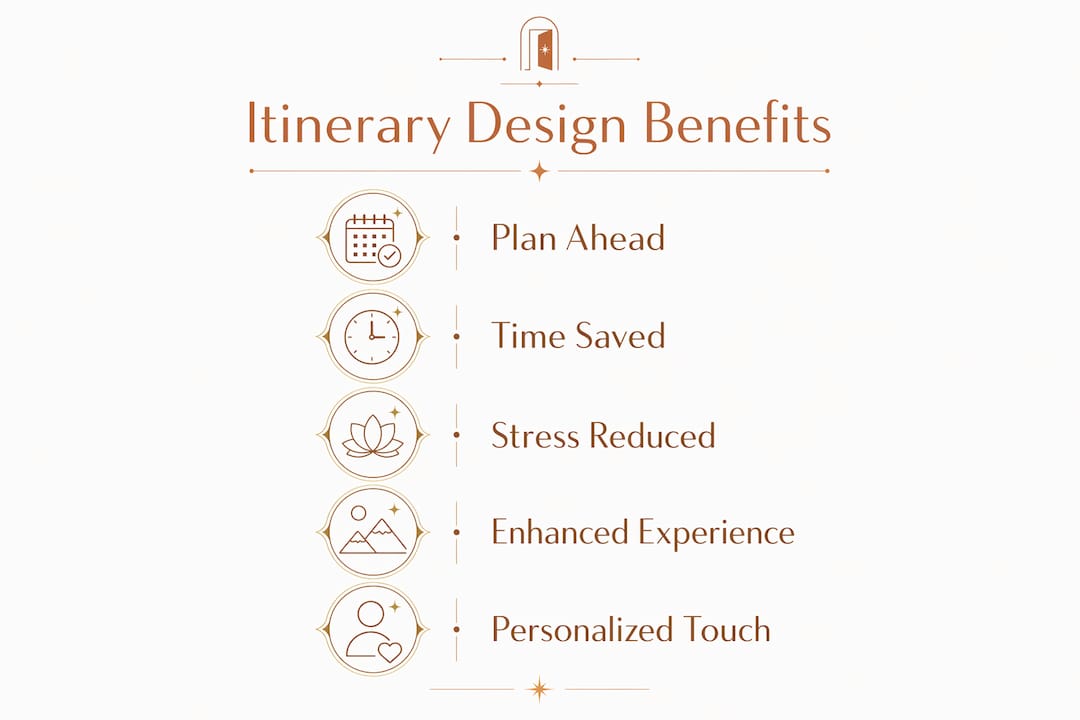
Itinerary design is the strategic blueprint that transforms a list of destinations into a coherent, personalized travel experience. For luxury travelers and the planners who serve them, this discipline goes far beyond booking flights and hotels. It determines how time flows, where energy is spent, and whether a trip feels like a curated story or a logistical scramble. The role of itinerary design is to balance structure with freedom, so every day delivers maximum value without sacrificing the spontaneity that makes travel memorable. Done well, it reduces stress, saves time, and creates the kind of trips clients talk about for years.
How does itinerary design improve travel efficiency?
Good itinerary design is one of the most measurable investments a traveler can make. Investing 3–5 hours of upfront planning saves over 10 hours of wasted trip time. That ratio matters enormously when you are paying premium rates for every hour of a luxury experience.
The stress factor is equally significant. 71% of travelers find booking and logistical planning stressful. A well-structured itinerary eliminates the daily decision fatigue that drains energy and erodes enjoyment. When travelers know what comes next, they can be fully present in each moment rather than mentally managing logistics.

Geographic clustering is one of the highest-impact techniques in the planner’s toolkit. Grouping attractions by zone reduces commute time by 30–50%. That recovered time translates directly into more experiences, longer meals, or genuine rest.
The most effective itineraries are built around these core efficiency principles:
- Anchor activities first. Identify the two or three non-negotiable experiences per destination, then build the day around them.
- Zone by geography. Group all activities within a district or neighborhood into a single half-day block.
- Build in white space. Leave at least one unscheduled hour per day for unexpected discoveries or simple rest.
- Allocate budget by priority. Assign spending to experiences before logistics, not after, so the best moments are never cut for cost reasons.
Pro Tip: When planning a multi-city trip, map every activity on a physical or digital map before finalizing the day order. Routing errors that look invisible on a spreadsheet become obvious on a map.
Why does narrative structure matter in luxury itineraries?
The difference between a good itinerary and a great one is emotional architecture. Luxury itinerary designers view trips as stories, weaving a consistent emotional and experiential arc that keeps travelers engaged from arrival to departure. A bullet-point list of reservations is not a story. A narrative itinerary is.
Emotional pacing follows a specific logic. Peak experiences placed two-thirds into the itinerary maximize anticipation without creating pressure. Think of it like a great novel: the climax does not come on page two. Placing a private villa dinner, a helicopter excursion, or a rare cultural access moment at the two-thirds mark gives the traveler something to build toward, then time to decompress and reflect before the trip ends.
White space is an intentional design element that enhances surprise and rest during travel. Luxury clients often resist unscheduled time initially. In practice, those open hours produce the most memorable stories: the local market discovered by accident, the restaurant recommended by a concierge, the afternoon that turned into an evening. Designing for spontaneity is not a contradiction. It is a skill.
“The best itinerary is one the traveler forgets they are following.” This is the standard Hiddendoortravel holds every bespoke trip to. When logistics disappear into the background, experience moves to the foreground.
Personalization is the final layer of narrative design. A traveler who prioritizes food and culture needs a different emotional arc than one focused on adventure and remote access. The itinerary should reflect the client’s personality, not just their destination list. For immersive cultural travel, this means weaving local history, artisan access, and culinary context into the sequence of each day.
What are the best practices for effective itinerary design?
Effective itinerary design follows a sequence most planners get wrong. Most travelers schedule activities before securing transport and accommodations, which creates inefficient and chaotic itineraries. The correct order is foundation first: confirm flights, transfers, and lodging before a single activity is added to the calendar.
Follow this sequence for any luxury itinerary:
- Set the framework. Lock in arrival and departure logistics, including airport transfers and inter-destination transport.
- Confirm accommodations. Choose properties that anchor each destination and reflect the trip’s overall tone.
- Identify anchor experiences. Select two or three signature moments per destination that define the trip’s character.
- Zone remaining activities. Group supporting experiences geographically around each anchor.
- Add white space deliberately. Mark open blocks on the calendar as intentional, not accidental.
- Review the emotional arc. Check that the sequence builds toward the peak experience, then eases into the final days.
AI tools like TripIt, Wanderlog, and Google Travel can draft initial frameworks and flag scheduling conflicts. They are useful for logistics. They are not substitutes for the local knowledge and emotional intelligence that define luxury planning. Real-world scouting timed with actual travel seasons provides itinerary designers critical insights that significantly improve client satisfaction. No algorithm replicates that.
Here is how the three main itinerary styles compare:
| Style | Structure | Best For | Risk |
|---|---|---|---|
| Rigid | Every hour scheduled | First-time visitors, complex logistics | No room for discovery or rest |
| Flexible | Anchor points only | Experienced travelers, open destinations | Under-utilizes available time |
| Hybrid | Anchors plus open options | Luxury and repeat travelers | Requires skilled curation to balance |
Hybrid itinerary planning yields more enjoyable and less stressful trips. Most experienced travelers prefer this cyclical approach over rigid schedules. For multi-destination luxury trips, the hybrid model is the standard Hiddendoortravel applies across every client engagement.
The most common pitfalls to avoid: over-scheduling consecutive days without rest, ignoring transit time between activities, and treating every day as equally important. Not every day needs a peak moment. Some days exist to prepare the traveler emotionally for what comes next.
What makes cruise itinerary design different?
The role of cruise itinerary design operates under constraints that land-based travel does not face. Port schedules, maritime regulations, and environmental compliance all shape what is possible before a single shore excursion is planned.
The 30-60-90 protocol sets strict timing requirements for cruise shore excursions, ensuring compliance and safety. The numbers refer to minimum time buffers: 30 minutes before departure for independent travelers, 60 minutes for small groups, and 90 minutes for large organized excursions. Missing these windows means missing the ship. No luxury experience justifies that risk.
Cruise itinerary design in 2026 is shaped heavily by environmental regulations. The EU Emissions Trading System now affects port call durations and operational timing across European waters. Itineraries that looked viable two years ago may require adjustment to account for carbon compliance windows and revised port access schedules.
Key operational factors every cruise itinerary must account for:
- Manifest cutoffs. Passenger manifests close before departure. Late returns create legal and logistical complications beyond a missed sailing.
- Transit times between ports. Overnight sailings affect morning energy levels and should inform how demanding the first shore activity is.
- Port congestion windows. Popular ports like Dubrovnik, Santorini, and Nassau have peak arrival times when multiple ships dock simultaneously. Scheduling excursions for early morning or late afternoon avoids the worst crowds.
- Ship app verification. Always confirm port schedules through the ship’s official app before finalizing excursion bookings. Port calls change due to weather, political conditions, and operational decisions.
For travelers considering a luxury cruise itinerary, these constraints are not obstacles. They are design parameters. Understanding them produces safer, more satisfying shore experiences.
Key takeaways
Effective itinerary design is the single most controllable factor in whether a luxury trip delivers on its promise.
| Point | Details |
|---|---|
| Plan the foundation first | Lock in transport and accommodations before scheduling any activities. |
| Use geographic zoning | Cluster activities by location to cut transit time by 30–50%. |
| Place peaks at two-thirds | Position the trip’s best experience two-thirds through for maximum emotional impact. |
| Design white space deliberately | Unscheduled time produces the most memorable spontaneous moments. |
| Apply the 30-60-90 rule on cruises | Respect mandatory time buffers for shore excursions to avoid missed departures. |
The itinerary is a framework, not a contract
I have reviewed hundreds of luxury itineraries over the years, and the ones that fail share a common flaw: they treat every hour as a commitment rather than a suggestion. Clients arrive exhausted from a long-haul flight and face a packed first day because the planner feared empty space. That is not luxury. That is anxiety with a nicer backdrop.
The itineraries I trust most are the ones built around three or four non-negotiable moments, with everything else held loosely. Cyclical planning, where you anchor the trip’s emotional high points and leave the connective tissue flexible, consistently produces better client feedback than rigid minute-by-minute schedules. Clients feel in control. They also feel free. That combination is rare and worth designing for.
The other thing I have learned: narrative detail in the written itinerary itself changes how clients experience the trip before they leave home. When a client reads a description of why a particular restaurant was chosen, what the chef’s philosophy is, and how it connects to the region’s food culture, they arrive at the table with context and anticipation. That is not fluff. That is the difference between a meal and a memory.
Combine data-driven geographic planning with emotional intelligence about pacing, and you have the foundation of a truly great luxury itinerary. The benefits of personalized travel service show up most clearly in this kind of detail work. It cannot be automated, and it cannot be rushed.
— Michael
Let Hiddendoortravel design your next luxury trip
Hiddendoortravel specializes in bespoke itinerary design for luxury travelers who want more than a booking confirmation. Every itinerary is built from the foundation up: transport, accommodations, geographic zoning, emotional arc, and the kind of local access that only comes from years of agency relationships and on-the-ground experience.
Whether you are planning a multi-destination cultural trip, a private expedition, or a tailored luxury cruise, the team at Hiddendoortravel brings the narrative intelligence and operational precision that transforms good trips into exceptional ones. Work with luxury travel experts who treat your itinerary as a story worth telling, not a checklist worth completing.
FAQ
What is the role of itinerary design in luxury travel?
Itinerary design is the process of structuring a trip’s logistics, pacing, and experiences into a coherent plan that maximizes enjoyment and minimizes wasted time. For luxury travel, it also incorporates narrative flow and personalization to create emotionally resonant experiences.
How much time does upfront itinerary planning save?
Investing 3–5 hours of planning before a trip saves over 10 hours of wasted time during the trip itself. That recovered time is especially valuable in luxury travel, where every hour carries a premium cost.
What is the 30-60-90 protocol for cruise itineraries?
The 30-60-90 protocol sets mandatory time buffers for returning to a cruise ship before departure: 30 minutes for independent travelers, 60 for small groups, and 90 for large excursions. Missing these windows results in missing the ship entirely.
What is the best itinerary style for luxury travelers?
The hybrid itinerary style, which combines fixed anchor experiences with flexible open time, produces the most enjoyable and least stressful trips for experienced luxury travelers. It balances structure with the freedom to discover.
Where should the peak experience fall in an itinerary?
The emotional peak of a trip should be placed two-thirds of the way through the itinerary. This placement maximizes anticipation during the early days and allows time for reflection and gentle wind-down before departure.