
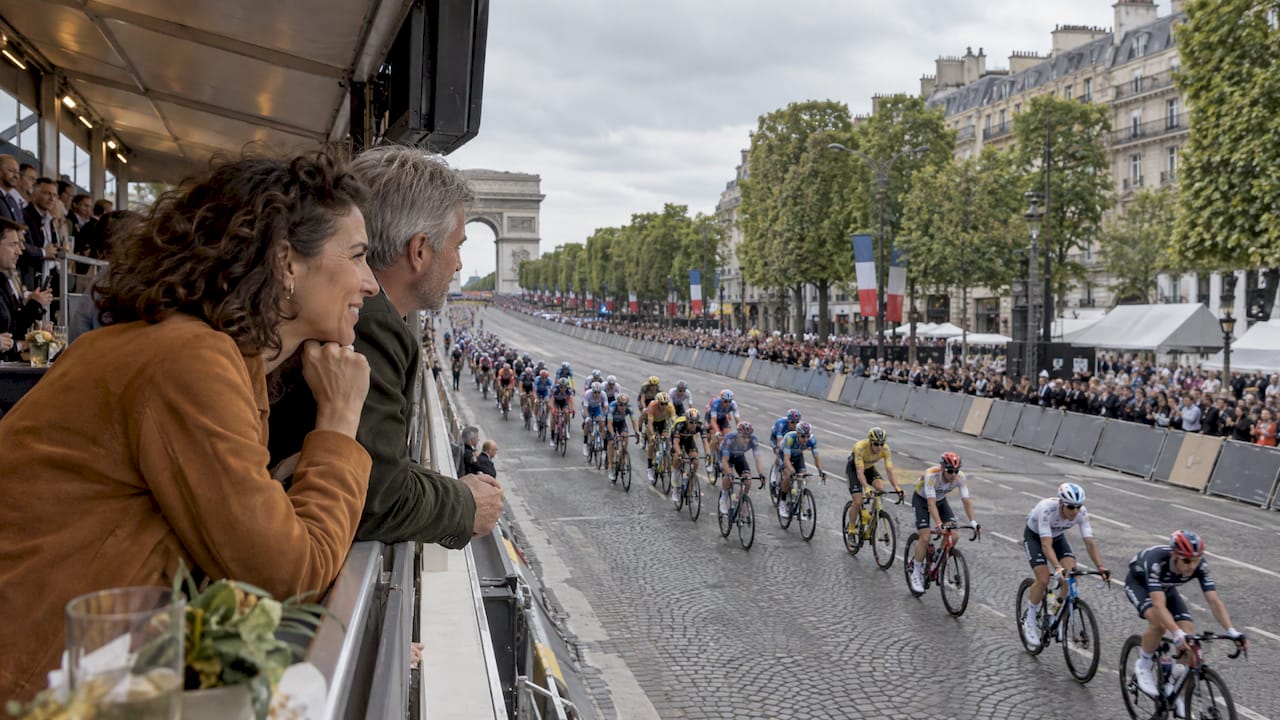
Tour de France hospitality is a ticketed viewing experience at a stage start, finish or roadside point. It gives you a reserved space, hosted food and drink, facilities and a protected view of the race. Roadside viewing stays free. Hospitality buys comfort, position and logistics. Official programs run from about €185 per person for a single day to fully hosted multi-day itineraries built around the race. This guide covers what you get, what it costs, and what American travelers should settle before booking.
TL;DR
- Hospitality means a reserved, hosted viewing zone with food, drinks, shade and restrooms. The roadside itself is free for everyone.
- Official single-day listings for 2027 start at €185 per person excluding VAT and reach €380 for the premium stage-finish formats.
- “In race” programs are for guests 18 and over, and “pre-race” programs for guests 16 and over.
- The 2027 Grand Départ is in Edinburgh on 2 July, so UK and France trips can be combined.
- A planner can bundle flights, hotels, transfers and hospitality into one trip, which is where a bespoke itinerary earns its keep.
Table of Contents
- What Tour de France hospitality actually is
- What you get at a stage
- What it costs
- Which editions and stages to plan around
- Age, access and rules to check first
- Hospitality or a bespoke trip
- A sample timeline for a July trip
- Our perspective
- Let us plan your Tour de France trip
- FAQ
- Sources
What Tour de France hospitality actually is
The race is not a stadium. Anyone can stand at the roadside on most of the route. What you pay for in hospitality is everything around that moment: a place to stand or sit, hosted service, and an easy way in and out.
The Tour’s own FAQ says free food and drink service is provided in all hospitality programs except the Grandstand programs. It also says you need no registration to attend activities inside the hospitality spaces. Official hospitality is sold through the organizer’s VIP programs page, which lists the current offers and a sales contact for the itinerant program.
There are broadly three tiers of experience:
- Stage start villages. You arrive early, meet the teams’ atmosphere and watch the riders sign on and roll out.
- Finish-line or near-finish spaces. These are the classic hospitality venues, with screens, drinks and a view of the last stretch.
- Multi-day programs. These combine several stages with transfers, hotels and sometimes helicopter or car-in-convoy access.
What you get at a stage
The organizer’s hospitality arm describes its finish-area format as a festive setting with a privileged view of the caravan and riders in the final hectometers. Guests get drinks, culinary activities and a live broadcast on screens. In the example listing, the space opens around 2:30 p.m. and closes 30 minutes after the riders arrive.
The practical gains over standing on a climb are real:
- A fixed position. You are not arriving at dawn to hold a spot on a mountain.
- Facilities. Per the FAQ, all hospitality areas have access ramps and adapted, priority sanitary facilities.
- Parking. The FAQ states guest parking is available at all start, stopover and finish sites, near the hospitality areas.
- Context. Screens show the live broadcast, so you understand the race while the riders are still miles away.
What hospitality does not change is the speed of the event. The peloton passes in seconds. The value is the day around it.
What it costs
The organizer’s hospitality listing for 2027 gives these per-person prices, quoted excluding VAT (HT):
| Package | Price per person (excl. VAT) | Parking noted |
|---|---|---|
| Champs-Élysées package | from €185 | Return to departure parking by official shuttle |
| Village Départ | €325 | Space for four people |
| Espace Izoard | €350 | Space for four people |
| Relais-Étape | €380 | Dedicated space |
Source for all four lines: ASO Hospitalité listing.
The Champs-Élysées package is the richest on that page for the money. It lists access to the Tour de France Village, a former professional cyclist as host, a transfer on the Tour route in an official vehicle, a boxed lunch, a 15 to 20 minute helicopter flight, access to the VIP bus at the finish, and an official shuttle back to the departure parking.

Two things to keep in mind when you budget. First, these are listed prices excluding VAT, so ask for the all-in amount in dollars before you commit. Second, a hospitality ticket is only one line of the trip. Flights, hotels near the route, ground transport and meals on non-hospitality days are separate, and in July they price at a premium. Exact figures change each edition, so confirm on the official pages for the year you plan to travel.
Which editions and stages to plan around
The official race page lists a Barcelona Grand Départ for 2026 and a Grande-Bretagne Grand Départ for 2027. For 2027, the men’s race starts in Edinburgh on Friday, 2 July 2027, with three days of racing through Scotland, England and Wales before moving to France.
That opens a different kind of trip for a U.S. traveler: a Grand Départ weekend in Edinburgh, then a flight or rail connection into France for mountain stages and the Paris finale. The Tour de France Femmes is run as its own race, with its own hospitality offers, so decide early whether you want the men’s race, the women’s race or both.
How to choose a stage:
- Mountain stage. Dramatic scenery and slow-moving riders, but the hardest logistics and the longest transfers.
- Flat finish. Easier access, sprint finishes and simpler hotel choices.
- Grand Départ. A festival atmosphere in a city, with the most dining and lodging options.
- Paris finale. The most polished format, in a city where a trip can extend naturally into a few days of sightseeing.
Age, access and rules to check first
The FAQ spells out the age rules: for security and protocol reasons, “in race” programs and the Presidential Grandstand in Paris are exclusively for people aged 18 and older. “Pre-race” programs are open from age 16. If you are traveling as a family with teenagers, that decides which program you can book, so settle it before you pay.
If your group includes keen cyclists who want to ride the climbs on a free day, you can find people to ride with before you leave and match pace and discipline.
Other items to confirm with the organizer or your planner in writing:
- What exactly the price covers: food, drinks, parking, transfers.
- Where the parking sits relative to the venue and how road closures affect arrival time.
- Whether a program is a pre-race or in-race format.
- Cancellation and name-change terms on tickets.
- Accessibility needs, since the official spaces provide ramps and priority facilities.
Hospitality or a bespoke trip
A hospitality ticket solves the viewing day. A bespoke trip solves everything else. For a luxury traveler the real friction is rarely the ticket. It is getting from a hotel to the right village before roads close, staying within reach of the route, and fitting a stage into a wider journey.
A well-built Tour trip usually has these layers:
- The viewing day. Official hospitality or a private arrangement chosen for the stage.
- Lodging near the route. Booked early, since towns on a stage fill up long before July.
- Ground transport. A private driver is often the simplest way to reach start and finish zones. Our notes on skipping the rental counter with a VIP driver explain why.
- Air access. For difficult terrain, helicopter transfer costs and options are worth understanding before you decide.
- A days-off plan. Wine country, Alpine lunches, or a few nights in Paris.
If you are comparing the Tour with other marquee events, our guides to Wimbledon hospitality, attending the Monaco Grand Prix and Olympic hospitality show how access, cost and timing compare. For a broader view, see these exclusive sporting event travel examples.
A sample timeline for a July trip
Hospitality sales for a given edition typically open well ahead, and the 2027 programs were already being promoted months before the race. Working backward from a July start gives a sensible rhythm:
- 12 months out: Pick the stage or stages, decide on the men’s race, the women’s race or both, and choose between official and curated hospitality.
- 9 to 12 months out: Secure hotels near your chosen stage, which are the first thing to sell out, and hold flights.
- 6 to 9 months out: Confirm hospitality tickets and in-race or pre-race eligibility for every traveler.
- 3 months out: Book ground transport, restaurant reservations and any helicopter or private guide services.
- Final month: Reconfirm schedules, parking and meeting points, and share a single day-by-day document with the group.
The official pages hold the current sales calendar, so treat this as a pattern, not a schedule.
Our perspective
Most people who ask us about Tour de France hospitality assume the hard part is getting a ticket. In our experience it is the sequence around it: where you sleep, how you reach the venue on a closed road, and how a single stage fits into a longer trip.
With more than 20 years of industry experience and direct destination knowledge, we build these trips around the traveler rather than around a package. We plan the hospitality day, the lodging, the transfers and the quiet days in between as one itinerary, and we handle the details that tend to unravel complex trips.
If you want the Tour as a centerpiece, tell us who is traveling, what pace you like and how close to the action you want to be. We will shape the rest.
Michael
Let us plan your Tour de France trip
We plan bespoke luxury trips, including custom itineraries, hotel and air bookings, transportation arrangements, exclusive event access and concierge services. For a Tour de France journey, that means one planner coordinating your viewing day, your lodging and your transfers, so you can focus on the race.
Tell us your dates, your group and the stage you have in mind through our vacation planning page, and we will start building your itinerary.
FAQ
Is Tour de France hospitality worth it compared with watching from the roadside?
Roadside viewing is free, and many fans enjoy it. Hospitality adds a reserved space, food and drink, restrooms, parking and a live broadcast. It suits you if comfort, position and an organized day matter more than the lowest cost.
How much does Tour de France hospitality cost?
The organizer’s 2027 hospitality listing shows packages from €185 to €380 per person excluding VAT. Multi-day trips with hotels, transfers and flights cost more, and prices change each edition, so confirm on the official page.
Can children attend Tour de France hospitality?
According to the official FAQ, “in race” programs are limited to people 18 and older, while “pre-race” programs accept guests 16 and older. Check the program type before booking with teenagers.
Where does the 2027 Tour de France start?
The 2027 Grand Départ is in Edinburgh on 2 July 2027. The race then moves through Scotland, England and Wales before continuing in France.
Sources
- Tour de France official FAQ
- Tour de France VIP programs
- Tour de France: The race
- ASO Hospitalité listing
- Tour de France 2027 Edinburgh Grand Départ
- Find people to ride with