

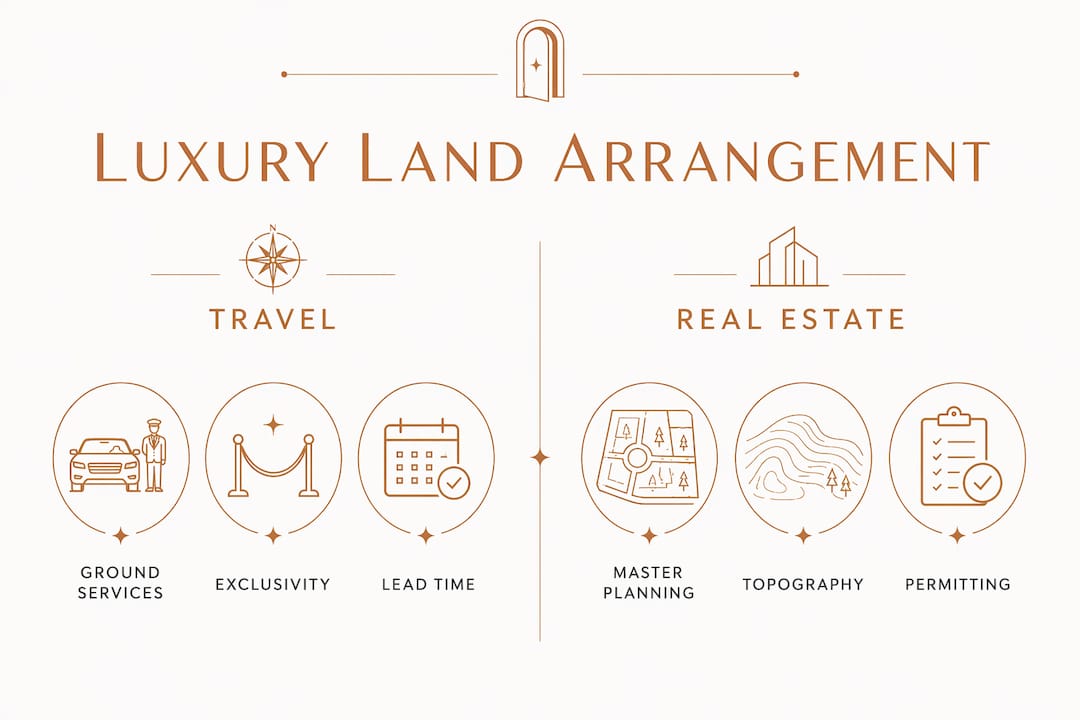
A luxury land arrangement is either a high-touch, ground-based travel program (everything at the destination except your international flights) or a master-planned site layout for a premium real estate development. The term sounds like industry jargon, but it covers two very different disciplines, and confusing them is easier than it sounds.
- In travel: A land arrangement covers all ground components of a trip, including private transfers, curated hotels, vetted local guides, sightseeing logistics, and concierge coordination. Firms like Hiddendoortravel and Dong DMC treat the “luxury” modifier as a mandate for real-time flexibility and operational control, not just upgraded hotels.
- In real estate: A luxury land arrangement is a master-planning exercise that integrates topography, ecology, infrastructure, and amenity programming before a single foundation is poured. Practitioners like LandDesign, WATG, and Bohler Engineering approach it as a site-first discipline where the land’s logic drives the layout.
Pro Tip: If someone quotes you a “luxury land arrangement” price without specifying which context they mean, ask immediately. The two disciplines share a name but almost nothing else.
Table of Contents
- What does a luxury land arrangement mean in travel?
- What does a luxury land arrangement mean in real estate?
- What features actually make a land arrangement “luxury”?
- What timelines and costs should you expect?
- How do you evaluate a luxury land arrangement before you commit?
- Hiddendoortravel’s expert perspective on the execution layer
- Key Takeaways
- The gap between what “luxury” promises and what it delivers
- Planning a luxury land arrangement with Hiddendoortravel
- Useful sources and firm examples
What does a luxury land arrangement mean in travel?
In the travel industry, a land arrangement refers to the ground-based portion of a trip, specifically excluding international airfare or ocean passage. You handle your own flights; the land arrangement handles everything once you touch down. That distinction matters practically: travelers using frequent-flyer awards, private aviation, or multi-destination routing often book land-only programs precisely because they want the ground experience managed without being locked into a bundled air ticket.

A standard land package might include a hotel room, an airport shuttle, and a group city tour. A luxury land arrangement is a different animal entirely.
Typical components in a luxury ground program include:
- Private transfers with meet-and-greet arrivals, name boards, and luggage handling
- Curated premium hotels selected for location, service standard, and suite availability
- Vetted local guides matched to the client’s interests and pace
- Exclusive-access experiences unavailable through public booking channels
- Bespoke timing with built-in buffer and flexibility for itinerary adjustments
- Concierge escalation for real-time problem-solving on the ground
- Operational reconfirmation of every supplier 24–48 hours before each service
That last point is where most “upscale” packages fall short. A luxury wine tour through Burgundy or a private safari in East Africa can look identical on paper to a premium group tour. The difference shows up when a guide cancels the morning of, a restaurant loses your reservation, or a private site access window shifts. Luxury execution means someone is already on the phone fixing it before you know there was a problem.
Hiddendoortravel’s approach to luxury transfer service illustrates this well. Private vehicle standards, driver briefings, and timing protocols are confirmed in writing before departure, not improvised on arrival. For remote or complex destinations, that operational rigor is what separates a genuinely bespoke experience from a well-marketed package tour.
Pro Tip: Ask any agency whether their ground operators are contracted partners or spot-booked vendors. Contracted partners mean accountability; spot-booked vendors mean whoever is available that week.
What does a luxury land arrangement mean in real estate?
In development, a luxury land arrangement is a master-planning process that determines how a site is organized before architecture begins. It covers lot placement, road and utility routing, amenity programming, landscape strategy, and infrastructure designed for longevity. The goal is not just to fit the most units on a parcel but to create a coherent living environment where privacy, views, and serviceability reinforce each other.
Luxury master planning typically addresses:
- Site analysis: GIS mapping of vegetation, solar exposure, drainage, and topography to drive lot placement decisions that preserve canopy and views
- Road and utility placement: Circulation routes that minimize visual intrusion and separate service traffic from resident movement
- Lot orientation: Positioning each parcel for privacy, natural light, and view corridors rather than maximum density
- Amenity programming: Clubhouses, wellness facilities, and landscape features placed where they generate the most resident value
- Infrastructure for serviceability: Dedicated staff circulation, back-of-house spaces, and utility corridors kept invisible to owners and guests
Espacio Lar’s Sanctuary master plan demonstrates this approach: the design reads topography and ecology first, then locates structures where the land already suggests them. LandDesign’s Costa Palmas project shows how resort-scale planning integrates native landscape, mixed residential uses, and high-end amenities into a single coherent experience. WATG’s Thanh Xuan Valley master plan preserved mature forest and used contour-driven villa placement to guarantee both privacy and views. Bohler Engineering’s rural farmland project used cluster development to preserve open space while navigating complex permitting, a strategy increasingly common in US luxury residential development.
In the US specifically, luxury land planning must account for state and county permitting timelines that can stretch from 12 months to several years for large-scale developments, environmental mitigation requirements, and the expectation among ultra-high-net-worth buyers that service infrastructure remains completely invisible.
| Planning Element | What It Addresses |
|---|---|
| Topographic analysis | Lot placement, drainage, view preservation |
| Road and utility routing | Service separation, visual impact, long-term maintenance |
| Lot orientation | Privacy, solar exposure, view corridors |
| Amenity programming | Clubhouse, wellness, landscape features |
| Infrastructure serviceability | Staff circulation, back-of-house, utility corridors |
What features actually make a land arrangement “luxury”?
Across both travel and real estate, a handful of attributes consistently separate luxury from premium or standard. They are not about price alone.
- Customization: In travel, this means a private guide briefed on your specific interests rather than a group tour script. In development, it means lot shapes and orientations designed around individual buyer preferences rather than a repeating grid.
- Operational control: The agency or developer maintains direct accountability for every supplier and contractor, not a chain of subcontractors with no single point of responsibility.
- Exclusive access: Travel programs include experiences unavailable through public booking. Developments include amenities, privacy buffers, and site features that cannot be replicated at lower price points.
- Premium supplier selection: Vetted, contracted partners rather than whoever is available. In travel, this means hotels and guides with documented service standards. In development, this means contractors with luxury residential track records.
- Privacy and serviceability: In travel, private vehicles and exclusive-access windows. In development, lot spacing, landscape buffers, and invisible service infrastructure.
- High-touch concierge: A named contact with authority to solve problems in real time, not a call center.
| Feature | Standard Arrangement | Luxury Arrangement |
|---|---|---|
| Access | Public booking, group timing | Exclusive windows, private access |
| Service control | Third-party vendors, limited accountability | Contracted partners, direct oversight |
| Customization | Fixed itinerary or fixed lot layout | Tailored to individual preferences |
| Concierge | General helpdesk | Named contact with escalation authority |
| Cost expectation | Budget to mid-range | Premium, with transparent scope |
What timelines and costs should you expect?
The two contexts operate on completely different clocks.
In travel, a bespoke luxury ground program for a single destination typically requires 4–12 weeks of lead time for planning, supplier confirmation, and reconfirmation. Complex multi-country itineraries or programs involving exclusive-access venues can require 3–6 months. Main cost drivers include private transport (often the single largest line item), exclusive-access fees, premium hotel rates, guide fees, and the agency’s planning and concierge labor.
In real estate, a luxury master plan for a US residential development moves on a timeline measured in years, not weeks. Permitting alone in many US jurisdictions takes 12–36 months for large parcels. The full cycle from site acquisition through infrastructure completion and first lot sales can span 5–10 years for resort-scale projects. Bohler Engineering’s rural farmland work illustrates how cluster-development strategies can compress some of that timeline by reducing the infrastructure footprint, but environmental review and local approval processes remain the dominant variable.
| Context | Planning Lead Time | Main Cost Drivers |
|---|---|---|
| Luxury travel ground program | 4–12 weeks (simple); 3–6 months (complex) | Private transport, exclusive access fees, premium hotels, concierge labor |
| Real estate master plan | 12–36 months permitting; 5–10 years full cycle | Site work, infrastructure, amenity build-outs, environmental mitigation, permitting |
For travel, the cost of a luxury land arrangement scales most sharply with exclusivity: private site access, dedicated vehicles, and a 24/7 on-call concierge add cost that group programs simply cannot replicate. For development, the biggest variable is usually infrastructure: roads, utilities, and amenity facilities on a raw site can dwarf the cost of the land itself.
How do you evaluate a luxury land arrangement before you commit?
Whether you are booking a ground travel program or reviewing a development’s master plan, the same discipline applies: verify the execution before you sign anything.
Verify operationally:
- Who are the named ground operators or contractors, and what are their service standards?
- Is there a 24/7 on-call contact with authority to resolve problems?
- How are supplier confirmations handled, and when?
- What is the contingency plan if a key supplier cancels?
- For development: who manages serviceability infrastructure, and how is it maintained?
Verify contractually:
- What is the exact scope of services, and what is explicitly excluded?
- What are the cancellation and force majeure terms?
- Who bears liability if a supplier fails to perform?
- Are insurance certificates available for all parties?
- What service-level expectations are written into the agreement?
Verify on-site or in-person:
- For travel: have the agency’s ground operators been visited or audited recently?
- For development: has the site been walked with the master planner to verify lot orientations and view corridors?
- Are the amenities and access points shown in renderings actually permitted and funded?
Red flags to watch for:
- Vague execution plans with no named suppliers or contractors
- No contingency or escalation process described in writing
- Renderings that show amenities with no confirmed permitting or funding
- An agency that cannot name the specific hotels or guides for your program
- A developer who cannot produce a current permitting status report
Use the elite agency selection checklist as a starting framework when vetting a travel provider.
Hiddendoortravel’s expert perspective on the execution layer
The most common mistake clients make when booking a luxury ground program is treating the hotel list as the product. The hotels matter, but they are the backdrop. What actually determines whether a trip delivers on its promise is the execution layer: the sequence of confirmations, the named contacts at each supplier, the contingency protocols, and the agency’s willingness to intervene when something goes sideways.
Hiddendoortravel’s luxury travel experts vet ground operators through direct relationships built over years of booking, not through aggregator platforms. Guide selection goes beyond language fluency to include subject-matter depth, pace compatibility, and the ability to adapt an itinerary in real time. Operational reconfirmation happens 24–48 hours before each service, not just at the start of the trip.
When qualifying a luxury land arrangement, the agency asks:
- “Who is the named ground contact for this program, and what is their direct line?” A satisfactory answer includes a specific person, not a general reservations inbox.
- “What happens if the private transfer provider cancels the morning of arrival?” A satisfactory answer includes a named backup provider, not a promise to “sort it out.”
- “Which hotels have you personally visited or audited in the last 18 months?” A satisfactory answer is specific, not a reference to star ratings or review scores.
Key Takeaways
A luxury land arrangement is defined by operational control and customization, whether you are booking a ground travel program or commissioning a real estate master plan.
| Point | Details |
|---|---|
| Two distinct meanings | “Luxury land arrangement” refers to either a ground travel program or a real estate master plan — context determines which. |
| Travel execution layer | Private transfers, vetted guides, exclusive access, and 24/7 concierge escalation separate luxury from standard ground programs. |
| Real estate master planning | Luxury development integrates topography, privacy, serviceability, and amenity programming before architecture begins. |
| Evaluation discipline | Always verify named suppliers, contingency protocols, and written service-level terms before signing or booking. |
| Hiddendoortravel’s role | Hiddendoortravel manages the full execution layer for luxury ground travel programs, from supplier vetting to real-time concierge escalation. |
The gap between what “luxury” promises and what it delivers
The word “luxury” in land arrangements, both travel and real estate, has been stretched so far that it has almost lost meaning. Every tour operator with a four-star hotel on the itinerary calls it luxury. Every developer with a clubhouse rendering calls the project luxury. What actually separates the real thing from the marketing copy is accountability.
In travel, accountability means a named person who answers the phone at 11 PM when your private transfer does not show. In development, it means a master plan where every lot orientation, utility corridor, and amenity placement has a documented rationale tied to the site’s actual conditions, not a generic template applied from another project. The bespoke travel approach that genuinely delivers on the luxury promise is built on that kind of operational specificity, not on a curated aesthetic.
The checklist in this article is not a nice-to-have. It is the fastest way to find out whether a provider is selling you a real luxury land arrangement or a well-designed brochure.
Planning a luxury land arrangement with Hiddendoortravel
Hiddendoortravel specializes in exactly the kind of ground-level execution that makes a luxury land arrangement worth the investment. Where most agencies hand off to local operators and hope for the best, Hiddendoortravel maintains direct supplier relationships, conducts operational reconfirmations before every service, and provides a named concierge contact for the duration of your program. That means private transfers that actually show up, guides who know your interests before they meet you, and exclusive access that is confirmed in writing, not promised verbally.
Whether you are planning a single-destination program or a multi-country itinerary built around exclusive access experiences, the starting point is a planning consultation where the agency maps your priorities against available ground options. Speak with Hiddendoortravel’s luxury travel experts to get a clear picture of what a fully executed luxury land program looks like for your specific trip.
Useful sources and firm examples
- DT Glossary — Land Arrangement: Defines the travel-industry meaning of land arrangements, covering ground components and typical inclusions.
- Law Insider — Land Only Definition: Industry contract reference defining “land only” as the tour cost excluding international airfare.
- Dong DMC — Vietnam Land Arrangement: Operational checklist used by a destination management company for luxury ground programs, including reconfirmation protocols.
- Espacio Lar — Sanctuary Master Planning: Project example showing ecological-first master planning where topography and site logic drive layout decisions.
- LandDesign — Costa Palmas: Resort-scale case study integrating native landscape, residential uses, and luxury amenities into a single master plan.
- WATG — Thanh Xuan Valley: Mixed-use master plan demonstrating contour-driven villa placement for privacy, views, and natural preservation.
- Bohler Engineering — Luxury Living on Rural Farmland: US-based project documenting cluster-development strategies, permitting solutions, and open-space preservation for luxury residential development.
- Hiddendoortravel — Luxury Transfer Service Explained: Agency-level guidance on private transfer standards and operational protocols for luxury ground programs.
- Hiddendoortravel — Bespoke Travel Meaning: Explains the agency’s philosophy on bespoke travel and how managed ground programs differ from packaged options.
- Sail Armada — Personalizing Yacht Holidays: Partner content illustrating personalization tactics for luxury group travel, including curated shore experiences that parallel land arrangement customization.