
What is a travel mastermind, and why does it matter?
A travel mastermind is a peer-to-peer collaborative group where travel professionals and luxury travelers share knowledge, solve real challenges, and sharpen their approach to bespoke travel planning. The concept traces back to Napoleon Hill, who introduced the mastermind idea in 1925 in The Law of Success, describing it as two or more people working together in harmony toward a common goal. That original idea has since been adapted across industries, and the travel sector has made it its own.
Programs like the Avoya Mastermind Program show what this looks like in practice: structured peer groups where advisors refine sales strategies, share booking intelligence, and hold each other accountable. For affluent travelers, a travel mastermind group represents something rarer still, access to a curated circle of people who think seriously about travel at the highest level.
Key features of a travel mastermind:
- Peer collaboration and shared problem-solving
- Accountability structures that keep members on track
- Collective wisdom that shortens the learning curve
- Networking that opens doors to exclusive travel access
- A confidential space to pressure-test ideas without judgment
How travel mastermind groups are structured
Most travel mastermind groups follow a scheduled rhythm, meeting weekly or monthly, in formats ranging from virtual sessions to in-person workshops and multi-day intensives. Program lengths vary from short three-day workshops to year-long cohorts, depending on the depth of focus.
Group size matters more than most people expect. Research points to groups with several participants as the ideal range to balance intimacy and perspective. Larger groups dilute the quality of feedback; smaller ones can lack the diversity of perspective that makes the format work.

The “hot seat” method is where the real value lives. One member presents a specific challenge, and the group responds with candid, structured feedback. No softening, no vague encouragement. Just direct input from people who understand the industry. Topics covered across sessions typically include marketing, sales, travel experience design, and mindset coaching.
Common mastermind formats:
- Weekly virtual sessions for ongoing accountability
- Monthly deep-dive calls with rotating hot seat participants
- Multi-day in-person workshops with live sales coaching
- Year-long cohorts combining all of the above
What are the real benefits of travel masterminds?
The Avoya Mastermind Program offers the clearest proof point available: participating agencies close leads at a rate over 60% higher than non-participants. That figure comes from a program built around interactive workshops, personality-based selling techniques, and peer networking, not passive training.
Stat to know: Avoya Mastermind Program participants close leads at a rate over 60% higher than advisors outside the program.
Beyond the numbers, the benefits of travel masterminds show up in ways that are harder to quantify but just as real. Members gain access to perspectives they would never encounter working alone, and they get honest feedback on ideas before committing resources to them.
Benefits for luxury travelers and travel advisors:
- Faster problem-solving through collective intelligence
- Access to exclusive partnerships and supplier relationships
- Accountability that converts good intentions into booked trips
- Exposure to personalized travel strategies refined by peers with real results
- A network that surfaces rare opportunities before they reach the open market
How masterminds differ from individual travel planning or consulting
Solo travel consulting gives you one expert’s perspective. A mastermind gives you eight to ten. That difference in input quality is the core distinction, and it changes how decisions get made.
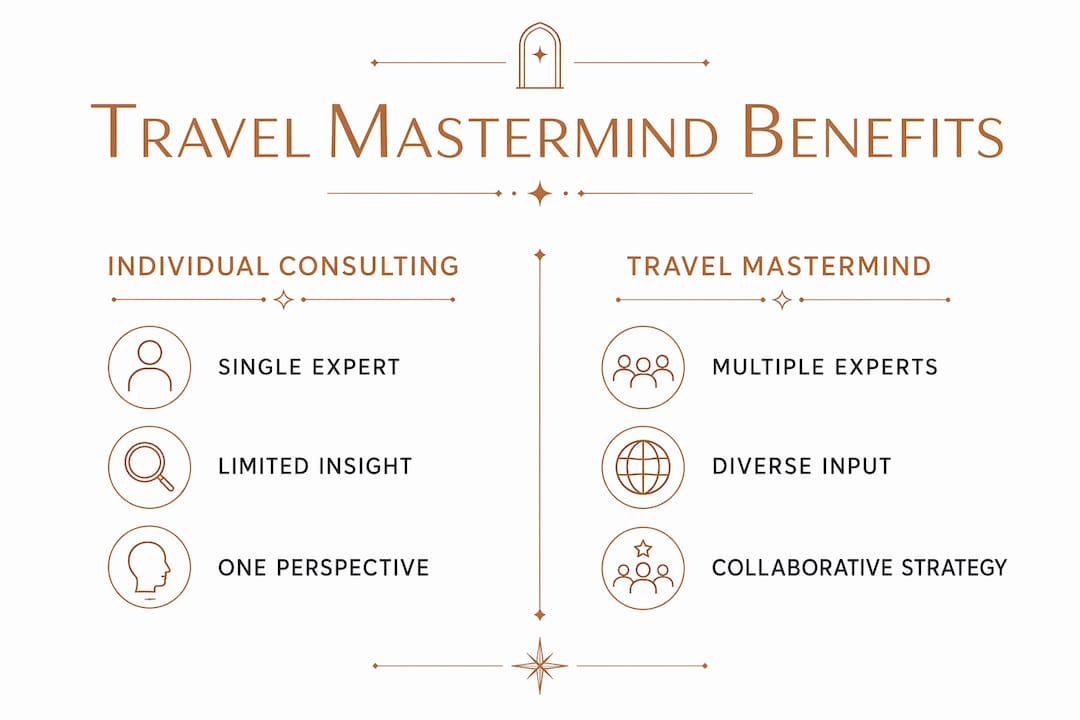
A mastermind acts as a force multiplier for members who bring genuine effort. It does not replace personal action or individual expertise. What it does is stress-test your thinking in ways that a single advisor, no matter how skilled, simply cannot replicate.
Mastermind vs. individual consulting at a glance:
- Mastermind: Multiple perspectives, peer accountability, collective brainstorming
- Individual consulting: Single expert, personalized advice, direct service delivery
- Mastermind: Pressure-tests ideas before execution
- Individual consulting: Executes on a defined brief
- Mastermind: Community-driven momentum
- Individual consulting: Advisor-driven outcomes
Pro Tip: Use mastermind insights to sharpen your brief before engaging a personal travel advisor. The clarity you gain from peer discussion translates directly into better, faster results from any one-on-one service.
How Hiddendoortravel’s philosophy aligns with the mastermind model
Hiddendoortravel is built on the belief that elite travel demands more than a good itinerary. It demands deep knowledge, trusted relationships, and a willingness to go further than any standard agency would. That is exactly what a well-run mastermind cultivates.
The mastermind model mirrors Hiddendoortravel’s approach in several direct ways. Both prioritize personalized service over volume. Both rely on curated relationships rather than transactional exchanges. And both treat travel as a craft worth refining continuously, not a product to be packaged and sold.
Points of alignment:
- Shared commitment to bespoke, client-first experiences
- Collective expertise that deepens over time through honest exchange
- Long-term relationships built on trust, not one-off transactions
- A discreet, high-trust environment where candid conversation is the norm
- Continuous refinement of what personalized luxury travel actually looks like in practice
How to get involved with a travel mastermind
Finding the right group takes more care than most people expect. A poorly matched mastermind, one where the members are at wildly different levels or the focus is too broad, delivers little. The right one can reshape how you think about travel entirely.
Start by evaluating groups on these criteria before committing:
- Group size: Aim for 8–10 members for meaningful engagement
- Session frequency: Weekly or monthly cadence suits most schedules
- Focus area: Confirm the group covers luxury travel, not general tourism
- Reputation: Look for programs with documented outcomes, not just testimonials
- Cost: Fee structures vary widely; some programs are included within host agency memberships, others charge separately
Industry associations, curated programs like the Avoya Mastermind Program, and travel networking events are the most reliable starting points. If no existing group fits, consider forming one by inviting five to eight trusted peers who share your standards and ambitions. Hiddendoortravel’s network and expert advisors can also point you toward the right connections.
Action steps to get started:
- Research programs tied to established host agencies or travel associations
- Attend one session as a guest before committing to membership
- Define your specific goals before joining so you can measure progress
- Prepare a real challenge to bring to your first hot seat session
- Review the business travel landscape to understand how peer learning shapes travel decisions at the professional level
Examples of successful travel mastermind groups
The Avoya Mastermind Program, launched in 2011, remains one of the most documented examples in the industry. Its Virtual Success Academy, held in February 2021, sold out the day it was announced and drew agencies across the Avoya Network for workshops on personality-based selling and adaptive communication.
The Nexion Travel Business Success Mastermind takes a different shape: a focused three-day in-person event combining business planning, marketing strategy, and live sales practice, with participants leaving with a 90-day action plan. Masters In Travel operates as an ongoing community for advisors, built around weekly conversations, podcasts, and peer accountability rather than a single event format.
Each of these programs works because the format matches the audience. Advisors at different stages need different structures, and the best programs acknowledge that rather than offering a one-size approach.
Key challenges to consider before joining a mastermind
Commitment is the first filter. A mastermind only works when every member shows up prepared, engaged, and willing to be honest. One disengaged participant can flatten the energy of an entire session.
Fit matters as much as quality. A group filled with advisors focused on budget group travel will not serve a luxury specialist well, even if the group itself runs perfectly. Mismatched expertise levels create a similar problem: if the gap between members is too wide, conversations default to the lowest common denominator.
Cost and time are real considerations. Some programs carry fees that reflect their depth and exclusivity; others are bundled within host agency memberships. Either way, the investment only pays off if you treat participation as a priority, not an optional add-on to an already full schedule.
Key Takeaways
A travel mastermind delivers peer-driven accountability, shared expertise, and exclusive networking that individual consulting alone cannot replicate, with documented results like the Avoya program’s 60%-plus lead closing advantage.
| Point | Details |
|---|---|
| Origin and definition | Napoleon Hill introduced the mastermind concept in 1925; travel masterminds apply it to luxury travel and advisor growth. |
| Ideal group size | Groups of 8–10 participants deliver the best balance of intimacy and diverse perspective. |
| Proven business impact | Avoya Mastermind Program participants close leads at a significantly higher rate than non-participants. |
| Mastermind vs. consulting | Masterminds multiply individual effort through peer input; they complement, not replace, personal advisors. |
| How to join | Evaluate group size, focus area, frequency, and reputation before committing; start with one guest session. |