

Travel agencies outperform apps by delivering personalized expertise, crisis advocacy, and post-booking support that no algorithm can replicate. The industry term for this is “travel advisory services,” and the distinction from app-based booking matters more than most travelers realize. 55% of families now use brick-and-mortar travel agents, up 19 points since 2019. That shift reflects a hard lesson many travelers learned after a missed connection or a botched itinerary: apps handle transactions, but agents handle outcomes. Hiddendoortravel builds its entire model on that difference.
Why travel agencies outperform apps on time and stress
Travel agents save time in ways that apps simply cannot. 66% of travelers say agents save them time, and that figure reflects hours of research, comparison, and coordination that never land on the traveler’s plate. An agent handles visa requirements, layover logistics, hotel category upgrades, and transfer timing behind the scenes. You receive a finished itinerary instead of a browser full of open tabs.
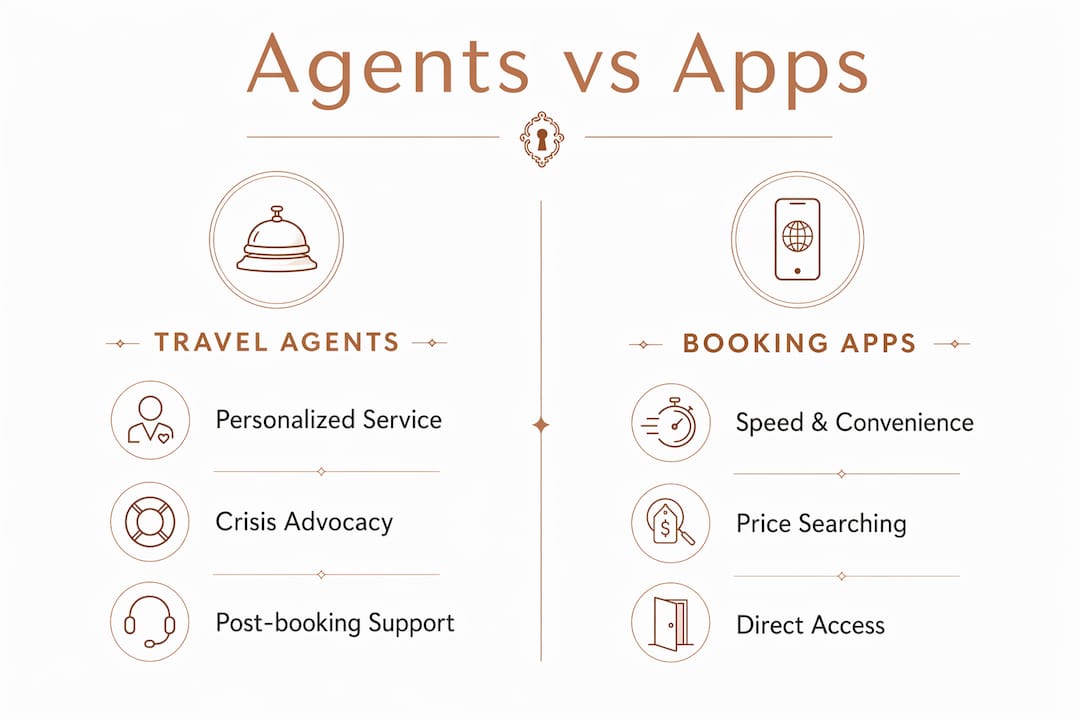
Apps offer options, not decisions. A booking app surfaces 400 flight combinations and leaves you to sort them. A travel agent narrows those to three that fit your schedule, budget, and preferences, then books the right one. The cognitive load difference is significant.
The stress gap widens when something goes wrong. Apps provide no real-time support during disruptions. An agent picks up the phone, contacts the airline directly, and has you rebooked before you reach the gate agent’s line.
- Apps require travelers to research, compare, and decide independently on every element.
- Agents pre-filter options based on your stated and unstated preferences.
- Agents monitor bookings after purchase and act without being asked.
- Apps offer no proactive service once a booking is confirmed.
Pro Tip: If your trip involves more than two connecting flights, a hotel check-in before 3 p.m., or a cruise departure, the time you spend self-booking will almost certainly exceed the time an agent saves you. That is the threshold where DIY booking stops being efficient.
Does the human element really matter in travel planning?
Apps excel at data processing. They cannot read a situation, offer reassurance, or make a judgment call when the rules conflict with reality. Apps lack empathy and crisis management capabilities that human agents provide as a core part of their service. That gap becomes critical the moment a trip goes sideways.
Consider a flight cancellation in a foreign airport at midnight. An app sends a notification. An agent calls you, already holding two rebooking options, and asks which you prefer. Agency clients get immediate rebooking during disruptions while app users wait hours on hold with airline customer service. The difference is not a feature. It is a relationship.
Agents also carry subjective knowledge that no database holds. They know which resort’s “ocean view” actually faces a parking structure. They know which cruise line’s “premium cabin” runs loud from engine noise. That kind of insight comes from personal visits, supplier relationships, and years of client feedback.
“Apps are for transactions. Travel agents are for transformations.” This distinction, recognized across the travel advisory profession, captures exactly why human judgment remains irreplaceable in complex travel planning.
- Flight cancellations and rebooking handled in minutes, not hours.
- Local knowledge about resort quality, neighborhood safety, and seasonal conditions.
- Emotional support and clear communication during high-stress travel moments.
- Advocacy with suppliers that individual travelers cannot access independently.
Pro Tip: Before any international trip, ask your agent for their emergency contact number and the supplier’s direct line. Agents with real supplier relationships will give you both without hesitation. That access is the clearest signal of genuine agency value.
How do agents optimize travel investment beyond price?
The cheapest booking is rarely the best value. Travel advisors maximize travel investment by prioritizing quality experiences and handling hidden regulatory complexities that apps never surface. Visa rules, airspace permissions, entry requirements, and health documentation change frequently. An agent tracks those changes and adjusts your booking accordingly.
OTAs capture 30%–40% of booking revenue through fees and margin structures that are largely invisible to travelers. That cost rarely shows up as a line item. It shows up as a worse room, a less flexible ticket, or a hotel that does not honor the amenity package you thought you purchased.
Agents also provide a service that apps cannot offer at all. Post-booking price monitoring and automatic re-rating means that if your hotel rate drops after you book, a good agent rebooks you at the lower price without you asking. That is money returned to your pocket from a service you did not have to request.
| Category | Travel app booking | Agent-assisted booking |
|---|---|---|
| Price transparency | Displayed price only | Full cost breakdown including fees |
| Post-booking price drops | No adjustment | Automatic re-rating when available |
| Hidden fees | Often embedded in OTA margin | Disclosed upfront |
| Regulatory compliance | Not monitored | Actively managed |
| Experience quality | Self-assessed | Verified through agent knowledge |
| Supplier perks | Rarely included | Frequently negotiated |
When do complex trips require an agent instead of an app?
Not every trip needs an agent. A direct flight to a city you know well, booked on a familiar airline, is a reasonable self-booking task. The calculation changes fast when complexity enters the picture.

Complex trips like cruises, Disney vacations, and multi-stop international itineraries can consume 40 or more hours of planning time without professional help. That is a full work week spent on logistics that an experienced agent resolves in a single conversation. The hidden complexity in these trips, including shore excursion timing, dining reservation windows, park ticket tiers, and visa sequencing, is exactly where apps fail and agents earn their value.
Travelers who book tours with agents report a 28% increase in tour participation, which reflects richer, more curated experiences rather than generic itineraries assembled from search results. Agents know which tours are worth the price and which are filler. That curation is a form of quality control that no booking engine provides.
Use an agent for these trip types:
- Multi-destination international itineraries with visa requirements.
- Cruise vacations, including pre and post-cruise hotel coordination.
- Group travel for families, weddings, or corporate retreats.
- Disney or theme park vacations with complex reservation systems.
- Adventure or expedition travel requiring health documentation and permits.
- Any trip where a single disruption would ruin the entire experience.
For a what is a travel advisor breakdown, Hiddendoortravel covers the full scope of what professional advisory services include.
How to combine apps and agents for the best travel strategy
The most effective travelers do not choose between apps and agents. They use each for what it does best. Modern travelers use apps for routine logistics and agents for high-stakes itinerary design, and that division produces better outcomes than either approach alone.
A practical framework for combining both looks like this:
- Use your agent for the core itinerary. Flights, hotels, transfers, and tours should be agent-booked for complex trips. This is where expertise and supplier relationships deliver real value.
- Use apps for real-time logistics. Weather apps, local transit apps, and restaurant discovery tools are genuinely useful once you arrive. They handle the day-to-day without requiring agent involvement.
- Keep your agent’s contact accessible. Save their number and email before departure. If anything changes, your agent is faster than any app at resolving it.
- Let agents handle post-booking monitoring. Do not check prices obsessively after booking. Your agent tracks that automatically and acts when a better rate appears.
- Use apps for inspiration, agents for execution. Browsing travel content and building a wish list is a great use of digital tools. Turning that wish list into a real trip is where personalized travel planning from a professional advisor adds the most value.
Combining AI tools with human agents delivers the best traveler experience by using technology for speed and humans for judgment. The goal is not to replace one with the other. The goal is a trip that actually goes the way you planned it.
Key Takeaways
Travel agencies outperform apps because human expertise, crisis advocacy, and post-booking support deliver outcomes that automated booking platforms cannot match.
| Point | Details |
|---|---|
| Time savings are measurable | 66% of travelers say agents save them time by handling research, logistics, and monitoring. |
| Crisis support is the clearest gap | Agents rebook clients immediately during disruptions; app users wait hours on hold. |
| Investment value exceeds price | Agents re-rate bookings when prices drop and disclose fees that OTAs embed invisibly. |
| Complex trips need human expertise | Multi-stop, cruise, and group trips can consume 40+ hours without professional planning help. |
| Apps and agents work best together | Use apps for daily logistics and agents for itinerary design and crisis management. |
What I’ve learned after years of watching travelers choose wrong
The travelers who regret using an app are never the ones who booked a simple weekend flight. They are the ones who booked a 14-night Mediterranean cruise, added three pre-cruise cities, and assumed the app would handle the rest. It never does.
What I have seen repeatedly is that the cost of a bad trip, measured in stress, lost time, and ruined expectations, always exceeds the perceived savings from self-booking. A missed connection in Rome because nobody flagged a 45-minute layover minimum. A hotel room that looked nothing like the photos because no agent had ever visited the property. These are not edge cases. They are the predictable result of removing human judgment from a complex planning process.
The agencies worth using are the ones that treat your trip as a relationship, not a transaction. They ask about your travel history, your tolerance for risk, your preferences for pace. They remember what you told them last time. That kind of continuity is what elite travel agency advantages actually look like in practice.
My honest advice: use apps freely for the parts of travel that are genuinely simple. But when the stakes are high, when the trip is expensive, when the itinerary is complex, or when something going wrong would be genuinely devastating, put a real person in your corner. The technology is impressive. The human is irreplaceable.
— Michael
Hiddendoortravel: bespoke expertise for trips that matter
Hiddendoortravel specializes in exactly the kind of travel where agency expertise makes the largest difference. Complex itineraries, luxury properties, and high-stakes trips are the core of what the team handles every day.
For travelers who want more than a confirmed booking, Hiddendoortravel’s luxury travel agency services cover everything from initial itinerary design through post-departure support. The team monitors bookings, manages disruptions, and applies the kind of supplier relationships that no booking app can replicate. If you are planning a trip where the details matter, working with a luxury travel agency is the clearest path to getting it right.
FAQ
Why do travel agencies outperform apps for complex trips?
Travel agencies handle visa rules, supplier negotiations, and real-time rebooking that apps cannot manage. Complex trips like cruises and multi-destination itineraries can take 40 or more hours to plan without professional help.
Do travel agents save money compared to booking apps?
Agents often save money through post-booking price monitoring and re-rating when rates drop. OTAs also embed 30%–40% revenue margins that travelers rarely see as explicit fees.
What happens during a travel disruption if I booked through an app?
App users typically wait hours on hold with airline customer service during cancellations. Travelers booked through agents receive immediate rebooking through private supplier channels.
When is it better to use an app instead of a travel agent?
Apps work well for simple, direct bookings on familiar routes with no visa requirements or complex logistics. The moment a trip involves multiple destinations, group coordination, or high financial stakes, an agent adds clear value.
How do I choose a quality travel agency in 2026?
Look for agencies that ask detailed questions about your preferences, disclose all fees upfront, and provide a direct emergency contact. Hiddendoortravel’s agency selection checklist covers the key criteria for evaluating any travel advisory service.