
Expect roughly $15,000 to $30,000 per person for a mainstream world cruise, $40,000 to $90,000 for a premium sailing, and $90,000 to $300,000 or more per person at the ultra-luxury end. That works out to somewhere between $150 and $700+ per person, per night, all told. Fares often exclude key extras such as flights, excursions, and insurance, which can significantly increase the total cost. Some luxury travel agencies treat those headline numbers as a starting point, not the final invoice.
TL;DR:
- The actual all-inclusive cost per night varies widely, with mainstream cruises averaging around $150 to $700+ depending on the tier and extras.
- Extra charges like airfare, excursions, specialty dining, and gratuities can double or triple the headline fare, making the true cost much higher than advertised.
- Booking early and bundling flights, excursions, and insurance can significantly reduce overall costs, especially for premium and ultra-luxury cruises.
- Comparing fares based on per-night, fully loaded costs reveals that shorter, cheaper-looking cruises may be more expensive per day than longer, higher-priced voyages.
- Engaging a luxury travel agency helps clarify true costs by negotiating inclusions and providing precise, itemized budgets before booking.
Table of Contents
- How Much Does a World Cruise Cost by Market Tier?
- What Does a World Cruise Fare Actually Include?
- How Do You Calculate the Real Cost of a World Cruise?
- How Can You Reduce World Cruise Costs Without Losing Quality?
- When Should You Book and What Should Your Budget Checklist Include?
- Why a Bespoke Agency Changes the World Cruise Cost Equation
- An Honest Take on World Cruise Budgeting
- Planning a World Cruise? Here’s Where to Start
- Where These World Cruise Cost Figures Came From
- Sources
How Much Does a World Cruise Cost by Market Tier?
The phrase “world cruise cost” hides a huge amount of variation, because the product itself varies enormously. A 110 night circumnavigation on a mainstream line and a 150 night ultra-luxury voyage share almost nothing beyond the marketing category. Understanding the three tiers is the fastest way to figure out where your expectations actually belong.
Mainstream lines sit at the accessible end. Fares commonly start around $15,000 to $30,000 per person for a full circumnavigation, usually in an interior or basic oceanview cabin. These itineraries run 100 to 140 nights and cover the classic route: transatlantic crossing, Mediterranean or Suez stretch, Indian Ocean, Southeast Asia, Pacific crossing, back through the Panama Canal or around South America. You get the ship, the cabin, meals in the main dining room, and entertainment. Almost everything else, from shore excursions to specialty coffee, gets billed separately.
Premium lines occupy the middle, where fares typically start in the $40,000 to $90,000 range per person. Cabins are larger, dining options expand, and some inclusions creep into the base fare, like a package of shore excursions or a wine and spirits allowance. This tier is where Regent Seven Seas and Silversea often publish starting prices in the high five figures to low six figures, depending on suite category and itinerary length.
Ultra-luxury is a different conversation entirely. Fares begin near $90,000 and climb past $500,000 for top-tier suites on the most exclusive ships and itineraries. At this level, nearly everything is bundled: business or first-class flights, private shore experiences, butler service, unlimited premium beverages, and sometimes even pre-cruise hotel nights. You’re not paying for transportation. You’re paying for a fully managed 4 to 6 month lifestyle at sea.
Here’s how the tiers typically break down:
- Mainstream: $15,000–$30,000 per person, 100–140 nights, limited inclusions beyond cabin and core dining
- Premium: $40,000–$90,000 per person, 120–160 nights, partial inclusions (some excursions, beverage packages)
- Ultra-luxury: $90,000–$300,000+ per person, 120–180 nights, most extras bundled into the fare
| Tier | Typical Starting Fare (per person) | Typical Duration | What’s Usually Bundled |
|---|---|---|---|
| Mainstream | $15,000–$30,000 | 100–140 nights | Cabin, main dining, entertainment |
| Premium | $40,000–$90,000 | 120–160 nights | Some excursions, beverage package, specialty dining credits |
| Ultra-luxury | $90,000–$300,000+ | 120–180 nights | Flights, most excursions, unlimited beverages, butler service |
A word of caution on published fares: the lowest number you see advertised is almost always a launch fare tied to the smallest cabin category, booked early, sometimes for a specific departure date with limited availability. Treat it as a floor, not a typical price.
There’s also a counterintuitive wrinkle in the math. World cruises typically run 100 to 180 nights, and the longer voyages, like Royal Caribbean’s Ultimate World Cruise, often produce a lower per-night rate even though the total fare is higher. A $120,000 fare over 180 nights works out to $667 per night. A $70,000 fare over 100 nights is $700 per night. The shorter, cheaper-looking cruise can actually cost more per day.
What Does a World Cruise Fare Actually Include?
Every fare covers a baseline: your cabin, main dining room meals, standard entertainment, use of ship facilities like the pool and gym, and basic housekeeping. Beyond that baseline, coverage splits sharply by tier and by cruise line, and assuming too much is where budgets go sideways.
Line items travelers consistently underestimate:
- Airfare to the embarkation port and home from disembarkation, rarely included on mainstream fares
- Shore excursions, where only a handful are bundled even on premium fares and the rest are paid per port
- Specialty dining beyond the main restaurant, typically $30 to $100 per person per visit
- Premium alcohol and specialty coffee, unless you’ve bought or been given a beverage package
- Spa treatments and fitness classes beyond what’s complimentary
- Laundry service, which adds up fast over a 4 to 6 month voyage
- Wi-Fi, often the single most annoying surprise cost on a long cruise
- Gratuities, usually charged daily per person and sometimes not included even at the premium tier
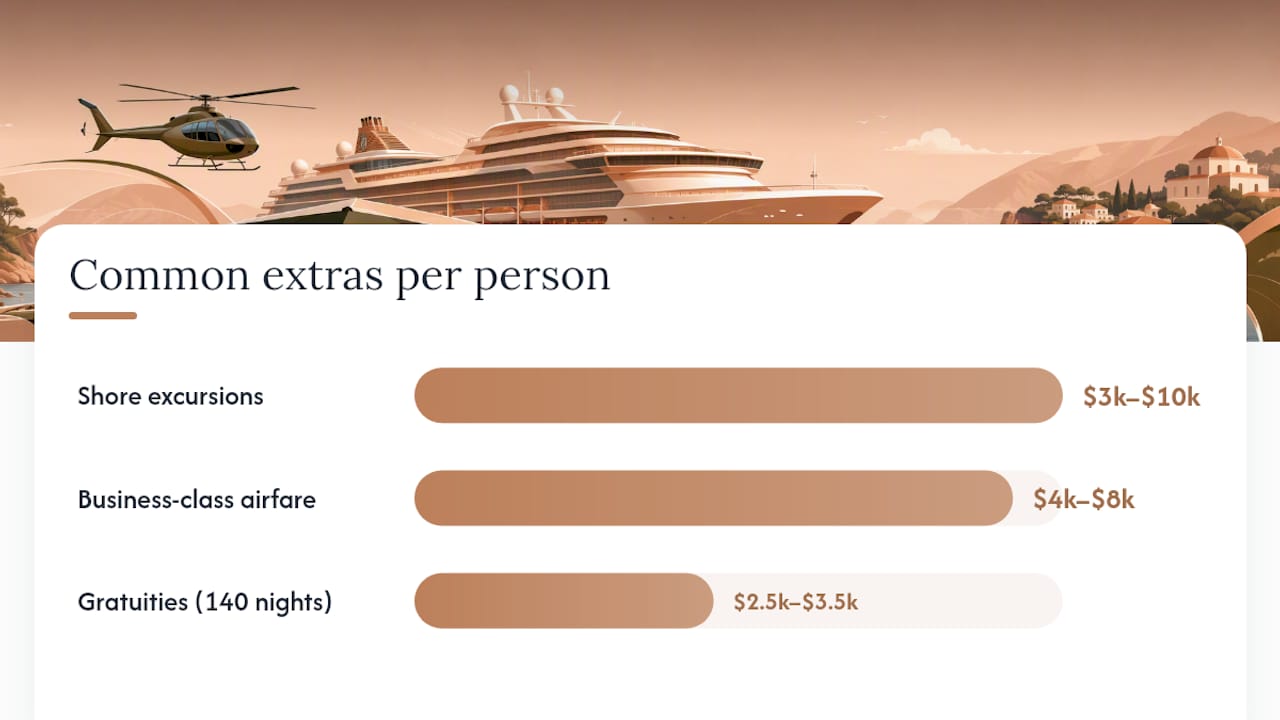
Pro Tip: Ask your planner for the line’s exact gratuity policy before you book. Some lines fold gratuities into the fare; others charge $18–$25 per person, per day, on top of everything else. Over 140 nights, that alone is $2,500 to $3,500 you didn’t see in the sticker price.
The dollar amounts on these “extras” are not trivial. Aggregate shore excursions across a full world cruise, if you’re doing private or premium tours rather than ship-organized group outings, commonly run $3,000 to $10,000 or more per person. Business-class airfare, if it isn’t bundled into your fare, typically adds another $4,000 to $8,000 per person for the long-haul segments most world cruises require. Travel insurance for extended voyages generally costs more than standard policies designed for shorter cruises, reflecting the higher coverage requirements for long durations.
The inclusion gap between tiers is the real story here, and it’s worth understanding before you compare two fares side by side. A mainstream fare that looks like a bargain against a premium fare can flip once you price out everything the premium line bundles in that the mainstream line charges for separately. Some ultra-luxury lines go further still, including round-trip business-class flights and nearly every shore excursion, which is why their headline fares look shocking until you realize there’s almost nothing left to add.
How Do You Calculate the Real Cost of a World Cruise?
The cleanest way to compare two very different-looking fares is to convert both to a per-night, all-inclusive figure. Take the base fare, divide by the number of nights, then layer in your estimated extras divided the same way. A $100,000 fare over 140 nights comes out to about $714 per person per night before extras. That’s the number that actually tells you what you’re paying for, because it strips away the psychological effect of a scary-looking total.
Here’s how that math plays out across three realistic scenarios:
Scenario 1: Mainstream, 120 nights. Base fares in the lower tens of thousands per person may see additional costs added for excursions, gratuities, airfare, insurance, Wi-Fi, and incidentals, which combined can roughly double the total cost, equating to several hundred dollars per night.
Scenario 2: Premium, 150 nights. Base fare $60,000 per person, with a beverage package and a handful of excursions already bundled. Add $6,000 for additional private excursions, $3,000 for specialty dining and spa, $6,000 for business-class airfare, and $2,500 for insurance and incidentals. Total: roughly $77,500 per person, or about $517 per night.
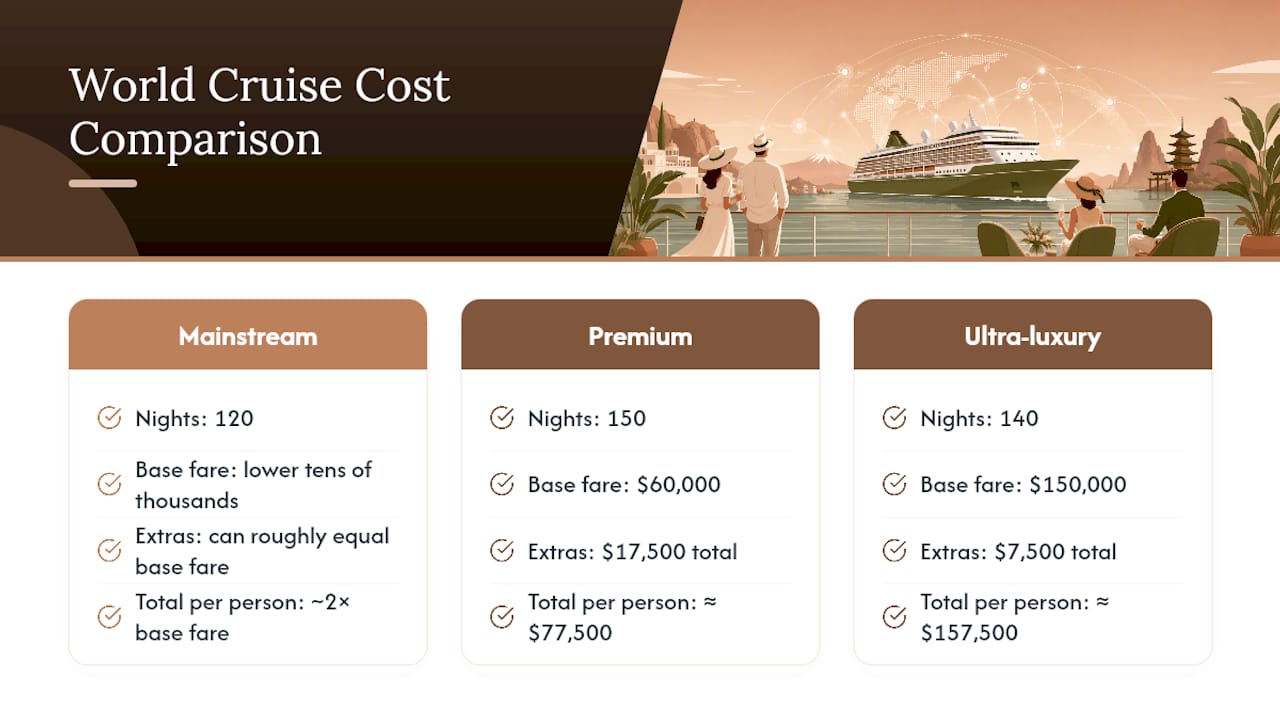
Scenario 3: Ultra-luxury, 140 nights. Base fare $150,000 per person, with flights, most excursions, and beverages bundled. Add $3,000 for the rare non-included private experience, $1,000 for spa treatments beyond the included allowance, and $3,500 for a higher-coverage insurance policy given the fare’s insured value. Total: roughly $157,500 per person, or about $1,125 per night.
Notice how the extras shrink as a percentage of total spend as you move up the tiers. That’s the real trade-off: mainstream fares look cheaper, but a larger share of your final bill shows up after you’ve already booked. Ultra-luxury fares look intimidating, but they’re closer to the true number from day one.
How Can You Reduce World Cruise Costs Without Losing Quality?
Cutting cost on a world cruise doesn’t have to mean cutting comfort. The highest-leverage moves happen before you book, not after.
- Book at launch. Fares almost always rise as departure approaches, and launch pricing frequently includes bonus incentives like onboard credit, included flights, or a bundled excursion package that can be worth several thousand dollars.
- Lock in bundled inclusions early, particularly flights and excursion packages, since these are the line items most likely to disappear or reprice once a sailing nears capacity.
- Book a segment instead of the full circumnavigation if your schedule allows. A 30 to 45 night segment covering the portion of the world you actually want to see can cost a fraction of the full fare while delivering the same onboard experience.
- Let an agency negotiate supplier bundling. Cabin category upgrades, onboard credit, and amenity packages are often available through supplier relationships that aren’t advertised on the public fare page.
- Consider timing flexibility and home arbitrage. Departing during shoulder season, or renting out your primary residence for the 4 to 6 months you’re away, can meaningfully offset the fare for travelers with the right property situation.
Pro Tip: Early-booking incentives aren’t just marketing fluff. Onboard credit, included flights, and bundled excursions can genuinely offset a higher headline fare on a premium or ultra-luxury sailing, sometimes by $5,000 or more per person.
When Should You Book and What Should Your Budget Checklist Include?
World cruise fares typically launch 18 to 24 months before departure, and the best cabin categories, especially suites and preferred locations on ultra-luxury ships, sell out well ahead of the sailing date. If a specific cabin type or itinerary matters to you, book inside that launch window rather than waiting for a “sale” that may never materialize on the categories you actually want.
Before you commit, run through this checklist with estimated ranges for each line item:
- Port taxes and government fees: usually $500–$1,500 per person, sometimes included in the quoted fare
- Airfare: $2,000 (economy) to $8,000 (business class) per person if not bundled
- Shore excursions: $3,000–$10,000+ depending on how many private tours you add
- Visa fees: $200–$600 per person depending on itinerary and passport
- Travel insurance: $2,000–$6,000+ per person for a long-voyage, high-coverage policy
- Gratuities: $2,500–$3,500 per person over a 130 to 150 night voyage
- Pre/post-cruise hotels: $300–$800 per night depending on port city
Three action items worth doing before you sign anything: confirm in writing exactly which excursions and amenities are bundled into your specific cabin category, get an authoritative airfare quote rather than estimating from memory, and check that your insurance policy actually covers a voyage of this length and value, since many standard travel policies cap coverage well below what a 4 to 6 month trip requires.
Why a Bespoke Agency Changes the World Cruise Cost Equation
Michael has spent years watching affluent travelers get blindsided by the gap between a headline fare and a final invoice. The pattern is consistent: the surprises aren’t random, they’re predictable, and they cluster around the same handful of line items every time. That’s exactly where a bespoke planning relationship earns its keep.
Some luxury travel agencies focus on securing bundled inclusions before they disappear, coordinating pre- and post-cruise logistics so nothing falls through the cracks, and steering clients toward insurance coverage sized correctly for a voyage that can run five figures deep in insured value. On a trip this long, the difference between a policy that actually covers you and one that technically checks a box can be the single most consequential decision in the entire budget.
An Honest Take on World Cruise Budgeting
Most advice on this topic treats the headline fare as the number that matters. It isn’t. The number that matters is the per-night, fully-loaded figure, because that’s the only version that lets you compare a 110 night mainstream sailing against a 160 night ultra-luxury one without getting fooled by scale.
The conventional wisdom also underrates how much early booking actually saves. Travelers fixate on the fare category and skip past the incentive structure, which is often where the real value sits. If you take one thing from this article, prioritize getting your inclusion list in writing before you compare two fares. A cheaper number with more exclusions can easily out-cost a higher one that’s already bundled. Do that math first. Everything else is arithmetic.
— Michael
Planning a World Cruise? Here’s Where to Start
A do-it-yourself approach to booking a world cruise means juggling a dozen supplier relationships, chasing down which excursions are actually included, and hoping your insurance policy covers a trip worth six figures. Hiddendoortravel exists so you don’t have to do that math alone. As a luxury travel agency, the firm builds bespoke itineraries, negotiates directly with cruise line suppliers for bundled inclusions and cabin upgrades, and helps you convert a headline fare into a firm, itemized total before you sign anything.

When you reach out to a luxury travel agency, expect a planning conversation first: your priority ports, your cabin preferences, and your real budget ceiling, not just the number on the brochure. From there, the agency handles supplier negotiation, flight and excursion bundling, and coordination with appropriate long-voyage insurance coverage. If you’re ready to see what a world cruise would actually cost for your specific itinerary, start with Hiddendoortravel’s luxury travel experts and get a real number instead of a launch-fare estimate.
Where These World Cruise Cost Figures Came From
Fare ranges and tier examples in this article draw from Wise’s world cruise cost breakdown, Aeria Voyages’ 2026 fare analysis, The Points Guy’s duration and itinerary reporting, Travel Arbitrage’s 2026 price comparison, and GoCruiseTravel’s extras and insurance guide. For inclusion differences by tier, see Hiddendoortravel’s guide on why luxury cruises differ from mainstream and its luxury cruise travel insurance guide.
Sources
- How much does a world cruise cost? – Wise
- Around the world cruises – The Points Guy
- 2026 World Cruise Price Comparison: From $699/Person to $550K/Cabin – Travel Arbitrage
- Around the world by sea: world cruise guide 2026 – GoCruiseTravel