
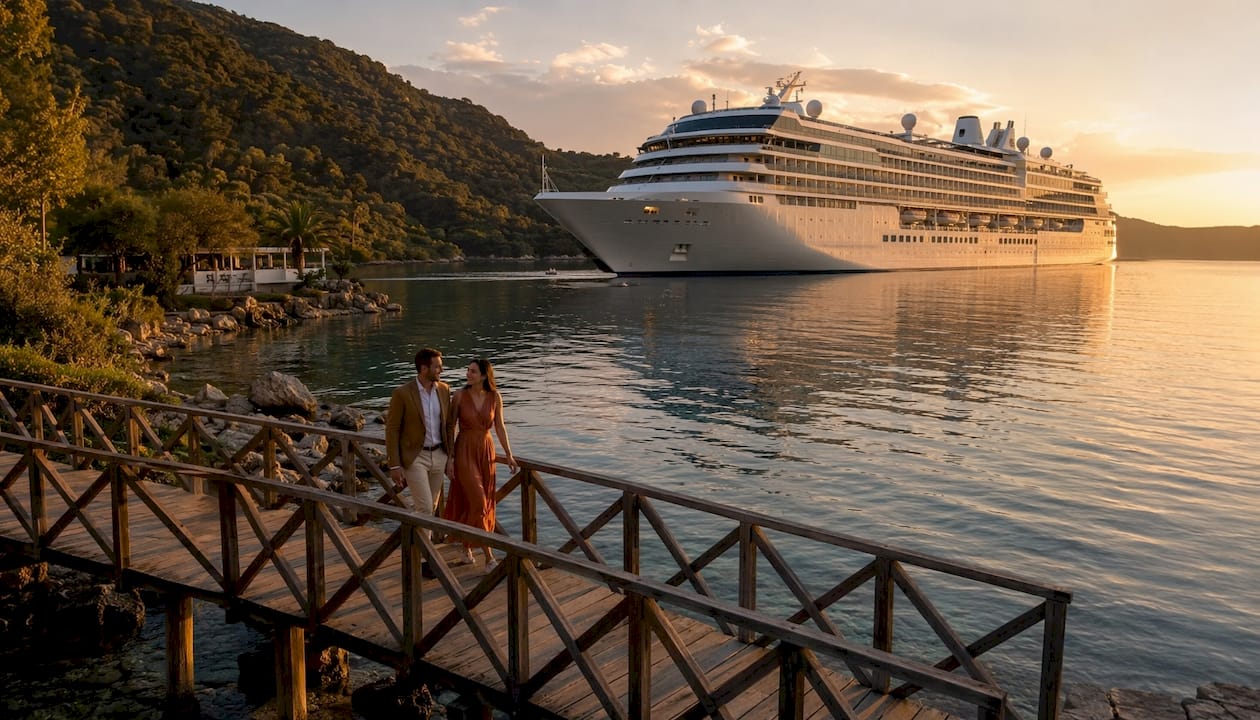
Luxury cruises are a fundamentally different vacation style — smaller ships, higher service density, and broader fare inclusions — not simply a pricier version of what Royal Caribbean or Carnival offers. If you want a floating resort with water parks, Broadway shows, and a lively crowd of 5,000, mainstream is the right call. If you want quiet mornings on a pool deck that isn’t packed by 8 AM, a butler who remembers your drink order, and a fare that already covers your wine at dinner, read on.
The three differences that matter most before you book:
- Ship scale and personal space: Mainstream ships carry thousands of guests; luxury ships typically carry several hundred. That gap shows up in every queue, every elevator, every pool chair.
- Service density and personalization: Mainstream lines run roughly 2.5:1–3:1 guest-to-crew; luxury lines run closer to 1.3:1–1.5:1. The ratio is the mechanism behind anticipatory service.
- Inclusions and real all-in cost: Luxury fares bundle drinks, gratuities, specialty dining, and Wi-Fi. Once you add those same items to a mainstream base fare, the actual price gap narrows to roughly 2.4× rather than the five-times difference the sticker prices suggest.
Table of Contents
- How the cruise industry categorizes ships and lines
- How ship size and cabin space change your daily experience
- What higher service density actually buys you onboard
- How dining, drinks, and onboard amenities differ across segments
- Why luxury lines can reach different ports and stay longer
- What to expect from entertainment, activities, and onboard energy
- How to compare price: the apples-to-apples checklist
- Who benefits most from luxury vs. mainstream cruising
- Why luxury feels different and when to use an agency
- Key Takeaways
- An advisor’s perspective on booking the right style
- Useful sources for deeper research
How the cruise industry categorizes ships and lines
The cruise market breaks into four tiers, and the structural differences between them are more significant than the marketing language implies.
Mainstream lines like Royal Caribbean, Carnival Cruise Line, Norwegian Cruise Line, and Princess Cruises operate mega-ships carrying 3,000–7,000 guests. Fares are base-priced with most amenities sold separately: drinks packages, specialty restaurants, Wi-Fi, gratuities, and shore excursions all appear as line items at checkout or onboard. The model is built for volume and variety, and it delivers both.
Premium lines sit one tier up. They offer slightly smaller ships, better base cabin quality, and sometimes a few more inclusions in the fare, but the upsell structure is still present. Think of it as mainstream with a quieter tone.
Luxury lines, including Viking Ocean Cruises and Silversea, typically carry several hundred guests and shift toward a more inclusive fare model. Drinks, gratuities, and specialty dining are often bundled. Ships are smaller, public spaces feel less crowded, and the onboard pace slows noticeably.
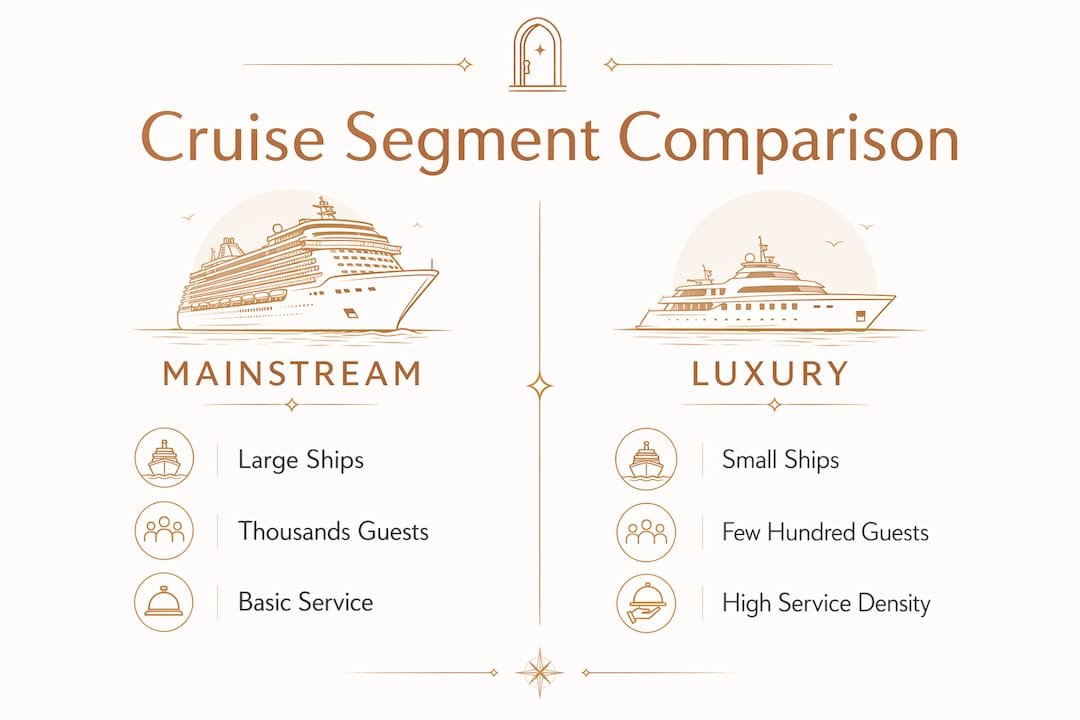
Ultra-luxury lines, including Regent Seven Seas Cruises and Seabourn, carry a few hundred guests and operate the most inclusive fare structures in the industry. Regent, for example, includes shore excursions in many fares. Seabourn includes alcohol, soft drinks, gratuities, and premium coffee. Cabins are all-suite. The experience is closer to a boutique hotel at sea than a resort ship.
A few practical notes on inclusions:
- “All-inclusive” means different things across lines — always read the fine print on shore excursions, specialty restaurants, and premium spirits.
- Mainstream lines frequently run promotions that bundle drinks or Wi-Fi, which can shift the value calculation.
- Upper-premium lines can sometimes be only 30–80% more than a fully loaded mainstream cruise and deliver much of what travelers want from luxury without the ultra-luxury price.
How ship size and cabin space change your daily experience
The physical scale of a ship is the single most underestimated variable in cruise planning. It shapes everything from how long you wait for an elevator to whether you can find a quiet corner at 3 PM.
| Dimension | Mainstream | Premium | Luxury | Ultra-Luxury |
|---|---|---|---|---|
| Passenger capacity | thousands | mid-thousands | several hundred | a few hundred |
| Ship size | Very large to mega | Large | Mid-size | Small/boutique |
| Cabin types | Inside, oceanview, balcony, suite | Oceanview to suite | Mostly balcony/suite | All-suite |
| Onboard atmosphere | High-energy, resort-style | Moderate energy | Calm, social | Quiet, boutique hotel |
| Guest profile | Families, groups, first-timers | Mixed, couples and families | Couples, experienced travelers | Couples, frequent luxury cruisers |
Cabin size differences are real and consequential. Mainstream balcony cabins typically run over 150 square feet. Luxury suite categories start larger and often include well-sized private verandas. On ultra-luxury ships, every cabin is a suite by definition.
What that space buys you in practice:
- No competition for pool loungers at sunrise on a 600-guest ship.
- No 20-minute elevator waits after a port return on a busy sea day.
- Quiet areas that stay quiet, because there simply aren’t enough people to fill every corner.
- Private outdoor space where a conversation doesn’t require lowering your voice.
The onboard atmosphere follows directly from the numbers. Mainstream ships are designed for stimulation: atriums, water slides, multiple entertainment decks, and constant programming. Ultra-luxury ships feel like boutique hotels at sea — understated, muted, and deliberately unhurried, as one experienced traveler described them. Neither is wrong. They are different products for different moods.
What higher service density actually buys you onboard
The guest-to-crew ratio is the clearest operational signal of what a line has decided to prioritize. Mainstream lines typically operate at 2.5:1–3:1; luxury and ultra-luxury lines run closer to 1.3:1–1.5:1, with some ultra-luxury ships approaching 1:1. That ratio isn’t just a marketing number — it determines whether a crew member has time to learn your name, remember your preferences, and act on them without being asked.
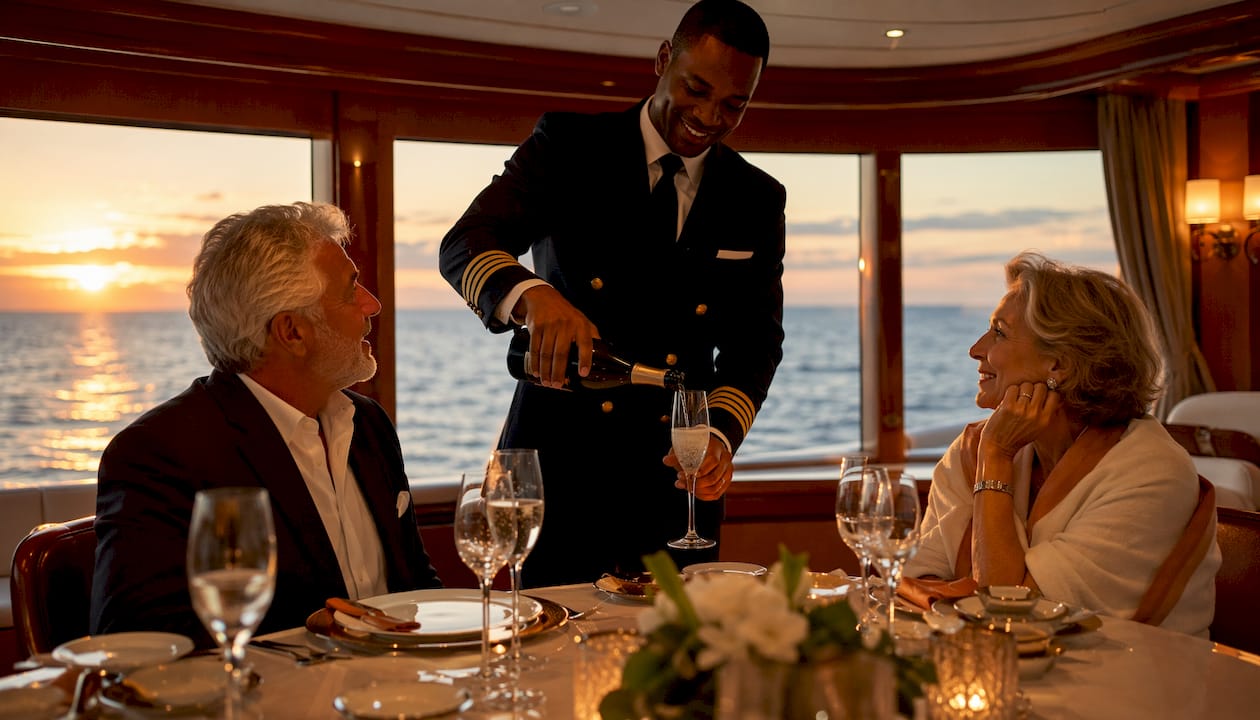
On Seabourn, for example, Personal Suite Hosts clean suites twice daily and stock the minibar to your preferences. Bartenders memorize regular orders. Servers track dietary restrictions across multiple meals without being reminded. That level of attentiveness is operationally impossible when one crew member is responsible for three times as many guests.
Concrete service differences you’ll notice:
- Butler or suite host service included in most luxury and ultra-luxury categories, versus a fee-based concierge on mainstream ships.
- Priority embarkation and disembarkation on smaller ships, where the process takes minutes rather than the better part of an hour.
- In-suite dining at the same quality as the main restaurant, not a limited room-service menu.
- Crew who use your name across departments — a small thing that changes the feel of every interaction.
- Faster table service in restaurants, because the kitchen is serving hundreds rather than thousands simultaneously.
One nuance worth naming: personalization can tip into intrusive if it isn’t calibrated well. The best luxury lines train staff to read when guests want conversation and when they want to be left alone. That judgment is part of what the service ratio makes possible.
Pro Tip: When comparing service levels, ask the line or your advisor for the guest-to-crew ratio for your specific ship, not the fleet average. Ratios vary within a brand.
How dining, drinks, and onboard amenities differ across segments
Food is where the difference between luxury and mainstream becomes visceral rather than statistical. Mainstream dining is impressive at scale — thousands of meals served efficiently — but the kitchen constraints are real. Dishes are batch-cooked, menus are tightened to manage cost, and premium items like lobster or steak often carry a surcharge even in specialty restaurants.
On luxury and ultra-luxury ships, the kitchen is serving a few hundred guests. Menus are larger, more dishes are cooked to order, and there are no surcharges for premium proteins. Ingredients skew toward higher quality across the board — the fruit at breakfast, the cuts of meat, the wine poured by the glass. Unlimited caviar delivered anywhere on the ship is a Seabourn signature, not a marketing line.
| Inclusion | Mainstream (base fare) | Premium | Luxury | Ultra-Luxury |
|---|---|---|---|---|
| Specialty dining | Extra charge | Partial/extra | Often included | Included |
| Alcoholic drinks | Extra charge | Partial packages | Included | Included |
| Wi-Fi | Extra charge | Extra charge | Often included | Included |
| Gratuities | Extra charge | Extra charge | Often included | Included |
| Shore excursions | Extra charge | Extra charge | Varies | Often included (Regent) |
| Premium coffee/tea | Extra charge | Varies | Included | Included |
For a deeper breakdown of what “all-inclusive” actually covers on different lines, the all-inclusive cruise guide from Hiddendoortravel is worth reading before you book.
Amenity differences beyond dining:
- Luxury ships offer multiple specialty restaurants with no cover charge, versus mainstream lines where specialty venues are a significant additional spend.
- Spa facilities on luxury ships tend to be quieter and less commercialized; the hard sell for products and upgrades is less aggressive.
- Enrichment programming (guest lecturers, culinary demonstrations, destination talks) is a luxury-line staple; mainstream ships prioritize entertainment volume over depth.
- Fitness facilities are proportionally similar, but the crowd factor on mainstream ships makes peak-hour use frustrating.
One marketing trap to watch: “all-inclusive” on a mainstream line during a promotional period may cover drinks and Wi-Fi but exclude gratuities, specialty dining, and excursions. Read the specific fare terms, not the headline.
The tactile quality of the cabin itself also reflects the tier. Bedding, linens, and soft furnishings on luxury ships align with what hospitality industry leaders identify as premium textile standards for high-end spaces — a detail important for an upscale hotel-like experience.
Why luxury lines can reach different ports and stay longer
Ship size is the primary constraint on where a cruise ship can go. A 7,000-passenger mega-ship needs a large commercial port with deep-water berths, significant infrastructure, and the capacity to process thousands of guests simultaneously. That requirement limits the itinerary to the same high-volume ports that every other mega-ship visits: Nassau, Cozumel, Juneau, Santorini in summer.
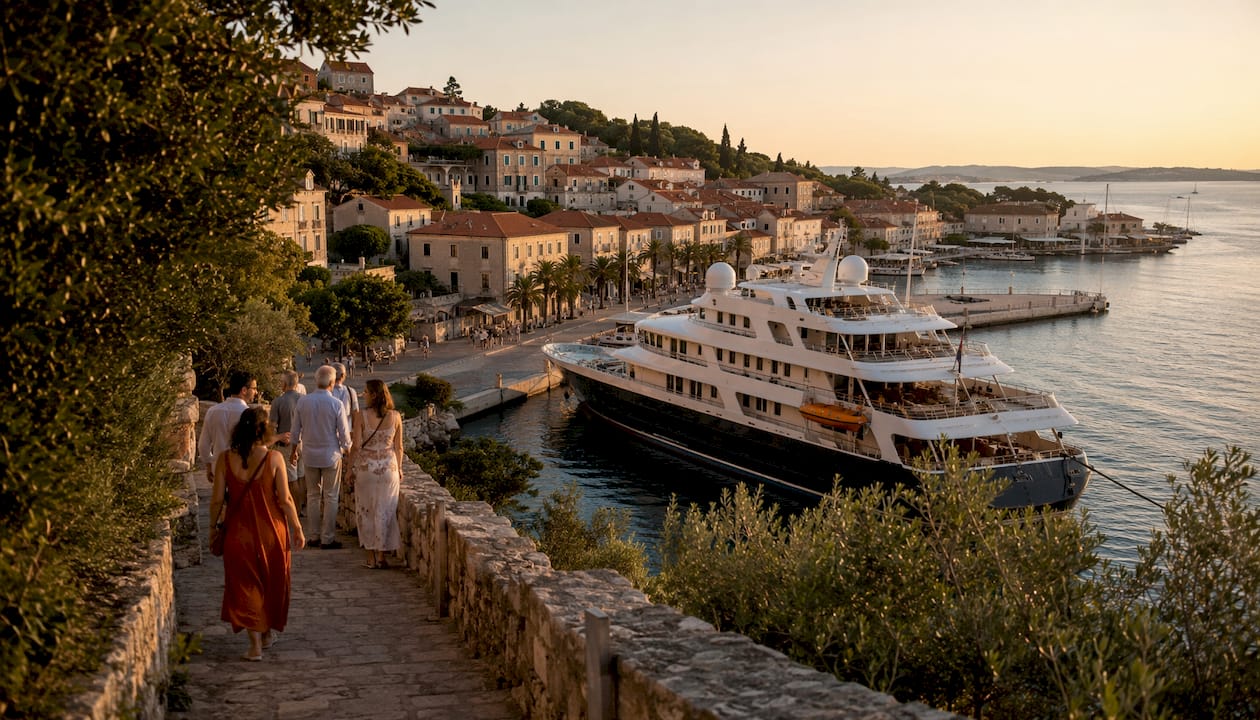
A 600-passenger luxury ship can dock in the heart of a historic city while the mega-ships anchor at the container port miles away. It can call at St. Barts, which simply cannot handle the passenger volumes of large mainstream ships. It can anchor in a small bay on a Greek island and tender guests ashore before the day-trippers arrive.
Luxury ships prioritize smaller, destination-focused ports, while mainstream ships function more as floating resorts with repeatable, high-volume itineraries. That’s not a criticism of mainstream — it’s a structural reality.
Itinerary differences that matter to destination-led travelers:
- Longer port stays, sometimes overnight, allowing evening exploration and dinner ashore.
- Earlier arrivals that beat the cruise-ship crowds at popular sites.
- Expedition-style calls — Zodiac landings, kayaking alongside glaciers, wildlife approaches — that are only possible on smaller vessels.
- Fewer sea days on port-intensive itineraries, because smaller ships can access more stops along a route.
- Access to expedition cruise destinations that mega-ships cannot physically reach.
Smaller ships often arrive earlier or stay later in port, which meaningfully improves shore time and reduces the experience of sharing a site with thousands of other visitors. For travelers whose primary motivation is the destination rather than the ship, that timing difference is often the deciding factor.
A practical planning note: even on luxury lines, some excursions carry an additional charge. Regent Seven Seas includes a broad range of tours in many fares; Seabourn’s standard excursions are extra, though its Ventures by Seabourn small-group expeditions are available as an add-on. Confirm the excursion model for your specific sailing before you budget.
What to expect from entertainment, activities, and onboard energy
The onboard tempo is where traveler expectations most often diverge from reality — in both directions. People who book luxury expecting a quieter version of mainstream are sometimes surprised by how much quieter it actually is. People who book mainstream expecting the energy of a Vegas resort are sometimes surprised by how much they enjoy it.
Mainstream entertainment contrasts with luxury in almost every dimension:
- Mainstream: Broadway-scale production shows with aerial acts and acrobatics, water parks, casinos, karaoke, bingo, themed pool parties, comedy clubs, and 80+ scheduled activities per day.
- Luxury/Ultra-luxury: Intimate evening performances (four to six singers and dancers), enrichment lectures, trivia, live music in smaller venues, craft classes, and destination talks. Evenings center on dining and conversation rather than performance.
The guest profile shapes the energy as much as the programming does. Mainstream ships on school-holiday sailings are genuinely family-oriented environments — kids’ clubs for multiple age bands, family cabins, and programming designed for multi-generational groups. Royal Caribbean’s Adventure Ocean and Carnival’s Camp Ocean are well-structured programs that families with children value highly.
Luxury ships are not technically adults-only in most cases, but the absence of kids’ programming makes them functionally adult environments. Seabourn, Silversea, Regent Seven Seas, and Viking Ocean Cruises don’t offer dedicated children’s facilities. Viking is explicitly adults-only. Oceania is adults-only. Parents who bring young children to these ships will find their kids bored and themselves apologizing.
A few things that surprised first-time luxury cruisers: the bars stay open as long as guests want them to, the crowd knows how to socialize, and trivia is just as competitive as on any mainstream ship. The difference is atmosphere and scale, not whether people are having fun.
For families with children, mainstream lines offer better variety, more cabin types, and entertainment suited to multi-generational groups. That’s not a knock on luxury — it’s a fit question.
How to compare price: the apples-to-apples checklist
The sticker-price gap between mainstream and luxury looks enormous until you model what you’d actually spend. A mainstream balcony cabin at $150 per person per night becomes a very different number once you add the items a luxury fare already includes.
The full cost checklist — apply it to every sailing you compare:
- Base fare (per person, per night)
- Taxes and port fees
- Gratuities (daily service charge per person)
- Drinks package or realistic per-day bar spend
- Specialty dining (number of meals × cover charge)
- Wi-Fi (per device, per day or per voyage)
- Shore excursions (per port, per person)
- Transfers (port to hotel and back)
- Flights and pre/post-cruise hotel nights
- Travel insurance
- Incidental spending (spa, casino, photos, paid attractions)
What luxury fares typically include vs. mainstream:
- Luxury/ultra-luxury: drinks, gratuities, specialty dining, Wi-Fi, premium coffee, and sometimes shore excursions — all bundled.
- Mainstream: base fare covers the cabin, main dining, and core entertainment. Everything else is a separate purchase.
Experts consistently advise comparing total cost rather than advertised base fares to reach an honest value comparison. When couples who would have purchased drinks, specialty dining, Wi-Fi, and excursions on a mainstream cruise run the full math, the luxury fare often looks more compelling than the headline prices suggest.
The worked math: a mainstream balcony cabin at $150 per person per night, plus $35 for drinks, $20 for gratuities, $15 for Wi-Fi, and $50 for excursions, reaches roughly $270 per person per night all-in. A luxury fare at $600 per person per night with drinks, gratuities, Wi-Fi, and specialty dining included represents a real-world gap closer to 2.4× rather than the four-to-five times difference the base fares imply.
Pro Tip: Model your realistic per-day mainstream spend before comparing to a luxury fare. Most travelers underestimate their drinks and excursion costs by 30–40%, which compresses the apparent gap significantly.
Upper-premium lines offer a useful middle ground. They can run 30–80% more than a fully loaded mainstream cruise while delivering most of what travelers want from luxury: smaller ships, better service ratios, and more inclusions. If the ultra-luxury price feels out of reach, that tier is worth pricing before you default to mainstream.
Who benefits most from luxury vs. mainstream cruising
The right choice depends on what you’re actually optimizing for. Work through this before you book.
-
What is your primary motivation for the trip? If the ship itself is the destination — the water park, the shows, the variety — mainstream delivers. If the ports and destinations are the point, luxury’s itinerary access and longer port stays matter more.
-
Who is traveling with you? Families with children under 16 will find mainstream lines far better equipped. Couples, solo travelers, and empty-nesters typically find luxury’s quieter environment more restorative.
-
How do you feel about upcharges? If the idea of tracking what’s included versus extra throughout a vacation is annoying, an inclusive luxury fare removes that friction entirely.
-
What’s your onboard tempo preference? Do you want constant programming and late-night energy, or do you want to read on a quiet deck and have a long dinner? Be honest — neither preference is wrong, but booking the wrong tempo is a common source of disappointment.
-
How important is culinary quality? If food is central to your vacation enjoyment, the difference in ingredient quality, menu size, and cooking-to-order on luxury ships is significant.
-
Do you want access to smaller or remote ports? If your bucket list includes St. Barts, the Norwegian fjords by tender, or expedition landings in Antarctica, ship size becomes a practical constraint, not a preference.
-
What’s your budget elasticity? If the all-in luxury fare is genuinely out of reach, price an upper-premium line before deciding. The gap from mainstream to upper-premium is often smaller than people expect.
Red flags indicating a mismatch:
- Booking a luxury sailing for a large, loud family reunion where half the group wants late-night nightlife and kids’ programming.
- Booking mainstream expecting quiet, no upcharges, and a destination-focused itinerary.
- Choosing ultra-luxury for a first cruise without understanding that the entertainment model is deliberately understated.
- Assuming “all-inclusive” on any line covers shore excursions without confirming it for your specific sailing.
For help matching an itinerary to your travel style, Hiddendoortravel’s planning resources walk through the decision in detail.
Why luxury feels different and when to use an agency
The experiential gap between luxury and mainstream isn’t primarily about amenities. It’s about friction. On a 5,000-passenger ship, friction is everywhere: queues, noise, competition for space, and a constant stream of upsell opportunities. On a 600-passenger luxury ship, most of that friction is designed out. No queue for a restaurant table. No card to present at the bar. No daily calculation of what’s included.
That reduction in friction is what travelers are paying for, more than any specific amenity. The caviar is a symbol of it, not the substance.
Practical trade-offs to weigh honestly:
- Luxury ships have fewer large-scale entertainment options. If you want acrobatics, a casino, and a water slide, you won’t find them.
- Mainstream ships offer more cabin-type variety, including affordable inside cabins that make cruising accessible at lower price points.
- Ultra-luxury ships are less tech-forward. Regent has operated without a dedicated app; Silversea’s digital tools are limited. For travelers who prefer a phone-free vacation, that’s a feature. For those who rely on apps to manage their day, it’s an adjustment.
- Visiting smaller or fragile ports carries a responsibility. Luxury lines that call at remote or ecologically sensitive destinations increasingly work with local operators to minimize impact — an important consideration when choosing expedition itineraries.
When working with an agency makes a material difference:
An agency adds the most value when the itinerary is complex, the inclusions language is ambiguous, or the shore experience needs to be bespoke. Parsing whether a specific Regent fare includes the excursions you actually want, or arranging a private guide in a port that a luxury ship visits for only six hours, requires the kind of bespoke shore experience expertise that a booking engine cannot provide.
Hiddendoortravel specializes in exactly this: reading the fine print on fare inclusions, designing shore programs that complement a luxury itinerary, and matching travelers to the right tier and line for their specific travel goals. The luxury travel agency team works with clients who know what they want but need someone who knows how to get it.
Key Takeaways
Luxury cruises are a distinct vacation style built around smaller ships, higher service density, and inclusive fares — not a premium version of the mainstream resort-at-sea model.
| Point | Details |
|---|---|
| Ship scale drives everything | Luxury ships carry 400–1,250 guests vs. 3,000–7,000 on mainstream, eliminating queues and crowding. |
| Service ratio is the mechanism | Luxury lines run 1.3:1–1.5:1 guest-to-crew vs. 2.5:1–3:1 on mainstream, enabling anticipatory, personalized service. |
| The real price gap is 2.4×, not 5× | Once mainstream add-ons are modeled, the all-in cost gap narrows to roughly 2.4× rather than the sticker-price difference. |
| Port access depends on ship size | Smaller luxury ships reach ports and timing that mega-ships physically cannot, which matters most to destination-led travelers. |
| Fit beats price as the decision rule | Families with children, travelers who want high-energy entertainment, and those on tighter budgets are often better served by mainstream lines. |
An advisor’s perspective on booking the right style
The most common mistake I see is travelers choosing a cruise tier based on price alone, in either direction. Someone books mainstream to save money and spends the whole trip frustrated by upcharges they didn’t anticipate. Someone else books ultra-luxury expecting perfection and is genuinely surprised that the evening show is four singers rather than a full production cast.
The fit question matters more than the budget question, and the two are related but not the same.
For an anniversary trip where the couple wants to feel genuinely looked after — not just adequately served — luxury is almost always the right call. The difference between a butler who stocks your minibar to your preferences and a room steward who does a competent daily clean is the difference between feeling like a guest and feeling like a passenger. That distinction is worth real money to the right traveler.
For a family holiday with kids under 12, mainstream wins on almost every dimension. The programming, the cabin variety, the onboard energy — it’s designed for exactly that group. Booking a luxury ship for that trip would be expensive and frustrating for everyone.
For a solo enrichment trip — someone who wants to learn, explore serious destinations, and have real conversations with fellow travelers — upper-premium or luxury lines tend to attract a more experienced, curious traveler profile. The enrichment lectures are better attended, the dinner conversations go deeper, and the ports are more interesting.
On timing: the best upgrade opportunities and promotional windows on luxury lines tend to appear 90–120 days before sailing, when unsold suite inventory gets discounted. Booking early secures the cabin category you want; watching for late promotions can improve it. An experienced advisor tracks both.
Useful sources for deeper research
These are the primary sources behind this article, organized by what each does best.
- GoCruiseTravel — Is a Luxury Cruise Actually Worth It? — The most thorough cost-math breakdown available, including the 2.4× real-world gap calculation. Start here if pricing is your primary question.
- GoCruiseTravel — Luxury vs. Mainstream Cruise Lines — Covers crew-to-guest ratio bands and the upper-premium bridge option in useful detail.
- Voyager Info — Mainstream vs. Luxury Cruises — Good on passenger capacity ranges and the port-access and timing advantages of smaller ships.
- TravelPulse — Destination immersion framing and the total-cost comparison methodology; useful for itinerary-focused research.
- CruiseTidbit — The Ultimate Cruise Lines Guide — Practical inclusion structures across lines; useful for checking what a specific fare model covers.
- IneedMyVacation — Luxury vs Standard — Best source for the family-travel and mainstream-variety argument.
- Hiddendoortravel — Why luxury travelers choose agencies — For travelers considering agency support for complex luxury itineraries or bespoke shore arrangements.