
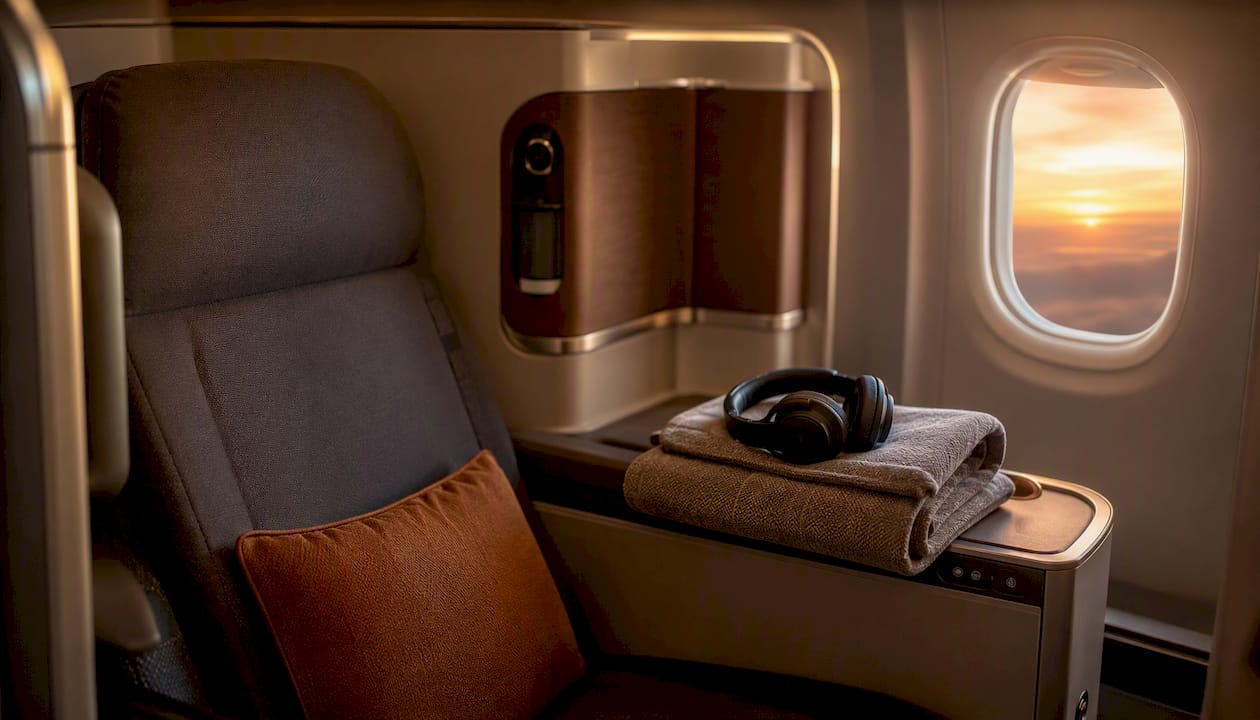
Qatar Airways Qsuite is the current benchmark for business class worldwide, recognized by Skytrax as the World’s Best Business Class for the ninth consecutive year. If you want the ranked shortlist immediately, it starts below. If you want to understand why one airline beats another for your specific route, priorities, and budget, the sections that follow will give you a more useful answer than any single ranking can.
The carriers worth knowing before you book:
- Qatar Airways (Qsuite, double beds, full doors)
- Singapore Airlines (Business Class Suites, exceptional consistency)
- All Nippon Airways / ANA (The Room, widest enclosed suite in the sky)
- Japan Airlines / JAL (JAL Sky Suite, outstanding soft product)
- Emirates (Business Class on A380 and 777, strong lounge network)
- Etihad Airways (Business Studio, improving hard product)
- Cathay Pacific (Business Class, reverse-herringbone with direct aisle access)
- Air France (Business Class, chef-driven dining)
- Lufthansa (Business Class, strong European hub connectivity)
- Turkish Airlines (Business Class, Istanbul hub, wide network)
- EVA Air (Royal Laurel, excellent value and soft product)
- Air Canada (Signature Suite, competitive transatlantic product)
- Delta Air Lines (Delta One Suite, best U.S.-carrier hard product)
- SWISS (Business Class, strong Zurich hub)
- Korean Air (Prestige Suite, solid Asia-Pacific option)
Pro Tip: Before you book based on airline brand alone, confirm which aircraft operates your specific flight. The same airline can fly a world-class suite on one route and a decade-old flat bed on another.
Key Takeaways
The best business class product for your trip depends on aircraft, route, and your personal priorities, not on brand rankings alone.
| Point | Details |
|---|---|
| Qatar Qsuite leads overall | Skytrax’s top-ranked business class for nine consecutive years, with the only double-bed configuration in the category. |
| Aircraft beats airline brand | The same carrier can fly two very different products; always confirm the aircraft type before booking. |
| Match product to priority | Sleep and privacy favor enclosed suites with doors; dining favors Singapore or Air France; value via points favors EVA Air or Korean Air. |
| Book early for award space | Top products on Qatar, ANA, and Singapore release in limited quantities, often 330–360 days out. |
| Hiddendoortravel adds real value | For complex multi-carrier itineraries or scarce award redemptions, the agency’s routing expertise and program knowledge secure seats that are difficult to find independently. |
Table of Contents
- 1. The Best Business Class Airlines Ranked: What Each One Delivers
- 2. How this ranking was compiled
- 3. How to choose the right business class airline for your priorities
- 4. Best business class airlines by traveler use case
- 5. How U.S. travelers can find and book the best business class seats
- 6. Key business class seat types and onboard features to recognize
- 7. Why an elite travel agency matters when booking top business class products
- 8. How business class amenities and services compare by airline
- 9. Cost vs. value: what to expect at different price levels
- 10. Customer service quality and consistency by airline
- 11. Upgrade, refund, and change policies for business class bookings
- 12. Baggage allowances and perks for business class travelers from the U.S.
- What the current business class era actually means for how you book
- Hiddendoortravel: bespoke business class booking for discerning travelers
- Sources
1. The Best Business Class Airlines Ranked: What Each One Delivers
The carriers below are ordered by overall product quality, factoring in hard product, soft product, lounge experience, and route availability from U.S. gateways. Independent reviewers with 200+ flights logged converge on a similar top tier, and this list reflects that consensus alongside Skytrax recognition.
| Airline | Hard Product | Soft Product | Lounge | U.S. Gateways | Best For | Award Note |
|---|---|---|---|---|---|---|
| Qatar Airways | Qsuite: full door, double bed, direct aisle | Outstanding dining, dine-on-demand | Al Mourjan, Doha | JFK, IAD, ORD, LAX, BOS, DFW | Privacy, couples, sleep | Skytrax #1 Business Class 2025 |
| Singapore Airlines | Enclosed suite, direct aisle, wide bed | Exceptional crew, Book the Cook | SilverKris, Changi | JFK, LAX, SFO | Consistency, dining, sleep | Skytrax top 5 |
| ANA | The Room: widest suite, full door | Attentive Japanese service | ANA Lounge, Narita/Haneda | LAX, SFO, JFK | Sleep, privacy, solo travelers | Skytrax top 5 |
| JAL | Sky Suite: direct aisle, lie-flat | Warm service, Japanese cuisine | JAL Sakura Lounge | LAX, JFK, ORD | Dining, soft product, Asia routes | Skytrax top 10 |
| Emirates | Reverse-herringbone (777), enclosed (A380) | Strong IFE, good dining | Emirates Lounge, DXB | JFK, LAX, IAH, DFW, BOS, ORD, SEA | IFE, lounge, network breadth | Skytrax top 10 |
| Cathay Pacific | Reverse-herringbone, direct aisle | Consistent crew, solid dining | The Pier, HKG | JFK, LAX, SFO, BOS | Transatlantic, Asia routing | Skytrax top 10 |
| Air France | Reverse-herringbone, direct aisle | Chef-driven menus, French wine | CDG lounges | JFK, LAX, IAD, ORD, MIA, SFO | Dining, Europe gateway | Skytrax top 10 |
| Etihad Airways | Business Studio, direct aisle | Good dining, improving consistency | Lounge & Spa, AUH | JFK, LAX, ORD, IAD | Middle East routing, value | Skytrax top 10 |
| Lufthansa | Reverse-herringbone, direct aisle | Solid service, good wine list | Senator/Business Lounge, FRA/MUC | JFK, LAX, IAD, ORD, MIA, BOS, SFO | Europe hub, reliability | Skytrax top 10 |
| Delta Air Lines | Delta One Suite: full door, direct aisle | Good dining, strong IFE | Delta Sky Club | JFK, LAX, ATL, BOS, SEA | Best U.S. carrier, transatlantic | Skytrax top 20 |
| Turkish Airlines | Reverse-herringbone, direct aisle | Wide network, good catering | CIP Lounge, IST | JFK, LAX, ORD, IAD, BOS, MIA | Network breadth, value | Skytrax top 10 |
| EVA Air | Royal Laurel: staggered, direct aisle | Excellent soft product, value | Infinity Lounge, TPE | LAX, SFO, JFK | Value, Asia routes, soft product | Skytrax top 10 |
| Air Canada | Signature Suite: full door, direct aisle | Improving dining, solid IFE | Maple Leaf Lounge | JFK, LAX, ORD, IAD, BOS, MIA | Transatlantic, North America | Skytrax top 20 |
| SWISS | Reverse-herringbone, direct aisle | Good dining, Zurich hub | SWISS Lounge, ZRH | JFK, LAX, IAD, ORD, BOS, MIA | Europe routing, reliability | Skytrax top 20 |
| Korean Air | Prestige Suite: direct aisle, lie-flat | Solid service, Korean cuisine | KAL Lounge, ICN | LAX, JFK, SFO, ATL | Asia-Pacific, value | Skytrax top 20 |
Qatar Airways Qsuite sets the hard-product ceiling. The double-bed configuration, full closing door, and quad arrangement for couples or colleagues traveling together have no direct equivalent in business class. Flights operate from JFK, IAD, ORD, LAX, BOS, and DFW, typically on Boeing 777 or A350 aircraft.
Singapore Airlines is the consistency benchmark. Book the Cook lets you pre-order from a restaurant-quality menu before departure, and the crew-to-passenger ratio keeps service genuinely attentive on long-haul sectors from JFK, LAX, and SFO.
ANA’s The Room is the widest enclosed suite currently flying in business class. The Japanese attention to detail extends from the bedding to the meal presentation, and the product is available on 777 and 787 services from LAX, SFO, and JFK.
JAL’s Sky Suite gives every passenger direct aisle access and a fully lie-flat bed. The soft product, particularly the Japanese cuisine and crew warmth, consistently outperforms carriers with comparable hard products.
Delta One Suite is the strongest U.S.-carrier option, with a full door and direct aisle access on select 767 and A330 routes. Coverage is not universal across Delta’s fleet, so confirming the aircraft matters before booking.
2. How this ranking was compiled
Rankings here draw on four evidence types, weighted in the order listed.
- Hard product (35%): Seat geometry, door or enclosure, direct aisle access, and bed length. Seat design and enclosure are the single most impactful differentiators for sleep and privacy on long-haul flights, which is why this category carries the most weight.
- Soft product (25%): Crew consistency, dining quality (dine-on-demand vs. set service), bedding, amenity kit level, and Wi-Fi.
- Route and aircraft availability (20%): Whether the flagship product actually flies from U.S. gateways, and on which aircraft. An award-winning suite that only operates on two routes from one hub scores lower here.
- Lounge and ground experience (10%): Dedicated lounge quality, chauffeur service, and fast-track access at hub airports.
- Award recognition and expert consensus (10%): Skytrax World Airline Awards provide the primary industry benchmark, supplemented by independent reviewer consensus from sources with extensive first-hand flight experience.
"Award recognition correlates with consistent product quality but does not guarantee the product on every route or aircraft. Always verify fleet and schedule before booking. The award is a starting point, not a booking confirmation.
Skytrax awards are useful precisely because they reflect traveler votes across a large sample, not a single reviewer’s opinion. Combined with seat-level reviews and aircraft-specific data, they give a reliable signal of which carriers invest consistently in their premium cabins.
3. How to choose the right business class airline for your priorities
Start with three questions before you look at any ranking.
- How long is the flight? Flights under seven hours make hard product less critical; soft product and lounge access matter more. For anything over ten hours, the seat is everything.
- What time does the flight depart? A daytime transatlantic flight changes the calculus: dining and IFE matter more than sleep geometry. A red-eye to Asia is almost entirely about the bed.
- Are you traveling solo, as a couple, or with colleagues? Qatar’s Qsuite quad configuration is purpose-built for pairs or small groups. ANA’s The Room and Singapore’s suites are better for solo travelers who want maximum privacy.
Once you have those answers, map your priority to the product:
- Sleep quality: Fully enclosed suites with doors (Qatar, ANA, Singapore, Delta One Suite on select routes). Bed length above 78 inches and a proper mattress topper separate the best from the merely adequate.
- Privacy: Door plus window seat. Qatar Qsuite and ANA The Room lead here. For couples who want to share a space, Qsuite’s double-bed configuration is unique.
- Dining: Singapore Airlines (Book the Cook), Air France (chef-curated menus), JAL (Japanese cuisine), and Turkish Airlines (wide catering variety) consistently outperform on food.
- Lounge and ground experience: Emirates (Dubai hub, extensive lounge network), Qatar (Al Mourjan Doha), Singapore (SilverKris Changi), and Cathay Pacific (The Pier, Hong Kong).
- Route convenience from the U.S.: Emirates serves the most U.S. gateways of any non-U.S. carrier. Turkish Airlines reaches the widest global network via Istanbul. For transatlantic routes specifically, Air France, Lufthansa, and SWISS offer strong frequency from multiple U.S. cities.
As One Mile at a Time documents, there is no universally best airline for every trip. Schedule and the newest aircraft on a given route often outweigh brand rankings for individual itineraries. If your choice is between a top-ranked carrier on an older aircraft and a second-tier carrier on a brand-new A350 with an enclosed suite, the A350 usually wins.
Pro Tip: Search by aircraft type, not just airline. Tools like SeatGuru and ExpertFlyer let you filter by aircraft to confirm which product you will actually sit in before you book.
4. Best business class airlines by traveler use case
- Best for sleep: ANA The Room. The widest enclosed suite in business class, combined with Japanese-quality bedding, makes this the top choice for overnight Asia routes from LAX or SFO.
- Best for privacy: Qatar Airways Qsuite. The full closing door and the option to convert center seats into a double bed give it an edge no other carrier matches in business class.
- Best for dining: Singapore Airlines. Book the Cook lets you pre-select from a curated menu days before departure. The galley execution on long-haul sectors is consistently restaurant-grade.
- Best lounge and ground experience: Emirates. The Dubai hub lounge network, combined with chauffeur service in select markets, creates a ground experience that rivals dedicated first-class terminals elsewhere.
- Best U.S. carrier: Delta Air Lines Delta One Suite. The door, direct aisle access, and improving catering put it ahead of domestic competition on transatlantic routes from JFK, LAX, and ATL.
- Best value via points: EVA Air Royal Laurel. Award space tends to be more available than on the top-tier Asian carriers, and the soft product consistently punches above its price point. Korean Air Prestige Suite is a close second for Asia-Pacific routing.
- Best for couples: Qatar Airways Qsuite. The double-bed configuration is the only business-class product that lets two passengers share a proper bed in flight.
- Best transatlantic business class: Air France on the A350 from JFK or LAX. The reverse-herringbone seat, chef-driven menus, and CDG lounge access make it the strongest European-carrier option for the crossing.
One trade-off worth flagging: carriers with outstanding hard products sometimes have thinner lounge networks at U.S. departure airports. ANA and JAL, for example, rely on partner lounges at most U.S. gateways rather than their own dedicated facilities.
5. How U.S. travelers can find and book the best business class seats
Cash vs. points: For one-off trips, cash fares on sale can be competitive, particularly on Turkish Airlines and EVA Air. For carriers like Qatar, Singapore, and ANA, points redemptions often deliver significantly better value per dollar spent, especially when you access saver-level award space. A luxury travel rewards program guide can help you identify which programs transfer to which carriers and at what ratio.
Booking windows: Award space on Qatar, Singapore, and ANA opens furthest in advance, often 330–360 days out. For cash fares, the sweet spot on transatlantic routes is typically 3–6 months before departure. Last-minute business class fares do appear, but relying on them for a specific product on a specific aircraft is a gamble.
Positioning strategies: Many of the best business-class products are not available on every flight from every U.S. city. A common approach is to position to a major hub (JFK, LAX, or ORD) on a domestic connection, then board the long-haul flight with the desired product. For Asia routes, LAX and SFO offer the most nonstop options. For Europe, JFK has the widest carrier selection.
Partner routing for points: Star Alliance (ANA, Singapore, Lufthansa, Turkish, Air Canada, EVA Air, SWISS) and SkyTeam (Air France, Korean Air, Delta) offer cross-carrier redemptions. Oneworld (Qatar, Cathay Pacific, JAL) is particularly strong for Asia and Middle East routing. Booking through a partner program sometimes unlocks better award rates than booking directly with the operating carrier.
| Route Type | Typical Cash Range (Business Class) | Points Ballpark (Round Trip) | Best Carrier Options |
|---|---|---|---|
| U.S. to Europe (transatlantic) | $3,000–$6,000 round trip | 100,000 miles and above | Air France, Lufthansa, SWISS, Turkish |
| U.S. to Middle East | $4,000–$9,000 round trip | 120,000 miles and above | Qatar, Emirates, Etihad |
| U.S. to Asia (long-haul) | $4,500–$11,000 round trip | 130,000 miles and above | ANA, Singapore, JAL, Cathay, Korean |
| U.S. to Asia (value) | $3,000–$6,000 round trip | 100,000–160,000 miles | EVA Air, Korean Air, Turkish |
Note: cash ranges reflect typical published fares and vary significantly by season, route, and booking timing. Points figures are approximate and depend on the redemption program used.
Skytrax award winners are a reliable signal of consistent quality, but they do not guarantee award availability. Checking multiple programs and booking early remains the most reliable strategy for securing the top products.
6. Key business class seat types and onboard features to recognize
Understanding seat families before you book prevents the most common disappointment in premium travel: paying for a flagship product and ending up on an older configuration.
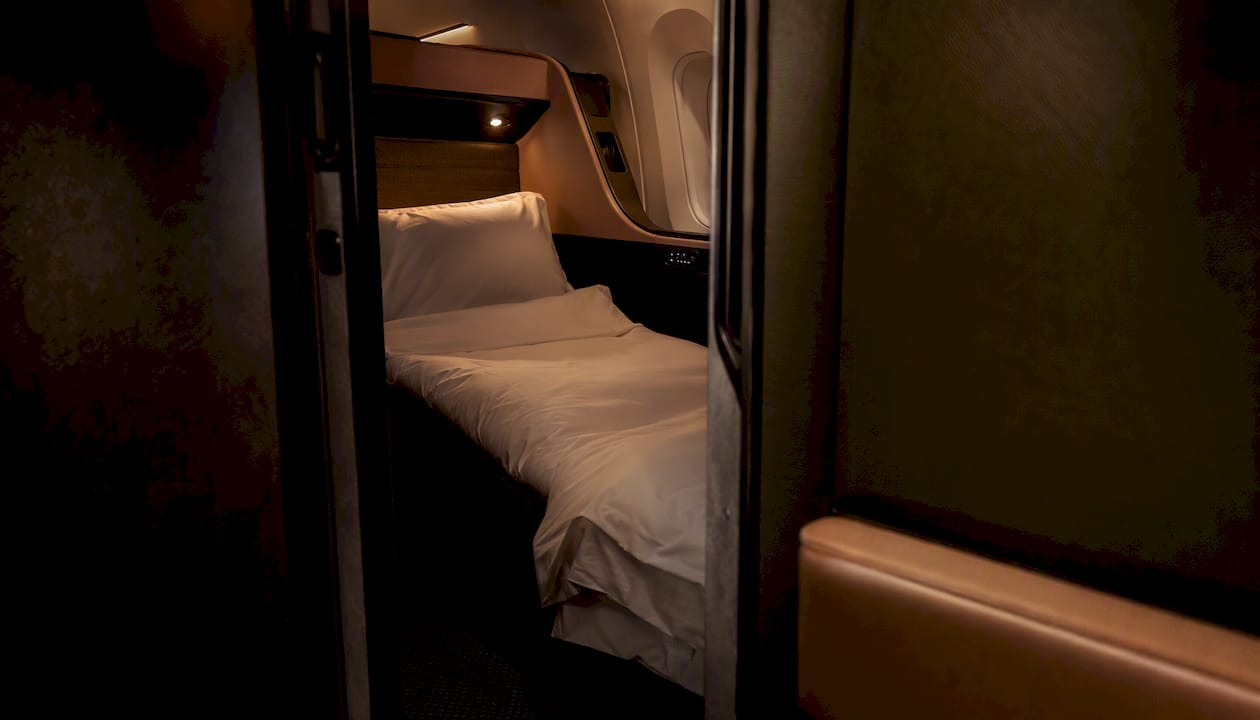
Enclosed suites with doors (Qatar Qsuite, ANA The Room, Singapore Business Class Suites, Delta One Suite on select aircraft, Air Canada Signature Suite) are the current gold standard. The door transforms the experience for light sleepers and anyone who values visual privacy.
Reverse-herringbone seats (Cathay Pacific, Air France, Lufthansa, SWISS, EVA Air Royal Laurel) give every passenger direct aisle access and a fully lie-flat bed in a herringbone pattern. They are excellent for solo travelers and remain the most common configuration among top-tier carriers.
Staggered configurations alternate between window and aisle positions. Window seats in this layout offer more privacy; aisle-adjacent seats are less private but easier to exit without disturbing a neighbor.
Soft-product features that materially affect the experience beyond the seat itself:
- Dine-on-demand vs. set service: Dine-on-demand (Qatar, Singapore, Emirates) lets you eat when you want rather than on the crew’s schedule. On overnight flights, this is the difference between sleeping through a meal service and eating when you are actually hungry.
- Mattress and bedding quality: Qatar, Singapore, and ANA provide proper mattress toppers and high-thread-count linens. The gap between these and a basic flat bed is noticeable on a 14-hour flight.
- Amenity kit level: Bulgari (Emirates), Acqua di Parma (Lufthansa), and Clarins (Air France) are among the branded kit partners. Kit quality is a soft signal of overall investment in the cabin.
- Wi-Fi quality: Viasat and Starlink installations vary by aircraft. Qatar and Emirates have invested heavily in connectivity; consistency still varies by route and aircraft age.
As business class has improved, the gap between top business class and first class has narrowed significantly. First class now remains meaningfully differentiated only on a shrinking set of carriers, primarily through in-flight showers (Emirates A380, Etihad First Apartments), private dining, and dedicated ground terminals.
Pro Tip: Within a reverse-herringbone cabin, odd-numbered window seats typically offer more privacy than even-numbered aisle-adjacent seats. In a Qsuite cabin, the center pairs (D and G seats) convert to the double-bed configuration.
7. Why an elite travel agency matters when booking top business class products
Securing the right seat on the right aircraft is harder than it looks. Award space for Qatar Qsuite, ANA The Room, and Singapore Suites is genuinely scarce, and the routing combinations that make a multi-leg itinerary work often require knowledge of interline agreements and partner program rules that most travelers encounter only once or twice.
Hiddendoortravel’s luxury travel experts provide concrete advantages at each stage of the booking process:
- Proactive award searches: Monitoring release patterns for Qsuite and ANA The Room space across multiple programs simultaneously, rather than checking once and settling.
- Preferred supplier relationships: Access to fare classes and seat inventory that may not appear on public booking tools.
- Bespoke routing: Engineering a multi-leg itinerary that captures the desired aircraft on each segment, including positioning flights and ground transfers between hubs.
- Ground-service coordination: Chauffeur arrangements, lounge access confirmation, and fast-track immigration at connecting hubs, so the premium experience extends beyond the aircraft door.
- Upgrade and interline management: Navigating the rules for mixed-carrier itineraries, where a single-carrier booking may block the best redemption option.
Elite travel agency advantages are most pronounced for complex itineraries: multi-continent trips, group bookings in premium cabins, or redemptions that require combining two or more loyalty programs. For a straightforward round trip on a single carrier, the agency’s value is in time saved and seat-selection expertise. For a three-continent itinerary mixing Qatar, ANA, and Singapore, the agency’s routing knowledge is the difference between a workable itinerary and a patchwork of compromises.
For extremely high-value redemptions, a proactive award search and willingness to build multi-carrier routings often yields access to otherwise hidden saver space that is difficult to assemble without deep program knowledge.
8. How business class amenities and services compare by airline
Dining, entertainment, and amenity kits vary more than seat geometry across this tier of carriers, and they are often what separates a memorable flight from a merely comfortable one.
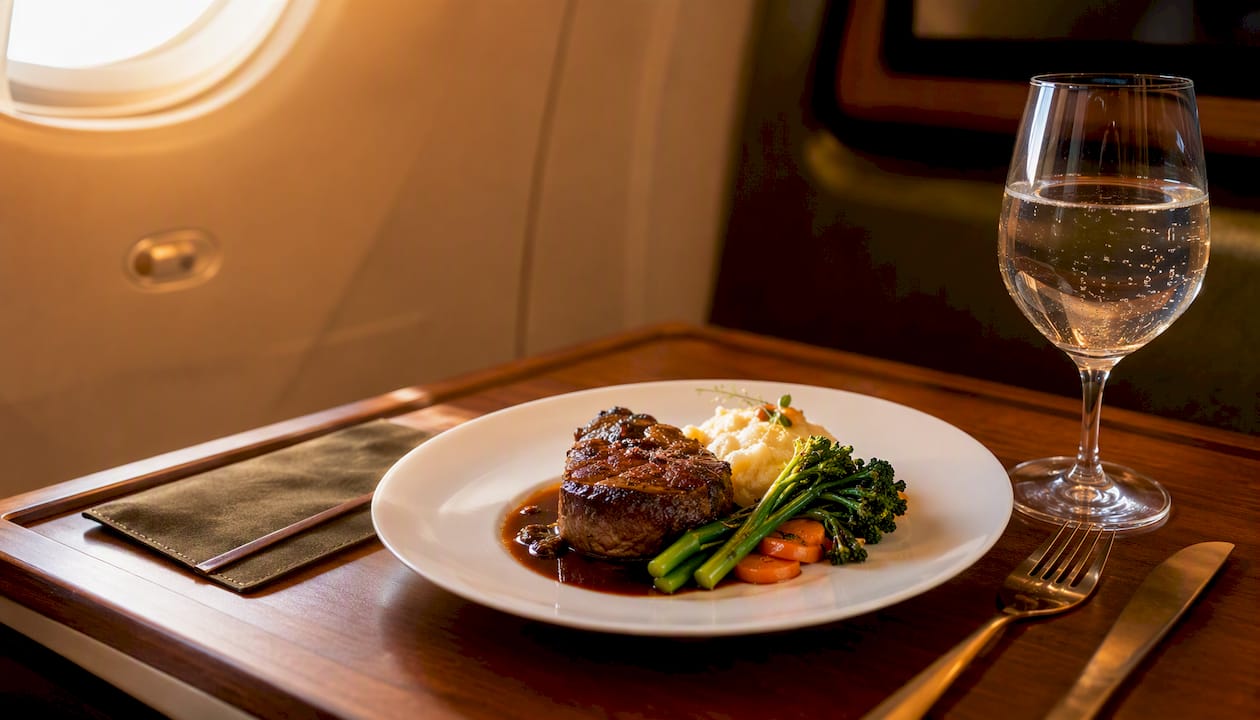
Dining: Singapore Airlines’ Book the Cook program is the most cited differentiator in this category. Passengers select from a restaurant-quality menu before departure, and the galley execution is consistently high. Air France partners with Michelin-starred chefs for its long-haul menus, with a particular focus on French wine pairings. JAL’s Japanese cuisine, particularly the kaiseki-style options, is a genuine draw for food-focused travelers. Qatar offers dine-on-demand across its Qsuite routes, meaning you eat when you choose rather than on a fixed schedule. Business travel dining expectations have risen sharply, and the carriers that treat the meal as a destination experience rather than a catering exercise are the ones that consistently earn repeat bookings.
In-flight entertainment: Emirates leads on screen size and content library, with its ICE system offering one of the widest selections in the sky. Qatar and Singapore are close behind. ANA and JAL offer strong Japanese-language content alongside international libraries. Lufthansa and SWISS have improved their IFE systems on newer aircraft but lag slightly on older 747 and A330 configurations.
Amenity kits: Emirates partners with Bulgari for its first-class kit and offers a strong business-class kit as well. Lufthansa uses Acqua di Parma, Air France uses Clarins, and Singapore uses Lalique on some routes. Qatar’s kits have improved with recent cabin refreshes. The kit is a minor detail in isolation, but it signals the overall level of investment in the passenger experience.
Wi-Fi and connectivity: Qatar and Emirates have made the most consistent investment in inflight connectivity. ANA and JAL offer reliable Wi-Fi on most long-haul routes. Lufthansa’s connectivity varies by aircraft generation. Convenience and connectivity are now primary expectations for business travelers, not optional extras.
9. Cost vs. value: what to expect at different price levels
Business class pricing from U.S. gateways spans a wide range, and the relationship between price and experience is not always linear.
$2,500–$4,000 round trip (transatlantic): This range typically covers Turkish Airlines, SWISS on sale, and occasional Air France or Lufthansa promotional fares. The hard product at this price point is usually a reverse-herringbone seat with direct aisle access and a lie-flat bed. Soft product is solid but not exceptional. Lounge access is included.
$4,000–$7,000 round trip (transatlantic or Middle East): The standard published range for Air France, Lufthansa, Emirates, and Etihad on most routes. At this level, you can expect a competitive hard product, good dining, and a strong lounge experience at the hub. Emirates and Etihad at the upper end of this range offer some of the best lounge experiences in the world.
$7,000–$12,000 round trip (Asia long-haul): Qatar, Singapore, ANA, and JAL typically sit in this range for published cash fares on U.S.-to-Asia routes. This is where the enclosed suite with a door becomes the norm rather than the exception, and where soft product differences (Book the Cook, Japanese cuisine, crew consistency) become the primary differentiators.
Points redemptions: The value case for miles is strongest at the top of the market. Redeeming 130,000–160,000 miles for a round-trip ANA The Room or Singapore Suites seat that would cost $9,000–$12,000 in cash represents a compelling return on points accumulation. The catch is availability: these seats release in limited quantities, often far in advance, and require flexibility on dates.
Managing luxury travel expenses across a multi-leg itinerary mixing cash and points requires planning, and the carriers that offer the best hard products are not always the ones with the most accessible award programs.
10. Customer service quality and consistency by airline
Hard product gets you the seat. Crew consistency determines whether the flight is actually enjoyable.
Singapore Airlines is the consistency benchmark. The crew-to-passenger ratio, training standards, and genuine attentiveness are cited in virtually every long-form review of the carrier. The experience is reliably excellent regardless of route or aircraft.
ANA and JAL deliver Japanese-style service that prioritizes anticipation over reaction. Crew members address needs before passengers articulate them, and the tone is warm without being intrusive. Both carriers score exceptionally well in passenger satisfaction surveys for long-haul premium travel.
Qatar Airways has improved its crew consistency significantly over the past several years. The Qsuite product is so strong that even average service does not diminish the experience materially, but the best Qatar flights combine the hard product with genuinely attentive crew.
Emirates is strong on service at scale. The carrier operates one of the largest business-class cabins in the sky, and maintaining consistency across that volume is a genuine operational achievement. Service can vary more than on smaller premium carriers, but the standard is reliably high.
Air France offers a distinctly French style of service: knowledgeable about food and wine, attentive without being formal, and occasionally inconsistent on shorter European connections. On long-haul routes from JFK or LAX, the experience is generally excellent.
Delta Air Lines has made the most progress of any U.S. carrier in closing the service gap with Asian and Middle Eastern competitors. Delta One Suite flights from JFK and LAX now deliver a materially better soft product than was available five years ago, though the gap to Singapore and ANA remains real.
Lufthansa and SWISS are reliable and professional. The service style is efficient rather than warm, which suits some travelers perfectly and leaves others wanting more personality. Both carriers are consistent, which matters more than style on a 10-hour flight.
11. Upgrade, refund, and change policies for business class bookings
Policies vary significantly by carrier and fare class, and the details matter when plans change.
Upgrades: Most carriers offer complimentary upgrades to elite-status members when space is available, but the definition of “available” differs. Qatar upgrades Privilege Club Platinum members when business class is not sold out. Singapore upgrades KrisFlyer Elite Gold and Elite Gold members on a space-available basis. Delta upgrades Medallion members based on a priority algorithm that considers status level, fare class, and check-in timing. Cash upgrades at the gate are available on most carriers but rarely represent good value compared to booking business class directly.
Refunds and changes: Fully flexible business class fares (typically the highest published fare class) allow changes and cancellations without penalty on most carriers. Discounted business class fares, which represent the majority of tickets sold, carry change fees ranging from $200 to $500 on most carriers, with some allowing free date changes but charging for route changes. Award tickets have their own rules: Qatar allows free changes to Qmiles awards up to 24 hours before departure; ANA’s Mileage Club awards allow one free change; Singapore’s KrisFlyer awards charge a fee for changes after ticketing.
Practical note: Booking through a travel agency often provides access to negotiated fare classes with more flexible terms than the same fare booked directly. For complex itineraries, the ability to modify a segment without repricing the entire ticket is worth factoring into the booking decision.
12. Baggage allowances and perks for business class travelers from the U.S.
Business class baggage allowances are generous across all carriers in this tier, but the specifics differ.
Checked baggage: Most carriers allow two checked bags at 32 kg (70 lbs) each for business class passengers. Qatar allows two bags at 32 kg each. Singapore allows two bags at 30 kg each. Emirates allows two bags at 32 kg each. Delta One allows two bags at 32 kg each on international routes. ANA and JAL allow two bags at 32 kg each on transpacific routes.
Carry-on: Business class passengers typically receive two carry-on items plus a personal item. Qatar and Emirates are among the most generous, allowing a garment bag in addition to the standard allowance on many routes.
Additional perks: Priority check-in and boarding are standard across all carriers. Fast-track security is available at most major hubs. Chauffeur service is offered by Emirates (in select cities), Qatar (in select cities), and Etihad (in select cities) for business class passengers. Lounge access at the departure airport and at connecting hubs is included on all carriers in this tier.
U.S.-specific note: On flights originating in the U.S., TSA PreCheck and CLEAR expedite security regardless of cabin class, but business class passengers typically have access to dedicated check-in counters that reduce queue time significantly at busy airports like JFK and LAX.
What the current business class era actually means for how you book
The most significant shift in premium aviation over the past five years is not a new seat design. It is the compression of the gap between business class and first class. First class remains meaningfully differentiated only on a shrinking set of carriers, primarily through in-flight showers, private dining rooms, and multi-room suites on Emirates, Etihad, and Singapore. For most routes and most travelers, the best business class products now deliver what first class delivered a decade ago.
The implication for booking strategy is direct: stop optimizing for cabin label and start optimizing for aircraft and product. A Qatar Qsuite in business class is a better experience than first class on a carrier that has not refreshed its premium cabin in eight years. The ranking matters less than the specific seat on the specific aircraft on your specific route.
The second shift worth noting is fleet unevenness within airlines. The same carrier can operate a world-class enclosed suite on its A350 routes and a decade-old reverse-herringbone on its 777 routes. Checking the aircraft before booking is not optional for travelers who care about the experience.
Hiddendoortravel: bespoke business class booking for discerning travelers
Booking a top business class seat is not complicated in theory. In practice, securing Qsuite on a specific date from JFK, or finding ANA The Room award space from LAX with a workable connection, requires monitoring multiple programs, understanding release patterns, and knowing which partner routings actually work.
Hiddendoortravel handles that complexity for you. The agency’s luxury travel planning services cover award searches across all major programs, preferred-rate cash fares, bespoke multi-carrier routing, chauffeur and ground-service coordination at hub airports, and suite or seat confirmation before you commit. For travelers who want the best seat on the right aircraft without spending hours in loyalty program forums, this is the practical alternative to doing it yourself. Reach out to the Hiddendoortravel team to discuss your next itinerary and get a recommendation built around your specific route, dates, and priorities.
Sources
- World’s Best Business Class Airlines 2025 | SKYTRAX
- Best business class seats | One Mile at a Time
- The Best Business Class Airlines in 2026 | Uncompromised Travel
- Riiiich
- 5 Airlines With The World’s Most Luxurious First Class Suites In 2026 | Simple Flying