

Elite travel wish list execution is the process of converting your most ambitious, personalized travel aspirations into fully realized, high-impact trips through deliberate planning and expert collaboration. Most affluent travelers have a mental list of dream destinations and experiences. The gap between that list and an actual trip comes down to priorities, logistics, and the right partnerships. This guide gives you a practical framework for luxury travel planning that moves from aspiration to execution without sacrificing the quality or exclusivity that defines the experience.
What does elite travel wish list execution actually require?
Elite travel wish list execution requires three things: a clear personal definition of luxury, a focused itinerary built around one exceptional base, and a logistics plan that protects your time on the ground. Without all three, even the most generous budget produces a fragmented, exhausting trip rather than a memorable one.
The industry term for this process is bespoke itinerary design. It combines your stated preferences with an advisor’s insider knowledge to produce a trip that functions as a single, coherent experience rather than a collection of bookings. Successful luxury travel results from a partnership where travelers provide detailed preferences and advisors fill the gaps with access and expertise. That partnership is the engine of execution.
Preferred travel advisors also deliver concrete financial value. Amenity packages commonly include daily breakfast, property credits, and confirmed room upgrades. Those benefits are locked in at booking, unlike availability-based loyalty upgrades that may never materialize.

How to define your elite travel priorities and non-negotiables
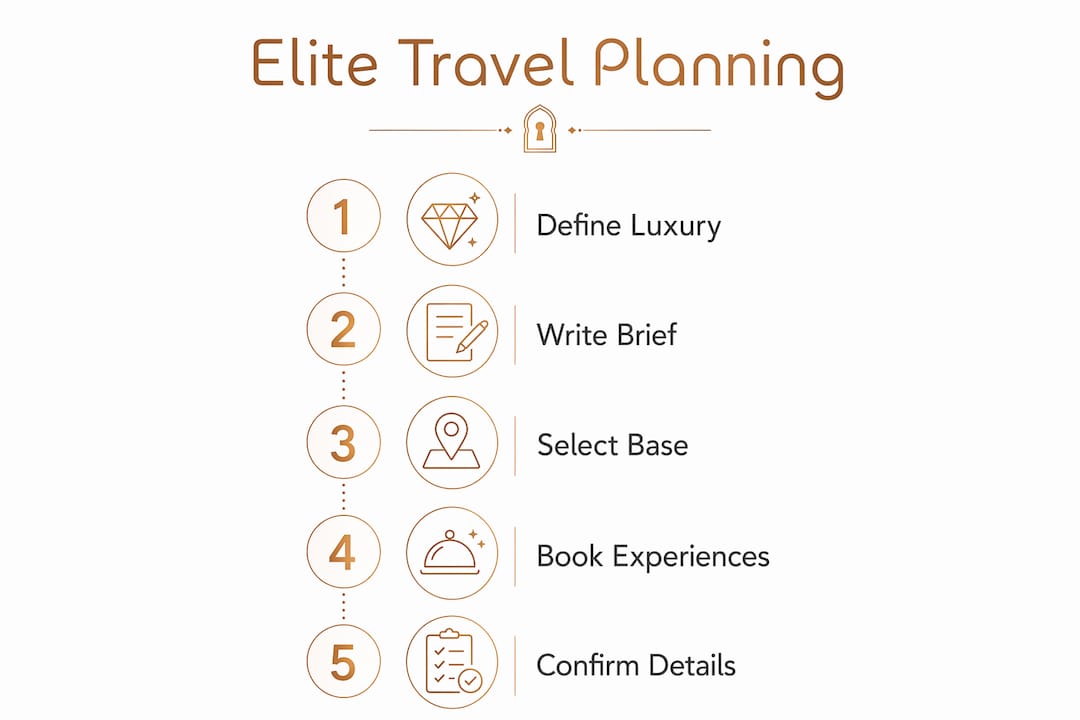
Luxury means something different to every traveler. Before you build any itinerary, you need a written definition of what it means to you specifically.
Start by answering four questions:
- What is the trip for? A honeymoon, a milestone birthday, a reset after a demanding year, or pure adventure each requires a different shape.
- What is non-negotiable? Privacy level, accommodation style, cuisine quality, and physical access requirements all belong on this list.
- What do you actively want to avoid? Crowded tourist sites, helicopter tours, group dining, and early morning starts are legitimate constraints that sharpen your options.
- What does success look like on the last night? Naming that outcome forces clarity on everything else.
Seasonality, privacy level, and group needs must align with your destination and villa selection for lasting satisfaction. A property that looks perfect in photos can fail completely if it sits in peak-season crowds or requires a two-hour transfer to reach your priority experiences.
Pro Tip: Write your wish list constraints as a one-page brief before contacting any advisor. Include three “must-haves,” three “would love,” and three “hard no” items. Advisors who receive this brief produce dramatically better first proposals.
The goal is not to limit your options. It is to filter out the 90% of options that look appealing but would not actually satisfy you, so your advisor can focus on the 10% that will.
Why a single exceptional base outperforms hotel-hopping
Decision fatigue is one of the most underestimated problems in luxury travel planning. Moving between three or four properties in a single trip means packing, unpacking, managing transfers, and re-orienting to a new environment every two days. That friction consumes the mental energy you came to restore.
The most effective high-end travel plans center around one base. Typical luxury planning involves parties of two staying approximately three nights, and the trips that generate the strongest satisfaction scores are built around a single property that anchors all other activities. Read more about designing multi-destination trips if your wish list genuinely requires more than one location.
| Approach | Key benefit | Key trade-off |
|---|---|---|
| Single exceptional base | Deep immersion, lower logistics load, stronger staff relationships | Less geographic variety |
| Multi-hotel itinerary | Broader destination coverage | Higher decision fatigue, more transfer time |
Criteria for choosing your base: proximity to your priority experiences, privacy level, on-property amenities that match your non-negotiables, and walkability or easy transport to key sites. A property that scores well on all four criteria is worth paying more for.
Pro Tip: Ask your advisor which specific rooms deliver the promised views or access. Experienced advisors know property details that never appear in official descriptions, including which floor gets noise from the pool bar and which suite faces east for sunrise.
How do you book signature experiences without over-scheduling?
Limit signature experiences to two or three per trip. That number sounds conservative, but it is the threshold at which each experience receives the attention and energy it deserves. More than three and you are managing a schedule rather than living a trip.
Follow this booking sequence:
- Identify your two or three non-negotiable experiences. Private dining at a chef’s table, a guided archaeological site visit before public opening, a spa day with a specific treatment protocol. Name them precisely.
- Book these first, before accommodation if necessary. Signature experiences sell out well before standard activities, and they define the trip’s exclusivity. Securing them early is the single highest-leverage action in the planning process.
- Build the rest of the itinerary around those anchor points. Leave at least one full unstructured day per four days of travel for rest, spontaneous discovery, or extended time at a place you love.
- Assign each experience a backup option. Not a lesser version, but a genuinely good alternative that you would be satisfied with if the primary falls through.
Common signature experience categories worth prioritizing: private dining with a local chef, after-hours cultural access (museums, archaeological sites, private collections), adventure activities with exclusive guides, and spa programs built around local ingredients or techniques. For travelers drawn to cultural depth, the Yucatan’s archaeological circuit offers private early-access options at sites like Uxmal that most travelers never experience.
Collaboration with a travel advisor at this stage is not optional. Advisors carry relationships with restaurants, guides, and properties that are not accessible through public booking channels. That access is the difference between a good experience and an exceptional one.
Automating logistics to protect your time on the ground
Logistics automation means pre-deciding every transfer, meal timing, and transport sequence so that no one in your party has to make those decisions in real time. Elite travel execution favors private aviation and discreet transfers coordinated by trusted partners, precisely because those arrangements remove the friction points that degrade the experience.
Practical steps to automate your logistics:
- Pre-book all ground transfers with named drivers and confirmed pickup times. Do not rely on ride-share apps for airport arrivals after long-haul flights.
- Confirm every booking 24 hours in advance. Flexible itineraries with backup plans protect your standards against last-minute issues. A 24-hour confirmation call catches problems while you still have time to fix them.
- Sequence meals and activities with realistic transfer times. A 45-minute transfer that looks fine on a map can take 90 minutes in local traffic. Build in the real number.
- Use a concierge service or travel app to hold all confirmations, contact numbers, and fallback options in one place. Your advisor should provide a trip document that includes all of this.
- Establish a single point of contact for the duration of the trip. One person who knows your preferences and has authority to resolve problems is worth more than a dozen customer service numbers.
Pro Tip: AI trip planners increasingly enable bespoke itinerary options that reduce decision fatigue. Use them for initial research and option generation, then hand the shortlist to your advisor for vetting and booking.
Common mistakes that undermine high-end trip execution
Over-scheduling is the most common mistake in high-end trip execution. Travelers who have invested significantly in a trip feel pressure to extract maximum value from every hour. That pressure produces exhaustion, not satisfaction.
Watch for these specific pitfalls:
- Ignoring your personal rhythm. If you function poorly before 9:00 AM, do not book a sunrise activity on day one of a long-haul trip. Your advisor needs to know this.
- Underestimating transfer times. This error cascades. One late arrival compresses every subsequent activity and forces rushed decisions.
- Misusing flexibility. Unstructured time is not wasted time. Travelers who fill every gap with optional activities often report the lowest satisfaction scores.
- Skipping direct reconfirmation. Always confirm key bookings directly with the provider, not just through your booking platform. Platforms can show confirmed status for reservations that the property has not actually received.
Pro Tip: Establish a “downgrade line” before you travel. Define the minimum acceptable standard for each key element: accommodation, dining, transport. When something goes wrong, you know immediately whether to accept the alternative or push for a solution. That clarity eliminates the paralysis that turns minor disruptions into ruined days.
Building resilient itineraries involves generous connection times, strategic sequencing, and pre-set fallback options. The travelers who execute their wish lists most successfully are not the ones with the most elaborate plans. They are the ones with the most honest ones.
Key Takeaways
Executing an elite travel wish list requires a written brief, a single exceptional base, two or three anchor experiences booked early, and pre-decided logistics that protect your time and standards throughout the trip.
| Point | Details |
|---|---|
| Define luxury personally | Write a one-page brief with must-haves, wish list items, and hard limits before engaging any advisor. |
| Choose one exceptional base | A single property reduces decision fatigue and deepens immersion more than multi-hotel itineraries. |
| Book signature experiences first | Secure your two or three anchor experiences before anything else; they sell out earliest and define the trip. |
| Automate all logistics | Pre-book transfers, confirm bookings 24 hours ahead, and hold all details in one accessible document. |
| Set a downgrade line | Define your minimum acceptable standard for each key element so disruptions get resolved, not endured. |
What I’ve learned from watching wish lists succeed and fail
The travelers who execute their wish lists most successfully share one habit: they are specific. Not demanding, not inflexible, but specific. They know the difference between “I want a great view” and “I want to watch the sun set over water from my room.” That specificity is what allows an advisor to deliver something real rather than something approximate.
The travelers who struggle are usually the ones who arrive with a mood board and no brief. They want to be surprised, which is a reasonable desire, but they have not told anyone what kind of surprise would delight them versus disappoint them. The advisor ends up guessing, and guessing at this level of investment is expensive.
Technology has changed this dynamic in useful ways. AI planning tools now generate credible first-draft itineraries that give travelers a concrete starting point for conversation. The traveler reacts to the draft, the advisor refines it, and the brief emerges from that dialogue rather than from a blank page. That process is faster and produces better results than either party working alone.
The other thing I have observed consistently: the trips that go wrong almost always involve a logistics gap, not an experience gap. The experience was booked. The transfer was not. Or the transfer was booked but not confirmed. Or it was confirmed but the timing was wrong. Protecting your time on the ground is not a detail. It is the whole game.
— Michael
Hiddendoortravel’s approach to executing your wish list
Hiddendoortravel works with a curated network of five-star properties that offer confirmed priority upgrades and amenity packages secured at booking, not subject to availability on arrival. Every itinerary is built around your written brief, with signature experiences locked in before the broader schedule is finalized.
The team handles all transfer sequencing, 24-hour confirmations, and fallback planning so you arrive at each experience ready rather than managing logistics. If you are ready to move from wish list to confirmed itinerary, the luxury travel experts at Hiddendoortravel are the right starting point. You can also review the elite agency selection checklist to understand exactly what to expect from a specialist advisor before your first conversation.
FAQ
What is elite travel wish list execution?
Elite travel wish list execution is the process of turning curated luxury travel aspirations into confirmed, fully planned trips through clear priorities, expert collaboration, and pre-decided logistics. It is the industry practice behind bespoke itinerary design.
How many signature experiences should I book per trip?
Limit signature experiences to two or three per trip. More than that shifts the focus from immersion to schedule management, which reduces overall satisfaction.
Why does a single base outperform multiple hotels?
A single exceptional base eliminates packing, transfer time, and re-orientation between properties. That reduction in logistical friction directly increases relaxation and immersion, which are the primary goals of high-end travel.
When should I confirm bookings before travel?
Confirm every key booking directly with the provider 24 hours before the activity. This catches errors while you still have time to arrange alternatives without disrupting the rest of the itinerary.
What does a travel advisor actually add to luxury planning?
Advisors secure confirmed amenity packages, priority upgrades, and access to experiences not available through public booking channels. They also carry property-level knowledge, such as which specific rooms deliver the promised views, that no website provides.