

Anticipatory travel service is defined as the proactive process of identifying and fulfilling a traveler’s needs before those needs are expressed. This approach sits at the heart of luxury and bespoke travel, where the difference between a good trip and an extraordinary one is almost always invisible. Research shows that 97% of travelers report higher happiness when they plan trips well in advance, and that visualization during planning reduces travel anxiety by 40%. Hiddendoortravel builds its entire service model on this principle, treating the planning phase as the first act of the trip itself.
What is the role of anticipatory travel service in luxury planning?
Anticipatory travel service does something reactive service cannot. It removes friction before friction has a chance to appear. A traveler who arrives at a remote lodge to find their dietary preferences already communicated to the kitchen, their preferred pillow firmness already set, and a private guide already briefed on their interests has experienced anticipatory service at its best. None of those details required a request. They required preparation.
The industry term for this approach is “anticipatory hospitality,” and it applies equally to travel advisors and on-property staff. The concept draws from behavioral economics and service design, recognizing that unmet needs create stress while preemptively met needs create delight. The gap between the two is where bespoke travel planning earns its value.
Anticipatory service also differs from personalization in one critical way. Personalization responds to stated preferences. Anticipatory service predicts unstated ones. A traveler who mentioned offhand that they love early mornings should find a pre-dawn excursion already scheduled. That is the distinction that separates premium travel from standard arrangements.
How does anticipatory planning shape the traveler’s psychological experience?
The psychological case for anticipatory planning is stronger than most travelers realize. Anticipatory planning activates the brain’s reward centers before the trip even begins, effectively doubling the psychological rewards of travel. The pleasure of looking forward to a confirmed reservation at a remote ryokan or a private wine tasting in Burgundy is neurologically real, not just emotional.

Travelers who engage deeply in the planning phase also show greater resilience when disruptions occur. Travelers involved in planning handle disruptions more positively and report higher overall satisfaction. The reason is straightforward: mental familiarity with a trip’s structure reduces the shock of unexpected changes.
Three psychological mechanisms drive the benefits of anticipatory travel:
- Savoring. Anticipating a confirmed experience generates genuine pleasure in the weeks before departure. Psychologists call this “prospective savoring,” and it extends the emotional value of a trip well beyond its actual duration.
- Anxiety reduction. Visualization exercises during planning strengthen positive neural pathways and measurably reduce pre-departure stress. Travelers who mentally rehearse positive outcomes arrive calmer and more present.
- Decision fatigue prevention. 73% of unplanned travelers experience decision fatigue within the first 48 hours of a trip. Pre-made, thoughtful decisions eliminate that drain entirely.
Pro Tip: Build a visual mood board of your confirmed itinerary two to three weeks before departure. Reviewing it for ten minutes each evening activates the same neural reward pathways as the trip itself, extending your enjoyment before you ever pack a bag.
The balance between structure and spontaneity matters here. Over-planning kills the joy of discovery. The goal of anticipatory planning is to remove logistical anxiety, not to script every hour. A well-planned trip leaves deliberate white space for serendipity.
What does anticipatory service actually entail behind the scenes?
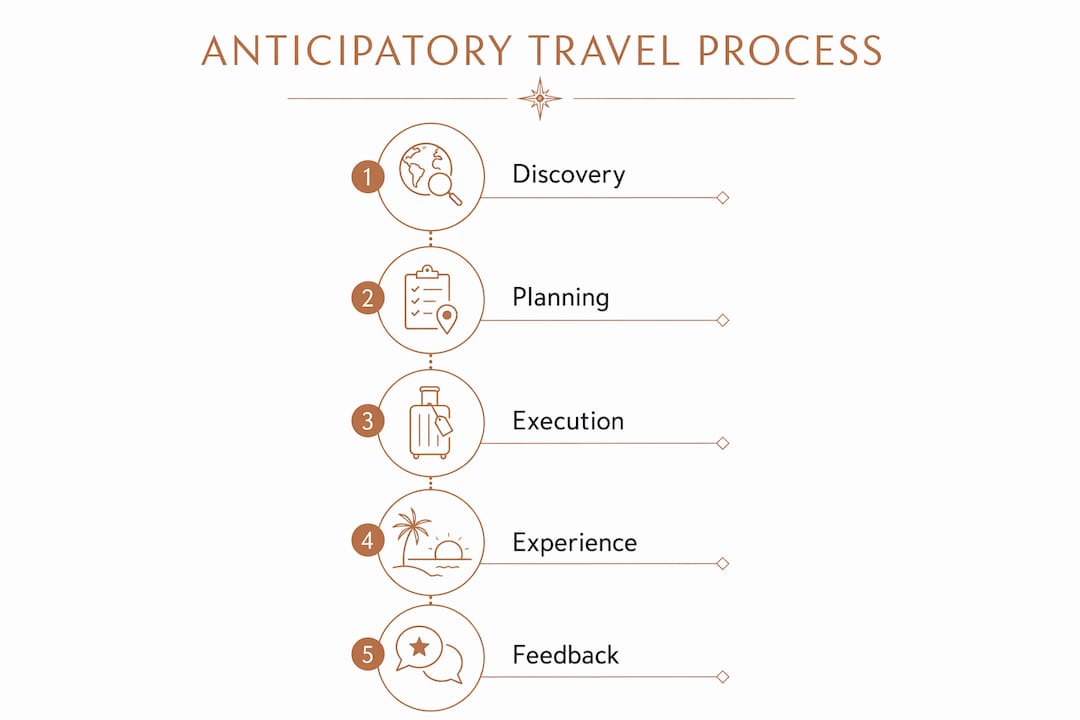
Most travelers never see the work that makes their trip feel effortless. That invisibility is the point. Successful anticipatory service relies on hundreds of micro-decisions made well before departure, including routing optimization, supplier vetting, logistical sequencing, and contingency planning for weather, access, or timing conflicts.
A skilled travel advisor working on a three-week East Africa itinerary, for example, will have already confirmed road conditions between camps, verified that a specific guide speaks the traveler’s preferred language, and arranged a private vehicle for a border crossing that commercial transfers routinely mishandle. None of this appears on the final itinerary. All of it determines whether the trip works.
“The luxury travel advisor’s greatest value lies in unseen proactive measures taken months ahead, crafting a personalized journey rather than reactive fixes. The work that prevents a problem is always invisible. The problem itself never is.”
Technology now supports this invisible work at scale. AI and CRM systems allow luxury properties to predict guest preferences and automate personalized services before check-in. A returning guest’s room temperature preference, their preferred newspaper, and their allergy profile can all be loaded into a property management system and actioned without a single conversation at the front desk.
The human element remains irreplaceable, though. Staff trained to read subtle cues, such as a traveler who lingers over a menu or glances repeatedly at a map, can respond with a recommendation before the question is asked. That skill is not algorithmic. It is cultivated through experience and genuine attention.
When should travelers engage with anticipatory services for the best results?
Timing is not arbitrary in anticipatory travel planning. Trip-planning activity peaks around 56 days before departure, marking a behavioral shift from aspirational browsing to active logistics. This is the window where anticipatory service has the most impact.
The planning arc for a bespoke luxury trip typically moves through three phases:
- Discovery (90+ days out). The traveler defines broad preferences: region, pace, interests, and non-negotiables. The advisor maps these against destination realities, seasonal conditions, and availability.
- Refinement (56–30 days out). Logistics lock in. Transfers, accommodations, guides, and dining reservations are confirmed. Contingency plans are built for the most likely disruptions.
- Preparation (30–0 days out). The traveler receives detailed briefings, packing guidance, and cultural context. The advisor conducts final checks with all suppliers.
| Phase | Timing | Primary Focus |
|---|---|---|
| Discovery | 90+ days out | Preferences, destinations, pace |
| Refinement | 56–30 days out | Logistics, confirmations, contingencies |
| Preparation | 30–0 days out | Briefings, supplier checks, final details |
Engaging a travel advisor early in the discovery phase produces measurably better outcomes. Advisors who enter at the refinement stage inherit decisions they cannot fully optimize. The personalized service benefits that define bespoke travel depend on time to gather information, build relationships with suppliers, and iterate on the plan.
Pro Tip: Share your travel history, including trips that disappointed you, with your advisor at the first conversation. Knowing what did not work is often more useful than knowing what did.
What are the benefits of anticipatory travel service for luxury travelers?
The benefits of anticipatory travel service operate on two levels: emotional and practical. Emotionally, travelers who experience genuine anticipatory care report feeling understood rather than processed. That distinction drives loyalty more reliably than any amenity upgrade.
Practically, the numbers are clear. 80% of luxury hospitality properties identify anticipatory service as essential to guest loyalty. Properties using anticipatory strategies see a 15% increase in customer retention. Those figures reflect a simple truth: travelers return to places and advisors that made them feel genuinely cared for.
The specific benefits for luxury travelers include:
- Reduced cognitive load. Pre-made decisions free travelers to be fully present rather than constantly managing logistics.
- Higher trip satisfaction. Anticipation fundamentally drives traveler happiness and resilience, shaping how meaningfully they experience their journeys.
- Stronger advisor relationships. Travelers who experience anticipatory service build trust with their advisor, making future trips progressively better as the advisor’s knowledge of their preferences deepens.
- Word-of-mouth referrals. Travelers who feel genuinely cared for share those experiences. Referrals from satisfied luxury travelers are the primary growth channel for premium travel agencies.
The future of anticipatory travel points toward deeper integration of behavioral data and human judgment. Technology will predict preferences with greater accuracy. The advisor’s role will shift toward interpreting that data and applying it with the kind of contextual intelligence that no algorithm currently replicates.
Key Takeaways
Anticipatory travel service is the single most effective differentiator in luxury travel, transforming invisible preparation into experiences that feel effortless, personal, and genuinely memorable.
| Point | Details |
|---|---|
| Proactive over reactive | Anticipatory service addresses needs before they arise, eliminating friction rather than fixing it. |
| Planning activates reward | 97% of travelers report higher happiness when planning well in advance, making the process part of the trip. |
| 56-day planning peak | Engaging an advisor before this window produces the most refined and resilient itineraries. |
| Loyalty through care | 80% of luxury properties cite anticipatory service as essential to repeat business and guest retention. |
| Technology supports humans | AI and CRM tools enhance anticipatory service, but experienced human judgment remains the deciding factor. |
What I have learned watching anticipatory service work in real luxury travel
The most revealing moments in luxury travel are not the grand gestures. They are the small ones that arrive before you knew you wanted them. I have watched travelers arrive at a remote property after a long journey to find a cold towel, a specific local drink they mentioned weeks earlier, and a note referencing a conversation from the planning call. The traveler’s reaction is always the same: quiet surprise, then genuine warmth. That reaction is not manufactured. It is the result of someone paying attention long before the trip began.
What I find most underappreciated is how much anticipatory planning protects travelers from themselves. Left to manage logistics in real time, even experienced travelers make decisions under fatigue and stress that they would never make at home. A well-prepared itinerary removes those moments of vulnerability. The traveler arrives at each stage of the trip already oriented, already expected, already cared for.
The common pitfall I see is travelers who engage too late or share too little. An advisor working with incomplete information defaults to safe choices. Safe choices produce fine trips. They rarely produce extraordinary ones. The travelers who get the most from anticipatory service are the ones who treat the planning conversation as seriously as the trip itself. They share preferences, past disappointments, and even anxieties. That information is the raw material from which genuinely memorable travel is built.
Flexibility matters too. The best anticipatory plans build in room for the unexpected, because the unexpected is often the best part. The goal is never to control every moment. It is to remove the friction that would otherwise prevent you from enjoying the ones that matter most.
— Michael
How Hiddendoortravel delivers anticipatory service for discerning travelers
Hiddendoortravel was built on the conviction that the best travel experiences are designed, not assembled. Every itinerary begins with a detailed discovery conversation, and the planning work that follows addresses logistics, contingencies, and personal preferences long before departure day.
For travelers who want to experience what genuinely anticipatory planning feels like, Hiddendoortravel’s luxury travel experts bring years of on-the-ground knowledge and supplier relationships to every trip. The result is travel that feels effortless because the effort happened months earlier, quietly and deliberately, on your behalf. Travelers ready to move beyond standard arrangements can also explore what a bespoke luxury agency actually delivers at the highest level of service.
FAQ
What is anticipatory travel service?
Anticipatory travel service is the proactive identification and fulfillment of a traveler’s needs before those needs are expressed. It differs from reactive service by addressing potential friction points during the planning phase rather than after problems arise.
How does anticipatory planning reduce travel anxiety?
Visualization and detailed planning reduce travel anxiety by up to 40% by activating positive neural pathways and giving travelers a clear mental map of their trip. Travelers who plan thoroughly arrive calmer and handle disruptions more effectively.
When is the best time to engage anticipatory travel services?
The ideal window is 90 or more days before departure, with the most critical logistics phase occurring around 56 days out. Engaging a travel advisor early allows full itinerary refinement and contingency planning before the execution phase begins.
Why do luxury properties prioritize anticipatory service?
80% of luxury hospitality properties identify anticipatory service as essential to guest loyalty, and properties using these strategies see a 15% increase in customer retention. Travelers who feel genuinely cared for return and refer others.
How does technology support anticipatory travel service?
AI and CRM systems allow luxury properties and travel advisors to store guest preferences, predict needs, and automate personalized touches before arrival. Human judgment remains essential for interpreting that data and applying it with contextual accuracy.