
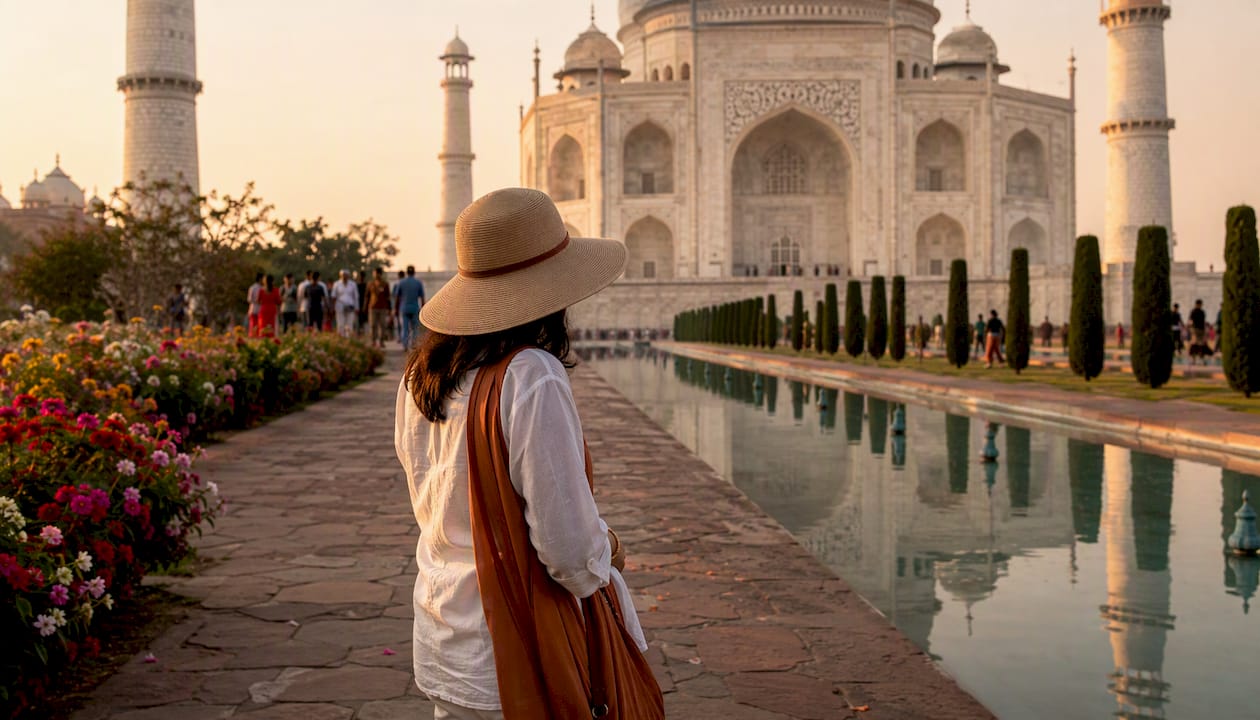
India’s most essential historical places, ranked for any heritage-focused trip: the Taj Mahal, Red Fort, Qutub Minar, Humayun’s Tomb, Agra Fort, Fatehpur Sikri, Ajanta and Ellora Caves, Hampi, Golden Temple, Mysore Palace, Bhimbetka Rock Shelters, Dholavira, Nalanda, Gateway of India, and India Gate. Cluster them by region and you can cover the best of North India in a week, add the South in another five days, and still have room for the prehistoric sites that most travelers skip entirely.
India holds 45 UNESCO World Heritage Sites, more than any other country in Asia, and the range is staggering: Paleolithic rock art, Harappan cities, medieval temple complexes, Mughal palaces, and British colonial monuments all survive in visitable condition. No single trip covers everything, so use this guide to prioritize by era, region, and time budget.
Quick shortlist by priority:
- Taj Mahal (Agra) — Mughal masterpiece, the single most visited monument in India
- Red Fort (Delhi) — UNESCO-listed Mughal fortress, site of India’s Independence Day address
- Qutub Minar (Delhi) — 12th-century Islamic tower, oldest surviving example of its kind in India
- Humayun’s Tomb (Delhi) — the architectural prototype for the Taj Mahal
- Agra Fort — Mughal power center, UNESCO-listed, walkable from the Taj
- Fatehpur Sikri — Akbar’s abandoned sandstone capital, 35 km from Agra
- Ajanta Caves (Maharashtra) — 2nd-century BCE Buddhist paintings, among the finest ancient art anywhere
- Ellora Caves (Maharashtra) — rock-cut Hindu, Buddhist, and Jain temples spanning 600 years
- Hampi (Karnataka) — 1,600+ surviving monuments of the Vijayanagara Empire
- Golden Temple (Amritsar) — Sikhism’s holiest shrine, 16th century, open to all
- Mysore Palace — Indo-Saracenic royal palace, one of India’s most visited buildings
- Bhimbetka Rock Shelters (Madhya Pradesh) — Paleolithic paintings dating back at least 30,000 years
- Dholavira (Gujarat) — Harappan city with sophisticated water management, c. 3000–1500 BCE
- Nalanda (Bihar) — ruins of the ancient world’s greatest university, 5th–12th century CE
- Gateway of India / India Gate — colonial-era landmarks that anchor Mumbai and Delhi respectively
For a first trip, the Delhi–Agra–Jaipur triangle (the “Golden Triangle”) covers six UNESCO sites in five days. For depth, pair that with Ajanta, Ellora, and Hampi.
Table of Contents
- Why India’s historical sites span 30,000 years of human civilization
- Top historical places in India, organized by region
- Lesser-known sites that reward serious history enthusiasts
- How to combine sites into efficient regional itineraries
- Practical visiting advice: tickets, timing, etiquette, and access
- How a bespoke itinerary elevates heritage visits
- Key Takeaways
- What most India itineraries get wrong
- Plan a bespoke heritage trip with Hiddendoortravel
- Authoritative further reading and official resources
Why India’s historical sites span 30,000 years of human civilization
Most travelers think of India’s history as beginning with the Mughals. The Archaeological Survey of India documents a continuous record stretching roughly 30,000 years, from Paleolithic cave painters to the architects of the British Raj. Understanding that arc makes each site visit richer.
Here is a compressed timeline of the eras you will encounter:
- Paleolithic (c. 30,000+ years ago): Bhimbetka rock shelters in Madhya Pradesh contain paintings and artifacts from this period, making them among the oldest evidence of human habitation on the subcontinent.
- Indus Valley / Harappan civilization (c. 3300–1300 BCE): Dholavira in Gujarat and Mohenjo-daro (Pakistan) represent one of the ancient world’s most sophisticated urban cultures, with grid-planned cities and advanced water systems.
- Vedic and early classical period (c. 1500–300 BCE): The foundations of Hinduism, Buddhism, and Jainism take shape. Sarnath, near Varanasi, is where the Buddha gave his first sermon.
- Mauryan and Gupta empires (c. 300 BCE–550 CE): Sanchi’s Buddhist stupas and the early phases of Ajanta’s cave paintings belong to this era. Nalanda University was founded during the Gupta period.
- Medieval temple-building period (c. 600–1200 CE): Ellora’s rock-cut temples, the Khajuraho sculptures, and the great Dravidian temple complexes of Tamil Nadu all date to this era.
- Sultanate and early Mughal period (c. 1200–1556 CE): Qutub Minar, Humayun’s Tomb, and the early phases of Agra Fort mark this transition.
- High Mughal period (c. 1556–1707 CE): The Taj Mahal, Red Fort, Fatehpur Sikri, and Lahore Fort represent the empire’s architectural peak.
- Colonial period (c. 1757–1947 CE): Gateway of India, India Gate, Victoria Memorial, and Chhatrapati Shivaji Terminus (Mumbai) are the most visited monuments from this era.
Statistic to anchor the scale: India’s 45 UNESCO World Heritage Sites span cultural, natural, and mixed categories, with 37 classified as cultural. No other Asian country matches that count.
Visiting sites from multiple eras in a single trip is not just possible — it is the most rewarding way to understand how each period built on, reacted to, or erased what came before. A Mughal emperor building over a Hindu temple, or a British engineer converting a Mughal fort into a garrison: those layers are visible on-site in ways no textbook captures.
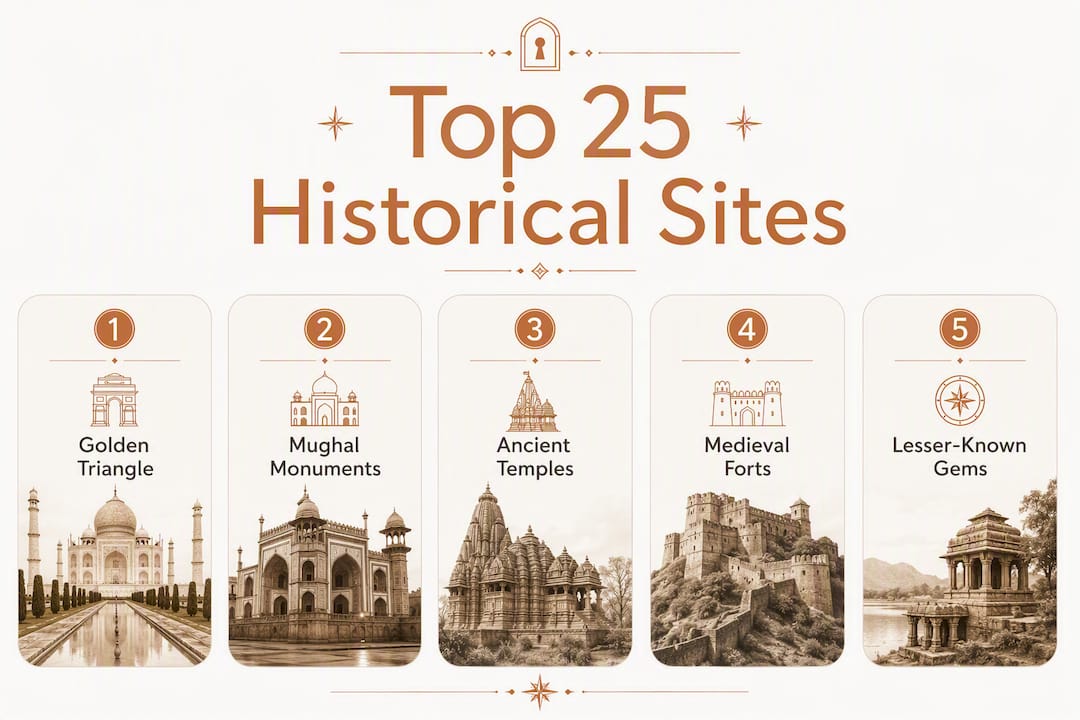
Top historical places in India, organized by region
North India: Delhi and Agra
Delhi is the densest concentration of historical monuments in India. Three UNESCO sites sit within the city limits.
- Red Fort (Lal Qila): Built by Shah Jahan in 1639, this sandstone fortress fuses Persian, Timurid, and Hindu architectural traditions. The Diwan-i-Aam (Hall of Public Audiences) and the Rang Mahal are the interior highlights. UNESCO-listed. Best visited in the morning before tour groups arrive. Allow 2–3 hours. Entry via the Lahori Gate.
- Qutub Minar: A 73-meter minaret begun in 1193 CE by Qutb ud-Din Aibak, making it the oldest surviving Islamic monument of its scale in India. The surrounding Qutub Complex includes the Alai Darwaza and the Iron Pillar, a 4th-century metallurgical marvel that has not rusted in 1,600 years. UNESCO-listed. Allow 1.5–2 hours.
- Humayun’s Tomb: Completed in 1572, this was the first garden-tomb in the Indian subcontinent and the direct architectural model for the Taj Mahal. UNESCO-listed. Quieter than the Taj, and often more photogenic at golden hour. Allow 1.5–2 hours.
Agra holds three UNESCO sites within 40 km of each other.
- Taj Mahal: Built by Shah Jahan between 1632 and 1653 as a mausoleum for his wife Mumtaz Mahal. The Taj Trapezium Zone covers roughly 10,400 sq km as an environmental protection area, restricting industrial activity and vehicle access near the monument. Sunrise is the best time: softer light, smaller crowds, and the marble shifts from pink to white as the sun rises. Strict entry rules apply — no food, no tobacco, no large bags. Allow 2–3 hours. Closed on Fridays.
- Agra Fort: The Mughal power center before Shah Jahan moved the capital to Delhi. The Diwan-i-Khas (Hall of Private Audiences) and the Musamman Burj — where Shah Jahan reportedly spent his final years gazing at the Taj — are the emotional highlights. UNESCO-listed. Allow 2 hours.
- Fatehpur Sikri: Akbar’s short-lived sandstone capital, built in 1571 and abandoned around 1585, likely due to water scarcity. The Buland Darwaza (Gate of Magnificence) is one of the largest gateways in the world. UNESCO-listed. 35 km from Agra; best combined with an Agra day or as a stop en route to Jaipur. Allow 2–3 hours.
West India: Gujarat and Rajasthan
- Dholavira (Gujarat): A major Harappan city on Khadir Island in the Rann of Kutch, occupied from roughly 3000 to 1500 BCE. The site reveals a three-part city plan (citadel, middle town, lower town) and an extraordinary rainwater harvesting system of reservoirs and channels. UNESCO-listed since 2021. Remote but rewarding; the nearest airport is Bhuj (220 km). Allow a full day.
- Champaner-Pavagadh (Gujarat): A UNESCO-listed archaeological park containing a 16th-century sultanate capital alongside a hilltop Hindu temple that predates it. The combination of Islamic and Hindu architecture on a single hill is rare anywhere in the world. Allow 4–5 hours.
- Hill Forts of Rajasthan: Six forts — Chittorgarh, Kumbhalgarh, Ranthambore, Gagron, Amber, and Jaisalmer — are collectively UNESCO-listed. Amber Fort near Jaipur is the most visited; Kumbhalgarh, with its 36-km perimeter wall (often called the “Great Wall of India”), is the most dramatic.
Central India: Madhya Pradesh and Bihar
- Bhimbetka Rock Shelters (Madhya Pradesh): Paintings and artifacts here indicate human habitation from at least 30,000 years ago. The shelters contain more than 700 rock paintings across a forested sandstone landscape. UNESCO-listed. 45 km south of Bhopal. Allow 2–3 hours with a guide.
- Sanchi (Madhya Pradesh): The Great Stupa at Sanchi, commissioned by Emperor Ashoka in the 3rd century BCE, is the oldest stone structure in India. The carved toranas (gateways) are among the finest examples of early Buddhist art. UNESCO-listed. 46 km from Bhopal. Allow 2–3 hours.
- Khajuraho (Madhya Pradesh): The Chandela dynasty’s 10th–11th century temple complex is famous for its erotic sculptures, but the architectural precision and the sheer density of carvings across 20 surviving temples is what actually impresses on-site. UNESCO-listed. Allow a full day.
- Nalanda (Bihar): The ruins of Nalanda Mahavihara, a Buddhist monastic university active from the 5th to 12th century CE, cover a vast excavated campus. At its peak, Nalanda housed thousands of monks and scholars from across Asia. UNESCO-listed since 2016. 90 km from Patna. Allow 3–4 hours.
South India: Karnataka, Tamil Nadu, and Kerala
- Hampi (Karnataka): The capital of the Vijayanagara Empire (14th–16th century CE) is now a UNESCO-listed archaeological landscape with more than 1,600 surviving monuments, including the Virupaksha Temple, Vittala Temple (with its famous stone chariot), royal enclosures, and an elaborate water-supply system. The site covers thousands of hectares across a boulder-strewn landscape. Allow 2–3 full days. Bicycles and auto-rickshaws are the practical way to cover ground.
- Mysore Palace (Karnataka): The official residence of the Wadiyar dynasty, rebuilt in its current Indo-Saracenic form in 1912. The interior — stained glass, carved wooden ceilings, and a Durbar Hall with a painted ceiling — is among the most ornate in India. One of the country’s most visited buildings. Allow 2–3 hours. The palace is illuminated on Sunday evenings and during Dasara.
- Great Living Chola Temples (Tamil Nadu): Three temples — Brihadisvara at Thanjavur, Brihadisvara at Gangaikondacholapuram, and Airavatesvara at Darasuram — are UNESCO-listed and still active places of worship. The Thanjavur temple’s 66-meter vimana (tower) was built without mortar in the 11th century. Allow a full day for Thanjavur; the other two are best combined on a day trip.
Colonial-era landmarks
- Gateway of India (Mumbai): Built to commemorate King George V’s 1911 visit, this basalt arch on the Mumbai waterfront is the city’s defining image. The last British troops departed through it in 1948. Allow 30–45 minutes; combine with a ferry to Elephanta Caves.
- India Gate (Delhi): A 42-meter war memorial designed by Edwin Lutyens, completed in 1931, honoring 70,000 Indian soldiers who died in World War I. The Eternal Flame beneath it was added in 1972. Best visited at dusk. Allow 30–45 minutes.
Lesser-known sites that reward serious history enthusiasts
The headline monuments draw the crowds. These sites draw the people who actually want to understand India.
Mandu (Madhya Pradesh) sits on a plateau in the Vindhya Range and contains the ruins of the Malwa Sultanate’s 15th-century capital: the Jahaz Mahal (Ship Palace), Hindola Mahal, and the Hoshang Shah’s Tomb, which is believed to have been studied by the architects of the Taj Mahal. The site is rarely crowded, the landscape is dramatic, and the combination of Afghan-style architecture with a jungle setting is unlike anything else in India. Allow a full day; best visited October through March.
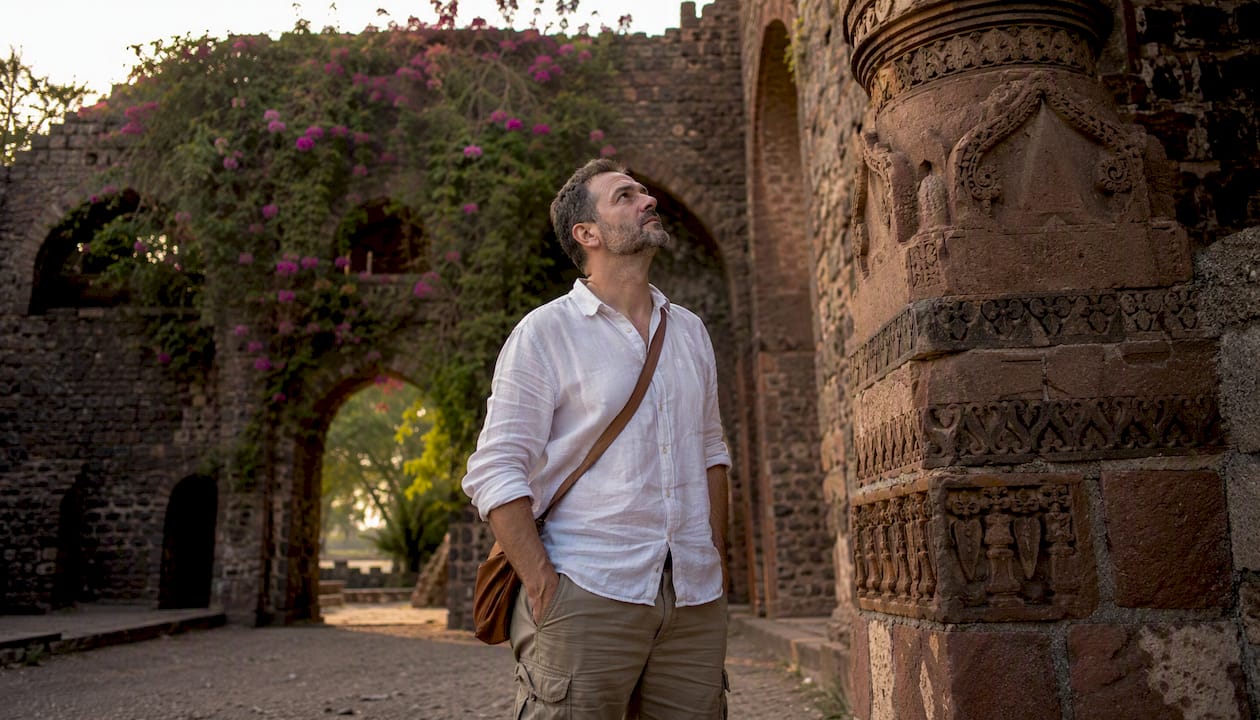
Vijayapura / Bijapur (Karnataka) contains the Gol Gumbaz, whose dome is the second largest in the world after St. Peter’s Basilica in Rome. The whispering gallery effect inside the dome is one of the more surprising acoustic experiences at any monument anywhere. The Ibrahim Rauza, a mausoleum that some scholars believe influenced the Taj Mahal’s design, is a short drive away. Allow 4–5 hours.
Pattadakal (Karnataka) is a UNESCO-listed complex of 8th-century Chalukya temples that shows the transition between northern Nagara and southern Dravidian architectural styles in a single site. Most visitors to Hampi never make the 140-km detour, which means you often have it nearly to yourself. Allow 2–3 hours.
Champaner-Pavagadh (Gujarat) deserves a second mention here because it is genuinely undervisited. The Jama Masjid at Champaner is one of the finest examples of pre-Mughal Islamic architecture in India, and the cable car up to the Kalika Mata Temple on the hilltop adds a pilgrimage dimension that makes the visit feel layered in a way that purely archaeological sites rarely do.
Elephanta Caves (Maharashtra): A short ferry from Mumbai, these 5th–8th century rock-cut Hindu temples contain the Trimurti sculpture — a three-faced depiction of Shiva that is one of the greatest works of Indian sculpture. UNESCO-listed. The ferry ride itself is part of the experience. Allow 2–3 hours on the island.
Pro Tip: At any of these lesser-visited sites, hire a local Archaeological Survey of India-licensed guide rather than relying on audio guides or apps. At Mandu and Pattadakal especially, the guides carry physical reference books with comparative architectural drawings that make the carvings legible in ways that no app currently replicates. Budget an extra hour for the conversation — it is usually the best part of the visit.
How to combine sites into efficient regional itineraries
Sample itineraries by trip length
1-day options (single city):
- Delhi circuit: Red Fort (morning) → Qutub Minar (midday) → Humayun’s Tomb (late afternoon). Three UNESCO sites, one city, one day.
- Agra day: Taj Mahal at sunrise → Agra Fort (mid-morning) → Fatehpur Sikri (afternoon, en route back to Delhi or Jaipur).
3-day Golden Triangle (Delhi–Agra–Jaipur):
- Day 1: Delhi (Red Fort, Qutub Minar, Humayun’s Tomb)
- Day 2: Agra (Taj Mahal at sunrise, Agra Fort, Fatehpur Sikri)
- Day 3: Jaipur (Amber Fort, City Palace, Jantar Mantar)
7-day classic heritage loop:
- Days 1–2: Delhi (full circuit including India Gate)
- Day 3: Agra (Taj Mahal, Agra Fort)
- Day 4: Fatehpur Sikri → overnight Aurangabad (flight or overnight train)
- Days 5–6: Ajanta Caves (Day 5), Ellora Caves (Day 6)
- Day 7: Flight to Bangalore → Hampi (overnight bus or drive)
10–14 day deep-history circuit:
- Days 1–2: Delhi
- Day 3: Agra and Fatehpur Sikri
- Day 4: Fly to Bhopal → Bhimbetka (afternoon) → Sanchi (late afternoon)
- Day 5: Khajuraho (fly or train from Bhopal)
- Day 6: Fly to Patna → Nalanda (afternoon)
- Day 7: Fly to Aurangabad → Ellora Caves
- Day 8: Ajanta Caves
- Day 9: Fly to Bangalore → Hampi (drive or overnight)
- Days 10–11: Hampi (two full days)
- Day 12: Pattadakal and Bijapur (Vijayapura) en route south
- Day 13: Mysore Palace
- Day 14: Fly from Mysore or Bangalore
Transit time reference table
| Route | Typical transit time | Best transport option |
|---|---|---|
| Delhi → Agra | 2 hours | Gatimaan Express or Shatabdi train |
| Agra → Fatehpur Sikri | 45 minutes | Private car |
| Agra → Jaipur | 4–5 hours | Private car or train |
| Delhi → Aurangabad | 2 hours | Direct flight |
| Aurangabad → Ajanta Caves | 1.5 hours | Private car or state bus |
| Aurangabad → Ellora Caves | 30 minutes | Private car or auto-rickshaw |
| Bangalore → Hampi | 5–6 hours | Private car or overnight bus |
| Hampi → Mysore | 5 hours | Private car via Hospet |
| Bhopal → Bhimbetka | 45 minutes | Private car |
| Patna → Nalanda | 1.5 hours | Private car or bus |
| Bhuj → Dholavira | 2–3 hours | Private car (only practical option) |
Train travel is the most comfortable and cost-effective way to cover the Delhi–Agra–Jaipur triangle and the Bhopal–Khajuraho corridor. Book through Indian Railways’ official IRCTC portal well in advance, especially for sleeper and AC classes during October through March. Flights make sense for longer jumps (Delhi to Aurangabad, Bangalore to Hampi’s nearest airport at Hubli). Private transfers are the only realistic option for Dholavira, Bhimbetka, and the Hampi–Mysore leg.
Pro Tip: The Ajanta–Ellora–Aurangabad loop works best with two nights in Aurangabad: Ellora on arrival day (it is closer), Ajanta the next morning when the light enters the cave paintings most directly. Reversing the order means arriving at Ajanta in flat afternoon light, which flattens the frescoes.
Practical visiting advice: tickets, timing, etiquette, and access
Ticketing and entry
The Archaeological Survey of India manages most major monuments. Tickets for the Taj Mahal, Agra Fort, Red Fort, Qutub Minar, and Humayun’s Tomb can be purchased online through the ASI’s official portal or at the gate, though online booking is strongly recommended during October through March. The Taj Mahal has a separate photography permit for the mausoleum interior.
Prohibited items at major ASI monuments typically include food, tobacco, tripods, and large bags. The Taj Mahal enforces these rules strictly, with bag storage available at the entry gates. Always check the specific site’s current rules before visiting, as restrictions change.
Best times to visit
October through March is the dry season and the most comfortable window for visiting North and Central India. South India (Hampi, Mysore, Tamil Nadu) is manageable year-round, though April through June brings intense heat. The monsoon (July through September) makes Hampi and Mandu dramatically beautiful but can disrupt access to remote sites like Dholavira.
For photography and crowd avoidance, sunrise visits are the standard recommendation at the Taj Mahal, Hampi’s Virupaksha Temple, and Mysore Palace (on illuminated evenings). Mid-morning works better for cave sites like Ajanta and Ellora, where natural light enters the caves at specific angles. Museum-style sites like Nalanda are best in the morning before the heat peaks.
On-site etiquette and responsible travel
At active religious sites — the Golden Temple, Mysore Palace during Dasara, and any functioning temple complex — dress modestly. Cover shoulders and knees, and remove shoes before entering temple sanctuaries. The Golden Temple requires covering your head; scarves are available at the entrance.
Photography rules vary. Most ASI monuments permit photography of exteriors; interior photography at the Taj Mahal mausoleum requires a paid permit. Flash photography is prohibited in the Ajanta caves to protect the ancient pigments.
Large archaeological landscapes like Hampi and Ajanta/Ellora demand physical stamina. Hampi’s core zone alone covers several kilometers of uneven terrain. Wear sturdy footwear, carry water, and plan for 4–6 hours of walking per day across multiple sub-sites. A bicycle or auto-rickshaw is not optional at Hampi — it is the only way to cover the site without exhaustion.
Conservation matters at sites like Hampi, which has previously been listed as endangered due to development pressures. Stay on marked paths, do not touch cave paintings, and avoid purchasing items from unlicensed vendors inside protected zones.
How a bespoke itinerary elevates heritage visits
Visiting India’s historical sites independently is entirely possible. But the difference between a competent visit and a genuinely memorable one often comes down to access, timing, and interpretation — and that is where professional curation changes the equation.
The specific advantages that matter most at heritage sites:
- Conservation-minded operations: — Working with vetted providers who follow ASI guidelines and avoid unlicensed access reduces visitor impact at fragile sites. This matters most at Ajanta, where the cave paintings are genuinely at risk from humidity generated by large visitor groups.
Balanced itineraries that pair headline monuments with quieter, context-rich sites — Nalanda alongside Bodh Gaya, Ajanta alongside Ellora, a lesser fort alongside Amber — deliver deeper learning and a more rewarding experience than any single-monument focus. The contrast between a crowded UNESCO icon and an empty archaeological site visited the next morning is itself part of the education.
For travelers who want private guided tour benefits at sites like Hampi or Ajanta, the logistics of specialist guides, timed entry, and private transport are the difference between a surface visit and a genuinely immersive one. Hiddendoortravel’s approach to luxury cultural immersion is built around exactly this kind of layered access.
Key Takeaways
India’s historical sites reward travelers most when visits are clustered by region, timed for early morning, and paired with specialist guides who can make the layers of history legible.
| Point | Details |
|---|---|
| Start with the Golden Triangle | Delhi, Agra, and Jaipur cover six UNESCO sites in five days and suit first-time visitors. |
| Add depth with prehistoric sites | Bhimbetka and Dholavira document 30,000+ years of history that most India itineraries skip entirely. |
| Time visits for sunrise or early morning | The Taj Mahal, Hampi, and Ajanta all reward early arrival with better light and smaller crowds. |
| India has many UNESCO World Heritage Sites | No other Asian country matches that count; use UNESCO status as a baseline quality filter when planning. |
| Hiddendoortravel builds bespoke heritage itineraries | Private guides, timed access, and specialist transport for remote sites like Dholavira and Mandu are core to the service. |
What most India itineraries get wrong
The conventional wisdom on visiting India’s historical places is to do the Golden Triangle and call it done. That is a reasonable first trip. But it leaves travelers with a Mughal-centric picture of a civilization that was producing sophisticated urban planning 4,000 years before Shah Jahan laid the first stone of the Taj Mahal.
The sites that reframe the whole story are the ones that require effort: Bhimbetka, where you stand in front of a 30,000-year-old handprint and realize the subcontinent’s human story is almost incomprehensibly long. Dholavira, where the grid-planned streets and reservoir system of a Bronze Age city make the Harappans feel startlingly modern. Nalanda, where the scale of the excavated university campus makes it viscerally clear why scholars traveled from China and Korea to study here.
The other thing most itineraries get wrong is pace. Hampi cannot be done in an afternoon. Ajanta cannot be done in two hours. These are not single buildings — they are landscapes and complexes that require multiple days and multiple angles. Travelers who rush them come away with photographs and not much else. The ones who slow down, hire a specialist guide, and spend a second morning walking the same ground with different questions — those are the visits people talk about for years.
The practical implication: build in one or two “slow” days at a major site rather than moving every day. The itinerary that covers 12 sites in 10 days sounds impressive. The one that covers 8 sites well is the one worth taking.
Plan a bespoke heritage trip with Hiddendoortravel
India’s historical sites are among the most rewarding on earth, and also among the most logistically demanding. Getting from Dholavira to Nalanda to Hampi in a single trip, with the right guides at each stop and private transport for the remote legs, is not something a booking app handles well.

Hiddendoortravel designs bespoke heritage itineraries for travelers who want more than a checklist of monuments. The service covers:
- Conservation-minded access — through vetted, ASI-compliant operators who follow preservation protocols
The starting point is a consultation to match your time budget, historical interests, and travel style to a realistic itinerary. Request yours at hiddendoortravel.com/luxury-travel-experts.
Authoritative further reading and official resources
- UNESCO World Heritage Sites in India — the official inscription list with statements of significance for all 45 sites; the definitive reference for conservation status and boundary maps.
- Archaeological Survey of India — India’s primary authority on monument conservation and protection; lists ticketing information, prohibited items, and legal protections for all centrally protected monuments.
- Taj Mahal — UNESCO World Heritage Centre — official site page covering the Taj Trapezium Zone, conservation status, and entry regulations.
- Group of Monuments at Hampi — UNESCO World Heritage Centre — covers the full extent of the Hampi property, its endangered listing history, and current management plans.
- Red Fort Complex — UNESCO World Heritage Centre — architectural analysis and conservation notes for the Red Fort and its Mughal-era structures.
- 15 best historical places in India — Lonely Planet — practical travel notes on Ajanta, Ellora, Dholavira, and other key sites; useful for logistics and visitor tips.
- List of World Heritage Sites in India — Wikipedia — a comprehensive, regularly updated list of all 45 UNESCO sites with inscription dates and categories.