

Private archipelago access means legally authorized entry to islands that are privately owned, reserved for exclusive rental or buyout, or reachable only through permitted visits arranged by licensed operators. Three paths cover nearly every scenario: outright ownership, exclusive-use rental or resort buyout, and permitted visitation through a vetted operator. Each path carries its own permit requirements, transport logistics, and cost structure.
Before you commit to anything, confirm the island’s ownership and permit status, secure your transport (boat, seaplane, or helicopter), obtain the necessary permits or exclusive-use booking confirmation, and plan on-site logistics including power, fresh water, and medical evacuation capability. Agencies like NOAA and the U.S. Fish & Wildlife Service govern access to many U.S. island environments, and their rules apply regardless of who holds the land title.
- Confirm land title or exclusive-use agreement in writing before booking transport.
- Identify all permit-issuing authorities: federal (NOAA, U.S. Fish & Wildlife Service), state coastal commissions, local port/harbor masters, and tribal governments where applicable.
- Secure transport that matches the crossing distance: tender for short hops, helicopter or seaplane for anything beyond roughly 30 minutes of open water.
- Budget for on-site infrastructure: power generation, desalination, waste removal, and satellite communications.
- Build in a contingency timeline of at least 4–12 weeks for government or Indigenous approvals.
Pro Tip: For remote islands, treat access as a primary budgeting and risk item from day one, not something to sort out after the dates are locked.
Table of Contents
- What is a private archipelago and how do access models differ?
- Who owns islands and what rights do they actually have?
- What U.S. legal framework governs access to private islands?
- How do people actually get to and use private islands?
- What permits will you need and how long do they take?
- What does it cost to access a private island?
- How do you visit a private island responsibly?
- What safety and liability requirements should you confirm before travel?
- How does a bespoke luxury agency arrange private island access?
- Key Takeaways
- A perspective on what private island access actually demands
- Hiddendoortravel’s approach to private island access
- Useful sources and where to get official guidance
What is a private archipelago and how do access models differ?
A private archipelago is a group of islands where one or more islands are held under private title, long-term lease, or concession, distinguishing them from publicly administered island chains where any visitor can arrive freely. The distinction matters because the access model determines everything downstream: what permits you need, what you pay, and how much flexibility you have once you arrive.
The main access models travelers encounter:
Outright ownership. A private individual or corporation holds fee-simple title to the island. Access is at the owner’s discretion, though adjacent navigable waters and foreshore areas may still carry public rights.
Long-term lease or concession. A government or regional authority grants a private operator the right to develop and manage an island for a fixed term. The operator controls access within the terms of the concession.
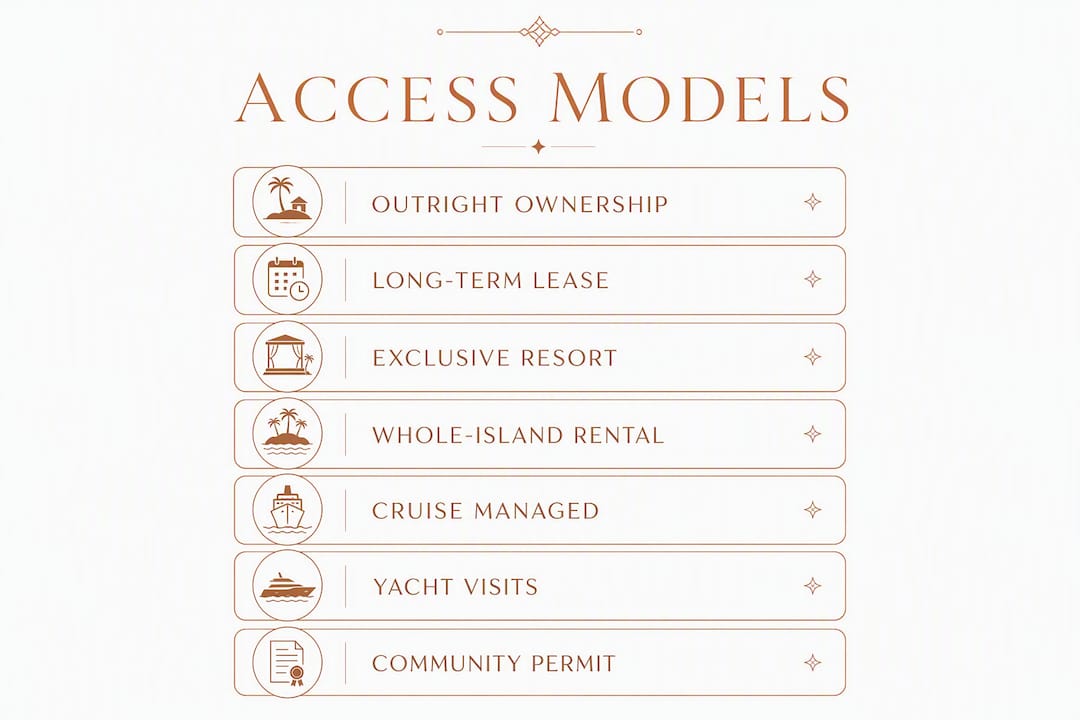
Exclusive-use resort buyout. A resort or lodge occupies a private island and rents the entire property to a single party for a defined period. Exclusive-use rentals provide complete control over the property during the stay, including dedicated staff, private chefs, and tailored itineraries. Little Palm Island in Florida is a well-known U.S. example of this model: a private-resort island where guests access the property exclusively through the resort’s own transfer system.
Whole-island rental. Similar to a buyout but applied to a standalone private island rather than a resort campus.
Cruise-operator or resort-managed private islands. Major cruise lines own or lease islands in the Bahamas and Caribbean, managing access entirely through their own port infrastructure.
Yacht or charter visits with anchorage permissions. A private yacht or chartered vessel anchors offshore and guests access the island by tender, subject to port authority and landowner permission.
Community or Indigenous-managed permit access. Some archipelagos are governed by Indigenous communities that issue their own entry permits and set visitor limits. The Guna Yala (San Blas) archipelago in Panama operates this way, requiring licensed operators and community entry fees paid directly to the Guna people.
The access model you choose shapes every other decision, from the permits you file to the insurance you carry.
Who owns islands and what rights do they actually have?
Private island ownership is more constrained than most buyers expect. Fee-simple title gives an owner control over the land surface and the structures on it. What it rarely conveys is control over the water surrounding the island, the foreshore at low tide, or subsurface mineral rights.
Common ownership structures include:
- Fee-simple private title: The most straightforward form. The owner holds the land outright, subject to local zoning, environmental regulations, and any easements recorded at purchase.
- Corporate-owned islands: A company holds title, often for resort development or investment purposes. Access is managed through the corporate entity’s booking or permitting process.
- Lease or concession from national/regional authorities: Common in the Pacific, Caribbean, and Southeast Asia. The leaseholder controls development and visitor access but does not own the underlying land.
- Indigenous or community-held islands: Governed by tribal law or community governance structures. Visitors must obtain permission from the community, not just a government agency.
The public trust doctrine is the most important legal concept for U.S. travelers to understand. Under this doctrine, navigable waters and tidal areas remain accessible to the public even when the upland is privately owned. A landowner cannot legally block a vessel from anchoring in navigable water adjacent to a private island, nor can they prevent passage along the foreshore below the mean high-water mark in most U.S. states.
Little Palm Island, off the Florida Keys, illustrates how this plays out in practice. The resort controls access to its upland property and manages all guest transfers, but the surrounding waters remain subject to Florida’s coastal regulations and federal navigational rules. Guests arrive exclusively through the resort’s own ferry service, which is both a hospitality choice and a practical enforcement of the property boundary.

Pro Tip: Always request the charter or title packet and recent permitting correspondence before finalizing any exclusive-use agreement. Gaps in that documentation are the most common source of access disputes.
What U.S. legal framework governs access to private islands?
Access to a U.S. private island depends on land title plus adjacent water rules, and in practice that means overlapping federal, state, and tribal authorities all have a say. Treating this as a single-agency problem is the most common planning mistake.
Primary authorities to consult:
- NOAA governs marine protected areas, navigational guidance, and National Marine Sanctuaries. Any island within or adjacent to a sanctuary requires NOAA clearance before anchoring or landing.
- U.S. Fish & Wildlife Service (USFWS) administers National Wildlife Refuges. Many island chains in Alaska, Hawaii, and the Florida Keys fall within refuge boundaries where landing restrictions apply year-round or seasonally.
- State coastal commissions and state park authorities regulate shoreline development, public beach access, and coastal zone management. California’s Coastal Commission, Florida’s Department of Environmental Protection, and similar bodies in Hawaii and the Pacific territories each have their own permit frameworks.
- Local port and harbor masters control docking, anchoring, and vessel traffic in their jurisdictions. Written clearance from the harbor master is a practical prerequisite for any private-island arrival by sea.
- Tribal governments hold sovereign authority over tribal lands and adjacent waters in many regions. In Alaska, Hawaii, and parts of the Pacific, Indigenous governance structures operate independently of state and federal frameworks.
The public trust doctrine (discussed above) means that beaches and foreshore areas below the mean high-water mark typically remain publicly accessible in most U.S. states, even when the upland is private. Some states, including Hawaii, extend public access rights further than the federal baseline.
Enforcement triggers that travelers consistently underestimate: landing on an island without written permission from the landowner or managing agency, disturbing protected species (triggering Endangered Species Act liability), and biosecurity breaches such as introducing invasive species. Penalties range from civil fines to criminal charges depending on the severity and jurisdiction.
Documents to request before travel:
- Current land title or lease agreement
- Active permits from NOAA, USFWS, and relevant state agencies
- Environmental assessment or impact study (required for many island developments)
- Written tribal clearance where applicable
- Port authority docking authorization
Pro Tip: For U.S. archipelagos, obtain written clearance from relevant tribal authorities and port/harbor officials before committing to any boat or airlift booking. Verbal assurances do not hold up if enforcement arrives.
How do people actually get to and use private islands?
Transport to a private island is not a detail to finalize last. The crossing method determines guest comfort, operational cost, and the island’s viability as a repeatable destination. Private island real estate analysis identifies three broad access models: tender-only, tender plus helipad, and private airstrip, with each tier representing a significant step up in capital investment and operational capability.
Primary transport options:
- Tender or short boat transfer: Appropriate for islands within 15–20 minutes of a marina or resort dock. Low cost, weather-dependent, and limited to calm-water conditions.
- Private yacht or charter vessel: Guests live aboard and access the island by tender. Offers flexibility for island hopping across an archipelago but requires anchorage permissions at each stop.
- Seaplane: Faster than a boat for crossings of 20–60 minutes, requires a calm-water landing zone, and is sensitive to wind and swell conditions.
- Helicopter: The most flexible option for remote islands. Not dependent on sea state, can land on a small helipad, and reduces transfer time to minutes. Higher per-trip cost.
- Private airstrip: The gold standard for islands with sufficient land area. Allows larger aircraft, more guests, and heavier provisioning loads. Maintenance of a grass or paved strip is a significant ongoing cost.
On-site infrastructure is where many island experiences fall short of expectations. Power generation (diesel generators or solar arrays with battery backup), desalination or rainwater collection for fresh water, waste management and removal, and satellite or microwave communications are not optional for a comfortable stay. They are the baseline. The Seychelles private-island model, where high staff-to-guest ratios and on-island conservation programs drive nightly rates, illustrates how infrastructure investment directly shapes the guest experience and cost structure.
Practical arrival planning also requires attention to weather windows, daylight-dependent landings (especially for seaplanes and helicopters), and tide-dependent docking at islands with shallow approaches.
Pro Tip: When the open-water crossing exceeds roughly 30 minutes, prioritize airlift for guest comfort. Long boat crossings in variable conditions are the single most common source of negative guest feedback on remote-island stays.

What permits will you need and how long do they take?
Expect multiple permits and a combined lead time measured in weeks to months. The exact timeline depends on jurisdiction, environmental sensitivity, and whether Indigenous governance is involved. A standard private-resort booking at a property like Little Palm Island requires no independent permit work from the guest. A visit to a restricted or protected archipelago is a different matter entirely.
Common permit types:
- Landing and anchorage permits from port/harbor authorities
- Protected-area permits from NOAA (National Marine Sanctuaries) or USFWS (National Wildlife Refuges)
- Tribal or Indigenous community access permits
- State park or marine reserve passes
- Customs and immigration clearances for international archipelagos
- Biosecurity and agricultural inspection approvals
Typical timelines by scenario:
- Standard private-resort booking (e.g., exclusive-use buyout at an established resort): Permit work is handled by the operator. Guest lead time: days to 2 weeks for confirmation.
- Chartered yacht visit to a U.S. protected archipelago: Port authority and NOAA/USFWS clearances required. Allow 2–6 weeks.
- Visit requiring tribal or Indigenous approvals: Timelines vary widely. Some communities process requests in 2–3 weeks; others require formal applications reviewed at community meetings, which can push timelines to 8–12 weeks or longer.
- International restricted archipelago (e.g., Mergui Archipelago in Myanmar): Special permits, visa checks, and registered tour companies are legally required. Allow 6–12 weeks minimum, and use only licensed operators with standing relationships in the region.
- Emergency or short-notice charter: Possible with licensed operators who maintain pre-approved access agreements, but expect surcharges and reduced destination flexibility.
Permit application checklist:
- Passport copies and vessel documentation for all travelers
- Detailed itinerary with GPS coordinates for planned anchorages and landings
- Proof of liability insurance for vessel and guests
- Environmental compliance statement or prior environmental assessment
- Letters of introduction from local operators or sponsors where required (some restricted regions, including certain Indian Ocean archipelagos, require authorized sponsors and regional entry fees)
What does it cost to access a private island?
Buying is capital-heavy; exclusive rentals and buyouts shift costs to the booking party but still require provisioning and staffing budgets on top of the headline rate. The range is genuinely wide, and the variables that drive cost are transport infrastructure, staffing ratios, and the island’s distance from supply chains.
Exclusive-use resort buyout (per night): Prices start at different levels depending on the property and region. For example, Tesoro Island Resort offers whole-island rentals with rates from their published starting prices; each resort sets its own minimums and inclusions.
| Helicopter transfer (round trip, per group) | Varies by distance and aircraft type; budget as a separate line item |
| Staffing and provisioning (per day) | Scales with guest count and staff-to-guest ratio |
| Fuel and generator costs | Significant for islands without shore power; depends on consumption and fuel delivery logistics |
| Desalination and water supply | Ongoing operational cost; higher for islands without reliable rainfall |
| Waste removal | Requires scheduled boat or helicopter runs; often overlooked in initial budgets |
| Liability and marine insurance | Required by most operators; varies by coverage scope |
| Permitting fees | Typically modest individually; can accumulate across multiple agencies |
| Conservation or community contributions | Increasingly standard in purpose-driven luxury models |
For buyers, ongoing operating costs include airstrip or dock maintenance, generator and solar array replacement cycles, desalination plant servicing, and satellite link subscriptions. These are not discretionary. An airstrip that hasn’t been maintained is a liability, not an asset. Industry brokers and listing platforms can provide market-rate comparisons and buyer guides that help contextualize acquisition costs against rental alternatives.
For renters and buyout clients, the most useful budgeting exercise is requesting the last 12 months of maintenance invoices for transport infrastructure and an itemized provisional budget from the operator before signing.
Pro Tip: Require suppliers to provide recent maintenance invoices for airstrips, docks, and generators alongside the booking contract. An operator who hesitates to share that documentation is telling you something important.
How do you visit a private island responsibly?
Visiting responsibly means following permit rules, respecting Indigenous governance, minimizing waste and biosecurity risks, and contributing to local conservation where appropriate. This is not optional etiquette. In many jurisdictions, violations carry legal consequences, and in Indigenous-governed archipelagos, breaches of community rules can result in immediate removal and permanent bans.
Practical behaviors that matter:
- Biosecurity checks before departure: Remove soil, seeds, and organic material from footwear and gear. Invasive species introductions are irreversible and are the leading cause of biodiversity loss on island ecosystems.
- No-take rules for marine life: Respect all fishing and collection prohibitions. These apply even to guests on exclusive-use properties in many marine protected areas.
- Controlled landing areas: Land only at designated points. Uncontrolled landings disturb nesting birds, damage coral, and trigger enforcement.
- Guest number limits: Many permits specify maximum visitor counts. Exceeding them voids the permit and exposes the operator to liability.
- Transparent payment of local access and community fees: Pay fees directly to the designated community authority, not through intermediaries who may not pass funds along.
The luxury private-island model is shifting. In the Seychelles, high-end operators now tie stays explicitly to conservation outcomes, funding turtle monitoring, coral restoration, and invasive species removal as part of the guest experience. This model is spreading. Sweden’s Allemansrätten (Right of Public Access) offers a different lesson: even where private charters reach remote skerries beyond standard ferry routes, public access rights still apply to the foreshore, and operators must communicate those limits clearly to guests.
Pro Tip: Ask for a conservation briefing on arrival and request a written copy of any island-specific rules. Operators who provide this proactively are the ones worth booking again.
What safety and liability requirements should you confirm before travel?
Confirm medevac capability, reliable communications, and clear liability coverage before travel. These are non-negotiable for any remote island stay, and the absence of any one of them should stop a booking.
Safety verification checklist:
- Medical provisions on-site: First aid kit at minimum; ideally a trained first responder or nurse for multi-day stays with large groups.
- Evacuation plan and contractor: A named medevac provider with confirmed response times to the nearest hospital. For U.S. island territories, confirm whether the Coast Guard covers the area or whether a private air ambulance contract is required.
- Communications: VHF marine radio as baseline; satellite phone or Iridium-type device for islands beyond cellular range. Confirm backup power for communications equipment.
- Recent safety drills: Ask the operator when the last evacuation drill was conducted and request documentation.
- Local emergency contacts: Nearest coast guard station, harbor master, and hospital with trauma capability.
Insurance and waivers to request from operators:
- Proof of general liability insurance covering guest activities on the island
- Hull and crew cover for all vessels used in transfers
- Guest medical evacuation policy (confirm coverage limits and geographic scope)
- Written liability waiver that clearly defines the operator’s and guest’s respective responsibilities
On the traveler’s side, standard travel insurance rarely covers remote-island medical evacuation adequately. A dedicated travel protection plan with a high evacuation benefit and “adventure activity” coverage is worth the additional cost. Hiddendoortravel can advise on appropriate coverage options as part of the trip planning process.
Pro Tip: Request the operator’s insurance certificates before the final payment deadline, not after. If coverage lapses or limits are inadequate, you want time to negotiate or walk away.
How does a bespoke luxury agency arrange private island access?
Agencies centralize permissions, logistics, and supplier vetting so the traveler receives one confirmed arrival plan rather than a stack of fragmented approvals from different authorities. For a private archipelago visit, that coordination function is where most of the value lies.
Step-by-step process a bespoke agency follows:
- Initial feasibility check: Confirm the island’s availability, ownership status, and whether the desired access model (buyout, charter, permit visit) is legally and logistically achievable within the client’s timeframe.
- Documentation requests: Obtain title or lease documentation, current permits, environmental assessments, and insurance certificates from the island operator or owner.
- Local partner engagement: Identify and vet licensed local operators, harbor masters, and community liaisons. In restricted regions like the Mergui Archipelago, this step is legally required and practically essential.
- Permit applications: File applications with all relevant authorities (NOAA, USFWS, state agencies, tribal governments, port authorities) and track approval timelines against the client’s travel dates.
- Transport and infrastructure confirmation: Book and confirm all transfer legs (boat, helicopter, seaplane, or private aircraft), verify on-site infrastructure status, and arrange provisioning.
- Contingency planning: Identify backup dates, alternative landing sites, and emergency protocols. Build weather windows into the schedule.
- Final confirmations and briefing: Deliver a single consolidated arrival plan to the client, including all permit copies, emergency contacts, and on-site rules.
What to expect on fees and deliverables:
- A bespoke agency charges a planning fee or service retainer, plus commissions from vetted suppliers. The planning fee covers the research, permit coordination, and supplier vetting described above.
- Deliverables include a confirmed itinerary, all permit documentation, transport bookings, and a written emergency protocol.
- Timelines for the full process range from a few weeks for straightforward resort buyouts to several months for restricted or Indigenous-governed archipelagos.
The personalized service model that a bespoke agency provides is particularly valuable here because private-island access involves supplier relationships that take years to build. An agency with standing relationships in a region can often secure access that is not publicly listed and can navigate permit delays that would stop an independent traveler entirely. For clients designing a multi-destination trip that includes a private-island component, the agency also coordinates the island visit within the broader itinerary so that transfer timing, provisioning, and contingency plans align across every leg.
Key Takeaways
Accessing a private archipelago requires confirmed legal authorization, transport matched to the crossing, permits from multiple agencies, and safety infrastructure in place before arrival.
| Point | Details |
|---|---|
| Verify title and permits first | Confirm ownership status and all active permits from NOAA, USFWS, state, and tribal authorities before booking transport. |
| Budget transport as a core line item | Crossing distance determines whether a tender, seaplane, or helicopter is required. Each option is priced separately; actual rates vary by region and operator. |
| Allow several weeks to months for approvals | Government and Indigenous permit timelines vary widely; short-notice access is possible but carries surcharges and reduced destination flexibility. |
| Confirm safety and evacuation capability | Require a named medevac provider, satellite communications, and proof of liability insurance before finalizing any remote-island booking. |
| Hiddendoortravel handles the full process | Hiddendoortravel coordinates permits, local operator vetting, transport, and contingency planning into one confirmed arrival plan for private-archipelago clients. |
A perspective on what private island access actually demands
The conventional framing of private island travel focuses on exclusivity and scenery. What it consistently underplays is the operational complexity that sits between “I want to go” and “I have arrived safely with everything confirmed.”
The permit layer alone surprises most travelers. It is not one permit from one agency. It is a sequence of approvals from overlapping authorities, some of which operate on their own timelines and have no obligation to align with your preferred travel dates. Tribal and Indigenous governance structures in particular deserve more respect than they typically receive in travel planning. These are sovereign entities with their own legal frameworks, and treating their approval as a formality is both legally risky and culturally wrong.
The infrastructure question is equally underestimated. Power, water, waste, and communications are the foundation of a comfortable stay on a remote island. An island that looks extraordinary in photographs but runs a single aging generator with no backup, no desalination redundancy, and no satellite communications is not a luxury destination. It is a liability. The shift toward conservation-integrated luxury, visible in the Seychelles model and increasingly elsewhere, is partly a response to this: operators who invest in proper infrastructure tend to also invest in environmental stewardship, because both require the same long-term thinking.
The travelers who have the best experiences on private islands are the ones who treat the access process as seriously as the destination itself. They verify documentation, they ask hard questions about safety, and they use operators with real standing relationships in the region. The ones who don’t are the ones who end up with a story about the trip that didn’t happen.
Hiddendoortravel’s approach to private island access
Private archipelago access is one of the most logistically demanding requests in luxury travel, and it is exactly where Hiddendoortravel’s bespoke planning model delivers the clearest advantage. Rather than handing you a list of permits to chase independently, Hiddendoortravel manages the entire process: ownership verification, permit applications across federal, state, and tribal authorities, licensed local operator procurement, transport booking, on-site infrastructure confirmation, and a written emergency protocol, all consolidated into a single arrival plan.

The agency is suited to affluent travelers and groups who value privacy, want confirmed access to destinations that are not publicly bookable, and are willing to pay professional planning fees for the certainty that every approval is in place before they travel. If you are considering a private-island or restricted-archipelago visit and want a feasibility review of your destination, timeline, and budget, contact Hiddendoortravel’s luxury travel experts to start the conversation.
Useful sources and where to get official guidance
The agencies and directories below are the appropriate starting points for permit research, market intelligence, and operator vetting.
| Resource | Purpose |
|---|---|
| NOAA Office of National Marine Sanctuaries | Permits and rules for U.S. marine protected areas and navigational guidance |
| U.S. Fish & Wildlife Service — National Wildlife Refuges | Landing and access rules for refuge islands; seasonal closures and permit applications |
| State coastal commissions (California, Florida, Hawaii, and Pacific territories) | Shoreline development permits, public access rules, and coastal zone management |
| Local port and harbor master offices | Docking, anchoring, and vessel traffic clearances for specific island approaches |
| Private Islands Online | Island listings, buyer guides, and broker resources for purchase and rental research |
| IYC Yachts — private island cost guide | Acquisition and ongoing operating cost overviews for prospective buyers |
For international archipelagos:
- Always verify visa and entry requirements through the destination country’s official embassy or consulate, not third-party travel guides.
- For Indigenous-governed archipelagos (Guna Yala, parts of the Pacific, and others), contact the community’s designated tourism authority directly or through a licensed local operator.
- In legally restricted regions such as the Mergui Archipelago, use only operators registered with the destination country’s tourism ministry and confirm their permit status in writing before paying any deposit.
This article provides general information about private island and archipelago access. It is not legal advice. Permit requirements, tribal governance rules, and environmental regulations change. Verify current requirements with the relevant primary agencies or a qualified legal professional before travel.