

The fastest way to get lounge access without elite status is a credit card that bundles Priority Pass Select or a proprietary network like Centurion or Chase Sapphire Lounges. If you’re not carrying one of those cards, your backup options are still solid: buy a day pass at an independent lounge, purchase an airline’s single-visit or annual club membership, or get added as an authorized user on someone else’s card.
Each route trades cost against reliability. A premium card costs the most upfront but pays off with frequent travel. Pay-per-entry lounges cost more per visit but require zero commitment. Authorized-user status is the cheapest fix if you already have a generous relative or partner. Here’s the quick math:
- Credit cards: most reliable for frequent flyers, but only if the card’s network covers your home airport.
- Priority Pass or similar memberships: wide but uneven coverage, subject to space availability.
- Pay-per-entry lounges: no commitment, best for occasional travel.
- Airline day passes or club memberships: strong if you’re loyal to one carrier.
- Authorized user access: the cheapest way to piggyback on someone else’s card.
Pro Tip: Check your existing wallet before buying anything. Some travelers already hold a card with lounge access and don’t realize it because they never activated the benefit.
Key Takeaways
Reliable lounge access without elite status comes down to matching one of five routes, credit cards, Priority Pass, pay-per-entry, airline passes, or authorized-user status, to your actual travel frequency and airports.
| Point | Details |
|---|---|
| Match route to frequency | Occasional flyers save money with pay-per-entry; frequent flyers benefit more from card-bundled or airline memberships. |
| Coverage beats price | A cheap card membership is worthless if its network doesn’t reach the airports you actually use. |
| Verify same-day rules | Nearly every lounge requires a same-day boarding pass, often within a three-hour departure window. |
| Capacity can override payment | Paid access, including Priority Pass and day passes, can still be denied when a lounge is full. |
| Guaranteed access needs planning | Groups, events, and complex itineraries call for advance arrangements rather than relying on card benefits alone. |
Table of Contents
- What Are the Main Ways to Get Airport Lounge Access Without Status?
- How Do Credit Cards Grant You Lounge Access?
- What Is Priority Pass and How Does Membership Work?
- When Should You Buy a Single Lounge Visit Instead?
- Are Airline Day Passes Worth It for Frequent Flyers?
- Can You Get Lounge Access as an Authorized User or Guest?
- Which Lounge Access Option Actually Fits Your Travel Pattern?
- When Does Guaranteed Access Matter More Than a Card Benefit?
- What Are the Real Limits of Non-Status Lounge Access?
- What Amenities Can You Access Without Any Lounge Membership?
- Get Guaranteed Access on Trips That Cannot Afford Uncertainty
- Michael’s Take: The Card Isn’t the Access, the Enrollment Is
- Sources
What Are the Main Ways to Get Airport Lounge Access Without Status?
There are six practical paths to a lounge door when you don’t have elite airline status, and most travelers end up combining two of them.
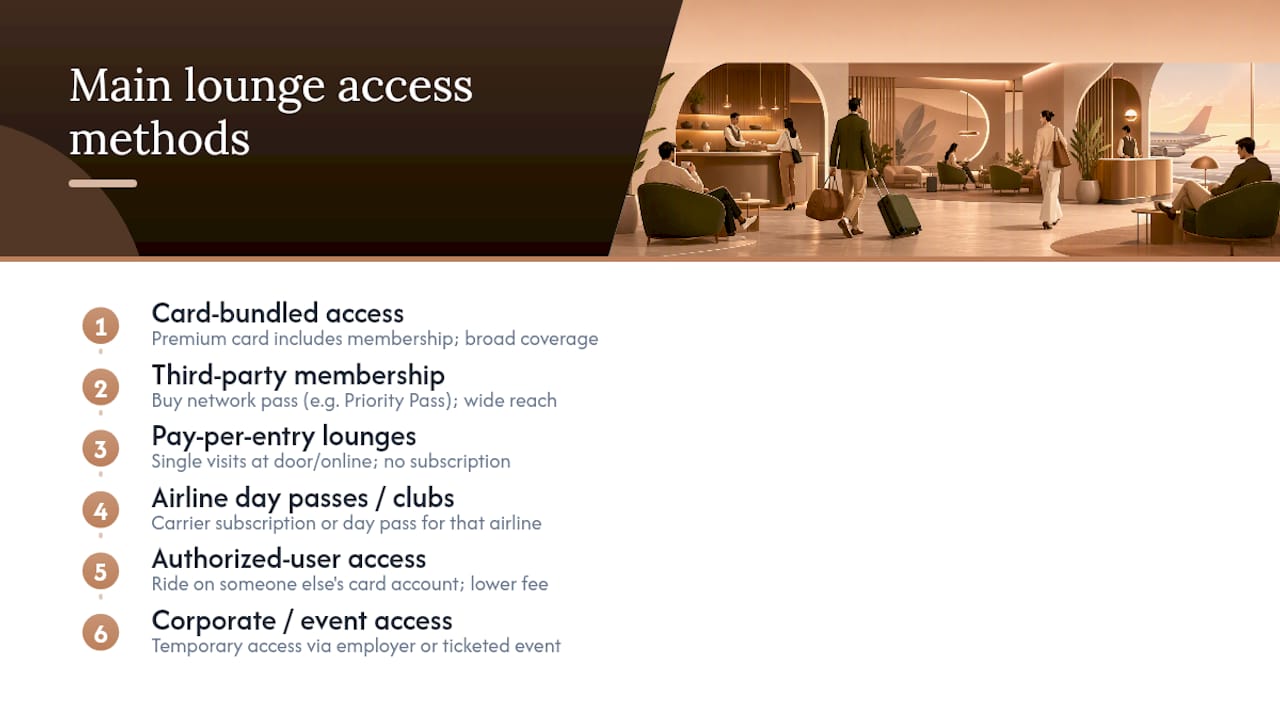
Card-bundled access comes from a premium credit card that includes a lounge membership or its own proprietary network. Third-party memberships like Priority Pass let you buy standalone entry to a large network of independent and partner lounges. Pay-per-entry lounges sell single visits at the door or online, no subscription required. Airline day passes and annual club memberships work like a subscription to one carrier’s own lounges. Authorized-user access rides on someone else’s card account for a fraction of the primary cardholder’s fee. And corporate or event-based arrangements occasionally grant temporary access through employers or ticketed experiences.
Every one of these routes shares the same fine print: you typically need a same-day boarding pass, you’re often required to arrive within a fixed window (commonly three hours) of your flight, and even paid access can get turned away when a lounge hits capacity.
If you fly often and always through the same two or three airports, skip ahead to the credit card section. If you fly rarely, the pay-per-entry section will save you money. If you’re weighing whether a card’s bundled Priority Pass is worth the annual fee, the comparison further down lays out the math.
How Do Credit Cards Grant You Lounge Access?
Premium travel cards buy lounge access two ways: they either hand you membership in an existing network, or they build their own private lounges you can only enter with that specific card.
The Chase Sapphire Reserve bundles Priority Pass Select access to more than 1,300 lounges worldwide, plus entry to Chase’s own Sapphire Lounges. Capital One Venture X pairs Priority Pass Select with Capital One’s growing lounge footprint in cities like Dallas, Denver, and Washington D.C. The American Express Platinum Card goes further with its Global Lounge Collection, anchored by the Centurion Lounge network, arguably the most consistently upscale lounges available to non-elite travelers in the U.S.
None of this access is automatic. Here’s the sequence that actually works:
- Enroll the benefit. Priority Pass Select membership tied to a card almost always requires you to activate it separately through the card’s online portal or the Priority Pass app.
- Carry the right documentation. Bring the physical or digital Priority Pass card issued after enrollment, plus your credit card, since some lounges check both.
- Show a same-day boarding pass. Nearly every lounge checks that you’re flying that day, typically within a three-hour window of departure.
- Confirm the lounge accepts your specific credential. A card can unlock Priority Pass membership, but the lounge checks the network membership itself, not the card, so an expired or unenrolled Priority Pass account gets you turned away even with the right card in hand.
Guest policies vary by card. Sapphire Reserve and Venture X generally include a set number of complimentary guests per visit through Priority Pass, while Amex Platinum’s Centurion access has historically tightened guest rules over the years, so check current terms before assuming your travel companion gets in free.
The real financial question is whether you’ll use the benefit enough to justify the fee. Experts generally agree that “free” lounge access isn’t actually free; it’s prepaid through the card’s annual cost. If a card runs $550 a year and a comparable day pass costs $32, you need roughly 17 visits to break even, though most of these cards bundle in enough other travel credits and perks that the lounge access alone doesn’t need to carry the entire fee.
Coverage matching matters more than the fee itself. A Priority Pass membership is only as good as the lounges near the airports you actually use, and domestic U.S. coverage tends to be thinner and more uneven in quality than international coverage. Some mid-tier cards include Priority Pass but charge $27 or more per guest, quietly eroding the value if you always travel with a partner.
What Is Priority Pass and How Does Membership Work?
Priority Pass is the largest independent lounge network in the world, and it comes in three membership tiers if you buy it directly rather than through a card: Standard, Standard Plus, and Prestige. Standard charges a fee per visit after enrollment, Standard Plus includes a set number of free visits annually before per-visit charges kick in, and Prestige includes unlimited visits for the highest annual fee. Pricing for standalone membership runs from roughly $99 to $469 a year depending on tier, separate from anything a credit card might already include.
Buying Priority Pass through a card versus purchasing it standalone changes what you’re actually getting. Card-bundled versions sometimes exclude the restaurant and retail credits that come with paid memberships, focusing purely on lounge entry. Read the fine print on your specific card before assuming you have the full membership experience.
Priority Pass lists more than 1,900 lounges and airport experiences globally, but access is subject to space availability, and pre-booking is only available at select locations, sometimes for an additional fee. A lounge listed in the app can still turn you away if it’s full, particularly during peak evening departure banks in major hub airports.
- Coverage is strongest internationally, especially in Europe and Asia.
- U.S. domestic coverage exists but skews toward smaller regional airports and lower-traffic terminals in some major hubs.
- Restaurant and retail credit perks (common at “Priority Pass restaurant” locations) are a different benefit than lounge access, and cards don’t always include both.
Standalone Priority Pass membership makes the most sense if you fly internationally several times a year but don’t want to carry a $550 annual-fee card. If you mostly fly domestically out of one or two airports, check the airline-specific and pay-per-entry sections below before committing.
When Should You Buy a Single Lounge Visit Instead?
Pay-per-entry lounges exist specifically for travelers who don’t want a subscription, and they’re often the smarter financial choice if you fly only a handful of times a year.
Plaza Premium operates independent lounges across dozens of international airports and several U.S. locations, selling walk-up and pre-booked day passes. Escape Lounges, common in U.S. airports like Boston, Austin, and Las Vegas, typically sell prebooked day passes at a fixed price, often in the $30 to $55 range. The Club and similar regional operators fill in gaps at smaller airports where the big networks don’t reach.

Booking in advance through a lounge’s own website or app usually locks in a lower price than paying at the door, and some operators offer partial refunds if your flight is delayed past the booking window, though policies vary enough that you should read the cancellation terms before paying.
Pay-per-entry works best in three scenarios: you’re facing one long layover and want a shower and a quiet place to work, you fly only two or three times a year and can’t justify an annual fee, or you’re departing from a domestic airport where Priority Pass coverage is thin. It doesn’t fix the coverage problem, since not every airport has an independent lounge to buy into.
Amenities vary widely. Some independent lounges offer full bars and hot buffets; others are little more than a quiet room with snacks and Wi-Fi. Guest rules differ too. Some day passes cover one guest at a flat additional price, while others charge full price per person.
Are Airline Day Passes Worth It for Frequent Flyers?
Airlines sell their own lounge access separate from elite status, and it’s worth considering if you’re loyal to one carrier and fly that airline’s hubs repeatedly, since annual club memberships can offer lasting value.
Several major U.S. carriers sell single-visit day passes for their branded clubs, typically running $50 to $95 depending on the lounge and airport. Annual memberships to airline-branded clubs run considerably higher, often $650 to $850 a year for an individual, with add-on options for a spouse or dependents.
- Access almost always requires same-day travel on that airline or a codeshare partner, unlike Priority Pass’s broader network.
- Guest policies differ from card-based access. Some airline club memberships include a fixed number of annual guest passes rather than unlimited companions per visit.
- A handful of clubs require reservations during peak hours, especially at hub airports during holiday travel.
For a traveler who flies the same airline out of the same hub twenty times a year, an airline club membership often beats a Priority Pass card because the lounges are more consistently available and closer to that carrier’s gates. For someone flying multiple airlines out of multiple cities, a broader network or a card-bundled membership makes more sense, since a single-airline pass is useless the moment you’re flying a competitor.
Can You Get Lounge Access as an Authorized User or Guest?
Being added as an authorized user on someone else’s premium card is one of the cheapest ways into a lounge, and most travelers overlook it entirely.
- Ask about authorized-user fees. Many premium cards charge $75 to $195 to add an authorized user, dramatically cheaper than opening your own card, and that user typically inherits the same Priority Pass or proprietary lounge access as the primary cardholder.
- Confirm the lounge accepts authorized users the same way it accepts primary cardholders. Most do, but some proprietary networks have tightened rules over the years, so verify current terms rather than assuming last year’s policy still applies.
- Check guest allowances separately from authorized-user status. These are two different things: an authorized user has their own card and credential, while a guest is someone the cardholder brings in under their own visit.
- Watch for network mismatches. A common failure mode is assuming an airline lounge will honor a credit card’s Priority Pass credential. Airline-specific lounges almost never accept third-party network memberships.
Corporate travel programs occasionally include lounge access as a negotiated perk for frequent business travelers, and certain event or VIP ticket packages bundle temporary lounge entry. Military ID sometimes grants access to specific military lounges at select airports, a separate system from commercial networks entirely.
Pro Tip: Never assume access. Verify the specific card, network, or program against the specific lounge’s posted rules before you’re standing at the door with a boarding pass and no plan B.
Which Lounge Access Option Actually Fits Your Travel Pattern?
Picking the right route comes down to four questions: how often you fly, which airports you use, whether you travel with companions, and how much you’re willing to pay annually versus per visit.
An occasional traveler, someone flying two or three times a year, almost always comes out ahead with pay-per-entry lounges or a lower-fee card that happens to include lounge access as a side perk. A traveler who moves through multiple airports and airlines benefits most from a card bundling Priority Pass Select, since that network’s breadth covers more of your itinerary than any single airline club. A frequent flyer loyal to one airline out of one or two hub airports usually gets better value from that airline’s own club membership or a co-branded card, since availability tends to be more consistent than shared third-party networks.
Before any trip, confirm four things: that your benefit is actually enrolled and activated, that you’re within the same-day boarding-pass window, whether the specific lounge requires a reservation, and what the guest policy actually allows this year rather than what it allowed last year.
- Red flag: assuming a card gives lounge access without separately enrolling in the underlying network.
- Red flag: expecting an airline-specific lounge to honor a Priority Pass credential.
- Red flag: showing up during a peak departure bank and expecting guaranteed entry regardless of capacity.
| Travel Pattern | Best-Fit Option |
|---|---|
| Occasional flyer (2 to 3 trips/year) | Pay-per-entry lounge or authorized-user status |
| Multi-airline, multi-airport traveler | Card bundling Priority Pass Select |
| Frequent single-airline flyer | Airline club membership or co-branded card |
| Traveling with companions regularly | Card with strong guest allowance, not per-guest fees |
When Does Guaranteed Access Matter More Than a Card Benefit?
For most travelers, the routes above are enough. But guaranteed access becomes a different problem entirely when the stakes are higher: a connection you cannot afford to miss, a group booking where mismatched cards mean half the party gets turned away, or an event where “usually available” isn’t good enough.
Hiddendoortravel builds itineraries around exactly this kind of certainty. Working relationships with suppliers and advance-booking arrangements let a bespoke travel planner confirm lounge and VIP arrangements ahead of departure day, rather than leaving a group to sort out five different cards and hope capacity holds.
Card-based and network-based lounge access work well for solo, flexible travelers. They start to break down for large groups, tight connections, or destination events where a “subject to availability” lounge simply isn’t an acceptable answer.
This isn’t a fit for every trip. It’s a fit for travelers planning complex multi-leg itineraries or high-profile events who need access locked in before they leave home, not routes for someone booking a single weekend getaway.
- Best for: destination weddings, group travel, high-profile events, complex multi-city routing.
- Not needed for: a single traveler with one premium card and a flexible schedule.
What Are the Real Limits of Non-Status Lounge Access?
Every non-status route comes with fine print that trips people up, usually at the worst possible moment.
Capacity limits apply even when you’ve paid. A Priority Pass lounge or a purchased day pass can still turn you away if the room is full, particularly during evening departure banks at major hubs. Airport lounges publish their access rules under five basic shapes: alliance status, independent network membership, specific card credentials, cabin-class tickets, or flat paid entry, and none of these rule shapes guarantee a seat once the room hits its posted limit.
Time windows are stricter than most travelers expect. Missing the same-day boarding-pass requirement, or showing up outside the typical three-hour window, means denial regardless of what card or membership you’re carrying. Network mismatches are another common trap: an airline-specific lounge will not accept a Priority Pass credential, and a third-party network lounge won’t honor airline elite credentials that aren’t paired with its own membership.
Guest policies shift year to year and card to card, so a guest allowance that existed last year may have been quietly reduced. And conditional card benefits, limited visits per year, or a requirement to fly a specific partner airline that day, can invalidate access even when the card itself is active and in good standing. Always verify the current rule rather than the one you remember from your last trip.
What Amenities Can You Access Without Any Lounge Membership?
Not every airport comfort requires a lounge credential at all, and some of the best options cost nothing beyond what you’d already spend at the gate.
Many airports now offer public relaxation areas, quiet zones, and free charging stations that require no membership whatsoever, particularly in newer terminals built after 2015. Some airport hotels sell day-use rooms with shower access for travelers on long layovers, often cheaper than a premium lounge day pass and considerably more private.
A handful of airports operate “recharge” or wellness zones with reclining chairs and low lighting, distinct from paid lounges and open to any ticketed passenger. Certain restaurants inside security offer a lounge-adjacent experience: table service, real plates, and a quieter setting than the food court, without any entry fee beyond your meal.
If your priority is simply a quiet place to work rather than a full lounge experience, some airports also offer paid co-working spaces or business centers, distinct from airline or network lounges, that charge by the hour rather than a flat day-pass rate. These tend to be underused because most travelers default straight to a lounge without checking what else exists in the terminal.
None of these alternatives replace a lounge’s food and drink service, but they solve the same underlying need, a quiet spot and a place to charge a phone, for travelers who don’t want to pay lounge pricing or don’t have a qualifying credential that day.
Get Guaranteed Access on Trips That Cannot Afford Uncertainty
Cards, memberships, and day passes cover most travel situations well. They stop being enough the moment you’re coordinating a group, a multi-leg international itinerary, or an event where lounge capacity denial simply isn’t an option. That’s where a service built around advance arrangements and supplier relationships earns its fee.
Hiddendoortravel plans bespoke luxury itineraries that fold lounge access, VIP arrangements, and transportation into a single confirmed plan before departure day, so a group wedding party or a multi-city business trip doesn’t hinge on whether everyone happens to hold the same card.
Michael’s Take: The Card Isn’t the Access, the Enrollment Is
The biggest misconception in lounge access isn’t which card to get. It’s assuming ownership equals entry. A Chase Sapphire Reserve or Capital One Venture X sitting unenrolled in a wallet does nothing at the door. The travelers who get stranded outside lounges aren’t the ones without a good card. They’re the ones who assumed the card alone was the credential.
Conventional advice obsesses over annual fees and lounge counts, but coverage match matters more than either. A $550 card with the “best” lounge network is worthless if none of those lounges sit near the three airports you actually fly through. I’d rather see a reader buy three or four day passes a year at $35 each than carry a card they barely break even on.
For anyone coordinating a group trip or an event where lounge denial isn’t an option, the calculation changes entirely. That’s not a card problem anymore. It’s a planning problem, and it needs a different kind of solution than a better rewards card.
— Michael
Sources
Confirm current terms directly with Chase Sapphire Reserve’s lounge page, Priority Pass, and your specific airline’s club page, since fees and guest rules change without notice. NerdWallet’s lounge access guide offers a solid overview for deeper reading. Re-check policies within 72 hours of travel, not months in advance.