
The most reliable way to secure a luxury hotel upgrade is booking through a travel advisor with preferred-partner access or a program like Amex Fine Hotels + Resorts, paired with elite loyalty status and the right room category from the start. Nothing guarantees an upgrade. If a suite is non-negotiable, book it outright and treat any upgrade as a bonus, not a plan.
TL;DR:
- Booking through a preferred-partner channel or elite loyalty program increases your chances of a confirmed upgrade before arrival.
- Most hotel upgrades depend on existing inventory, with suites and large room jumps rarely available without payment or through specific programs.
- Confirmable upgrades or special benefits like breakfast and credits are more reliably offered through Amex FHR and certain luxury program partnerships.
- Asking for an upgrade politely at check-in after 2 p.m., especially with a longer stay and on off-peak dates, improves your odds.
- Building relationships via direct calls or hotel partnerships before arrival significantly increases the likelihood of receiving an upgrade.
Table of Contents
- What Actually Moves the Needle on Luxury Hotel Upgrades
- How Do Hotels Decide Who Gets Upgraded?
- Which Programs Actually Deliver Confirmed Upgrades?
- When Should You Ask for an Upgrade at Check-In?
- Habits That Quietly Kill Your Upgrade Chances
- What Does a Luxury Travel Advisor Actually Do Behind the Scenes?
- Pre-Arrival Checklist for Better Upgrade Odds
- What Kind of Upgrade Should You Actually Expect?
- How Do You Actually Word an Upgrade Request?
- An Advisor’s View on What Actually Works
- Get the Advisor Advantage on Your Next Luxury Stay
- Sources
What Actually Moves the Needle on Luxury Hotel Upgrades
Most travelers chase upgrades backward. They book the cheapest room on an OTA, then hope that charm at the front desk fixes it. It rarely does. The sequence below reflects how hotels actually allocate rooms, not folklore.
- Book through an advisor or a confirmed-at-booking program. Preferred-partner channels and Amex FHR sit near the top of a hotel’s priority list before you even arrive, reflecting how convenience shapes business travel priorities.
- Use loyalty status and card benefits correctly. Elite tiers from major chains and premium travel cards often carry contractual upgrade language, not just goodwill.
- Book one category below your actual target. If a corner suite is the goal, reserve the deluxe room directly beneath it. Multi-category jumps almost never happen.
- Add reservation notes and call ahead. A short note about an anniversary or a direct call to the hotel days before arrival puts a human face on your booking.
- Choose off-peak dates and a considerate check-in time. Slow weeks and later arrivals give a rooms division more inventory to work with.
Pro Tip: Skip the generic “any upgrade available?” email. Specify the exact category you’re hoping for. Hotels can act on a concrete ask far more easily than a vague one.
Layering these tactics compounds your odds. Skipping straight to step five while ignoring the booking channel in step one is why most upgrade requests go nowhere.
How Do Hotels Decide Who Gets Upgraded?
Upgrades follow a priority stack, not a lottery. Hotels use revenue-management logic to protect their most profitable inventory, allocating what’s left to guests they most want to reward or retain, according to insiders interviewed by Condé Nast Traveller Middle East.
The typical order looks like this:
- Preferred-partner and advisor bookings flagged with VIP status
- In-house loyalty elites, particularly top-tier members with a stay history at that property
- Amex FHR, Virtuoso, and similar consortia bookings
- Direct bookings through the hotel’s own website or call center
- Third-party OTA bookings, which usually sit last
Rooms are rarely surprises at the front desk. Assignments are typically finalized on arrival reports hours or sometimes days ahead of check-in, based on projected occupancy. That’s also why the “one-category rule” holds so firmly: jumping from a standard room to a two-bedroom suite would burn inventory a hotel needs to sell at full rate. A single step up is the realistic ceiling for a complimentary upgrade.
Which Programs Actually Deliver Confirmed Upgrades?
Some channels promise upgrades in spirit. A shorter list actually confirms them in writing. Knowing the difference saves you from banking on hope.
- Amex Fine Hotels + Resorts contracts arrival upgrades subject to availability, along with daily breakfast and a property credit, when booked through eligible Amex channels, according to travel writer Merritt Olson. The upgrade itself still depends on what’s open at check-in.
- Hyatt Prive, Peninsula PenClub, Shangri-La Luxury Circle, and Oetker Collection are preferred-partner programs that advisors access directly. Some can confirm a one-category upgrade at the time of booking, not just on arrival, when the next room category is available at reservation time.
- Hilton Honors now offers Confirmable Upgrade Rewards, letting eligible elites lock in a suite upgrade during booking or digital check-in at participating properties, a notable shift from the old “hope and ask” model.
The trade-off is worth understanding. Amex FHR is easy to book yourself and works well at chain and boutique properties inside its network. Advisor-only preferred-partner deals tend to shine at independent luxury hotels where relationships, not points programs, drive allocation. Neither guarantees anything, but both beat booking blind through a generic search engine.
When Should You Ask for an Upgrade at Check-In?
Timing at the front desk still matters, even after everything upstream is set correctly.
- Aim for a 2 to 4 p.m. arrival or later. Rooms have mostly been assigned by then, and staff can see the full picture of what’s unsold for the night.
- Ask, don’t announce. Try: “Is there any chance of a complimentary upgrade today?” instead of assuming one is owed to you.
- Loop in your advisor before you land. A call from an advisor to the director of rooms or sales carries more weight than a request made cold at the desk.
- Factor in your length of stay. A five-night booking is more attractive to upgrade than a single night, since it ties up premium inventory longer for a guest worth keeping happy.
Longer stays and early arrivals on quiet weeks are consistently the best combination for last-minute movement, according to Merritt Olson’s reporting on upgrade mechanics.
Habits That Quietly Kill Your Upgrade Chances
A few behaviors reliably backfire, no matter how polite the delivery.
- Inventing a fake anniversary or birthday. Front desk staff hear this constantly and it erodes trust fast.
- Tipping cash for an upgrade. It can read as pushy and rarely outperforms a well-placed advisor call.
- Booking through an OTA and expecting chain-level treatment. OTA bookings typically rank lowest in the upgrade priority stack because the hotel pays a commission and has less visibility into who you are.
- Expecting a two or three-category jump. That almost never happens outside of paid upsells.
What Does a Luxury Travel Advisor Actually Do Behind the Scenes?
Some luxury travel advisors work channels that don’t show up on a booking page. They may tap preferred-partner inventory, place personal calls to a property’s director of sales or rooms division, and ask to have a booking flagged on the arrival report well before the guest checks in, a practice documented in Travel Weekly’s coverage of Oetker Collection’s advisor relationships.
- Confirm upgrade-at-booking promotions that are circulated to advisors, not published publicly
- Flag special occasions and VIP status directly with hotel management, not through a generic note field
- Follow up 48 to 24 hours before arrival to reconfirm status and any pending upgrade offers
Pro Tip: If a property’s top category is sold out for your dates, an advisor can often tell you that upfront, saving you from paying for a “chance” that inventory can’t support.
None of this guarantees a result. What it does is stack the odds correctly and set honest expectations before you ever unpack a suitcase. When the room truly matters, paying for the category outright remains the only certainty.
Pre-Arrival Checklist for Better Upgrade Odds
- 72 to 48 hours out: verify your booking channel, share your arrival time and any occasion with the hotel or your advisor, and ask to be flagged on the reservation.
- 24 hours out: reconfirm with reservations or the rooms division, and check for any paid upgrade offers worth considering.
- At check-in: arrive mid-afternoon or later, ask politely rather than demand, and accept an alternative perk gracefully if no upgrade is available.
| Timing | Action | Goal |
|---|---|---|
| 72 to 48 hours before | Confirm channel, share occasion, request a flag | Get on the hotel’s radar early |
| 24 hours before | Reconfirm with reservations, review paid offers | Lock in the best available option |
| At check-in | Arrive after 2 p.m., ask (don’t demand) | Maximize same-day flexibility |
What Kind of Upgrade Should You Actually Expect?
Luxury upgrades break down into three categories, and confusing them leads to disappointment. Room upgrades usually mean a better view, a higher floor, or a slightly larger footprint within the same room type. This is the most common complimentary upgrade and the one most attainable through the tactics above.
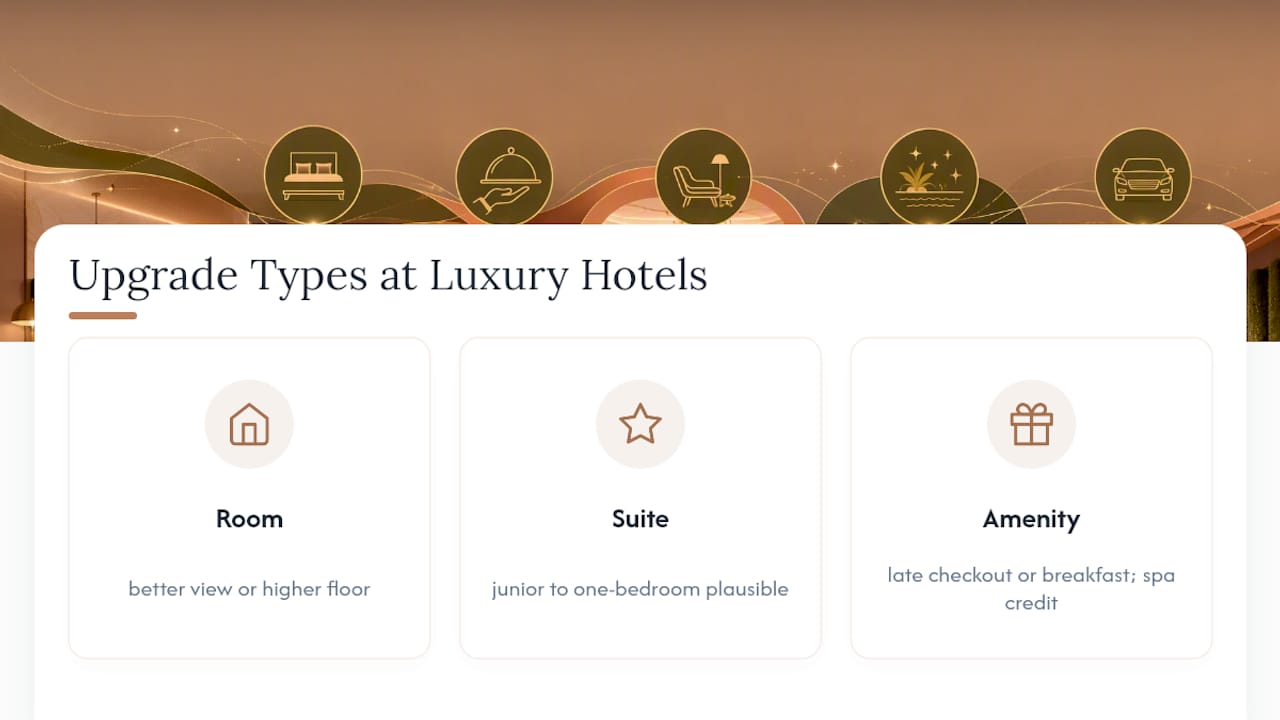
Suite upgrades are a bigger jump and far more limited. Most hotels only offer these when suite inventory is unsold close to arrival, which explains why the one-category rule dominates realistic outcomes. Booking a junior suite and getting bumped to a one-bedroom suite is plausible. Going from a standard king to a two-bedroom presidential suite almost never happens without paying for it.
Amenity upgrades are the most underrated win. Late checkout, a welcome amenity, complimentary breakfast, spa credit, or a property credit through Amex FHR often costs a hotel far less than physically moving a guest to a different room, so staff grant these more freely. If a room upgrade isn’t available, these are worth asking for directly rather than walking away empty-handed.
Setting expectations around these three tiers keeps you from treating a genuinely good outcome, like a free breakfast and late checkout, as a failure just because the room number didn’t change.
How Do You Actually Word an Upgrade Request?
The difference between a request that works and one that gets a polite no is almost always the wording. Demanding language, vague hints, or overly apologetic phrasing all underperform a direct, warm ask.
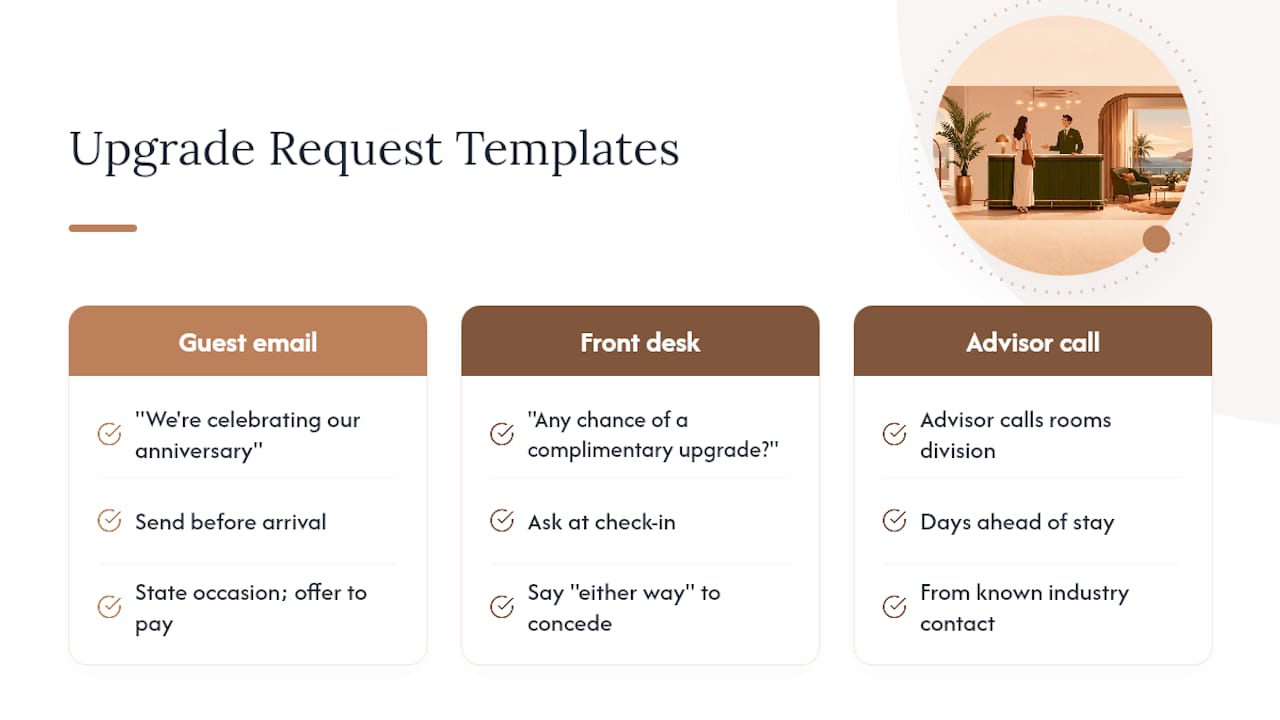
For an email sent to the hotel or your advisor before arrival, try: “We’re celebrating our anniversary during this stay and would love to know if a room upgrade might be available. We’re happy to pay any applicable rate difference if that helps.” This works because it states the occasion plainly, asks rather than assumes, and removes the awkwardness around cost.
At the front desk, a simple version lands well: “Is there any chance of a complimentary upgrade today? We’d be grateful either way.” The phrase “either way” matters. It signals you won’t make a scene if the answer is no, which staff remember and reward on future stays.
If you’re working with an advisor, the request often never needs to come from you at all. The advisor’s call to the rooms division days ahead, mentioning the occasion and asking what’s available, tends to outperform any guest-written email because it comes from a known industry contact rather than a stranger.
An Advisor’s View on What Actually Works
Every confirmed upgrade arranged by some luxury travel advisors traces back to a relationship, not a script. A phone call to a director of rooms, made days before arrival, can consistently beat any polished email a guest could send alone. Folklore tactics like fake celebrations rarely move the needle. Relationships and the right channel do.
— Michael
Get the Advisor Advantage on Your Next Luxury Stay
Some luxury travel advisors give you something a hotel website or a public loyalty account can’t: a real relationship with the property before you ever arrive. Where Amex FHR and chain loyalty programs depend on availability and algorithms, these advisors work preferred-partner access at properties like those in the Oetker Collection and Shangri-La Luxury Circle, placing direct calls to rooms directors and flagging your stay well ahead of check-in.
That advocacy doesn’t guarantee an upgrade. What it does is put your booking in front of the people making the decision, with the context that actually influences it. Hidden Door Travel also handles the rest of the trip, from bespoke itinerary design to the preferred-partner relationships that make upgrades more likely in the first place. If your next stay has a category you truly want, reach out to Hidden Door Travel’s luxury travel experts before you book and let an advisor put the odds in your favor.
Sources
- Luxury Hotels That Confirm an Upgrade at Booking, 2026
- How to actually get a free hotel upgrade, according to the people who decide | Condé Nast Traveller Middle East
- How Upgrades Work and How To Get Them – by Merritt Olson
- Hilton Honors Adds Guaranteed Suite Upgrades