

The best way to get true around the world tickets, in the sense that matters to a discerning traveler, is to skip airline RTW passes entirely and let a luxury advisor engineer the trip: premium-cabin multi-city routing or a private-jet program, matched to your calendar and your standards for hotels. For a family or couple who wants total customization, that means either an advisor-built fare construction across scheduled carriers or a curated private-jet circumnavigation. Either way, the next move is the same: talk to an advisor or request a private-jet proposal before you touch a booking engine.
TL;DR:
- A truly bespoke around-the-world trip is built through an advisor, combining private jets, scheduled premium flights, and luxury properties rather than relying on alliance RTW passes.
- Private jet programs offer maximum control and privacy but come at a high cost, while multi-city fare construction maximizes value by exploiting airline rules and stopover opportunities.
- Advance booking of six to twelve months is necessary for private jets and exclusive properties, with seasonal timing crucial for pricing and availability.
- Flexibility varies: multi-city tickets provide some change protection; separate one-ways require careful planning for delays; private jets demand substantial non-refundable deposits.
- Using a trusted luxury advisor grants access to upgrades, amenities, and on-trip support unavailable through direct booking or generic online platforms.
Table of Contents
- What “Around the World Tickets” Means in This Guide
- How Do You Actually Book a Multi-Destination Luxury Trip?
- Why Use a Luxury Travel Advisor for This?
- What Does a Real Around-the-World Itinerary Look Like?
- Logistics Checklist: Visas, Insurance, and Luggage
- Bespoke Around-the-World Trips vs. Airline RTW Passes
- How Should You Choose Destinations and Sequence the Route?
- What Goes Wrong on Bespoke Around-the-World Trips?
- When Should You Book, and Does Season Matter?
- How Flexible Are Changes on a Bespoke Itinerary?
- What Hidden Door Travel Brings to a Global Itinerary
- Ready to Plan Your Own Global Journey?
- Sources
- FAQ
What “Around the World Tickets” Means in This Guide
This article is not about airline alliance RTW passes, the multi-coupon products sold by broker sites that route you through a fixed number of continents on a mileage cap. Those are a different product built for budget-conscious backpackers, and we exclude them entirely here.
What we mean by around the world tickets is a fully bespoke, premium multi-destination trip: business or first-class flights (or a private jet), luxury hotels, private transfers, and concierge support woven into one itinerary designed around your priorities rather than a fare rule. The components typically include premium or private air travel between stops, four- and five-star or ultra-luxury properties, ground transportation and guides at each destination, and a single point of contact managing all of it.
Build in lead time. Private-jet circumnavigations and hard-to-book properties (a suite at a sold-out lodge in the Serengeti, a private island buyout) often require designing a multi-destination luxury trip months in advance, sometimes a year for peak season or marquee events.
How Do You Actually Book a Multi-Destination Luxury Trip?
Three approaches dominate this category, and each fits a different kind of traveler.
Private jet programs trade schedule flexibility for total control. You are not waiting on connections or airline seasonal routes. Published programs like Four Seasons’ private-jet circumnavigations bundle the aircraft, ground transport, meals, and often a trip physician into one price, which removes nearly every logistics decision from your plate.
Premium-cabin multi-city fare construction uses scheduled airlines and alliance routing, built by someone who understands open-jaw tickets, stopover allowances, and mileage rules. This is where expert fare construction matters most: a single ticket routed correctly can unlock a stopover in Tokyo en route to Sydney at little extra cost, but push past the maximum permitted mileage on a fare and the price jumps sharply.
Separate one-way tickets give you the most freedom to mix airlines and cabins destination by destination. They also carry the most risk. If a flight is delayed and you miss a connection, you are rebooking and paying for it yourself, which is why routing specialists recommend treating this option as a deliberate trade-off, not a default.
- Private jet: best for parties wanting privacy, flexibility, and zero connection risk, at the highest cost.
- Multi-city fare construction: best value when an advisor can exploit stopover and open-jaw rules on one ticket.
- Separate one-ways: useful for adding an off-route destination, but budget 4 to 6 hours of connection buffer and expect no missed-connection protection.
Why Use a Luxury Travel Advisor for This?
An advisor’s real value shows up in access you cannot buy directly. Through consortia like Virtuoso and designations such as Four Seasons Preferred Partner, advisors routinely secure confirmed upgrades, property credits, and daily breakfast at properties that would otherwise quote you rack rate with no perks attached. Virtuoso alone works with more than 2,200 participating hotels and operators, which is why advisor-booked stays often include amenities a direct booking simply does not offer.
Fee models vary by complexity. Some advisors charge nothing and work on supplier commission; specialists handling true multi-country, multi-cabin trips often charge $500 to $1,500 or more for the research and fare-construction testing a circumnavigation demands. That fee usually buys 24/7 on-trip support, too, which matters when a flight cancels in Nairobi and you need rebooking handled while you sleep.
Pro Tip: Ask any advisor you’re vetting whether they’ve personally stayed at the properties on your list. Firsthand experience is a far better predictor of fit than a glossy brochure of partner hotels.
Before hiring anyone, ask:
- Which consortia or preferred-partner programs do you hold, and what perks come with them?
- Have you personally traveled the regions in my itinerary?
- What is your fee structure, and what happens on-trip if something breaks?
- How do you handle fare construction across multiple cabins and alliances?
- Can you provide references from a comparable multi-country trip?
What Does a Real Around-the-World Itinerary Look Like?
A typical bespoke circumnavigation for a couple might run five stops: a private charter into a remote lodge, a scheduled first-class long-haul, a chauffeured transfer to a coastal resort, another long-haul in business class, and a final private-jet leg home. Each transport mode gets chosen for the leg, not applied uniformly across the trip, and travelers seeking the ultimate in luxury ground transport might opt for private chauffeured Maybach Sprinter vans to ensure comfort and style between destinations.
Lead times matter more than most travelers expect.
Published pricing gives a useful anchor. Four Seasons’ 2026 Grand Horizons private-jet program, a 24-day circumnavigation, is priced at $229,000 per person on a double-occupancy basis, with a $22,900 solo-traveler supplement.
That figure covers the private aircraft, accommodations, meals, ground transport, a trip physician, luggage concierge, and a private ship segment among the exclusive experiences built into the itinerary. It is a useful budget ceiling reference, not a floor: a premium-cabin, scheduled-airline version of a similar trip, hotels included, can land well under half that per person, while a shorter private-jet charter for a smaller group falls somewhere between the two. The primary cost drivers are aircraft type, number of stops, property tier, and how many bespoke experiences (private guides, closed-door access, chartered vessels) get added.
Logistics Checklist: Visas, Insurance, and Luggage
A trip touching six countries means six sets of entry rules, and missing one derails the whole sequence. Check each country’s current visa policy directly with its embassy or a service like the U.S. State Department’s travel pages well before ticketing, since requirements shift without much notice.
Insurance deserves real attention, not an afterthought box to check. A policy with medevac coverage is worth the premium on any itinerary that includes remote lodges, expedition legs, or destinations with limited hospital infrastructure, because a medical evacuation from a remote region can run into six figures without it.
- Confirm visa and entry requirements for every stop, including transit countries, at least 90 days out.
- Buy trip insurance with medevac coverage, not just trip-cancellation protection.
- Use a luggage concierge service for door-to-door bag handling between private and scheduled legs.
- If booking separate tickets, build in 4 to 6 hour connection buffers and ask your advisor to write contingency terms into the contract.
Bespoke Around-the-World Trips vs. Airline RTW Passes
The comparison matters because the two products solve completely different problems. Airline RTW passes lock you into a fixed continent count and a mileage cap sold by an alliance, with limited cabin choice and rigid change rules. They exist for travelers optimizing for price per mile, not experience.
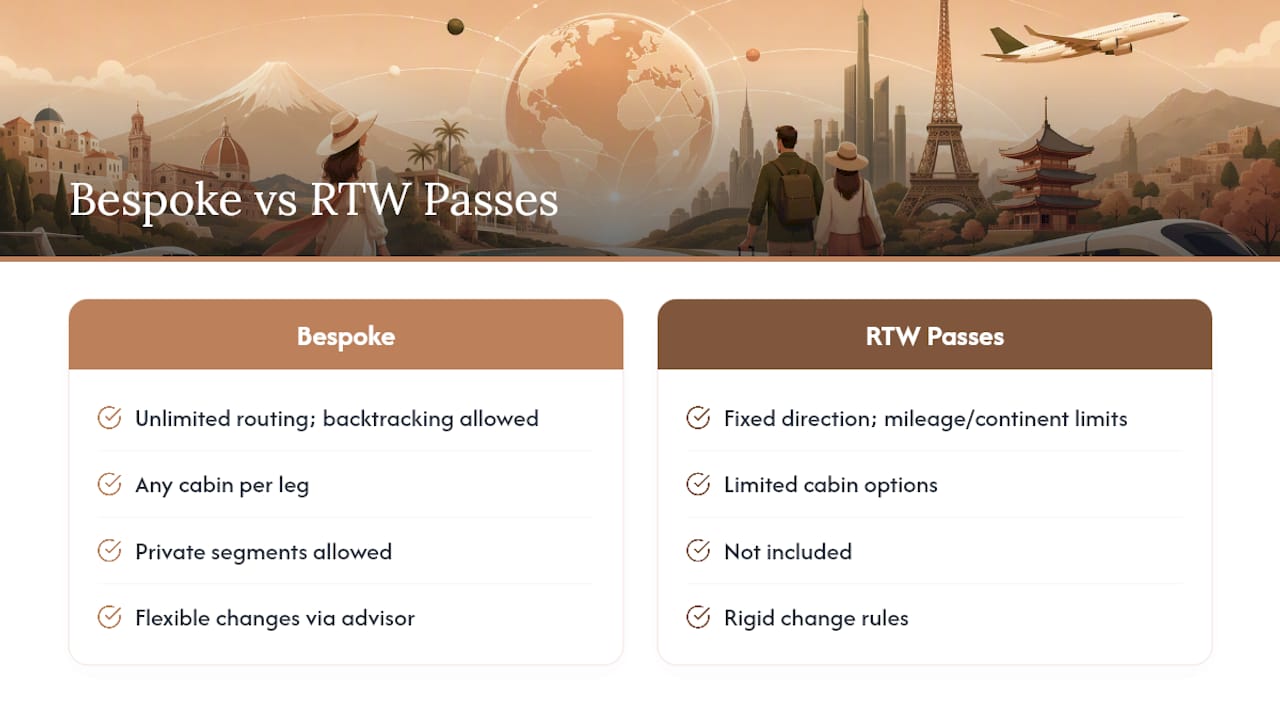
A bespoke luxury itinerary flips every one of those constraints. You choose the number of stops, the cabin on each leg, and whether any segment flies private. There is no mileage cap dictating your route, and no requirement to keep moving in one direction around the globe. An advisor can route you Tokyo to Marrakech to Buenos Aires with no penalty for backtracking, something an alliance RTW fare structurally forbids.
The trade-off is straightforward: RTW passes are cheaper and simpler to book online, but they cap your choices to whatever the alliance permits. A bespoke itinerary costs more and takes longer to plan, but it delivers the cabin, property tier, and routing logic that airline passes were never designed to offer. For a traveler weighing weeks of comfort against a fixed budget cap, the bespoke route is the one built for personalization rather than economy. It’s also the only route that lets private jet segments and hard-to-book properties enter the itinerary at all, since alliance RTW products simply do not include them.
How Should You Choose Destinations and Sequence the Route?
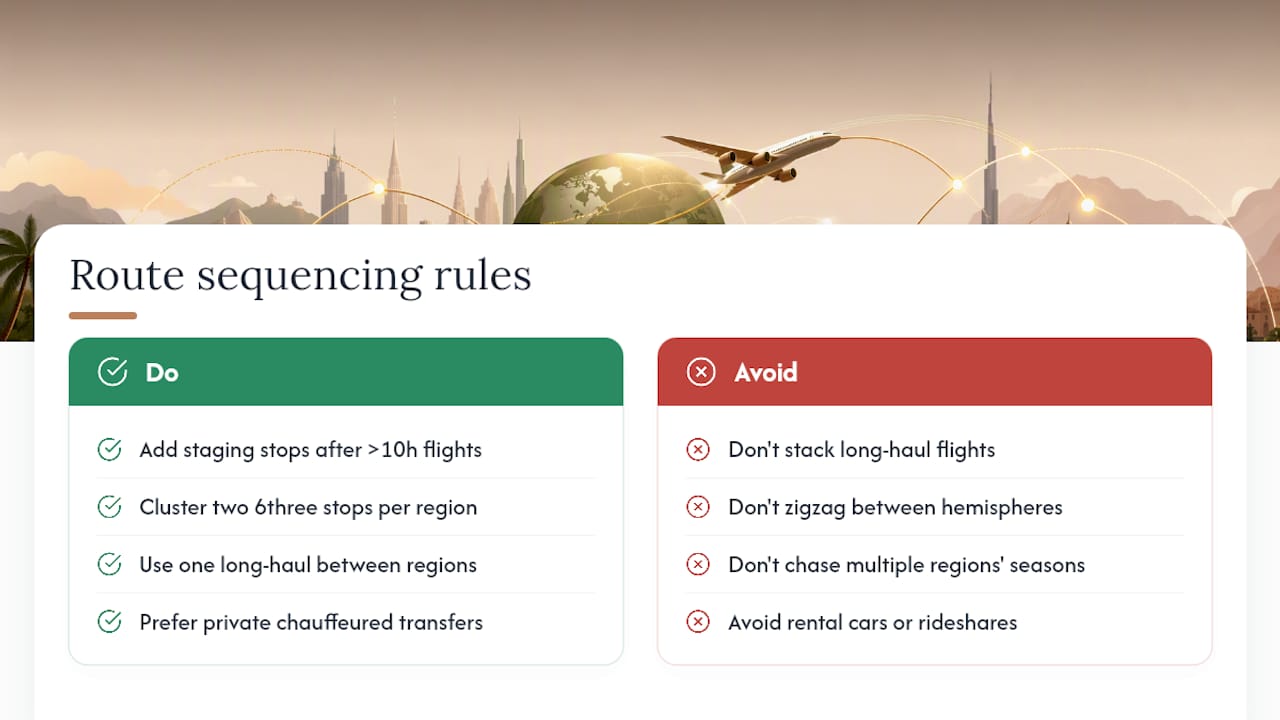
Sequencing decides whether a circumnavigation feels restorative or exhausting, and the biggest mistake is stacking long-haul flights back to back. Planners who design custom global journeys build in staging stops after any intercontinental leg longer than ten hours, giving you 36 to 48 hours to reset before the next transition.
Group destinations by region rather than by bucket-list order. A route that zigzags between hemispheres to hit specific cities on a wish list burns days in transit that could otherwise be spent at your destinations. Instead, cluster two or three stops per region and let one long-haul flight carry you between regions, not between every city.
Weather and seasonality shape sequencing too. Chasing dry season in East Africa, shoulder season in Southeast Asia, and shoulder season in Patagonia simultaneously often means the trip has to run in a specific order, not the order you’d pick from a map. This is also where a world cruise segment can slot in as one leg of a broader itinerary, replacing two or three flights with a single, more restful transition. Ground transport choices matter at this stage as well. A private chauffeured vehicle for city-to-city legs, rather than a rental car or rideshare, keeps transitions predictable and shortens door-to-door time on travel days.
What Goes Wrong on Bespoke Around-the-World Trips?
The most common failure is underestimating how fare rules punish flexibility. Travelers who lock in a multi-city fare and then want to add a stop midway often find the change costs more than booking a whole new segment, because the original fare construction no longer holds.
Connection risk on separate tickets is the second recurring problem. When each leg is ticketed independently to save money, a delay on one airline becomes entirely your problem to solve and pay for, with no rebooking protection from anyone.
Underbooking hard-to-book properties early is a third pitfall. A traveler who finalizes flights first and hotels second frequently discovers the property they wanted is sold out for their dates, forcing a scramble that reshapes the whole itinerary around whatever room is left.
Finally, travelers sometimes hire an advisor for the flights but manage hotels and transfers themselves, which fragments accountability. When something breaks mid-trip, there is no single person responsible for fixing all of it, and the traveler ends up coordinating three separate vendors from a hotel room overseas instead of making one phone call.
When Should You Book, and Does Season Matter?
Book earlier than you think you need to. Private-jet circumnavigations and marquee properties often sell out 6 to 12 months ahead, and premium-cabin award and paid inventory on scheduled airlines tightens considerably 3 to 6 months before departure on popular routes.
Season shapes both price and experience. Traveling during a destination’s shoulder season, just before or after peak, often means better property availability and calmer crowds, while still avoiding the weather risk of true off-season travel. Peak season everywhere (Northern Hemisphere summer, for instance) pushes private-jet program pricing and luxury lodge rates to their highest point, since demand is highest exactly when the most travelers want to go.
Holidays and major global events compound this further. A circumnavigation that happens to cross a destination during a marquee festival or a national holiday period needs that leg locked in earliest, since local hotel inventory disappears fastest around fixed calendar dates.
How Flexible Are Changes on a Bespoke Itinerary?
Flexibility depends entirely on how the trip is ticketed, which is why this decision deserves attention before you book, not after. A single multi-city ticket across one alliance typically allows date and routing changes for a fee, and it protects you if one leg is delayed, since the airline is contractually responsible for getting you to the next stop.
Separate one-way tickets offer more freedom to swap airlines or cabins destination by destination, but each ticket changes independently, at its own fare rules and its own change fee, with zero cross-ticket protection if one flight disrupts the next.
Private-jet programs sit at the flexible end for schedule control (you are not bound by someone else’s flight times) but at the rigid end for cancellation, since deposits on a chartered circumnavigation are typically substantial and non-refundable past certain milestones. Ask any advisor managing your booking to spell out, in writing, exactly what happens if one segment of the trip needs to shift once deposits are paid.
What Hidden Door Travel Brings to a Global Itinerary
The agency builds bespoke, multi-destination journeys around premium and private air travel, hard-to-book properties, and on-the-ground concierge support, drawing on years of agency experience across complex international routing. Every itinerary is planned around the client’s calendar and standards, not a fixed template.
Support does not stop at booking. Hidden Door Travel stays engaged through the planning process and during travel, so a disrupted flight or a closed border crossing becomes a phone call, not a solo problem to solve from a departure lounge.
— Michael
Ready to Plan Your Own Global Journey?
Building a real around the world itinerary, one with private-jet legs, alliance fare construction, and hard-to-book properties working together, takes an advisor who has actually routed trips like this before, not a booking engine guessing at connections. An expert travel advisor handles the fare construction, the consortium access, and the property negotiations as one coordinated process, so you are not stitching together three separate vendors and hoping the timing holds.

This means one point of contact for the entire trip, from the first flight to the last transfer, backed by consortium relationships that can turn a standard hotel booking into one with a confirmed upgrade and daily breakfast included. If you already have a route in mind, or just a list of places you have always wanted to see in one trip, request a consultation with Hidden Door Travel’s luxury travel experts and start the planning conversation now.
Sources
- Four Seasons Grand Horizons private-jet itinerary (Aug–Sept 2026)
- Do you need a luxury travel advisor? (Luxury advisor explainer)
- Multi-city flight routing: mastering complex itineraries and fare construction (DMC Quote)
FAQ
How Far in Advance Should You Book a Global Itinerary?
Start 6 to 12 months out for private-jet programs and hard-to-book properties, and at least 3 to 6 months out for premium-cabin scheduled flights.
Is a Private Jet Cheaper or More Expensive Than Scheduled Business Class?
A private-jet program is significantly more expensive. Four Seasons’ 2026 Grand Horizons circumnavigation runs $229,000 per person on a double-occupancy basis, well above a comparable premium-cabin scheduled itinerary.
How Much Do Luxury Travel Advisors Charge?
Fees vary widely, from $0 for advisors working on supplier commission to $500 to $1,500 or more for advisors handling complex, multi-country fare construction and property negotiation.
Should You Book Separate One-Way Tickets or One Multi-City Fare?
A single multi-city fare offers missed-connection protection and often better pricing through stopover rules; separate one-ways offer more airline flexibility but need 4 to 6 hour connection buffers and carry no cross-ticket protection.
Does Hidden Door Travel Handle Private-Jet and Multi-City Bookings?
Yes. Hidden Door Travel plans bespoke multi-destination itineraries across private aviation, premium-cabin scheduled flights, hotels, and concierge logistics as one coordinated trip.