

Luxury travel document preparation is the process of assembling every required passport, visa, insurance certificate, and supporting paper your destination demands before you step foot in a first-class lounge. Get this wrong and no amount of private jet access or five-star reservations will save your trip. The stakes are higher for exclusive itineraries because multi-destination routes, extended stays, and VIP entry programs each carry their own documentation layers. This guide covers every document category you need, how to evaluate premium processing services, and the timing strategy that prevents last-minute crises.
What essential documents are required for luxury travel trips?
Luxury trip documentation starts with your passport and ends with a carefully organized folder of supporting evidence. Every document in that folder must tell the same story.
Passport validity and renewal
Your passport must be valid for at least six months beyond your return date. Many luxury travelers discover this rule only when a check-in agent flags it at the gate. If your passport expires within that window, renew it before booking anything else. The U.S. Department of State offers expedited passport services through registered couriers, but registered courier firms must be enrolled with each agency they serve. Using an unregistered service risks stacked appointments, delays, and outright fraud.

Visa requirements and the Schengen example
The Schengen visa is the clearest illustration of how demanding exclusive travel visa preparation can be. A complete Schengen application requires 11 document categories: a valid passport, the VIDEX application form, two recent photos, travel medical insurance with a minimum €30,000 coverage, a confirmed flight reservation, proof of accommodation, proof of financial means, employment or status documentation, a personal cover letter, the visa fee receipt (typically €90 for adults), and any supplementary documents specific to your trip. Processing normally takes 15 days but can extend to 45 days under additional scrutiny. That range alone justifies starting preparation months in advance.
Pro Tip: Write your cover letter as a narrative, not a list. Visa officers read hundreds of applications daily. A clear, chronological account of your itinerary, purpose, and financial standing reads as credible and organized.
Supporting documents that matter most
Beyond the core visa checklist, luxury travelers need to prepare several supporting layers:
- Proof of accommodation: Hotel confirmation letters on official letterhead, or signed villa rental agreements for destinations like Provence, where villa stay documentation follows specific local requirements.
- Financial evidence: Bank statements covering the last three to six months, with balances that clearly support your planned expenditure.
- Employment or status proof: A letter from your employer confirming leave approval, or incorporation documents if you are self-employed.
- Travel medical insurance: Coverage must meet the destination’s minimum threshold. For Schengen countries, €30,000 is the floor, not the target. Premium travelers should carry policies that cover medical evacuation and repatriation.
- Arrival documents: Travelers entering Canada on study or program permits must carry a port of entry letter and a valid eTA or visa. According to Canadian immigration guidance, passport stamps obtained on arrival serve as proof of entry for school or program enrollment. Treat arrival documentation as part of your pre-departure checklist, not an afterthought.
The most underestimated element is consistency. Minor data mismatches across your passport, visa form, flight reservation, and hotel booking trigger delays at visa centers and consulates. Names, dates, and passport numbers must match exactly across every document you submit.
How do premium visa services actually work?
Outsourced visa application centers handle the logistics between you and the consulate. VFS Global, which processes applications for dozens of governments, is the most widely used example. These centers charge mandatory service fees on top of the official visa fee. They also offer optional premium add-ons that range from SMS status alerts to at-home biometric collection.
Premium add-on pricing spans from roughly €80 for courier document return to €3,500 for concierge home visits. That range reflects genuine convenience for some travelers and unnecessary expense for others. The key distinction is that visa approval remains entirely the consulate’s decision. The application center manages logistics only. Paying for a premium lounge at a visa center does not improve your approval odds.
Smart luxury travelers predefine their service needs before arriving at a visa center rather than deciding under pressure at the counter. If you travel frequently to Europe, at-home biometric collection is a legitimate time-saver. If you submit once a year, the standard service with a tracked courier return is sufficient.
- Mandatory fees: Visa application fee plus the center’s processing fee. These are non-negotiable.
- Courier document return: Tracked delivery of your passport after processing. Worth paying for on high-value trips.
- Premium lounge access: Faster queue, private seating, dedicated staff. Useful if your schedule is tight.
- At-home biometric collection: An officer visits your location to collect fingerprints and photos. The highest-cost option, justified for travelers with mobility constraints or extreme schedule demands.
- SMS and email alerts: Low-cost updates on application status. Almost always worth adding.
Pro Tip: Verify that any passport courier or expeditor you hire is registered with the State Department. Unregistered services cannot guarantee appointment slots and may duplicate bookings, which causes rejections.
When should you start preparing travel documents?
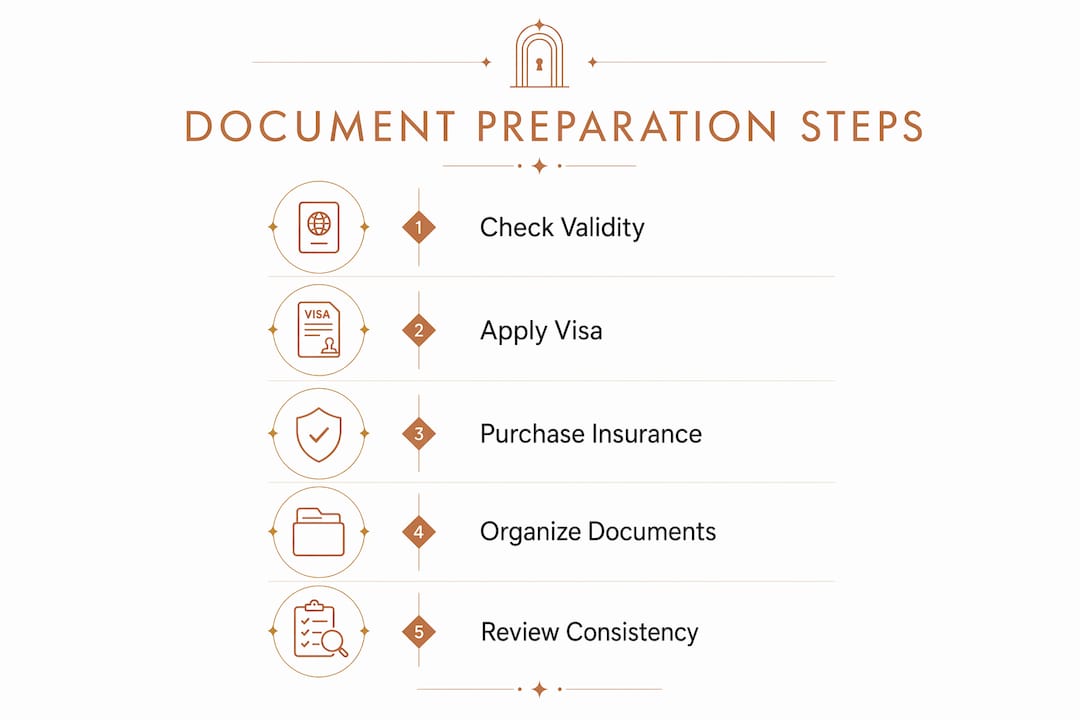
Starting document preparation three to six months before departure is the standard for luxury trips. That window accommodates passport renewal, visa processing, insurance procurement, and any consulate-specific requirements that surface during research.
Here is the workflow Hiddendoortravel recommends for every exclusive itinerary:
- Confirm destination entry requirements at least five months out. Consulate websites change requirements without wide notice.
- Renew your passport if it expires within 12 months of your return date. Build in buffer beyond the six-month rule.
- Book your flights and accommodation before starting visa applications. Most consulates require confirmed reservations, not tentative bookings.
- Gather financial and employment documents and date-stamp them. Bank statements older than three months are routinely rejected.
- Complete your visa application forms and run a side-by-side check against your passport. Every name, number, and date must match.
- Submit your application with all supporting documents organized in the order the consulate specifies.
- Track your application and confirm passport return logistics before your departure date.
| Stage | Recommended timing |
|---|---|
| Passport validity check and renewal | 5 to 6 months before departure |
| Visa application submission | 2 to 3 months before departure |
| Insurance procurement | 6 to 8 weeks before departure |
| Final document consistency review | 2 weeks before departure |
| Arrival document check | 48 hours before departure |
For multi-destination trips, coordinate each country’s requirements independently. A multi-destination luxury itinerary can involve three or more separate visa processes running in parallel, each with different processing windows.
Pro Tip: If you need an expedited U.S. passport, book your appointment through the official State Department portal, not a third-party site. Third-party appointment bookings may not be honored and create duplicate slots that delay other travelers.
Common mistakes to avoid in luxury travel document preparation
Even experienced travelers make errors that derail exclusive trips. These are the most frequent and the most preventable.
- Inconsistent information across documents. A middle name on your passport that does not appear on your visa form is enough to trigger a rejection. Run every document through a side-by-side reconciliation before submission.
- Using unofficial service providers. Fraudulent booking services target high-net-worth travelers who value speed over verification. The U.S. Department of State explicitly warns against paying for passport forms or appointment bookings through unofficial channels.
- Underestimating processing times. A Schengen visa that normally takes 15 days can take 45 under additional review. Booking a non-refundable villa rental before your visa is approved is a costly assumption.
- Incomplete financial documentation. Bank statements must show consistent balances, not a single large deposit made the week before submission. Consulates recognize last-minute fund transfers as a red flag.
- Ignoring arrival documents. Travelers entering Canada on program permits who skip the port of entry stamp may face enrollment delays. Treat every stamp and letter you receive on arrival as a document to preserve.
- Overlooking consulate-specific requirements. Some embassies require notarized translations, sponsor letters, or property ownership proof. These requirements do not appear on generic visa checklists.
Visa approval is the government’s decision. The application center handles logistics. Your job is to give the consulate no reason to doubt your application. Every document must be complete, consistent, and credible before it leaves your hands.
The real role of travel insurance in this context goes beyond meeting a minimum coverage threshold. A policy that covers trip cancellation, medical evacuation, and document loss protects the financial investment of a high-end itinerary when paperwork problems arise.
Key takeaways
Luxury travel document preparation succeeds when you start early, verify every detail for consistency, and select premium services based on genuine need rather than convenience upsells.
| Point | Details |
|---|---|
| Start at least 3 to 6 months out | Visa processing, passport renewal, and insurance procurement all require lead time. |
| Consistency across all documents | Names, dates, and passport numbers must match exactly on every form you submit. |
| Schengen requires 11 document categories | Travel insurance with €30,000 minimum coverage is mandatory, not optional. |
| Verify every service provider | Only use passport couriers registered with the relevant government agency. |
| Predefine premium service needs | Decide which add-ons you need before arriving at a visa center to avoid pressure upsells. |
Why document preparation is where luxury trips actually succeed or fail
I have worked with travelers who spent six figures on a single itinerary and nearly lost the entire trip over a name discrepancy on a visa form. Not a missing document. Not a denied application. A single middle initial that appeared on the passport but not on the hotel booking. That is the level of precision this process demands.
The travelers who handle this best are not the ones who pay the most for premium services. They are the ones who treat document preparation as a project with a timeline, a checklist, and a final review stage. They book their flights and accommodation before touching a visa form. They run every document against their passport before submission. They choose courier services based on registration status, not marketing copy.
Where I see luxury travelers go wrong most often is in delegating document preparation to someone who does not understand the stakes. A general assistant who books your calendar is not equipped to cross-reference a Schengen application against 11 document categories. That task belongs to someone who has done it dozens of times and knows which consulates add requirements without notice.
The premium add-on question is worth addressing directly. At-home biometric collection is genuinely useful for travelers with packed schedules or mobility considerations. A premium lounge at a visa center is a comfort, not a strategy. Neither one affects your approval. What affects your approval is the accuracy and completeness of what you submit. Spend your attention there first, and spend money on convenience second.
Iceland trips, for example, require Schengen documentation, and the premium transport logistics for remote luxury experiences there add another layer of coordination that benefits from having all documents confirmed well in advance.
— Michael
How Hiddendoortravel handles your travel documentation
Hiddendoortravel’s team of luxury travel experts manages the full document preparation process for exclusive clients, from passport validity checks to visa application coordination and insurance procurement. You receive a personalized document checklist built around your specific itinerary, not a generic template.
Every bespoke itinerary Hiddendoortravel designs includes a dedicated documentation review stage. The team cross-references your passport details against every booking confirmation, visa form, and supporting document before submission. For complex multi-destination trips, the agency coordinates parallel visa processes so nothing falls through the gaps. Contact Hiddendoortravel’s luxury travel agency team to start your document preparation with the same precision that defines every other element of your trip.
FAQ
What documents are required for a Schengen visa application?
A Schengen visa requires 11 document categories including a valid passport, completed VIDEX form, two photos, travel insurance with at least €30,000 coverage, flight reservation, accommodation proof, financial evidence, employment documentation, a cover letter, the visa fee receipt, and any supplementary consulate-specific documents. Processing takes 15 to 45 days depending on the application.
How far in advance should I start luxury travel document preparation?
Start at least three to six months before your departure date. This window covers passport renewal, visa processing timelines, insurance procurement, and any consulate-specific requirements that require additional documentation.
Are premium visa center add-ons worth paying for?
Premium add-ons like at-home biometric collection and tracked courier return offer genuine convenience but do not affect visa approval odds. Decide which services you need before arriving at the visa center to avoid on-site upsells.
How do I avoid fraud when using passport courier services?
Only use courier companies registered with the U.S. Department of State or the relevant government agency. Never pay for passport forms or appointment bookings through unofficial third-party websites, as these services may not be honored and carry fraud risk.
Why does document consistency matter so much?
Minor mismatches in names, dates, or passport numbers across your visa form, flight booking, and hotel confirmation are a leading cause of application delays and rejections. A side-by-side reconciliation of all documents before submission is the single most effective step you can take.