

Luxury travel costs more because it bundles premium accommodations, all-inclusive services, and personalized logistics into a single price rather than charging separately for every amenity. A Four Seasons suite, a Regent Seven Seas cruise, or a United Polaris business-class suite each reflects a fundamentally different service model than budget alternatives. The gap is not arbitrary. It is the product of higher staffing ratios, physical product quality, and the deliberate removal of friction that budget travel leaves entirely to you. Understanding these luxury travel pricing factors helps you decide whether the premium is worth it for your specific trip.
Why luxury travel costs more: the core pricing drivers
The price of a luxury trip reflects several compounding cost layers, not a single markup. Each element adds to the total, and together they explain why premium travel budgets look so different from standard ones.
Accommodations with bundled fees
Luxury hotels charge additional daily fees for Wi-Fi, parking, and resort access that can add $50 to $100 per day, while luxury vacation rentals typically include all of these in the headline rate. That distinction matters when you are comparing sticker prices. A Four Seasons room at $600 per night may carry $80 in daily fees, while a luxury rental at $700 per night includes everything. The rental is actually cheaper once you do the math.
Premium flights with private infrastructure
Airlines have been expanding premium cabin space because it is profitable. A United Polaris suite on the San Francisco to Singapore route can exceed $9,000 versus roughly $2,000 for economy on the same flight. That price gap funds a private door, lie-flat bedding, dedicated cabin crew, and lounge access at both ends. You are not paying more for the same seat. You are paying for a different product category entirely.
Dining costs outpacing everything else
Food is now the fastest-rising travel expense. Daily meal costs grew 28.2% from 2019 to 2025, more than double the 12.9% growth in lodging costs over the same period. Luxury resorts and high-end restaurants sit at the top of that curve. When dining is included in a luxury package, that inflation is absorbed by the operator rather than passed to you as a surprise bill.
Operational certainty as a paid service
Luxury pricing also funds what you never see. 24/7 support, professional management, and guaranteed service standards are built into the rate at ultra-luxury properties. This is not indulgence. It is risk reduction. When a transfer is late, a room is not ready, or a restaurant booking falls through, someone else solves it. That reliability has real monetary value, especially on trips where your time is the scarcest resource.
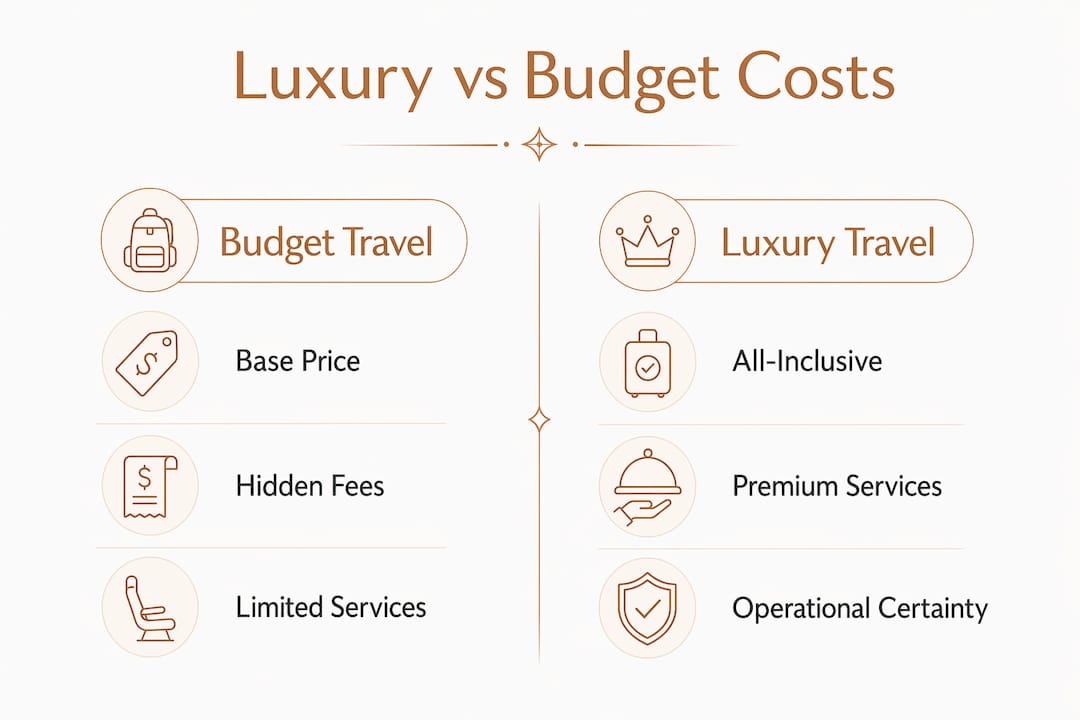
Pro Tip: When comparing luxury and budget travel costs, always calculate the total trip cost including add-ons, not just the headline rate. A mainstream cruise at $899 per person can reach $2,500 after drinks, gratuities, and excursions.
How do luxury and budget travel costs actually compare?
Direct price comparisons between luxury and budget travel mislead without accounting for inclusions, group size, and hidden charges. The table below illustrates the real cost gap across three travel categories.
| Category | Budget option | Budget true cost | Luxury option | Luxury true cost |
|---|---|---|---|---|
| Cruise (per person) | Mainstream fare $899 | ~$2,500 after add-ons | Luxury fare $5,500 | ~$6,000 all-in |
| Hotel room (per night) | Standard room $150 | $230 with fees and meals | Luxury suite $600 | $680 with fees included |
| Flight (economy vs. business) | Economy $2,000 | $2,000 | Polaris suite $9,000+ | $9,000 with full service |
The cruise comparison is particularly instructive. A mainstream fare of $899 can total $2,500 after drinks packages, Wi-Fi, gratuities, and shore excursions. A luxury cruise fare of $5,500 to $9,000 covers nearly all of those expenses upfront. The gap narrows significantly once you account for what each ticket actually includes.
Group travel changes the math further. For parties of eight or more, luxury rental per-person nightly rates can drop below $200, compared to $350 or more per hotel room. A luxury villa with a full kitchen, shared living space, and included amenities often costs less per head than booking multiple hotel rooms, while delivering a substantially better experience.
Pro Tip: For groups of six or more, run a per-person cost comparison between a luxury rental and equivalent hotel rooms before assuming the rental is out of budget. The rental frequently wins on both price and experience.
Luxury cruise ships also deliver a measurably different physical product. Luxury ships allocate 60 to 80 gross tons per passenger versus 30 to 40 for mainstream lines, and maintain a guest-to-crew ratio of approximately 1.4 to 1 compared to 3 to 1 on mainstream ships. More space and more staff per guest are not marketing language. They are structural cost inputs that explain why the ticket costs more. You can learn more about how these pricing structures work in this all-inclusive cruise guide from Hiddendoortravel.
Why do travelers keep spending on luxury despite rising costs?
Luxury travel demand is not softening despite broader economic pressure. Marquee vacation budgets increased 17% year over year in 2026, even as only 45% of Americans planned paid lodging vacations, the lowest share in six years. Fewer people are traveling, but those who are traveling are spending more. This is the premiumization of travel in practice.
Several forces sustain this pattern:
- Time scarcity. Affluent travelers place a high dollar value on their time. Luxury travel removes logistical friction, which translates directly into more usable vacation hours. A private transfer, a pre-cleared hotel check-in, or a dedicated concierge is not a luxury in the abstract. It is time bought back.
- Experience over goods. Research consistently shows that experiential spending produces longer-lasting satisfaction than material purchases. A two-week trip to the Maldives with a private overwater villa generates memories that a new car does not replicate.
- Price insensitivity at the top. Luxury hotel guests tolerate 10 to 20% price increases without reducing demand. Exclusivity and unique experiences drive this tolerance. When a property is genuinely rare, price becomes a secondary consideration.
- Predictable total costs. Luxury pricing transparency appeals to travelers who want to know what a trip will cost before they book. The all-in model removes the anxiety of accumulating add-ons.
Airlines are responding to this demand by expanding premium cabin space at the expense of economy capacity. That is a structural bet on where profitable demand is concentrated. For travelers considering a multi-destination luxury trip, understanding this shift matters when planning flight segments.
Is luxury travel worth the extra cost for your trip?
The answer depends on how you travel, not just how much you spend. Luxury delivers the strongest value when you actually use what you are paying for.
- Assess how much time you will spend at the property. A luxury resort makes sense for a week-long beach trip where you will use the pool, spa, and restaurants daily. For a city trip where you are out from 8am to midnight, a well-located mid-range hotel may serve you better.
- Calculate per-person costs for groups. A luxury villa at $1,500 per night for ten people costs $150 per person. Four hotel rooms at $350 each cost $140 per person before resort fees, but without the shared kitchen, living space, or private pool. The villa wins on experience and often on price.
- Evaluate the inclusion value honestly. If you drink alcohol on vacation, a luxury cruise with included beverages saves real money. If you do not, that inclusion has no value to you regardless of how it is marketed.
- Consider solo travel economics separately. Solo travelers rarely benefit from luxury rental economics. A single traveler in a luxury property pays the full nightly rate for space they cannot share. Hotels offer better per-person value for solo trips in most cases.
- Weigh financial stress against expected enjoyment. A trip that stretches your budget to the point of anxiety will not deliver the relaxation luxury is supposed to provide. A slightly less premium trip taken without financial stress often produces a better experience than an overextended luxury booking.
Pro Tip: Before booking any luxury accommodation, list every amenity you will realistically use. If you skip the spa, rarely use the concierge, and eat out most nights, a luxury hotel’s value proposition shrinks considerably.
Key takeaways
Luxury travel costs more because it bundles premium service, physical quality, and logistical certainty into a single price that budget travel distributes across dozens of separate charges.
| Point | Details |
|---|---|
| Bundled pricing explains the gap | Luxury rates include fees, amenities, and services that budget options charge separately, making true cost comparisons essential. |
| Group travel changes the math | Luxury rentals for eight or more guests often cost less per person than equivalent hotel rooms once all fees are included. |
| Cruise true costs are close | A mainstream cruise at $899 can reach $2,500 all-in; a luxury fare at $5,500 covers nearly everything upfront. |
| Demand is rising, not falling | Luxury travel budgets grew 17% year over year in 2026, even as overall travel participation declined. |
| Value depends on usage | Luxury delivers best value when you use the included services. Assess your actual habits before paying the premium. |
The real cost of cheap travel
I have spent years helping clients plan premium trips, and the most consistent mistake I see is treating the headline price as the real price. A traveler books a mainstream cruise at $899 per person, feels smart about the deal, and then spends $1,600 more on drinks, excursions, and gratuities before the ship docks. They paid $2,500 for a product they could have had for $5,500 with better service, more space, and zero bill anxiety at the end.
The uncomfortable truth about luxury travel pricing is that budget travel is often not cheaper. It is just less transparent. The costs are real. They are simply distributed differently, and that distribution is designed to make the initial price look attractive.
What I find genuinely interesting about the current moment is the premiumization trend. Fewer Americans are traveling in 2026, but those who are traveling are spending more per trip. That is not irrational behavior. It reflects a deliberate choice to invest in fewer, better experiences rather than more frequent, mediocre ones. That shift in priorities is something I think more travelers should consider consciously rather than defaulting to the cheapest available option.
The one area where I push back on the luxury industry is transparency. Some properties still obscure total costs behind resort fees and mandatory service charges. The best luxury operators, whether a Regent cruise or an Aman resort, quote you a real number upfront. That transparency is itself a signal of quality. If a property makes it hard to calculate what you will actually spend, that is worth noting before you book.
— Michael
Plan a luxury trip that actually delivers value

Understanding why luxury trips are expensive is the first step. Knowing how to build a trip where every premium element earns its place is where Hiddendoortravel comes in. The agency specializes in bespoke luxury itineraries that match your travel style, group size, and priorities rather than defaulting to the most expensive option available. From private villa sourcing to premium flight routing and all-inclusive cruise selection, the team handles the logistics so you spend your time traveling, not planning. Explore what a genuinely personalized luxury experience looks like by connecting with the luxury travel experts at Hiddendoortravel, or browse the full range of services through the luxury travel agency page.
FAQ
Why does luxury travel cost so much more than budget travel?
Luxury travel bundles accommodations, services, dining, and logistics into a single all-inclusive price, while budget travel charges separately for each element. The true cost gap is smaller than headline prices suggest once all add-ons are included.
Is a luxury cruise actually worth the higher fare?
A luxury cruise fare of $5,500 to $9,000 covers nearly all expenses upfront, while a mainstream fare of $899 typically reaches $2,500 after drinks, gratuities, Wi-Fi, and excursions. For travelers who use those services, the luxury fare often represents comparable or better value.
When does a luxury vacation rental beat a hotel on price?
For groups of eight or more, luxury rental per-person nightly rates can drop below $200, compared to $350 or more per hotel room. The shared kitchen also reduces meal costs significantly over a multi-night stay.
What is driving continued growth in luxury travel spending?
Deloitte’s 2026 travel survey found that marquee vacation budgets increased 17% year over year even as overall travel participation fell to a six-year low. Affluent travelers are prioritizing fewer, higher-quality trips over more frequent budget travel.
How much more does a premium airline seat cost than economy?
A United Polaris suite on the San Francisco to Singapore route can exceed $9,000 compared to roughly $2,000 for economy on the same flight. The premium funds a private suite, lie-flat bedding, dedicated service, and lounge access at both ends of the journey.