

A short hop in a light jet runs roughly $4,500 to $9,000 all in, a cross-country trip in a midsize or super-midsize jet lands between $18,000 and $45,000, and a transoceanic run on a heavy or ultra-long-range aircraft can climb past $100,000. The hourly rate a broker quotes you is never the final number: Federal Excise Tax, fuel surcharges, handling fees, and repositioning legs typically add another 10% to 30% on top. Flying more than about 50 hours a year often favors considering a jet card, while flying less typically favors on-demand charter financially.
TL;DR:
- Additional fees such as federal excise tax, fuel surcharges, handling fees, crew costs, catering, and repositioning can add up to 30% or more to the quoted hourly rate.
- Repositioning and daily minimums can inflate the actual cost by 10% to 40%, especially if the aircraft is based far from your departure location.
- The true all-in cost for a typical flight includes various hidden charges; requesting a detailed, itemized quote helps avoid surprises.
- Choosing between jet cards and on-demand charter depends on your annual flight hours, with on-demand usually cheaper under 50 hours per year.
- Empty leg opportunities, off-peak scheduling, small aircraft options, and operator-based aircraft can significantly reduce overall costs.
Table of Contents
- What Drives Private Jet Hourly Rates by Aircraft Category
- The Hidden Line Items That Inflate Your Quote
- How to Calculate Your All-In Private Jet Charter Cost
- Sample Route Costs: Short Hop to Long-Range
- Jet Cards vs. On-Demand Charter: Which Actually Saves Money
- Ways to Cut Your Private Jet Charter Cost
- Cancellation and Change Fee Policies to Watch
- Why Most Cost Estimates Miss the Real Number
- How Hidden Door Travel Handles Private Jet Pricing for Clients
- Sources
What Drives Private Jet Hourly Rates by Aircraft Category
Every private jet charter cost estimate starts with the aircraft category, and the spread between the bottom and top of the market is enormous. A turboprop costs a fraction of what an ultra-long-range airliner-style jet costs per hour, and the gap only widens once you factor in cabin size, range, and crew requirements.
Private jet hourly rates in 2026 generally break down like this:
- Turboprops and very light jets (Pilatus PC-12, Cessna Citation Mustang): roughly $1,200 to $3,000 per hour, seating 4 to 8 passengers, best for flights under 90 minutes.
- Light jets (Citation CJ3, Phenom 300): typically priced at moderate rates, seating 6 to 8, suited to regional hops of 1 to 2 hours.
- Midsize jets (Hawker 800XP, Citation Excel): generally have higher hourly costs, seating 7 to 9, comfortable for 2 to 3 hour legs.
- Super-midsize jets (Citation Longitude, Challenger 350): normally command higher hourly rates, seating 8 to 10, suitable for coast-to-coast domestic travel.
- Heavy jets (Gulfstream G450, Falcon 900): generally more expensive per hour, seating 10 to 16, common for longer domestic and short international legs.
- Ultra-long-range and VIP airliner-class aircraft (Gulfstream G650, BBJ-type aircraft): represent the higher end of pricing with larger seating, built for nonstop transoceanic missions.
These ranges reflect current operator-quoted rates and booking-engine data, which show base rates for most categories landing between $2,300 and $17,000 per hour depending on the specific tail and market. The category you need depends entirely on mission length and passenger count, not just budget. A family of four flying Miami to Aspen doesn’t need a heavy jet’s range; they need a light jet’s speed and a shorter daily minimum.
The Hidden Line Items That Inflate Your Quote
The quoted hourly rate is the entry point, not the invoice total. Understanding what gets added on separates a smart charter shopper from someone who gets an unpleasant surprise the week before departure.
Billable flight time is calculated from the moment the aircraft’s engines start to the moment they shut down at your destination, not from wheels-up to wheels-down. Most operators also enforce a daily minimum, typically 2 hours, meaning even a 45-minute hop gets billed as if it took 2 hours. This detail alone catches first-time charterers off guard more than any other single fee.
Here’s what typically shows up on top of the base rate:
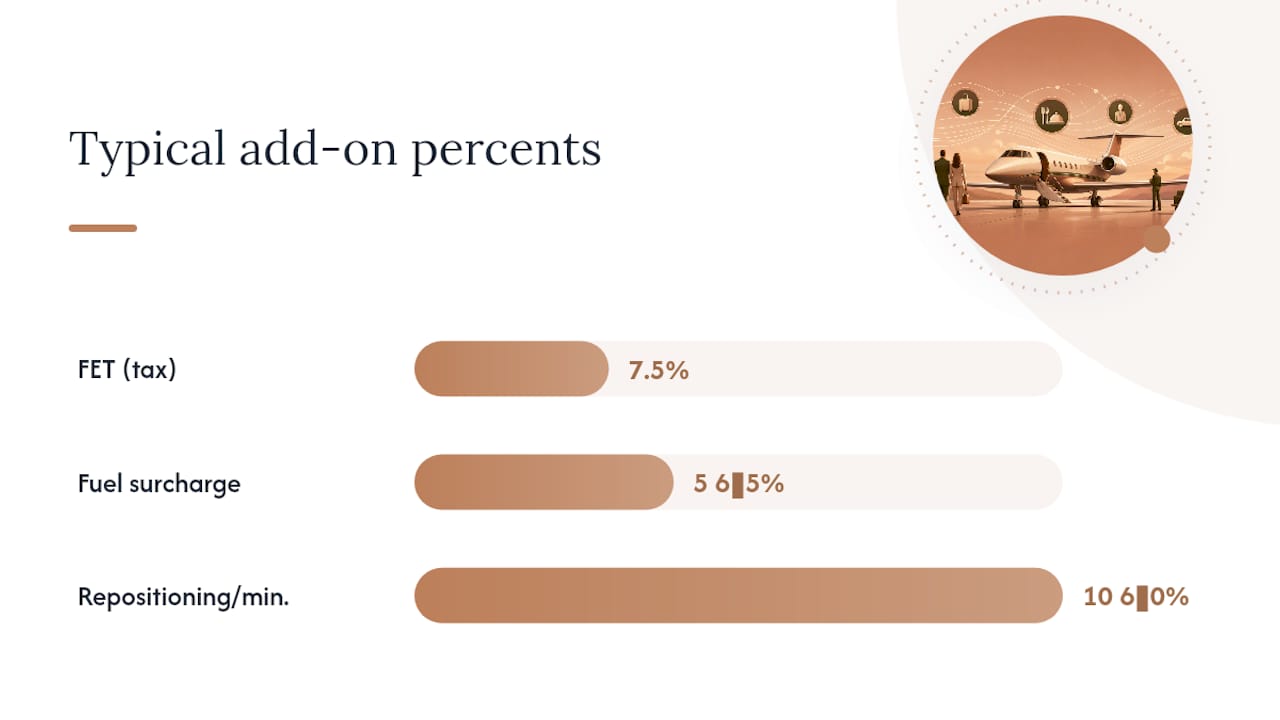
- Federal Excise Tax (FET): a flat 7.5% tax applied to domestic charter fares, covering the base fare itself but not international segments or certain segment fees.
- Fuel surcharge: usually 5% to 15% of the base fare, adjusted monthly based on jet fuel price movements tracked by IATA.
- FBO and handling fees: $500 to $2,500 per stop, higher at major hubs like Teterboro or Van Nuys during peak travel windows.
- Crew fees: overnight per diems and hotel costs, generally $150 to $400 per crew member per night if the trip requires an overnight stay away from base.
- Catering: $50 to $500 per leg depending on whether you want basic snacks or a full multi-course meal service.
- Repositioning (deadhead) legs: billed at the same hourly rate to fly the aircraft to your departure point if it isn’t already there.
Pro Tip: Always request a written, itemized quote that separates FET, fuel surcharge, FBO fees, and repositioning as distinct line items. Operators who bundle everything into one number are the ones most likely to add surprise fees later.
Repositioning and daily minimums alone can add 10% to 40% to a quoted trip cost, according to industry cost breakdowns, depending on how far the aircraft has to travel to reach you.
How to Calculate Your All-In Private Jet Charter Cost
The math isn’t complicated once you know which numbers to plug in. Use this formula as your baseline:
All-in cost = (hourly rate × billable hours) + FET + fuel surcharge + FBO fees + catering + repositioning + incidentals
Here’s how that plays out on a real trip: a 3-hour regional flight in a midsize jet quoted at $6,000 per hour.
- Base flight cost: $6,000 × 3 hours = $18,000
- FET (7.5%): $18,000 × 0.075 = $1,350
- Fuel surcharge (10%): $18,000 × 0.10 = $1,800
- FBO handling (both ends): $1,200
- Catering: $250
- Total all-in cost: roughly $22,600
Now add a 1-hour repositioning leg because the aircraft is based somewhere else.
Split among four passengers, that’s the difference between $5,650 and $7,538 per person, which is exactly why asking about the aircraft’s home base before booking matters as much as asking about the hourly rate.
Sample Route Costs: Short Hop to Long-Range
Numbers land differently depending on the mission, and seeing three real scenarios side by side makes the pricing tiers click faster than any rate chart.
A short hop like New York to Boston in a light jet runs about 1 hour of flight time. Base cost lands near $4,500, and after FET, fuel surcharge, and a single FBO fee, the all-in total typically comes to $5,500 to $6,500. If the aircraft is already positioned nearby, an empty-leg opportunity on this route could cut that to $2,000 to $3,000.
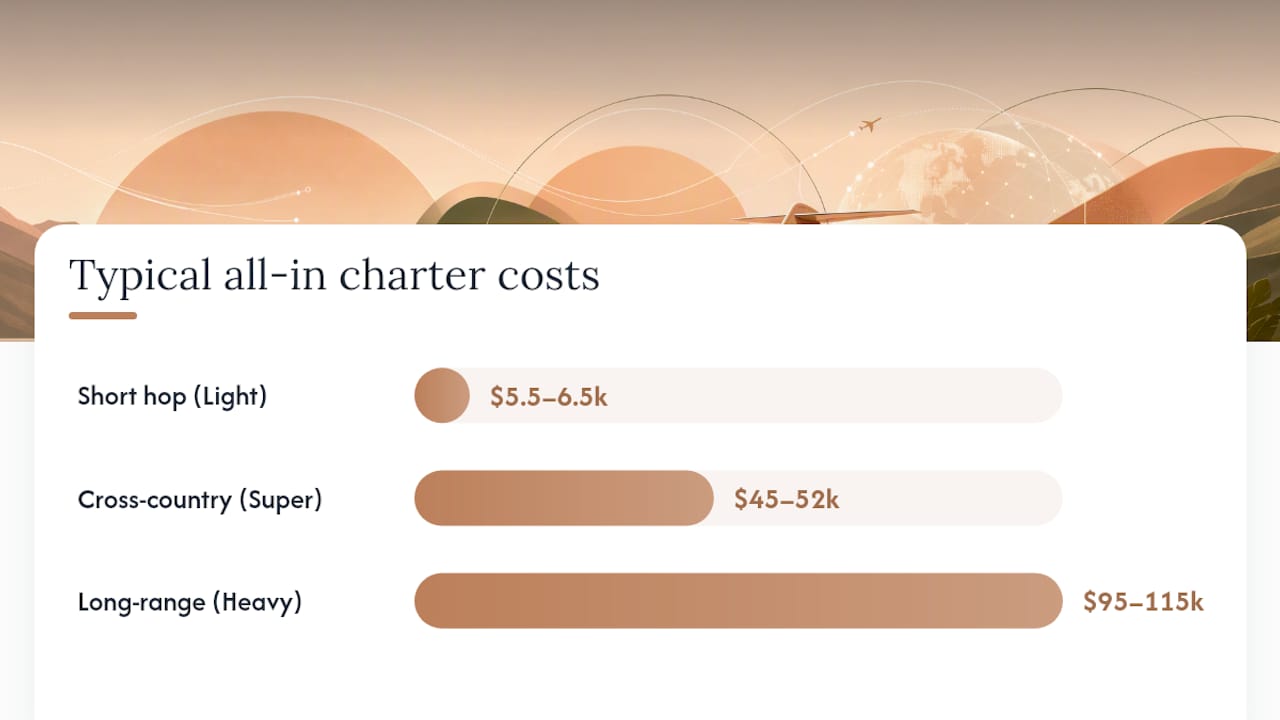
A cross-country trip such as Los Angeles to New York in a super-midsize jet covers roughly 5 hours. Base cost around $37,500, plus FET, fuel surcharge, catering, and FBO fees at both ends pushes the all-in total to $45,000 to $52,000. Add a repositioning leg from a different base city and you could see another $8,000 to $12,000 tacked on.
A long-range international leg like New York to London in a heavy jet covers about 7 hours. Base cost near $70,000, with international handling fees, customs coordination, overnight crew costs, and higher catering standards, the realistic all-in total runs $95,000 to $115,000. Transoceanic missions also carry higher insurance and overflight fee exposure than domestic routes, which is part of why the per-hour rate alone understates the true cost so badly on these trips.
| Route type | Flight time | Aircraft category | Typical all-in cost |
|---|---|---|---|
| Short hop | ~1 hour | Light jet | $5,500 to $6,500 |
| Cross-country | ~5 hours | Super-midsize jet | $45,000 to $52,000 |
| Long-range international | ~7 hours | Heavy jet | $95,000 to $115,000 |
Jet Cards vs. On-Demand Charter: Which Actually Saves Money
A jet card is a prepaid block of flight hours, usually 25 to 50 hours, locked in at a fixed hourly rate for a set period, typically 12 to 24 months. Fractional ownership goes further, buying you a percentage share of an actual aircraft with guaranteed availability. On-demand charter, by contrast, means booking each trip individually against current market rates with no upfront commitment.
The tradeoffs are real and specific:
- Jet cards offer price predictability and guaranteed availability but require $100,000 or more in upfront capital, often carry blackout dates around holidays, and leave you exposed if the provider’s financial health wavers.
- Fractional ownership removes availability risk almost entirely but ties up serious capital and includes monthly management fees regardless of how much you fly.
- On-demand charter has zero upfront commitment and full flexibility on aircraft choice, but you’re exposed to market pricing swings during high-demand periods like holiday weeks.
Broker analysis consistently shows that on-demand charter wins financially below roughly 50 flight hours per year. Above that threshold, prepaid programs start paying for themselves through rate locks and availability guarantees. Treat that number as a starting point, not a rule; your actual routes, seasonal patterns, and aircraft preferences can shift the breakeven point in either direction.
Pro Tip: Before signing any jet card agreement, get a live charter quote for your actual most-flown route and compare it against the card’s locked rate. Cards look great on paper until you run your real numbers against them.
Ways to Cut Your Private Jet Charter Cost
Empty legs, the flights an aircraft makes without passengers while repositioning, sell at 30% to 75% off standard rates when your schedule can flex to match the aircraft’s timing rather than the other way around.
A few other levers worth pulling:
- Seat-by-seat charters and turboprops cost significantly less than a full light jet for solo or small-group travel under 90 minutes.
- Off-peak booking (weekday departures, avoiding Sunday afternoons) can shave 10% to 20% off quotes during otherwise busy seasons.
- Booking outside peak weeks (Thanksgiving, late December, major holiday weekends) avoids the demand surcharges that stack on top of already-high base rates.
- Specifying operator-based aircraft for your route eliminates repositioning charges entirely.
- Bundling round-trip and multi-leg bookings with one operator sometimes unlocks a waived daily minimum on the return leg.
Pro Tip: Ask brokers directly whether they have empty-leg inventory on your preferred dates before committing to a full on-demand quote. Broker networks with deep operator relationships see these opportunities first.
Cancellation and Change Fee Policies to Watch
Cancellation terms vary by operator, but most charter contracts follow a tiered structure tied to how close to departure you cancel. Cancel more than 7 to 14 days out and you typically forfeit a small deposit, often 10% to 25% of the trip cost. Cancel within 72 hours and expect to lose 50% to 100% of the full fare, since the operator has already committed the aircraft and crew to your schedule.
Weather and mechanical cancellations initiated by the operator are usually fully refundable or rebooked at no charge, but a client-initiated same-day cancellation almost never gets any relief. Schedule changes work similarly: adjusting departure time by a few hours is often free if requested early, while changing dates within 48 hours of departure can trigger a repositioning charge if the aircraft was already staged elsewhere for your original itinerary.
Jet card programs sometimes soften these penalties with more flexible rebooking windows, one more reason usage frequency matters when weighing card commitments against on-demand bookings. Whatever purchase model you choose, read the cancellation clause before you sign anything, not after a schedule changes. The fine print on change fees is where a well-negotiated charter agreement earns its keep, and it’s worth factoring into your overall luxury travel budget from the start rather than treating it as an afterthought.
Why Most Cost Estimates Miss the Real Number
The conventional advice on private jet charter cost treats the hourly rate as the answer. It isn’t. The rate is the opening bid in a negotiation that includes taxes, fuel volatility, positioning logistics, and crew schedules, and every one of those variables can shift the final number by thousands of dollars in either direction.
What the research actually supports is this: readers who ask for a single hourly figure get quoted the smallest number an operator can defensibly offer. Readers who ask for a full itemized breakdown, including repositioning, daily minimums, and fuel surcharge basis, get a number they can trust. That’s not a minor distinction.
The jet card versus charter decision gets oversimplified too. Most guidance reduces it to a single hours-per-year threshold. In practice, your specific routes, how far in advance you typically book, and how much schedule flexibility you have matter just as much as raw annual hours. Run your own numbers before committing capital to any card program.
— Michael
How Hidden Door Travel Handles Private Jet Pricing for Clients
Booking a private flight through a single broker limits you to that broker’s aircraft network and their markup structure. Some travel agencies draw on broker and operator relationships across the market to match the right aircraft category to your actual mission instead of whatever inventory happens to be available.

Some agencies arrange charters by requesting an itemized breakdown: base rate, FET, fuel surcharge basis, FBO fees at every stop, and repositioning costs, then negotiate on clients’ behalf and consolidate everything into a single invoice that may also include ground transportation and VIP FBO arrangements. That means no reconciling five separate bills for one trip.
To produce an accurate quote, we need your preferred dates, passenger count, departure and arrival airports, and any flexibility you have on timing, since that flexibility is often what unlocks empty-leg savings or eliminates a repositioning charge entirely. If you want a bespoke, all-in estimate for your next trip rather than a bare hourly number, our luxury travel experts can put one together and walk you through every line before you commit to anything.
Sources
- Private Jet Cost Per Hour (2026) – All Aircraft Types
- IRS tax topic page (FET guidance)
- IATA fuel monitor
- Jet Card vs Charter: Which Saves You More? | Flyius
- Private Jet Rental | Jet Cost & Hourly Rates (2026)