

Yes, travel insurance can cover pre-existing conditions, but only if you buy a plan with a pre-existing condition exclusion waiver inside the insurer’s time-sensitive purchase window. You must also be medically able to travel on the day you buy the policy and insure the full nonrefundable cost of your trip. Miss any one of those three, and the waiver, and the coverage, disappears.
TL;DR:
- Travelers must purchase a plan with a pre-existing condition waiver within a specific time window, insure all nonrefundable trip costs, and be fit to travel on purchase day.
- A broad look-back period, ranging from 60 to 180 days, captures recent symptoms, treatments, or medication changes that can disqualify conditions from waiver coverage.
- The waiver only removes the exclusion for known conditions; failing to disclose or delaying disclosure risks claim denial and policy rescission.
- Adequate emergency medical and medevac coverage is essential, especially for remote or high-cost regions, to handle potential flare-ups cost-effectively.
- Managing conditions on the road requires proper medication storage, documentation, and communication with doctors about travel adjustments to avoid emergencies or claim disputes.
Table of Contents
- What Counts as a Pre-Existing Condition in Travel Insurance?
- How Does a Pre-Existing Condition Waiver Work, and Who Qualifies?
- How Much Emergency Medical and Medevac Coverage Do You Actually Need?
- What Does “Medically Able to Travel” Really Mean?
- Buying Travel Insurance With a Pre-Existing Condition: Step by Step
- Coordinating Insurance, Medevac, and Concierge Support: An Expert View
- Late Disclosure and Nondisclosure: Why It Backfires
- Managing Your Condition on the Road: Medication and Continuity of Care
- When a Travel Planner Beats DIY Insurance Shopping
- How Hidden Door Travel Helps Travelers With Pre-Existing Conditions
- Where to Verify the Details Before You Buy
- Sources
What Counts as a Pre-Existing Condition in Travel Insurance?
Insurers define “pre-existing condition” more broadly than most travelers expect. It’s not just a diagnosed illness. It’s any condition for which you had symptoms, sought treatment, took medication, or received a new test result or medication change within a specific look-back window before your policy’s effective date.
That window, the look-back period, typically runs 60 to 180 days depending on the carrier. A shorter 60-day window is more forgiving. It only scrutinizes the two months right before purchase. A 180-day window digs back half a year, catching things you might not think to mention, like a dosage tweak for blood pressure medication three months ago.
Here’s how that plays out in practice:
- A traveler with well-controlled type 2 diabetes, same medication and dose for a year, generally reads as stable under most look-back rules.
- A traveler who had chest pain investigated two weeks before buying a policy, even with no formal diagnosis yet, likely falls inside the look-back window.
- A recent hospitalization, ER visit, or new prescription within the look-back period almost always disqualifies that specific condition from waiver coverage, even if the trip itself is unrelated.
The distinction insurers care about is stability, not severity. A serious but unchanged condition often qualifies. A minor but recently altered one often doesn’t.
How Does a Pre-Existing Condition Waiver Work, and Who Qualifies?
A waiver doesn’t add new coverage. It removes the standard exclusion that would otherwise block claims tied to a known medical condition. Without it, a flare-up of an existing condition is treated the same as a condition you never disclosed: not covered. With it, that same flare-up is treated like any other covered medical event.
Qualifying isn’t automatic. Most insurers apply the same three-part test:
- Buy within the time-sensitive window. This is usually within a few weeks after your first nonrefundable trip payment, not before departure. Miss this window and no amount of medical stability saves the waiver.
- Insure the full nonrefundable trip cost. Experian’s research confirms insurers require the entire nonrefundable amount, not a partial figure, insured as of the purchase date. Add costs later, like a second hotel deposit, and you typically have 14 days to insure that addition too.
- Be medically able to travel on the purchase date. You can’t be under doctor’s orders to avoid travel, and some insurers ask for a physician’s confirmation.
Keep every receipt tied to your trip deposits. Insurers verifying a claim will cross-reference your purchase date against your first payment date, and a fuzzy paper trail is the most common reason a legitimate waiver claim gets delayed.
Pro Tip: Set a calendar reminder the same day you pay your first trip deposit. The waiver clock starts ticking immediately, not when you finally sit down to shop for insurance.
How Much Emergency Medical and Medevac Coverage Do You Actually Need?
For travelers with a pre-existing condition, the coverage limit matters more than almost any other policy detail, because a flare-up abroad tends to be expensive fast.
Marketplace guidance generally points to two minimums:
- At least substantial emergency medical coverage.
- At least substantial medical evacuation coverage.
Squaremouth’s data backs both figures as reasonable floors for travelers managing an existing condition, not luxury add-ons. A medevac from a remote region or a foreign hospital that can’t manage your condition can run into six figures on its own, before any medical treatment is billed. Emergency medical coverage handles the treatment; medevac coverage handles getting you somewhere that can actually provide it.
Plans that bundle a pre-existing condition waiver with primary medical coverage (meaning it pays first, without you fighting your domestic insurer first) tend to cost more. That premium buys you speed when it matters most: a claims process that doesn’t stall while two insurers argue over who pays first. For itineraries with remote legs, our breakdown of medevac coverage amounts walks through how those sums scale with destination risk.
What Does “Medically Able to Travel” Really Mean?
This phrase does a lot of work in a waiver clause, and it trips up more travelers than the look-back period does. It means no new symptoms, no new treatment, and no medication changes for your condition during the insurer’s look-back window, not just “feeling fine” on the day you buy.
A few concrete examples clarify the line:
- Stable and likely to qualify: controlled hypertension on the same medication for eight months, a healed fracture with no follow-up care needed, well-managed asthma with no recent ER visits.
- Likely disqualifying: a medication dosage increase last month, a hospital stay in the past 90 days, a new referral to a specialist for the same condition.
If your condition is borderline or complex, ask your doctor for a brief fit-to-travel letter dated close to your purchase date. Insurers sometimes request this after the fact if a claim gets questioned, and a contemporaneous letter carries far more weight than one written retroactively during a dispute. Keep it filed with your policy documents, not buried in an email you’ll never find again.
Buying Travel Insurance With a Pre-Existing Condition: Step by Step
The sequence matters as much as the shopping. Here’s the order that actually protects your waiver eligibility.
- Pay your first nonrefundable deposit, then immediately note the date. This starts the purchase window clock, which most insurers set at 14 to 21 days.
- Total every nonrefundable cost you expect for the trip, flights, hotels, tours, and insure that full figure, not a rounded-down estimate.
- Confirm the waiver appears in the Certificate of Insurance, not just in marketing copy. This document is the actual contract language that governs a claim.
- Select medical and medevac limits appropriate to your destination and condition, then keep digital and printed copies of your policy, deposit receipts, and any medical documentation.
When you call an insurer, ask directly: “Does this waiver apply to the specific condition I’m disclosing, and does it cover both cancellation and in-trip medical costs?” A red flag worth walking away from: vague language like “may be covered” instead of a clear waiver clause naming both cancellation and emergency medical benefits.
Pro Tip: If your trip involves supplier deposits on a staggered schedule, common with cruises and multi-stop itineraries, insure the total contracted cost upfront rather than in pieces. Partial insuring is one of the fastest ways to accidentally void a waiver. Our guide to coordinating deposit schedules covers this in more detail.
Coordinating Insurance, Medevac, and Concierge Support: An Expert View
Travelers assume their US health plan travels with them. It doesn’t, not for anything beyond domestic borders, which is why emergency medical and medevac limits deserve more attention than most people give them.
For a remote or multi-country luxury itinerary, I’d rather see a client oversized on medevac coverage than undersized. A medevac from a private island or a rural region isn’t a $10,000 problem, it’s often a $100,000-plus problem, and that gap is where trips get financially ruined. Pairing that coverage with a claims concierge matters too, because the single biggest cause of a denied waiver claim isn’t the medical condition itself. It’s an administrative slip: a missed purchase window or a trip insured in pieces instead of in full.
Bespoke planners who coordinate deposit schedules with policy purchase dates close that gap before it opens.
— Michael
Late Disclosure and Nondisclosure: Why It Backfires
Leaving a condition off your application, or disclosing it after the policy is already in force, doesn’t reduce your risk. It eliminates your coverage for that condition entirely.
Insurers investigate pre-existing condition claims by pulling medical records around the trip dates and comparing them against your disclosed history. If a condition surfaces that wasn’t disclosed and falls inside the look-back period, the claim for that condition gets denied, even if everything else about the trip was insured correctly. Some insurers go further and rescind the entire policy for material nondisclosure, not just the one claim.
This is different from the domestic health insurance protections most Americans are used to. Under the Affordable Care Act, a domestic health plan can’t refuse you coverage or charge you more for a pre-existing condition. Travel insurance doesn’t work that way. It’s a separate product built around disclosure and waivers, and that ACA protection has no bearing on whether your trip cancellation or in-trip medical claim gets paid.
The fix isn’t complicated: disclose everything relevant at the time of purchase, even conditions that feel minor or unrelated to your destination. A condition you left off because “it’s not a big deal” is exactly the kind of thing an insurer’s records request turns up later, usually right when you need the claim paid most.
Managing Your Condition on the Road: Medication and Continuity of Care
Coverage on paper doesn’t help if you can’t manage your condition once you land. A few habits reduce both the medical risk and the odds of a claim dispute later.
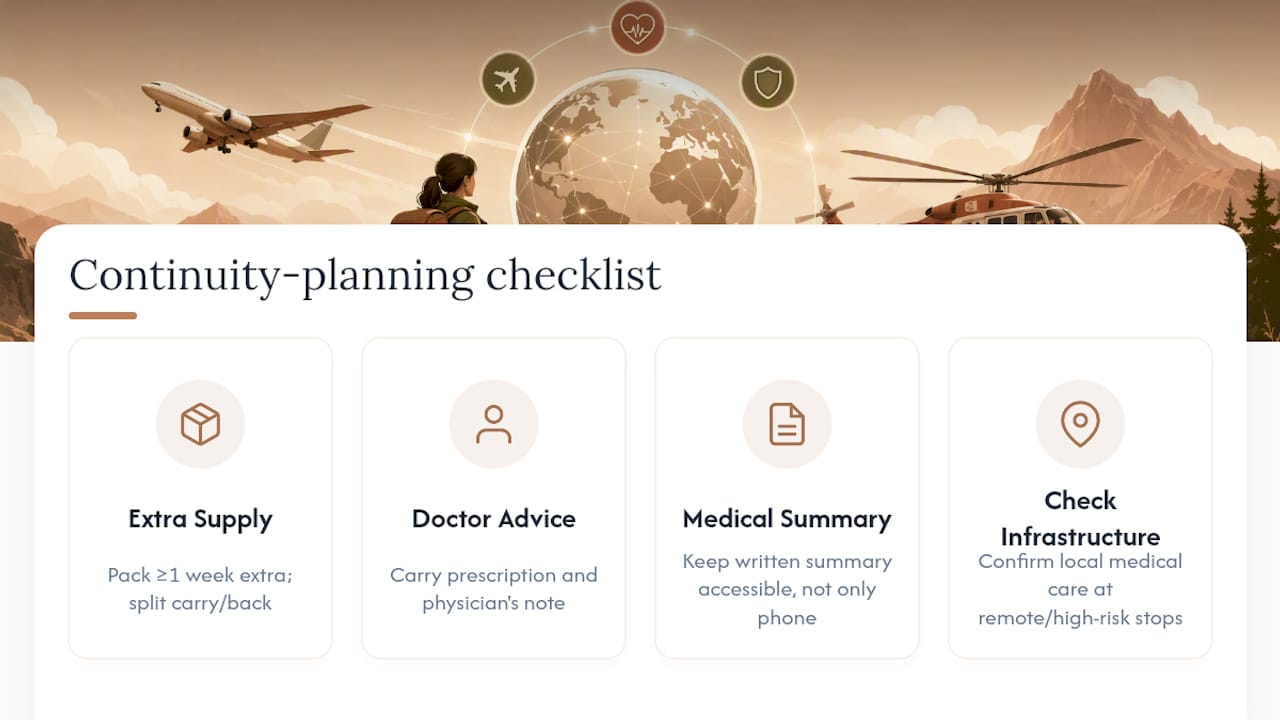
Carry medications in original, labeled packaging, split between your carry-on and a backup bag, never all in checked luggage. Pack at least a week’s extra supply beyond your planned trip length in case of delays. For controlled substances or injectables, carry your prescription and a brief physician’s note describing dosage and medical necessity, since customs officers in some countries ask.

Keep a written summary of your condition, current medications, dosages, and treating physician’s contact information somewhere accessible, not just in your phone. If you need emergency care abroad, that summary speeds up treatment and gives the receiving doctor a starting point instead of guesswork.
If your trip crosses time zones significantly, talk to your doctor beforehand about adjusting medication timing, particularly for insulin, blood thinners, or anything dosed on a strict schedule. And if your itinerary includes remote stops, confirm in advance what local medical infrastructure actually exists there. A stable condition at sea level can behave differently at altitude or in extreme heat, which is worth flagging to your doctor before you go, not after a flare-up starts.
When a Travel Planner Beats DIY Insurance Shopping
For complex itineraries, multiple suppliers, staggered deposits, remote legs, a planner catches the mistakes that quietly void waivers: a missed purchase window, a partially insured trip cost, a medevac limit that doesn’t match the destination.
Concierge planning earns its cost when your trip involves six-figure deposits, multi-country routing, or destinations with limited medical infrastructure. Before hiring one, ask specifically about their experience coordinating waiver timing with supplier deposit schedules, not just booking the trip itself.
How Hidden Door Travel Helps Travelers With Pre-Existing Conditions
Shopping for a waiver-compliant policy on your own means tracking purchase windows, total trip costs, and medevac math across multiple suppliers, often while also trying to book the actual trip. This coordination can be folded into the planning process itself, so the insurance timeline moves in step with your deposit schedule instead of trailing behind it.

Certificate of Insurance language can be reviewed against your specific itinerary, waiver timing confirmed against your first deposit date, and medevac coverage sized to match remote or multi-country routing. For travelers managing a condition, local medical resources near your destinations can be flagged and claims support coordinated if something goes wrong mid-trip.
To get started, bring your draft itinerary, deposit receipts, and a brief medical summary to a consultation. From there, our luxury travel planning team builds the insurance timeline directly into your itinerary, so nothing slips through a missed window or a partially insured trip cost.
Where to Verify the Details Before You Buy
Policy language varies by insurer and by state, so treat this article as a starting framework, not a substitute for reading your own plan’s Certificate of Insurance.
For primary sourcing, review Allianz’s explanation of waiver eligibility, Squaremouth’s marketplace comparison of plans covering pre-existing conditions, and the HHS overview of how domestic ACA protections differ from travel insurance. Always confirm the specific waiver terms against your trip’s own Certificate of Insurance before relying on general guidance.
Sources
- Travel insurance for pre-existing conditions | Experian
- Best travel insurance for pre-existing conditions | Squaremouth
- Pre-existing conditions & travel insurance | Allianz
- Can I get coverage if I have a pre-existing condition? | HHS