

Private security travel, in the sense that matters for high-value trips, is bespoke luxury travel planning and concierge support paired with optional protection add-ons like evacuation membership and comprehensive insurance. It’s built for affluent travelers whose itineraries are too complex, too expensive, or too irreplaceable to leave to chance. The payoff is straightforward: back-channel access, fewer disasters, and financial protection if something goes wrong.
TL;DR:
- Private security travel focuses on operational and financial protections, not physical bodyguard services, including evacuation memberships and comprehensive insurance.
- A luxury concierge offers exclusive access, 24/7 local support, and dispute advocacy, especially valuable for complex itineraries with multiple interdependent components.
- High-net-worth travelers should purchase evacuation, travel insurance, and valuables coverage separately within a specific timeframe after booking to preserve benefits.
- Vetting a concierge involves testing their crisis handling, understanding their alliances, fee structure, and data security protocols before booking large or multi-vendor trips.
- Risk assessment must be destination-specific and updated throughout the planning process, with a clear emergency response plan tailored to potential failure points.
Table of Contents
- What Does Private Security Travel Actually Cover?
- Why Hire a Bespoke Travel Agency Instead of Booking It Yourself?
- What Travel Protection Do You Need for a High-Value Trip?
- How Do You Choose the Right Travel Concierge?
- What’s the Pre-Trip Checklist for Agency-Led Luxury Travel?
- How Do You Assess Risk Before a High-Value Trip?
- Where Do Personal Security Personnel Fit Into a Luxury Trip?
- How Does an Agency Coordinate With Embassies and Local Authorities?
- What Technology Keeps High-Value Trips Secure?
- What Should an Emergency Response Plan Look Like?
- What Legal Issues Come Up With Travel Protection Abroad?
- Hidden Door Travel’s Take on Pairing Concierge Planning With Protection
- Ready to Plan Your Next High-Value Trip?
- Sources
- FAQ
What Does Private Security Travel Actually Cover?
Here, private security travel refers to a private travel agency’s concierge planning combined with financial and logistical safeguards for expensive trips, as explained in what is a business traveler guest and their needs. It is not hired bodyguards or executive-protection teams walking beside a client. That’s a different service entirely, and this article does not cover it.
What it does cover: custom itinerary design, hotel and cruise bookings, exclusive event access, transportation arrangements, destination weddings, and on-trip concierge support. Layered on top are optional protection products: evacuation memberships, comprehensive travel insurance (sometimes with Cancel For Any Reason coverage), and scheduled valuables policies for jewelry, watches, or art. The security in the phrase is financial and operational security, not physical bodyguard coverage. Think of it as travel risk management for your money and your plans, executed by people who’ve booked thousands of trips like yours.
Why Hire a Bespoke Travel Agency Instead of Booking It Yourself?
A luxury concierge functions less like a booking agent and more like a personal chief operating officer for your trip, reducing friction and coordinating every moving part so you never have to. That distinction shows up most clearly when something breaks mid-trip, not when everything goes to plan.
A few concrete advantages stand out:
- Access you can’t buy online. Consortia relationships (Virtuoso is a well-known example) unlock room upgrades, private tastings, and reservations at booked-out restaurants that no public site offers.
- Someone answers at 2 a.m. When a flight cancels in Milan or a villa’s water heater dies before a wedding, a concierge with local contacts fixes it while you sleep.
- Time reallocation, not just time savings. Every hour you don’t spend comparing flight itineraries is an hour spent deciding what actually matters. Advisors typically save clients meaningful planning time on multi-stop or multi-vendor trips.
- Advocacy when things go sideways. An agency with existing supplier relationships resolves disputes faster than an individual traveler calling a call center.
Pro Tip: If a trip involves more than three moving components, cruise, private jet, multiple hotels, ground transfers, the coordination burden alone usually justifies agency support, independent of budget.
DIY planning still works fine for a single hotel stay or a straightforward flight-and-resort package. It stops working once your itinerary has interdependent parts that can cascade if one piece fails.
What Travel Protection Do You Need for a High-Value Trip?
Three distinct products cover three distinct risks, and confusing them is the most common expensive mistake affluent travelers make. High-net-worth travelers should treat these exposures separately rather than assuming one policy handles everything.
- Evacuation membership. Companies like Global Rescue and Medjet arrange medical transport home or to a better facility during a crisis abroad. This is membership-based, not insurance, and it activates fast.
- Comprehensive travel insurance. Covers trip cancellation, interruption, emergency medical expenses, and baggage. Adding Cancel For Any Reason coverage lets you cancel for a reason a standard policy would reject, at a higher premium.
- Scheduled valuables policies. Separate coverage for jewelry, watches, or art that a standard travel or homeowner’s policy caps too low to matter.
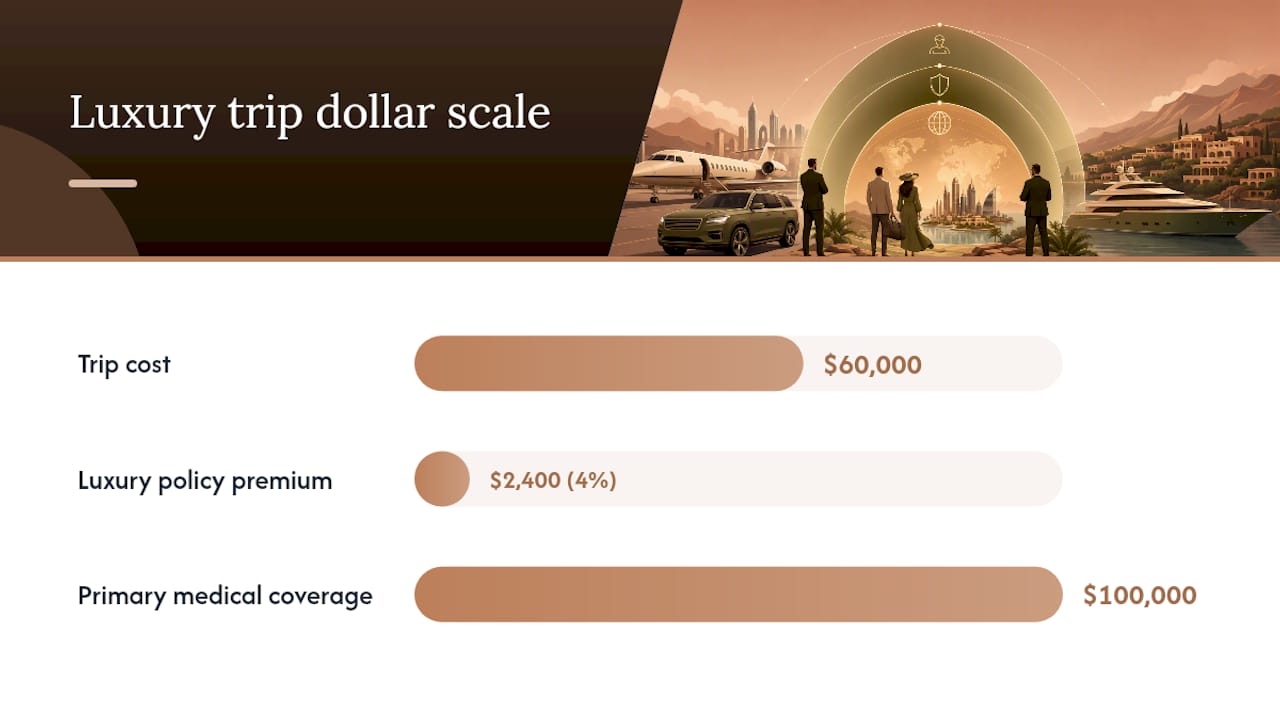
A real-world example shows how this scales in practice: a family spending $60,000 on a trip purchased a luxury policy priced around $2,400, roughly 4% of trip cost which included 30 covered cancellation reasons and $100,000 of primary medical coverage. That 4% ratio is a reasonable planning benchmark, though CFAR riders and evacuation memberships add to it.
Premium credit cards are not a substitute here. Card-issued travel benefits usually cap evacuation and valuables coverage well below what a high-value trip actually needs.
Buy the moment you book. Waiting to purchase can cost you the CFAR window and pre-existing condition waivers that only apply within a set number of days of your deposit, a timing detail comparison platforms flag repeatedly. For weddings, multi-family reunions, or group expeditions, group travel insurance plans through comparison marketplaces often beat buying ten individual policies. Our guide to travel insurance for luxury trips breaks down when each layer actually earns its premium.
How Do You Choose the Right Travel Concierge?
Vetting a concierge or agency is less about credentials and more about watching how they handle a hypothetical crisis before you hand them a real one.
- Ask what happens when a flight cancels at 11 p.m. local time. A strong answer names a specific process, a 24/7 contact line, rebooking authority, backup hotel relationships, not a vague promise to “help.”
- Request a sample itinerary for a comparable trip. This reveals whether they actually book at your level or are stretching to reach it.
- Ask about consortia affiliations. Virtuoso and similar networks are a quick proxy for real supplier leverage.
- Clarify the fee model up front. Some agencies charge planning fees from nothing to several thousand dollars depending on complexity, with the rest of their revenue coming from supplier commissions. Hidden Door Travel’s own fee structure breakdown shows what clients get at different price points.
- Ask how they handle sensitive personal and payment data. Encrypted communication channels and controlled data access are reasonable baseline expectations for any agency handling passport numbers and payment details.
Pro Tip: Test the relationship with a contained booking, a long weekend or a single hotel stay, before committing to a six-figure itinerary. A trial run reveals judgment and responsiveness far faster than any sales call.
Watch for how they communicate day to day. A genuinely proactive concierge flags issues before you notice them, not after.
What’s the Pre-Trip Checklist for Agency-Led Luxury Travel?
Timing matters as much as the bookings themselves. A rough sequence that works for most complex, high-value trips:
- 60 to 90 days out: Lock hotel, cruise, or villa bookings and buy comprehensive insurance immediately after the first deposit to preserve CFAR eligibility.
- 45 days out: Get valuables appraised and scheduled on a dedicated policy if you’re traveling with jewelry or watches above your homeowner’s cap.
- 30 days out: Confirm evacuation membership is active and file your itinerary with them if the destination is remote.
- 14 days out: Reconfirm every reservation directly, restaurants, private guides, transfers, since third-party bookings sometimes drop.
- 72 hours out: Verify passport, visa, and any required entry documentation; pack according to a structured packing checklist rather than memory.
How Do You Assess Risk Before a High-Value Trip?
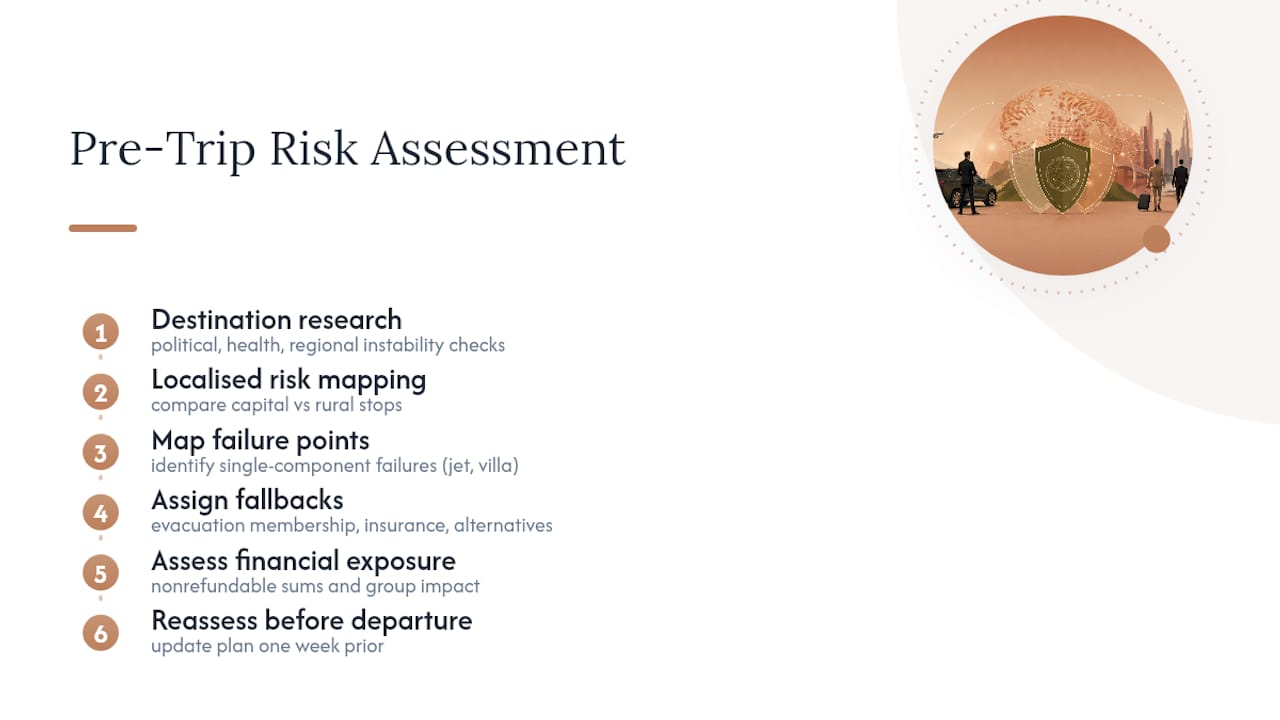
Risk assessment for a luxury trip starts with destination-specific research, not generic worst-case scenarios. A competent agency or advisor reviews the current political and health situation at your destination, checks for regional instability, and cross-references it against your itinerary’s specific stops, since risk in a capital city can differ sharply from risk in a rural region two hours away.
The next layer is trip-specific: what happens if a single component fails? A cruise missing a port call, a private jet grounded by weather, a villa contract falling through days before a wedding. Mapping these failure points in advance, then assigning a fallback for each, is the core of practical risk management. This is where evacuation membership and comprehensive insurance intersect with planning: the assessment tells you which protection layer actually matters for your specific route.
Financial exposure gets evaluated too. A trip with $200,000 in nonrefundable deposits carries a different insurance conversation than one with $15,000 at stake. Family or group trips add a layer, since a medical event affecting one traveler can derail the itinerary for everyone traveling with them. Good risk assessment isn’t a checklist you fill out once; it’s revisited as the itinerary firms up and again a week before departure, when real-world conditions might have shifted from what was true at booking.
Where Do Personal Security Personnel Fit Into a Luxury Trip?
Some high-net-worth travelers do bring dedicated personal security or bodyguards on certain trips, typically for public figures, executives with elevated exposure, or destinations with genuine safety concerns. That’s a distinct service from what a luxury concierge provides, and it usually comes from a specialized security firm rather than a travel agency.
Where the two intersect is coordination. A concierge team that already knows the itinerary, the property, and the local contacts can integrate smoothly with a security detail a client brings independently, sharing schedules, confirming secure transportation windows, and adjusting reservations around the detail’s requirements. The concierge isn’t providing the personnel; it’s making sure the travel logistics don’t work against them.
For most affluent leisure travelers, though, the practical substitute for a security detail is simply better planning: vetted transportation, pre-vetted accommodations, and a concierge who knows which neighborhoods, drivers, and venues carry a track record. That’s the layer Hidden Door Travel actually operates in, logistics and access, not physical protection details.
How Does an Agency Coordinate With Embassies and Local Authorities?
When something goes wrong abroad, medical emergency, lost documents, a legal issue, the fastest resolution usually runs through two channels: local authorities and your embassy or consulate. A concierge with destination experience already knows which local numbers actually get answered and which hotel or resort security contacts are reliable versus decorative.
Registering your trip with the U.S. Department of State’s Smart Traveler Enrollment Program before departure is a practical step any traveler can take independently. It gives the nearest embassy your itinerary and contact information, so if a natural disaster, civil unrest, or personal emergency hits while you’re there, they already know where to look for you.
An experienced agency also keeps a working list of English-speaking legal contacts, medical facilities with international patient experience, and local fixers in destinations it books regularly. That local knowledge, built over repeated trips to the same regions, is one of the harder things to replicate with a single Google search when a crisis is already underway.
What Technology Keeps High-Value Trips Secure?
Data handling matters more than most travelers realize when a third party is holding your passport numbers, payment details, and full itinerary. A reputable concierge operation runs on encrypted communication channels and controlled internal access to client data, not shared spreadsheets emailed between staff.
On the traveler side, a few tools matter more than the rest. Encrypted messaging apps protect trip details and location sharing between family members or a security team, if one is present. GPS trackers or check-in apps give family back home real-time location visibility during remote expeditions or multi-leg trips. Digital copies of passports, insurance policy numbers, and evacuation membership IDs, stored in an encrypted vault rather than a plain photo album, save critical time during an actual emergency.
Ask any agency directly whether they encrypt client files and limit who on staff can see full itineraries and payment information. A vague answer is itself useful information.
What Should an Emergency Response Plan Look Like?
A real emergency plan isn’t a document you write once and forget. It’s a short, specific list: who you call first, in what order, and what each contact can actually do.
For a medical crisis abroad, the order typically runs: local emergency services first, evacuation membership provider second (they coordinate transport and can talk directly to local doctors), then travel insurance carrier for cost coverage and claims. For a security or civil unrest situation, the order shifts: embassy or consulate first, then your agency’s local contacts, who often know evacuation routes or safe accommodations faster than a hotline reading from a script.
The plan should also specify who back home gets notified and how. A family member with copies of your itinerary, insurance numbers, and passport scans can act as a coordination point if you’re incapacitated or unreachable. Building this before departure, rather than improvising it mid-crisis, is the entire point of paying for concierge support in the first place.
What Legal Issues Come Up With Travel Protection Abroad?
Insurance and protection products carry jurisdiction-specific rules that trip up travelers who assume coverage works the same everywhere. Evacuation membership terms, for instance, define exactly what counts as a qualifying medical event, and that definition varies by provider and sometimes by destination country’s medical infrastructure.
CFAR riders on comprehensive travel insurance have strict purchase windows, typically within a set number of days of your initial trip deposit, and missing that window forfeits the option permanently. Scheduled valuables policies for jewelry or watches carried internationally sometimes require customs documentation proving you owned the item before departure, to avoid import duty disputes on the way back.
Cross-border medical evacuation itself involves aviation and customs regulations in both the departure and destination countries, which is exactly why membership-based providers with existing operational relationships in dozens of countries move faster than an ad hoc arrangement would. None of this replaces qualified legal or insurance advice for your specific policy and destination, but knowing these friction points exist before you book lets you ask sharper questions of whoever is selling you the coverage.
Hidden Door Travel’s Take on Pairing Concierge Planning With Protection
We’ve watched enough complex itineraries unravel to know the pattern: the trip that fails isn’t the one with the biggest budget, it’s the one where nobody mapped the failure points in advance. A family recently combined a multi-country itinerary with an evacuation membership and a scheduled valuables policy for travel jewelry; when a connecting flight canceled mid-trip, having both the concierge relationship and the membership active meant the disruption cost them an afternoon, not the vacation.
That’s the whole argument for pairing planning with protection: one handles logistics, the other handles the financial floor beneath them.
— Michael
Ready to Plan Your Next High-Value Trip?
A specialized luxury travel agency is an alternative to piecing together your own itinerary across a dozen browser tabs and hoping the connections hold. Experienced travel agencies handle custom itinerary design, bookings, exclusive access, and optional travel-protection layers as one coordinated plan, not a stack of separate purchases you have to reconcile yourself.

A discovery call starts with your destinations, your budget range, and what’s non-negotiable, then we outline what a concierge relationship with us actually looks like week to week. If your trip includes multiple vendors, a wedding, or valuables worth scheduling separately, the travel concierge will flag the protection layers worth discussing before you book anything. Start by reviewing our customized all-inclusive travel experiences and requesting a consultation to see where your itinerary stands today.
Sources
- Luxury travel insurance: here’s how to protect a million-dollar vacation (Forbes)
- Squaremouth travel insurance comparison
- Best travel insurance for HNW travelers (Trillionaire Daily)
- Your luxury travel concierge guide (Passport Premiere)
- Why use a luxury travel agent? (Superior Cruise and Travel)
FAQ
What Is Private Security Travel?
It refers to bespoke luxury travel planning and concierge support, paired with optional protection add-ons like evacuation membership and comprehensive insurance. It does not mean hiring bodyguards or executive-protection personnel.
How Much Does Travel Protection Cost for a Luxury Trip?
Luxury travel insurance typically runs around 4% to 10% of total trip cost, depending on coverage limits and whether CFAR is added. Evacuation memberships and scheduled valuables policies are priced separately from trip insurance.
Do I Need Both Evacuation Membership and Travel Insurance?
Yes, they cover different risks. Evacuation membership handles medical transport, while comprehensive travel insurance covers trip cancellation, interruption, and medical expenses, so most complex itineraries benefit from carrying both.
What Does Hidden Door Travel Charge for Trip Planning?
Pricing depends on trip complexity and the services involved; current fee details are available directly on our travel planning fees page. Fees can range from a modest planning charge to a higher rate for fully custom, multi-destination itineraries.
Is My Credit Card’s Travel Insurance Enough for a Luxury Trip?
Usually not. Premium card benefits typically cap evacuation and valuables coverage well below what high-value trips actually require, especially for medical evacuation or scheduled jewelry.