

Too many travelers spend weeks comparing ships and suites, then choose a cruise itinerary almost as an afterthought. That’s the mistake that leads to exhaustion on day four, rushed port visits, and a vague sense that something didn’t quite land. Selecting a luxury cruise itinerary that genuinely fits you, known in the industry as itinerary curation, requires thinking about pacing, port access, and emotional goals before you ever look at a ship deck plan. This guide gives you the framework to do exactly that.
Table of Contents
- Key takeaways
- Selecting a luxury cruise itinerary: what most guides skip
- Aligning your travel goals with the right itinerary
- Practical steps for evaluating itinerary options
- Making the most of your itinerary after booking
- My take: the itinerary is the experience
- Let Hiddendoortravel build your ideal cruise itinerary
- FAQ
Key takeaways
| Point | Details |
|---|---|
| Pacing shapes satisfaction | The ratio of sea days to port days directly affects how rested and fulfilled you feel throughout the voyage. |
| Port depth beats port count | Overnight stays and late departures create more meaningful experiences than squeezing in extra ports. |
| Align goals before choosing | Defining your emotional travel goal first filters itinerary options faster than any comparison chart. |
| Verify times before you sail | Arrival and departure times change due to operational factors; check them again close to your sailing date. |
| Expert planning protects your time | A luxury travel specialist can secure early berths, recommend pacing, and match you to the right line. |
Selecting a luxury cruise itinerary: what most guides skip
The industry term for what you’re building is a curated voyage itinerary, and the components that make or break it go well beyond which ports appear on the map. Itinerary design determines daily energy and satisfaction more than ship features alone. That’s not a minor detail. It’s the whole game.
Sea days versus port days
A common misconception is that more port stops equals better value. In reality, aiming for roughly one sea day for every two to three port days gives your body and mind the recovery time that makes each destination feel fresh rather than frantic. Sea days on a true luxury ship are not filler. They are when you use the spa, linger over a three-course lunch, and actually read the novel you brought.
Docking type matters too. A ship that docks directly at a pier gives you walkable access to the destination from the moment the gangway opens. A tendered port requires a small boat transfer, which adds 20 to 40 minutes each way and introduces weather-dependent delays. If you plan independent excursions, a tender port on a short call can eat a significant portion of your usable shore time.
- Port call duration: Calls under six hours often feel rushed once transit time is removed. Look for calls of eight hours or more.
- Late departures: A 10 p.m. or midnight sailing gives you evening in the destination, including dinner ashore or a cultural performance.
- Overnight stays: Nearly 250 exclusive nighttime excursions are offered by lines that prioritize overnight port calls, reflecting real traveler demand for deeper immersion.
- Arrival times: A 7 a.m. arrival is very different from a noon arrival on a port with a 6 p.m. departure. Do the math before you book.
- Docking logistics: Check whether key ports on your itinerary are docked or tendered, especially for destinations with tender-only access like Santorini or Bora Bora.
Pro Tip: When reviewing an itinerary, map each port call on paper with its arrival time, departure time, and docking type. Subtract 90 minutes for tendering or logistics, and you’ll see your real usable shore time clearly.
Luxury fare inclusions also vary more than most travelers expect. All-inclusive pricing differs widely across lines, with some covering gratuities and specialty dining while charging separately for shore excursions and premium beverages. Understanding what’s bundled shapes both your budget and your experience on any given port day.

Aligning your travel goals with the right itinerary
Before comparing ports, ask yourself one honest question: what do you actually want to feel at the end of this trip? Matching emotional travel goals before narrowing itineraries is the most effective way to reduce decision fatigue and improve trip satisfaction. The answer shapes everything else.
Here is a practical sequence for that alignment process:
-
Define your emotional goal. Rest and restoration calls for fewer ports, more sea days, and a line known for spa and onboard dining. Cultural immersion calls for overnight stays, UNESCO destinations, and excursion-heavy schedules. Adventure requires a different ship class entirely, likely a smaller expedition vessel capable of reaching remote or polar destinations.
-
Match itinerary tone to destination character. A 12-night Mediterranean itinerary hitting eight ports in quick succession can feel more like a highlight reel than a real experience. A 10-night itinerary covering five ports with two overnights allows you to go deeper. The tone of the route should match your definition of luxury.
-
Factor in seasonality seriously. The best cruise itineraries are not the same year-round. Norway’s fjords are extraordinary in late spring and early summer. The Caribbean shoulder season from May through June offers lower prices and fewer crowds but carries weather risk. The top luxury cruise destinations each have a window of optimal conditions, and booking outside that window for the sake of convenience usually costs you in experience quality.
-
Build recovery days into active itineraries. If your route includes consecutive full-day excursions, place at least one sea day between clusters of activity. Building a cadence plan that alternates active and restorative days maximizes enjoyment of even intensive schedules.
-
Choose the cruise line category that fits your vibe. The types of luxury cruise lines range from ultra-inclusive mega-yachts like Scenic Eclipse to expedition-focused small ships and classic white-glove ocean liners. Comparing luxury expedition cruise lines against resort-style ships is not apples to apples. The line you choose sets the entire tone of the experience, and the best adults-only luxury cruise lines add a further layer of atmosphere that shapes social dynamics onboard.
Pro Tip: Write three sentences describing your ideal day on this trip, one at sea, one in port, and one in the evening. If a proposed itinerary cannot realistically deliver all three, it is the wrong itinerary regardless of how good the price looks.
Practical steps for evaluating itinerary options
Choosing among the best cruise itineraries requires a structured comparison, not gut instinct. Here is a step-by-step process that the Hiddendoortravel team uses when consulting clients on luxury cruise planning.
Step 1: Go beyond port names. Look up each port’s actual arrival and departure times in the itinerary documents, not just the brochure summary. A port listed simply as “Dubrovnik” could mean 7 a.m. to 2 p.m. or 10 a.m. to 10 p.m. Those are profoundly different experiences.
Step 2: Map the day-by-day rhythm. Plot sea days and port days sequentially. If you see five consecutive port days with no recovery, that is an exhaustion pattern regardless of how beautiful the destinations are.
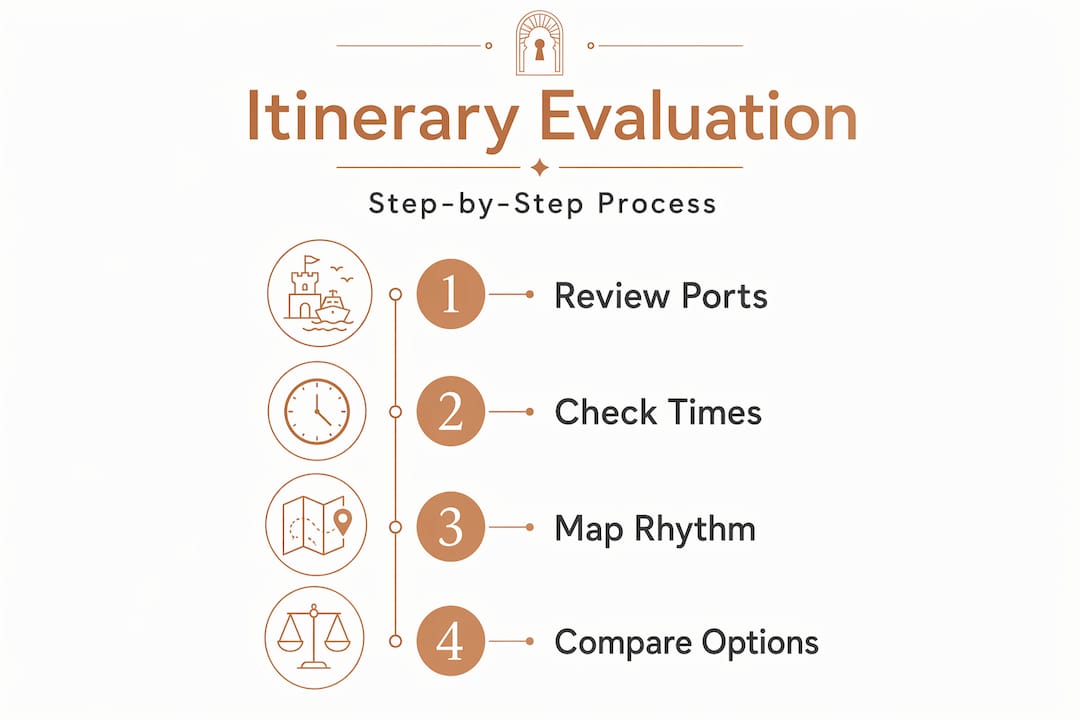
Step 3: Use a comparison table. When weighing two itineraries side by side, the difference often becomes obvious when you see it structured.
| Criteria | Itinerary A (8 ports, 10 nights) | Itinerary B (5 ports, 10 nights) |
|---|---|---|
| Sea days | 2 | 5 |
| Overnight stays | 0 | 2 |
| Average port call duration | 5.5 hours | 9 hours |
| Tendered ports | 3 | 1 |
| Late departures (after 8 p.m.) | 1 | 3 |
Itinerary B, despite having fewer destinations, delivers a qualitatively richer experience by nearly every measurable metric.
Step 4: Account for operational realities. EU carbon regulations and labor actions can reduce usable port time by up to four hours on some routes in 2026 due to slow steaming requirements. The printed arrival time is not always the effective arrival time once maneuvering and clearance are factored in.
Step 5: Watch for over-packed schedules. An itinerary with no buffer for independent exploration forces you into the ship’s organized excursion timeline. That is not luxury. Luxury is having the choice to wander on your own terms. For tips on managing complexity in multi-stop routes, Hiddendoortravel’s guide on designing multi-destination trips applies directly to cruise route logic.
“The itinerary is the architecture of the trip. Get the structure wrong and no amount of five-star service repairs the experience.” — Hiddendoortravel advisory team
Making the most of your itinerary after booking
Booking the right cruise is step one. Protecting your experience between booking and sailing is step two.
- Re-verify port times 30 to 60 days before sailing. Operational tidal and scheduling factors mean that published times can shift. A port call that moved from 8 hours to 5 hours changes your entire plan for that day.
- Buffer independent excursions generously. Shore excursions need at least 90 minutes of buffer before the ship’s departure to account for traffic, unexpected delays, and tender ports with transit complexity. Missing a ship in a foreign port is not a theoretical risk.
- Book specialty dining and onboard experiences early. On luxury lines with limited-seat restaurants or spa suites, availability fills well before sailing. Align your dinner reservations with port days that have late departures so you can come back from an evening ashore and continue the experience onboard.
- Consider pre- and post-cruise extensions. A two-night land stay at the embarkation or disembarkation port transforms your experience of that destination from an airport transfer into an actual visit. Many of the top luxury cruise destinations, like Lisbon, Istanbul, or Singapore, reward that extra time enormously.
- Build in intentional onboard time. The temptation when planning luxury cruises is to fill every port hour. Resist it. Some of the most memorable moments happen when you stay on a nearly empty ship while everyone else is ashore.
Pro Tip: Ask your travel advisor specifically whether your itinerary includes any early berth request ports. These are popular destinations where longer stays require securing a berth years in advance, and a specialist can flag whether your preferred sailing has that access.
My take: the itinerary is the experience
I’ve worked alongside travelers who spent months selecting the perfect ship, then accepted whatever itinerary was available at their preferred sailing date. I understand the logic. But I’ve seen that approach backfire more times than I can count.
The real luxury in cruising lies in itinerary quality: the balance between rest, meaningful ports, and genuine onboard time. A perfectly designed itinerary feels almost invisible. You’re never exhausted. You’re never rushed. You have time to go deep in places that matter to you, and you return to the ship genuinely glad to be there.
What I find consistently undervalued is the sea day. Travelers often see it as the day between things. In reality, it’s the day the trip actually breathes. Some of my clients’ most treasured cruise memories happened entirely at sea, not in any port.
More ports is not better. It’s almost always worse for anyone who wants to return home feeling genuinely restored rather than just well-stamped. If you are evaluating two itineraries and one has more stops, I’d ask you to look harder at the one with fewer before you decide. Slow travel philosophy, which you can read more about in this piece on slow luxury travel, maps directly onto what makes a great cruise itinerary.
The checklist mentality, “I’ve been to twelve countries in ten days,” produces a specific kind of exhaustion that no amount of luxury amenity can fix. Build the emotional journey first. The ports will follow.
— Michael
Let Hiddendoortravel build your ideal cruise itinerary
At Hiddendoortravel, itinerary selection is where we spend the most time with clients, and for good reason. The difference between an average luxury cruise and one that becomes a reference point for every trip that follows almost always comes down to route design and pacing, not the ship’s thread count.
Our luxury travel experts have direct relationships with the leading luxury and expedition cruise lines, which means early access to limited berths, honest comparisons across ship categories, and the ability to negotiate VIP boarding and onboard credits most travelers never see publicly offered. We match you to an itinerary based on how you actually travel, not what looks good on paper. Whether you’re weighing a classical ocean voyage, a remote expedition, or a multi-destination sailing, our team at Hiddendoortravel brings the depth of experience that turns a well-priced cruise into a genuinely exceptional one. Reach out to start the conversation.
FAQ
What is the ideal sea day to port day ratio?
Aim for roughly one sea day for every two to three port days to maintain energy and avoid itinerary fatigue. This ratio is particularly important on voyages of seven nights or more.
How do overnight port stays improve a luxury cruise?
Overnight stays allow you to experience destinations in the evening and morning, which are often the most authentic and crowd-free times. Lines offering multiple overnights per voyage consistently score higher on traveler satisfaction.
How do I choose between different types of luxury cruise lines?
Start with your emotional travel goal. Ultra-luxury lines like Seabourn or Silversea suit those seeking white-glove service and destination depth, while expedition lines suit adventure-focused travelers. Match the ship category to what you actually want to feel, not to prestige alone.
Why does docking type matter when selecting an itinerary?
Tendered ports add 20 to 40 minutes of transfer time each way, which meaningfully reduces usable shore time. On short port calls, a tendered arrival can cut your effective destination time nearly in half.
How far in advance should I book a luxury cruise itinerary with preferred port stays?
Popular itineraries with overnight port calls or extended stays in high-demand destinations often require booking 12 to 24 months out. Berth availability for longer port calls is genuinely limited, and working with a specialist gives you the best access.