

The term “all inclusive cruise” sounds straightforward until you actually try to book one. Travelers arrive on board expecting everything covered, only to discover their minibar, Wi-Fi, and shore excursions all carry separate price tags. Understanding what is an all inclusive cruise really means is the most valuable thing you can do before handing over a deposit. The reality is that cruise lines use the phrase loosely. Some bundle a handful of extras into the base fare and call it a day. Others, particularly luxury lines, come genuinely close to covering everything. Knowing the difference saves you hundreds, sometimes thousands, of dollars.
Table of Contents
- Key Takeaways
- What is an all inclusive cruise and what it covers
- What you will still pay for on most cruises
- Luxury cruise packages that actually deliver on the promise
- How to evaluate cruise packages and choose wisely
- Common myths about all inclusive cruises
- My honest take after years of booking these trips
- Plan your all inclusive cruise with Hiddendoortravel
- FAQ
Key Takeaways
| Point | Details |
|---|---|
| “All-inclusive” varies widely | The term has no standard definition across cruise lines, so always verify what each fare actually covers. |
| Baseline inclusions are consistent | Most cruise fares include accommodations, main dining, basic drinks, and onboard entertainment across mainstream lines. |
| Common extras still cost money | Wi-Fi, shore excursions, specialty dining, and gratuities are typically add-ons even on “all-inclusive” fares. |
| Luxury lines offer true coverage | Lines like Regent Seven Seas include unlimited shore excursions, premium drinks, prepaid gratuities, and internet. |
| Read the fine print before booking | Comparing fare details line by line is the only reliable way to evaluate real value across cruise packages. |
What is an all inclusive cruise and what it covers
An all inclusive cruise, in the broadest industry sense, refers to a fare structure where the base ticket price bundles accommodations, meals, and some form of entertainment into a single charge. The formal term you will see used interchangeably by travel professionals is “bundled cruise fare.” Most mainstream lines apply this model as their default, which is why a cruise can feel like extraordinary value compared to booking a hotel where every meal costs extra.
Here is what the baseline typically covers across most major cruise lines:
- Stateroom accommodations including daily housekeeping, linens, and toiletries
- Main dining room access for breakfast, lunch, and dinner at no added charge
- Buffet dining throughout the day, usually at the ship’s main lido deck restaurant
- Basic non-alcoholic beverages such as water, juices, coffee, and tea
- Onboard entertainment including live shows, theater performances, and deck events
- Access to pools, fitness centers, and public areas across the ship
- Select onboard activities like trivia nights, cooking demos, and dance classes
What this baseline does not usually include often surprises first-time cruisers. As inclusions and exclusions vary considerably by line and package, the bundled fare is really a starting point rather than a ceiling.
Pro Tip: Book with the mindset that the base fare covers your shelter and basic food. Everything else is potentially a la carte until you confirm otherwise in writing.
What you will still pay for on most cruises
This is where the marketing hype and the reality part ways. Even on a cruise advertised as all inclusive, several categories almost always carry additional charges. Extras like Wi-Fi, specialty dining, and shore excursions frequently fall outside the bundled fare, creating costs that can genuinely rival the base ticket price if you are not careful.
The most common extras you should budget for:
- Specialty restaurants such as steakhouses, sushi bars, and teppanyaki venues
- Alcoholic beverages including beer, wine, spirits, and cocktails at bars
- Wi-Fi and internet access, which is typically charged per device, per day at rates that dwarf what you pay on land
- Shore excursions booked through the cruise line, which range from $50 to several hundred dollars per person
- Gratuities and service charges, often automatically added at $15 to $20 per person per day
- Spa treatments, salon services, and personal training sessions
- Premium beverages like specialty coffees, fresh-squeezed juices, and premium bottled water
- Photos taken by onboard photographers
The gratuity situation alone catches many travelers off guard. On a 10-night sailing for two people, automatic gratuities alone can add $300 or more to the final bill. Policies differ between mainstream lines, so identifying what costs extra before you sail is the only way to build an accurate travel budget.
Pro Tip: Before booking, total up your daily spending habits at home for food, drinks, and activities. That number is a rough guide to how much you might spend above the base fare on a mainstream cruise.
Luxury cruise packages that actually deliver on the promise
Here is where the experience changes completely. Luxury cruise lines offer all inclusive cruise packages that are genuinely close to the full-coverage model most travelers imagine when they hear the term. Regent Seven Seas, widely regarded as one of the most inclusive lines in the industry, builds unlimited shore excursions, specialty dining, premium drinks, unlimited Wi-Fi, and prepaid gratuities directly into every fare.
The difference in planning approach is significant. When gratuities and Wi-Fi are prepaid and excursions are unlimited, your onboard spending drops to near zero beyond personal shopping. The budgeting conversation shifts from “how much will this trip actually cost” to “which of these amazing included excursions do I want to take.”

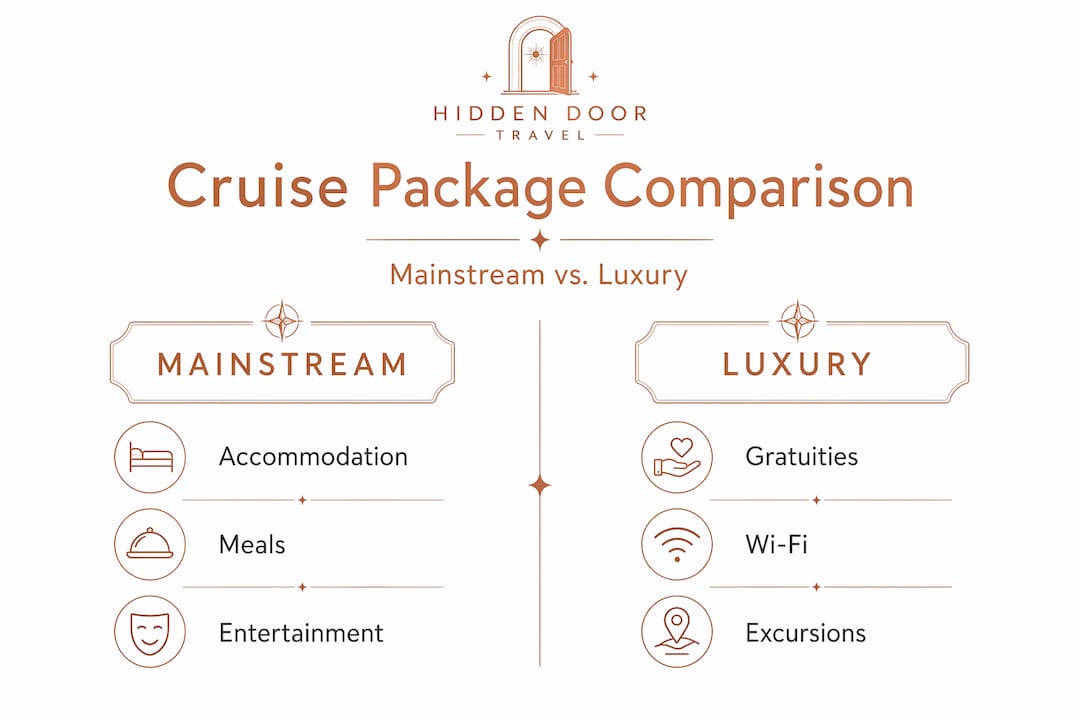
Mainstream vs. luxury inclusions at a glance
| Category | Mainstream lines | Luxury lines (e.g., Regent Seven Seas) |
|---|---|---|
| Accommodations | Included | Included (suite-level standard) |
| Main dining | Included | Included |
| Specialty dining | Extra charge | Unlimited, included |
| Alcoholic beverages | Package required | Included, premium brands |
| Shore excursions | Extra charge | Unlimited, included |
| Wi-Fi | Extra charge | Included |
| Gratuities | Extra charge | Prepaid, included |
| Spa access | Extra charge | Varies by line |
One nuance worth knowing: planning shore excursions months in advance is critical even on luxury lines with unlimited inclusions. Popular excursions sell out, and booking windows open well before sailing. On a line where excursions are already paid for, missing availability is a real loss rather than just a missed upsell.
Some mainstream lines now offer semi-inclusive bundle packages. Carnival’s cruise value packages bundle premium dining, drinks, excursions, spa access, photos, and Wi-Fi into a single prepurchase option for select 2026 sailings. The catch is that these packages require purchase within a specified pre-cruise booking window, so timing matters.
Pro Tip: For luxury cruise planning, working with an experienced travel advisor pays for itself. Advisors often have access to cabin upgrades and shipboard credits that offset or exceed their fees.
How to evaluate cruise packages and choose wisely
Choosing the right all inclusive cruise packages requires more than comparing sticker prices. Here is a practical process that works regardless of your budget:
- List what you will actually use. Be honest about your habits. If you drink alcohol daily and expect to visit every port, a luxury inclusive fare may be better value than a cheap base fare loaded with add-ons.
- Request the full inclusions list in writing. Never rely on a website summary or a phone sales call. Get the fare inclusions document and read it.
- Calculate the true per-person daily cost. Divide the total fare by the number of nights, then add realistic estimates for your expected extras. Compare that number across cruise lines and package tiers.
- Compare the timing of package purchases. Some add-on packages must be bought weeks before sailing. Missing that window means paying onboard rates, which are consistently higher.
- Check gratuity policies separately. Lines vary between auto-added daily charges, prepaid options, and truly included gratuities. This line item alone can shift which option delivers better value.
- Look at family-friendly all inclusive cruises specifically if traveling with children. Kids’ club access, youth dining, and activity programs may or may not be included depending on the line and ship. Confirm each category before booking.
Maximizing pre-paid inclusions while selectively adding only the extras you genuinely want is the approach that consistently produces the best value. Trying to recreate the luxury experience on a mainstream budget by buying every package usually costs more than booking a luxury fare to begin with.
Common myths about all inclusive cruises
Even experienced travelers carry misconceptions about how cruise pricing actually works. Here are the ones that cause the most real-world frustration:
- “All inclusive means no extra charges, ever.” No mainstream line operates this way. Extras are always available, and some are aggressively marketed once you board. Marketing language rarely aligns with the literal meaning travelers expect.
- “Wi-Fi is obviously included.” Wi-Fi is excluded on most mainstream cruise fares. When it is available as a package, the pricing structure differs significantly from hotel or resort Wi-Fi. Assume nothing.
- “Shore excursions are part of the ticket.” On mainstream lines, shore excursions are a significant revenue source for the line. They are almost universally an add-on unless you are on a luxury fare.
- “Gratuities are covered in the fare.” Standard practice on most mainstream lines is to add automatic daily gratuity charges. These show up on your onboard account, not the original booking total.
- “Specialty restaurants are just a fancier version of what’s already included.” They are separate dining venues with separate cover charges that can run $30 to $60 per person per visit.
My honest take after years of booking these trips
I have watched clients walk off their first “all inclusive” cruise genuinely surprised by a final onboard bill in the thousands. Not because they were careless spenders, but because the marketing around this term is genuinely misleading.
My honest observation is this: the best all inclusive cruise experiences I have helped plan have almost always been on luxury lines where the fare structure is transparent from the start. You pay more upfront, full stop. But the planning simplicity and the zero-surprise final bill are worth something real, especially for travelers who do not want to spend their vacation managing a running tab.
For families, I find the math especially compelling. When shore excursions, specialty dining, and drinks are included, a family of four can enjoy the same experience at a fraction of the stress. The alternative on a mainstream line is making dozens of small financial decisions every day of the trip.
If you are doing your first all inclusive cruise, my strongest advice is to research cruise destinations before you choose a line. The itinerary shapes how much you will actually spend on excursions, which in turn determines whether paying more for a luxury inclusive fare is mathematically smart.
— Michael
Plan your all inclusive cruise with Hiddendoortravel

Cutting through the noise on all inclusive cruise packages takes real experience, and that is exactly what the team at Hiddendoortravel brings to every booking. As a luxury travel agency with deep knowledge of the best all inclusive cruise lines, Hiddendoortravel matches travelers to the fares that genuinely align with how they actually vacation. Whether you are weighing a luxury line with full inclusions or trying to build a smart package on a mainstream sailing, the advisors here have booked both and know exactly where the hidden costs appear. Connect with the luxury travel experts at Hiddendoortravel for personalized guidance, access to exclusive fares, and a plan built around your travel style.
FAQ
What is included in a standard all inclusive cruise fare?
Most standard all inclusive cruise fares cover accommodations, main dining room meals, buffet access, non-alcoholic beverages, and onboard entertainment. Specialty dining, alcoholic drinks, Wi-Fi, shore excursions, and gratuities are typically charged separately.
Are all inclusive cruises worth it for families?
Family-friendly all inclusive cruises can offer excellent value when the fare genuinely includes kids’ club access, dining for all ages, and entertainment. On luxury lines where excursions and dining are fully included, families often save significant money compared to paying for each activity individually on mainstream sailings.
How much does an all inclusive cruise cost?
Mainstream all inclusive cruise packages start around $100 to $200 per person per night before extras. True luxury inclusive fares, like those on Regent Seven Seas, typically range from $500 to over $1,000 per person per night but cover nearly everything including shore excursions, premium drinks, and gratuities.
Do all inclusive cruises include Wi-Fi?
Wi-Fi is not included in most mainstream all inclusive cruise fares. It is sold as an add-on and priced per device, per day, which can add up quickly on longer sailings. Luxury lines like Regent Seven Seas include unlimited Wi-Fi in the base fare.
What is the difference between mainstream and luxury all inclusive cruise lines?
Mainstream lines bundle accommodations, meals, and basic entertainment but charge for most premium services. Luxury lines include nearly everything, from unlimited shore excursions and specialty dining to premium beverages and prepaid gratuities, making the total cost more predictable from the start.