

Most people assume that luxury travel and sustainability are fundamentally at odds. They are not, but the gap between them is wider than the industry admits. A luxury resort generates 40–65 kg CO2e per guest night, while a certified eco-lodge produces just 3–10 kg for the same stay. That is not a small difference. It is the entire premise of sustainable luxury travel explained honestly: you can travel well, spend generously, and still make choices that protect the places you love. This article shows you exactly how.
Table of Contents
- Key Takeaways
- Sustainable luxury travel explained: what it actually means
- The real environmental cost of luxury travel
- How to spot genuinely sustainable luxury properties
- How the best properties embed sustainability into the experience
- Practical tips for planning your sustainable luxury vacation
- My take on what most travelers still get wrong
- Plan your sustainable luxury vacation with Hiddendoortravel
- FAQ
Key Takeaways
| Point | Details |
|---|---|
| Sustainability has three pillars | Environmental, social, and economic responsibility all must be present for travel to qualify as truly sustainable. |
| Certifications cut through greenwashing | Look for Green Globe, Green Key, or GSTC credentials backed by independent audits, not just marketing language. |
| Flights dominate your footprint | Choosing direct routes and sustainable aviation fuel options can reduce trip emissions by up to 40–60%. |
| Luxury resorts can and do lead | The best properties embed renewable energy, local sourcing, and conservation programs directly into guest experiences. |
| Intent alone is not enough | Fewer than 3% of flyers offset their flights despite most saying sustainability matters to their booking decisions. |
Sustainable luxury travel explained: what it actually means
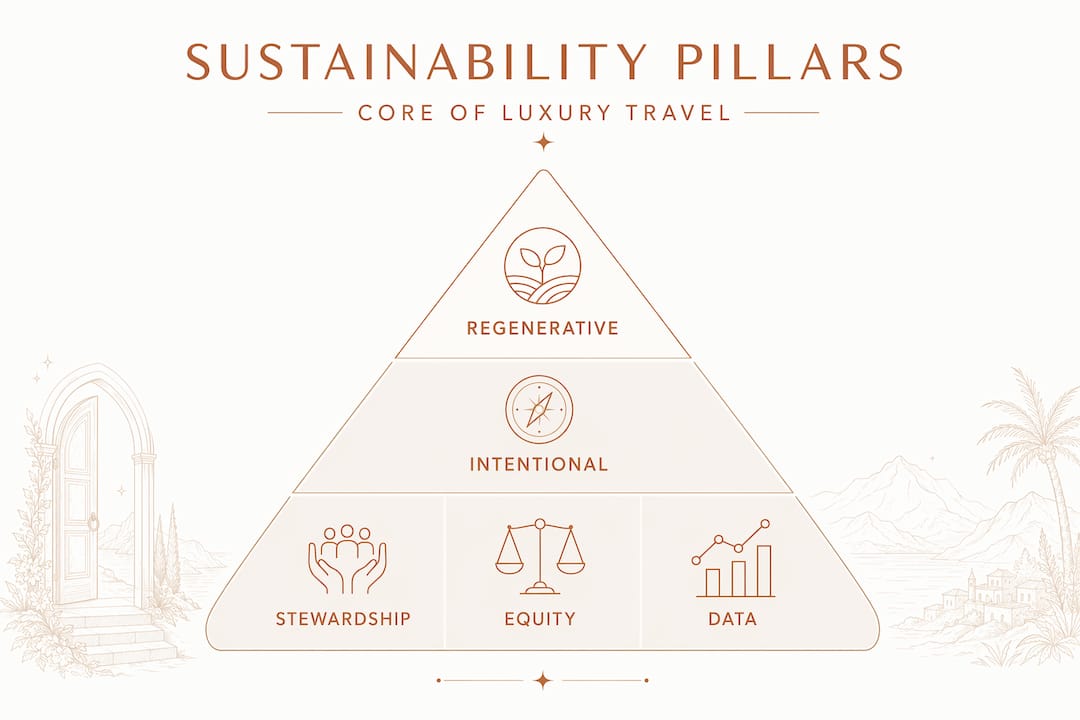
The phrase gets used loosely. Hotels slap “eco-friendly” on their website, resorts plant a few trees, and travelers feel better without asking hard questions. Sustainable luxury travel, at its core, is built on three interdependent pillars: environmental stewardship, social equity, and economic contribution to local communities.
Environmental stewardship means measurable reductions in carbon output, water use, and waste. Social equity means the people who live and work in your destination genuinely benefit from your visit, not just the ownership class. Economic contribution means money flows into local supply chains, not just international hotel groups.
What separates sustainable luxury from conventional luxury is intentionality at the operational level. And what separates it from budget eco-travel is that comfort, design, and service quality are never sacrificed. The goal, as Cornell University research articulates, is to embed sustainability as a core value and competitive differentiator, not a footnote.
The concept of regenerative travel pushes this further. Rather than simply minimizing harm, regenerative travel aims to leave a destination better than you found it. Think reef restoration programs guests can participate in, or reforestation initiatives funded by your nightly rate. This is where sustainable tourism practices move from damage control into genuine impact.
Pro Tip: When evaluating a luxury property’s sustainability claims, ask for their annual impact report. Any serious operator publishes one. If they cannot produce it, treat every green claim with skepticism.
Key characteristics of authentic sustainable luxury travel include:
- Independently verified environmental certifications
- Transparent reporting on emissions, water use, and waste diversion
- Active community partnerships with measurable local economic benefits
- Guest programs that connect travelers to conservation or cultural preservation
- A commitment to continuous improvement, not a one-time initiative
The real environmental cost of luxury travel
Tourism contributes roughly 8% of global greenhouse gas emissions. That figure includes everything from your flight to the electricity powering your hotel’s pool heater. Within that total, luxury travel carries an outsized share.
| Accommodation Type | CO2e per Guest Night | Waste Diversion Rate | Local Procurement |
|---|---|---|---|
| Luxury resort | 40–65 kg | 30–55% | 15–35% |
| Eco-lodge | 3–10 kg | 65–85% | 50–75% |
| Budget hotel | 20–35 kg | 25–45% | 10–25% |
The numbers tell a clear story. A week at a conventional luxury resort can generate as much carbon as a month of daily commuting. But true sustainable luxury shifts the focus from absolute output to measurable efficiency improvements and local procurement percentages.

Flights make everything more complicated. They represent the single largest chunk of most travelers’ trip footprint, and the options for reducing that footprint are still limited. What is deeply revealing is that fewer than 3% of airline passengers voluntarily offset their flights, even though over 70% say sustainability influences their booking decisions. That gap between intention and action is where greenwashing thrives.
Carbon offsets deserve particular scrutiny. Many popular offset programs fail additionality tests, meaning the carbon savings they claim would have happened anyway. Responsible travelers treat offsets as a last resort, not a conscience cleaner. Reduction comes first.
How to spot genuinely sustainable luxury properties
The words “eco,” “green,” and “sustainable” carry no legal weight in most countries. Any hotel can use them. This is changing. Regulatory pressure, particularly the EU’s Green Claims Directive, is forcing greater transparency from luxury hotels about the substance behind their marketing language. But until those standards become universal, you need your own framework.
The most reliable certifications in luxury green vacations require independent audits and ongoing performance improvements:
- Green Globe: One of the oldest and most recognized certifications, covering environmental, social, and economic criteria with annual audits.
- Green Key: Widely respected across Europe and growing globally, focused on operational environmental standards.
- GSTC (Global Sustainable Tourism Council): The gold standard for certification bodies, providing the framework that other certifications align to.
- Regenera Luxury: A newer credential specifically designed for high-end properties, emphasizing regenerative criteria alongside environmental metrics.
Certifications are a starting point, not an ending point. Savvy travelers verify that the certification body itself conducts transparent, recent audits. Many popular eco-labels lack meaningful oversight or a clearly defined scope.
Real sustainability data looks specific. It includes Scope 1, 2, and 3 greenhouse gas emissions, progress toward reduction targets, and verified offset details. Vague marketing language without specific KPIs is a red flag, not a reassurance.
Pro Tip: Search the property’s name alongside “sustainability report” or “impact report” before booking. If the only results are their own press releases, dig deeper before you commit.
How the best properties embed sustainability into the experience
The luxury properties leading this space do not treat sustainability as a constraint. They treat it as a design principle. Farm-to-table dining, renewable energy systems, and community partnerships are woven into what guests actually experience, not hidden in the back office.
Consider what this looks like operationally. A property running on 80% solar power is not just reducing its carbon bill. It is demonstrating to guests that premium experiences do not require fossil fuel dependency. A kitchen sourcing 70% of its ingredients from farms within 50 miles is not just cutting transport emissions. It is giving guests a reason to care about the region they are visiting.
The benefits of sustainable travel extend to the business case as well. Properties that invest seriously in sustainability report stronger guest loyalty and better differentiation in an increasingly crowded market. Guests who connect with a property’s conservation mission or cultural programming return. Guests who simply enjoyed a comfortable room do not always.
Long-term sustainability investment typically follows a phased model:
- Phase one focuses on operational efficiency: energy, water, and waste
- Phase two integrates community sourcing and local employment practices
- Phase three develops guest-facing conservation and cultural programs
- Phase four moves into regenerative territory, actively restoring ecosystems or heritage
The luxury travel experts who understand this model know which properties are genuinely in phase three or four, and which ones are still talking about reusable straws and calling it sustainability.
Practical tips for planning your sustainable luxury vacation
You do not need to choose between comfort and conscience. You do need to be deliberate. Travelers who apply even a few of these practices can reduce trip emissions by 40–60% without changing the fundamental nature of their trip.
- Fly direct whenever possible. Takeoff and landing account for a disproportionate share of flight emissions. A direct long-haul flight is nearly always lower impact than two shorter legs.
- Choose certified sustainable accommodations. Use the certification list above as a filter, not an afterthought. A certified property at a higher nightly rate often has a lower actual environmental cost than an uncertified “eco” option.
- Support local economies deliberately. Book guides, restaurants, and excursions that are locally owned. This is one of the most direct ways your spending creates equitable benefit.
- Travel off-peak when you can. Research shows 77% of purpose-led travelers choose off-peak timing to reduce pressure on destinations, and 52% say it improves their own experience too.
- Ask your accommodation about their sourcing. A property proud of its food and supply chain will answer immediately. One that cannot answer is telling you something important.
- Prioritize reduction over offsetting. If you do offset, use verified programs that pass additionality and permanence tests, such as Gold Standard certified projects.
Pro Tip: When choosing between two luxury properties of similar quality and price, request each one’s most recent sustainability data. The property that responds fastest and with the most specifics is almost always the better choice.
My take on what most travelers still get wrong
I have spent years watching well-intentioned travelers make the same mistake. They do all their research on the hotel and none on how they are getting there. The flight is the single biggest lever in your sustainability footprint, and it is the one most people treat as fixed.
What I have also seen is a tendency to trust beautiful branding over boring data. A stunning eco-resort photographed against pristine jungle looks more sustainable than a spreadsheet showing a 40% renewable energy mix and 65% local procurement rate. But the spreadsheet tells you something real. The photography tells you nothing.
My honest view is that sustainability in luxury travel has moved past being optional. The destinations travelers love most are under the most pressure from overtourism, climate change, and economic extraction. Choosing properties that actively work to reverse that pressure is not a sacrifice. It is the only way to protect access to the places worth visiting.
The travelers I respect most are not the ones who claim to be perfectly sustainable. They are the ones who ask better questions, accept imperfect answers, and keep improving. That mindset is the actual foundation of responsible travel explained well.
— Michael
Plan your sustainable luxury vacation with Hiddendoortravel
At Hiddendoortravel, we have spent years developing relationships with the properties that take sustainability seriously enough to prove it. We know which certifications carry weight, which local operators create real community impact, and which experiences connect guests to a destination’s conservation story in ways that stay with them long after they return home.

If you are ready to plan a luxury vacation that reflects your values without compromising the standards you expect, our luxury travel agency team is built exactly for this. We handle the research, the vetting, and the bespoke planning so your next trip delivers both indulgence and genuine impact. Reach out and let us show you what eco-friendly luxury travel looks like when it is done right.
FAQ
What is sustainable luxury travel?
Sustainable luxury travel combines high-end travel experiences with genuine environmental, social, and economic responsibility. It goes beyond green marketing to include certified properties, community benefit, and measurable impact reduction.
How do I identify greenwashing in luxury travel?
Look for independent certification from bodies like Green Globe or GSTC, and request specific emissions data and audit reports. Properties that cannot provide verified KPIs are likely relying on vague marketing rather than real practices.
Does sustainable travel mean less comfort?
No. The best sustainable luxury properties treat eco-conscious operations as a design principle, not a limitation. Renewable energy, local sourcing, and conservation programs enhance the guest experience rather than diminishing it.
Are carbon offsets a reliable solution for flight emissions?
Carbon offsets are imperfect and often fail additionality tests. Prioritize reducing emissions first by flying direct and choosing sustainable accommodations, then use Gold Standard certified offsets for what remains.
Which certifications should I trust for eco-friendly luxury hotels?
Green Globe, Green Key, and GSTC-aligned certifications are the most credible for luxury resorts with eco initiatives. Always verify that the certification includes independent audits and recent reporting, not just a badge on the website.