

Luxury travel has always promised escape. But what is regenerative luxury travel, and why is it redefining what a truly great trip looks like? Unlike conventional vacations designed purely around personal comfort, regenerative luxury travel is built on a different premise entirely: your presence should leave a destination measurably better than you found it. That means restored ecosystems, stronger communities, preserved cultural heritage, and a traveler who returns home genuinely transformed. This is not sustainable travel rebranded. It is something more ambitious, more specific, and far more meaningful.
Table of Contents
- Key takeaways
- What regenerative luxury travel really means
- How regenerative travel benefits destinations and guests
- Regenerative vs. sustainable vs. traditional luxury travel
- Practical tips for choosing regenerative luxury experiences
- Emerging trends shaping the future of regenerative travel
- My perspective on what regenerative travel actually demands
- Plan your regenerative luxury trip with Hiddendoortravel
- FAQ
Key takeaways
| Point | Details |
|---|---|
| Beyond harm reduction | Regenerative luxury travel actively restores ecosystems and communities, not just minimizes damage. |
| Five core pillars | Properties operate across design, ecosystem restoration, cultural co-creation, guest transformation, and financial regeneration. |
| Measurable impact matters | Credible properties track KPIs like biodiversity gains, soil health, and community wealth-sharing. |
| Travelers pay more willingly | 73% of luxury travelers prefer hotels with proven positive impact and pay 20 to 40% more for it. |
| Greenwashing is a real risk | Look for respected certifications and transparent impact reporting before booking any regenerative property. |
What regenerative luxury travel really means
The regenerative travel definition starts with one word: net-positive. Where sustainable travel aims to reduce harm, regenerative luxury travel sets a higher bar. Every stay, every experience, every interaction with a local community is designed to produce a genuine improvement in the condition of the place you are visiting.
Regenera Luxury, one of the most respected voices in this space, describes regenerative luxury as a system built on five strategic pillars:
- Regenerative design and architecture: Buildings and infrastructure that work with natural systems, not against them.
- Ecosystem restoration: Active programs to recover biodiversity, soil health, water quality, and native habitat.
- Cultural and community co-creation: Genuine partnerships with local and indigenous communities that preserve living heritage and share economic benefit.
- Transformational guest experience: Immersive, participatory stays that shift a traveler’s perspective and emotional relationship with a place.
- Financial regeneration: Economic models that circulate wealth locally rather than extracting it for distant shareholders.
This is not a checklist. Regenera Luxury Certification requires measurable KPIs across all five pillars, tracked through a formal Regenerative Management System that monitors everything from biodiversity gains to community wealth-sharing outcomes. A property cannot claim this label by installing solar panels and calling it done.
Pro Tip: When researching a property, ask directly what KPIs they track and how they report progress. Any credible regenerative luxury operator will have a clear, evidence-based answer. Vague language about “giving back” is a red flag.
The distinction between regenerative and sustainable also matters on a philosophical level. Sustainable travel reframes the traveler as a consumer who tries not to overconsume. Regenerative travel reframes you as a partner, even a gardener, who is invested in the long-term vitality of the destination. That shift in identity changes everything about how a trip is designed and experienced.
How regenerative travel benefits destinations and guests
The benefits of regenerative tourism ripple outward in three directions at once: the natural environment, the local community, and the traveler.
On the environmental side, truly regenerative properties run active habitat restoration programs. Guests at a lodge in the Ecuadorian cloud forest might plant native tree species in the morning and track wildlife recovery data in the afternoon. These are not photo opportunities. They are contributions to measurable ecological gains.

The social and cultural benefits are equally significant. Community wealth-sharing models mean that a meaningful percentage of revenue stays in local hands, funding schools, healthcare, and cultural preservation. Indigenous knowledge systems are treated as intellectual assets worth protecting, not local color to be packaged and sold.
For the traveler, the transformation is personal. Regenerative luxury integrates wellness, equity, and genuine quietness into the experience, creating a shift in consciousness that guests carry home with them. This is not spa-induced relaxation followed by forgotten good intentions. It is the kind of experience that changes how you think about travel itself.
The data behind these outcomes is compelling:
| Benefit | Impact |
|---|---|
| Guest willingness to pay | 20 to 40% price premium for verified regenerative properties |
| Repeat visit rate | Over 30% increase when guests are emotionally transformed |
| Traveler preference | 73% of luxury travelers prefer hotels with measurable positive impact |
| Community outcome | Wealth-sharing models strengthen local economic resilience |
“The goal is not to do less harm. It’s to do more good. Travelers who embrace that shift stop being tourists and start being participants in the story of a place.” — More Than Tourism
Regenerative experiences also require active guest participation as co-creators, which is part of why they leave such a strong emotional imprint. Passive luxury fades quickly from memory. The afternoon you spent learning to weave with an elder in Oaxaca, contributing to a cultural archive project, does not.
Regenerative vs. sustainable vs. traditional luxury travel
Understanding where regenerative luxury sits relative to other travel philosophies clarifies why it represents something genuinely new.
Traditional luxury travel delivers comfort, exclusivity, and service at the highest level. It asks nothing of the traveler except the willingness to pay. Its environmental and social footprint is rarely a design consideration.
Sustainable luxury travel, which gained serious momentum through the 2010s, introduced the idea that high-end travel should at minimum reduce its negative impacts. Carbon offsetting, water conservation, local sourcing. These are real improvements. But carbon offsetting alone does not make travel regenerative, and place-based ecosystem management paired with genuine cultural partnership is something offsetting cannot replicate.
Regenerative luxury travel starts from an entirely different premise. The question is not “how do we reduce our footprint?” It is “how do we leave this place stronger?”
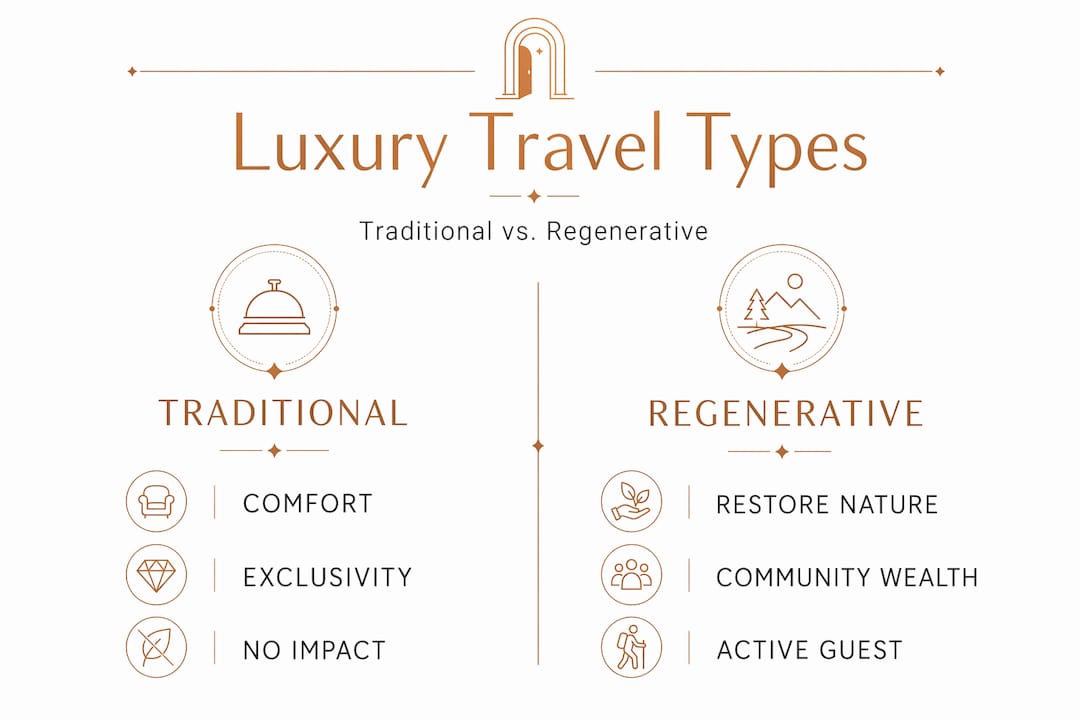
| Attribute | Traditional luxury | Sustainable luxury | Regenerative luxury |
|---|---|---|---|
| Environmental goal | None or minimal | Reduce harm | Active restoration |
| Community role | Employed as staff | Sourced locally | Equity partners and co-creators |
| Guest role | Passive consumer | Informed consumer | Active participant |
| Impact measurement | Rare | Partial | Rigorous, KPI-tracked |
| Travel philosophy | Comfort and exclusivity | Responsibility | Stewardship and transformation |
One common misconception worth addressing directly: greenwashing is widespread. Without transparent reporting and measurable outcomes, regenerative claims risk becoming marketing rhetoric. A property that uses the word “regenerative” in its branding but cannot point to documented biodiversity improvements or community partnership agreements is selling a feeling, not a result.
Practical tips for choosing regenerative luxury experiences
Getting this right takes a bit more due diligence than booking a standard luxury resort. Here is a practical sequence to follow:
- Check for respected certifications. Look for properties with credible third-party verification. The Regenera Luxury Certification framework is one of the most rigorous available, requiring evidence-based KPI reporting across all five regenerative pillars.
- Ask about impact reporting. Request access to a property’s most recent impact report before booking. Credible operators publish this data because they are proud of it.
- Engage with what is offered. Regenerative eco-friendly luxury vacations are designed around participation. Opt into the restoration activities, cultural workshops, and community visits. The value of the experience multiplies the more you contribute.
- Embrace a slower pace. Most regenerative luxury properties are designed for depth, not speed. Budget more time per destination and resist the urge to pack in multiple stops. The transformation requires presence.
- Ask who benefits economically. Find out what percentage of your spend stays in the local community. A genuinely regenerative property will have a clear answer and will likely be proud to share the numbers.
Pro Tip: Before any booking, search the property name alongside terms like “impact report,” “community partnership,” or “biodiversity.” What comes up in that search tells you a lot more than the official website ever will.
The most common pitfall travelers encounter is assuming that high price automatically signals genuine regenerative credentials. Luxury eco travel can be expensive without being regenerative. The price of your room does not tell you whether the ecosystem around that room is recovering or degrading. Ask the harder questions.
Emerging trends shaping the future of regenerative travel
The market for regenerative luxury travel is growing faster than the industry anticipated. Several forces are converging in 2026 that make this more than a niche preference:
- Certification frameworks are maturing. Programs like Regenera Luxury Certification are raising the bar for what constitutes credible regenerative practice, making it harder for properties to coast on vague sustainability claims.
- Indigenous knowledge is being centered, not borrowed. The best operators are moving away from treating indigenous cultures as an amenity and toward genuine co-governance models that give communities real authority over how their land and heritage are shared.
- Design is catching up to philosophy. A new generation of properties is being built from the ground up with regenerative principles embedded at the architectural level, from water and soil systems to building materials sourced through community enterprise.
- Traveler expectations are rising sharply. The future of luxury hospitality rests on regenerative practices that integrate ecological renewal with guest transformation and equity.
- Transparency technology is helping. Digital impact dashboards, real-time biodiversity tracking, and community benefit reporting tools are making it easier for properties to demonstrate and for travelers to verify genuine outcomes.
The challenge the industry faces is scaling these practices without diluting them. Credible impact requires rigorous frameworks and genuine transparency. As demand grows, so does the temptation to use the language of regeneration without doing the work. Travelers who know what to look for are the market’s best quality control.
My perspective on what regenerative travel actually demands
I’ve worked with luxury travelers for a long time, and the most consistent thing I’ve seen is that people arrive wanting something they can’t quite name. They’ve done the Maldives villa. They’ve done the private safari. They want something that matters, but they are not sure what that looks like in practice.
What I’ve learned is that regenerative luxury travel is not a product category. It is a mindset shift. And it asks more of the traveler than most people expect. You have to be willing to be present in a way that is genuinely uncomfortable sometimes. You have to sit with the complexity of a place rather than being insulated from it.
The trips that have stayed with me, and with the travelers I’ve helped plan them for, are the ones where you left something behind. Not just money. Actual effort, actual attention, actual relationship with a community and a piece of land. That is what purposeful luxury travel delivers when it is done right.
My honest observation: most travelers underestimate how much they are capable of contributing. And most regenerative properties underestimate how hungry their guests are to do so. When those two things align, the experience is genuinely unlike anything else in travel.
— Michael
Plan your regenerative luxury trip with Hiddendoortravel

At Hiddendoortravel, we specialize in exactly this: finding the properties where the regenerative credentials are real, the community relationships are genuine, and the guest experience is transformational rather than performative. Our team has spent years building relationships with verified operators across the world’s most ecologically and culturally significant destinations.
We don’t hand you a list and wish you luck. We design bespoke responsible luxury holidays around your specific values, timeline, and the kind of impact you want to have. Whether you are drawn to ecosystem restoration in the Amazon, cultural co-creation in Japan, or reef recovery projects in the Indian Ocean, our luxury travel agency brings unmatched access and experience to the planning process. Contact us to start building a trip worth coming home from.
FAQ
What is the regenerative travel definition in simple terms?
Regenerative travel means leaving a destination measurably better than you found it, through active ecosystem restoration, community wealth-sharing, and cultural preservation rather than simply reducing harm.
How does regenerative luxury travel differ from sustainable travel?
Sustainable travel focuses on minimizing negative impact, while regenerative luxury travel sets a net-positive standard, requiring properties to actively restore ecosystems and empower communities through verified, measurable outcomes.
What should I look for when booking eco-friendly luxury vacations?
Look for properties with credible third-party certifications like Regenera Luxury Certification, published impact reports with measurable KPIs, and documented community partnership models rather than vague sustainability marketing.
Do regenerative luxury experiences cost more?
Yes, typically. Research shows guests pay a 20 to 40% premium for verified regenerative properties, and the value delivered through transformation, participation, and genuine impact justifies that difference for most travelers who experience it.
Can a single trip really make a measurable difference?
Yes, when properties operate proper Regenerative Management Systems tracking biodiversity, soil health, and community wealth-sharing, each guest stay contributes to cumulative, evidence-based improvements in the destination over time.