

A destination specialist is a travel expert who combines authentic local insight, trusted relationships, and personalized service to craft bespoke travel experiences that no algorithm can replicate. The industry term for this professional is “destination management consultant” or DMC specialist, though “destination specialist” has become the widely accepted shorthand among luxury travel planners. The role of destination specialists goes far beyond booking flights and hotels. They function as local insiders, crisis managers, cultural interpreters, and quality gatekeepers, all in one. A May 2026 SITE PULSE survey of 286 industry professionals found that local expertise and authentic insight are rated 4.6 times more important than other factors when choosing destination partners. That number tells you exactly where the real value sits.
What are the key functions of destination specialists?
Destination specialist duties cover a wide range of responsibilities, from the first planning conversation to real-time support during the trip itself. These are not generalists who book from a catalog. They are specialists who know a destination at street level, season by season.
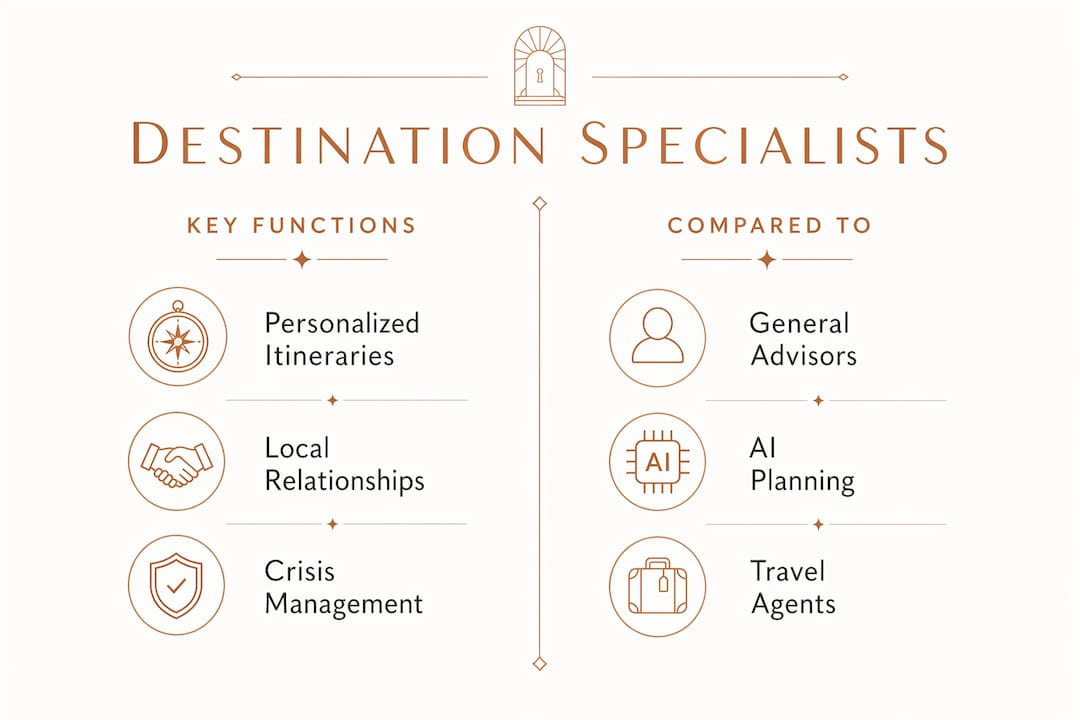
The core functions of travel consultants in this role include:
- Personalized itinerary design. Specialists build trips around your pace, interests, and preferences, not a standard template. A traveler who wants to photograph wildlife at dawn in Botswana gets a completely different schedule than one who wants wine tastings in Tuscany.
- Insider local knowledge. They know which months bring the best game viewing in the Serengeti, which neighborhoods in Kyoto are worth walking at dusk, and which restaurants require a contact to get a table.
- Supplier and partner management. Specialists maintain direct relationships with lodges, guides, private villa owners, and transport operators. Those relationships produce access and pricing that public booking platforms cannot match.
- Refining AI-generated plans. Travelers increasingly bring AI drafts to specialists for refinement. The specialist corrects seasonal errors, replaces generic suggestions with vetted alternatives, and adds the cultural context the algorithm missed.
- Crisis management. When a flight cancels, a border closes, or a weather event disrupts a region, the specialist activates their network immediately.
Pro Tip: If you are using an AI tool to draft a trip itinerary, treat that output as a first draft only. Bring it to a destination specialist for a full audit before you book anything.
Specialists also audit conservation credentials, verify the emotional tone of an itinerary, and check that routing is seasonally appropriate. These are details that matter enormously in luxury travel and that most travelers would never think to check themselves.

How do destination specialists compare to general travel advisors and AI tools?
The difference between a destination specialist, a general travel advisor, and an AI planning tool is not just a matter of depth. It is a matter of what each one can actually deliver when the stakes are high.
| Feature | Destination specialist | General travel advisor | AI planning tool |
|---|---|---|---|
| Local, on-the-ground knowledge | Deep and current | Broad but surface-level | Aggregated, often outdated |
| Trusted supplier relationships | Direct and exclusive | Varies widely | None |
| Crisis management capability | Immediate, network-based | Limited | None |
| Cultural and conservation awareness | Built into every recommendation | Inconsistent | Absent |
| Itinerary personalization | Fully bespoke | Partially customized | Template-based |
| Real-time updates during travel | Yes, via local contacts | Rarely | No |
Technology and scale support but cannot replace the depth of local knowledge, judgment, and relationships that specialists provide for memorable travel. That is the consensus among industry leaders, and it holds up in practice. A general advisor can book a safari. A destination specialist can tell you which specific camp has the best leopard sightings in october, which guide speaks Swahili and has a background in ornithology, and what to pack for the specific microclimate you will encounter.
Pro Tip: When evaluating a destination specialist, ask them one question that only someone with firsthand knowledge could answer. “What is the best table at [specific restaurant]?” or “Which route avoids the crowds at [specific site] in high season?” Their answer tells you everything.
The specialists’ role increasingly involves refining and humanizing digital plans based on current, firsthand local knowledge. AI is a useful starting point. A destination specialist is the finishing layer that makes a trip worth taking.
Why does authentic local insight matter so much in luxury travel?
Authentic local insight is the defining advantage of working with a destination specialist. Without it, even a well-funded trip can feel generic, rushed, or culturally tone-deaf.
Specialists help travelers avoid overcrowded tourist traps and facilitate deeper cultural connections at a traveler’s own pace. That means structuring days so you arrive at a site before the tour buses, eat where locals eat, and leave before the crowds arrive. It sounds simple. Executing it requires knowledge that only comes from being there repeatedly.
The specific benefits of authentic local insight include:
- Exclusive access. Specialists with established local relationships can arrange private viewings, after-hours museum access, or introductions to artisans and community leaders that are simply not available through public channels.
- Seasonal precision. Knowing that the cherry blossoms in Kyoto peak in late march, that the Amalfi Coast is genuinely quiet in november, or that the Okavango Delta floods in june and july changes every decision in an itinerary.
- Cultural respect. A specialist briefs you on dress codes, tipping customs, photography etiquette, and local sensitivities before you arrive. That preparation prevents awkward moments and builds genuine connection.
- Conservation alignment. For wildlife and nature travel, specialists vet operators against recognized conservation standards. They know which lodges fund anti-poaching programs and which ones are greenwashing.
- Pace and flow. High-end travelers benefit from itineraries structured at their own pace, enabling genuine cultural encounters rather than a checklist of sights.
Local insight and trusted relationships rank as the top decision-making criteria for destination partner selection, ahead of technology and organizational scale. Luxury travelers who have worked with both generalist and specialist advisors consistently report the same thing: the specialist version of the trip felt different at a fundamental level.
The importance of destination experts is not abstract. It shows up in the specific moments that make a trip memorable. The private dinner on a rooftop in Marrakech arranged through a contact. The guide in the Galápagos who knows every bird by name. The lodge in Rwanda that has a relationship with the gorilla trekking authority and can secure a permit when the public allocation is sold out.
How do destination specialists manage travel disruptions?
Crisis management is one of the most undervalued destination specialist duties, and one of the most important. When something goes wrong during a trip, the difference between a specialist and a standard booking platform is the difference between a resolved situation and a ruined vacation.
Here is how specialists handle disruptions in practice:
- Pre-trip contingency planning. Before you depart, a specialist maps out the scenarios most likely to affect your specific itinerary. A trip through Southeast Asia during typhoon season gets a different contingency plan than a European river cruise in summer.
- Immediate network activation. When a disruption hits, the specialist contacts their on-the-ground partners directly. They are not calling a general customer service line. They are calling the lodge manager, the local driver, or the regional airline contact they have worked with for years.
- Real-time, transparent communication. Specialists provide real-time updates and alternative arrangements not available to the public. You know what is happening and what the plan is, not hours later but within minutes.
- Alternative arrangements, not just rebooking. A specialist does not simply rebook you on the next available flight. They assess the full impact on your itinerary and rebuild it around the disruption, preserving as much of the original experience as possible.
- Emotional reassurance. Travel disruptions are stressful. A specialist who knows you, knows your trip, and has already solved problems like this before provides a level of reassurance that no automated system can offer.
True crisis mitigation involves pre-established contingency plans and immediate, on-the-ground reassurance rather than just rebooking. That distinction matters. Rebooking is administrative. Crisis management is personal, fast, and built on relationships.
The value of this capability becomes clear when you consider what the alternative looks like. A traveler without a specialist, facing a canceled connection in a country where they do not speak the language, is on hold with an airline call center. A traveler with a specialist has a local contact already working the problem.
Key Takeaways
Destination specialists deliver bespoke luxury travel by combining deep local knowledge, trusted supplier relationships, and real-time crisis management that no technology or generalist advisor can replicate.
| Point | Details |
|---|---|
| Local expertise is the top factor | A SITE PULSE survey rated local insight 4.6 times more important than other DMC selection criteria. |
| Specialists refine AI-generated plans | Travelers bring AI drafts, but specialists correct seasonal errors, add cultural context, and vet suppliers. |
| Crisis management is a core duty | Specialists use pre-established contingency plans and on-the-ground networks, not just rebooking tools. |
| Authentic insight prevents generic trips | Specialists secure exclusive access, enforce seasonal precision, and structure itineraries at your pace. |
| Human judgment beats technology | Industry leaders confirm that local knowledge and trusted relationships outperform scale and digital tools. |
What I have learned about destination specialists after 15 years in travel
The travel industry has spent the last decade debating whether technology would replace human expertise. My honest view is that the debate was always misframed. The question was never whether AI could generate an itinerary. Of course it can. The question is whether that itinerary is actually good, and whether it holds up when something goes wrong.
Every time I have seen a destination specialist at work, the value shows up in the details that no database captures. The specialist who knew that a particular lodge in Zambia had changed ownership and dropped its standards. The one who rerouted a client’s entire Morocco trip in 48 hours after civil unrest closed a key city. The one who arranged a private cooking lesson with a family in Oaxaca that the client still talks about three years later.
What strikes me most in 2026 is how the role has evolved rather than diminished. Specialists are now the people who make AI useful. They take the draft the algorithm produces and turn it into something real. They catch the errors, fill the gaps, and add the human layer that transforms a list of bookings into an actual experience. That is a more sophisticated role than it was ten years ago, not a lesser one.
The travelers who get the most from their trips are the ones who treat their specialist as a genuine partner, not a booking service. They share their preferences, their anxieties, their past disappointments. They ask questions. They trust the recommendations. That relationship is what makes bespoke luxury travel worth the investment.
— Michael
How Hiddendoortravel’s destination specialists work for you
Hiddendoortravel builds every trip around the kind of local knowledge and trusted relationships this article describes. The team does not work from templates. Each itinerary is built from scratch, informed by firsthand experience and direct supplier contacts built over years of operating at the luxury end of the market.
Whether you are planning a first safari, a multi-country cultural trip, or a private island escape, Hiddendoortravel’s luxury travel experts handle every detail from initial concept to on-trip support. If something goes wrong, you have a specialist in your corner with the network to fix it fast. If you want to go deeper into what personalized travel planning actually looks like in practice, the team is ready to show you.
FAQ
What is the role of destination specialists in luxury travel?
Destination specialists design personalized itineraries, manage supplier relationships, and provide real-time crisis support using deep local knowledge. They go beyond logistics to deliver culturally immersive, bespoke experiences that generic booking tools cannot produce.
How do destination specialists differ from travel agents?
General travel agents book from available inventory across many destinations. Destination specialists have firsthand, current knowledge of specific regions and maintain direct relationships with local suppliers, guides, and operators that produce exclusive access and faster crisis resolution.
Can AI replace destination specialists?
AI can generate a draft itinerary but cannot replace the local judgment, supplier relationships, or crisis management that specialists provide. Industry leaders confirm that technology supports but does not replace the depth of human expertise in luxury travel.
Why is local expertise the most important factor in choosing a destination partner?
A SITE PULSE survey of 286 professionals found that local expertise ranks 4.6 times higher than other selection criteria. Local knowledge drives itinerary accuracy, exclusive access, and effective crisis response in ways that scale and technology cannot.
How do destination specialists handle travel disruptions?
Specialists activate pre-established contingency plans and contact on-the-ground partners immediately when disruptions occur. They provide real-time updates and rebuild itineraries around the disruption rather than simply rebooking the next available option.