

Most travelers assume curated travel just means nicer hotels or a few pre-selected restaurant bookings. That assumption costs them some of the most meaningful trips they could ever take. A curated travel experience is something fundamentally different: an intentionally orchestrated journey where every element, from flights and transfers to meals and cultural encounters, is designed to work together with purpose. Understanding the real curated travel definition changes how you plan, what you expect, and ultimately what you remember.
Table of Contents
- Key takeaways
- What a curated travel experience actually means
- How sequencing and integration create a meaningful journey
- Types of curated travel tailored to your passions
- Benefits of curated travel you will actually feel
- How to spot genuinely curated travel services
- My take on what curated travel really changes
- How Hiddendoortravel brings curated travel to life
- FAQ
Key takeaways
| Point | Details |
|---|---|
| Curation goes beyond personalization | True curated travel integrates every trip element into a coherent arc, not just surface-level preferences. |
| Sequencing drives the experience | The order and timing of activities shapes emotional depth and engagement throughout the journey. |
| Expert vetting sets it apart | Quality curators personally visit properties, meet guides, and check logistics before you ever book. |
| Themed trips create deeper meaning | Structuring a trip around a passion, like food, wine, or culture, builds knowledge and memory over time. |
| Booking smart saves stress | Choosing a genuine curator reduces friction, guesswork, and the disappointment of disconnected experiences. |
What a curated travel experience actually means
The word “curated” gets used loosely. A playlist is curated. A boutique shop display is curated. But when it comes to travel, the definition carries real weight.
A curated travel experience is intentionally designed around traveler preferences with orchestration across flights, accommodations, transport, and activities. That word, orchestration, is the key distinction. It is not about selecting attractive individual options and placing them side by side. It is about designing how those elements interact and build on each other to serve a single, coherent purpose.
Think of it this way. A standard travel package puts great things on your itinerary. A curated experience thinks about what you feel on day one versus day four, how you arrive at each location mentally and emotionally, and what the entire arc of the trip is supposed to leave you with.
Here is what curated travel meaning looks like in practice:
- Thematic alignment: Every activity, meal, and cultural encounter connects to a central theme or traveler intent, rather than being picked for general appeal.
- Logical sequencing: The order of experiences is deliberate. You build toward something, rather than jumping randomly between disconnected highlights.
- Friction-point planning: Transfers, timing, and logistics are mapped to support the experience, not just to get you from A to B.
- Coherent emotional arc: A well-curated trip leaves you with a story, not a checklist.
Curation differs fundamentally from personalization in one critical way: personalization adjusts surface-level details, like your seat preference or dietary requirement. Curation integrates elements to support your trip’s purpose and progression from start to finish. One tweaks the edges. The other designs the whole.
How sequencing and integration create a meaningful journey
The difference between a good trip and an extraordinary one often comes down to flow. When activities are stitched together thoughtfully, each experience prepares you for the next one.

Consider the Emerald Cruises “Savor the Moment” voyage planned for 2026 through the Rhône Valley. The itinerary is not just a succession of wine tastings. It progressively builds knowledge and engagement through curated tastings, regional food pairings, and local producer insights. Each day deepens what the previous one established. By the end, travelers have not just visited wineries. They understand the region, the craft, and why certain wines taste the way they do. That is the power of a designed arc.
Effective curation also means minimizing travel friction. Aligning arrival times, transport, tours, and meals so they support each other is a technical skill that most self-planned itineraries completely miss. Arriving at a private vineyard experience frazzled and late after a confusing transfer is the exact opposite of what a curated trip should feel like.
Here is a practical framework for how quality curated travel handles integration:
- Map the emotional journey first. Before logistics, define what the traveler should feel at each stage, excited, contemplative, exhilarated, or moved.
- Align transport timing to experience quality. A morning museum visit hits differently after a relaxed breakfast than after a rushed taxi sprint.
- Layer intensity intentionally. Start lighter, build depth, allow space for reflection. Overloading day one burns out engagement before the best moments arrive.
- Build in flexible discovery moments. The best curated tours balance planned experiences with opportunities for spontaneous personal engagement that cannot be scripted but can be facilitated.
Pro Tip: When reviewing a proposed itinerary, ask yourself whether the sequence tells a story. If you could shuffle the days randomly and the trip would feel the same, it is not truly curated.
Types of curated travel tailored to your passions
One of the most compelling aspects of defining curated travel journeys is how personal they can become. Curated travel is not a single product type. It is a design approach that can be applied to almost any passion or interest a traveler holds.
Here are the most common and rewarding forms:
- Culinary and food culture trips: Multi-day programs built around regional cuisine, market visits, chef-led cooking sessions, and producer relationships. Not restaurant tours. Deep food understanding.
- Wine and vineyard voyages: Like the Rhône Valley example above, these structure tasting progression, producer access, and food pairing around a specific wine region or theme.
- Cultural immersion journeys: Crafted around art, architecture, history, or local traditions, with expert guides and community connections that go far beyond a standard museum visit.
- Wellness and nature retreats: Sequenced around physical and mental renewal, with carefully chosen timing, environments, and practitioners who understand pacing and purpose.
- Education-focused expeditions: Trips designed around learning, such as wildlife conservation treks, language and culture programs, or historical pilgrimages.
Travelers increasingly prioritize privacy, cultural immersion, and authentic local experiences over destination tick-lists in 2026. That shift is what drives the demand for this level of design. People are no longer satisfied with “I went to Paris.” They want to be able to say, “I spent four days understanding how Montmartre evolved as an artistic community and why it still matters.”
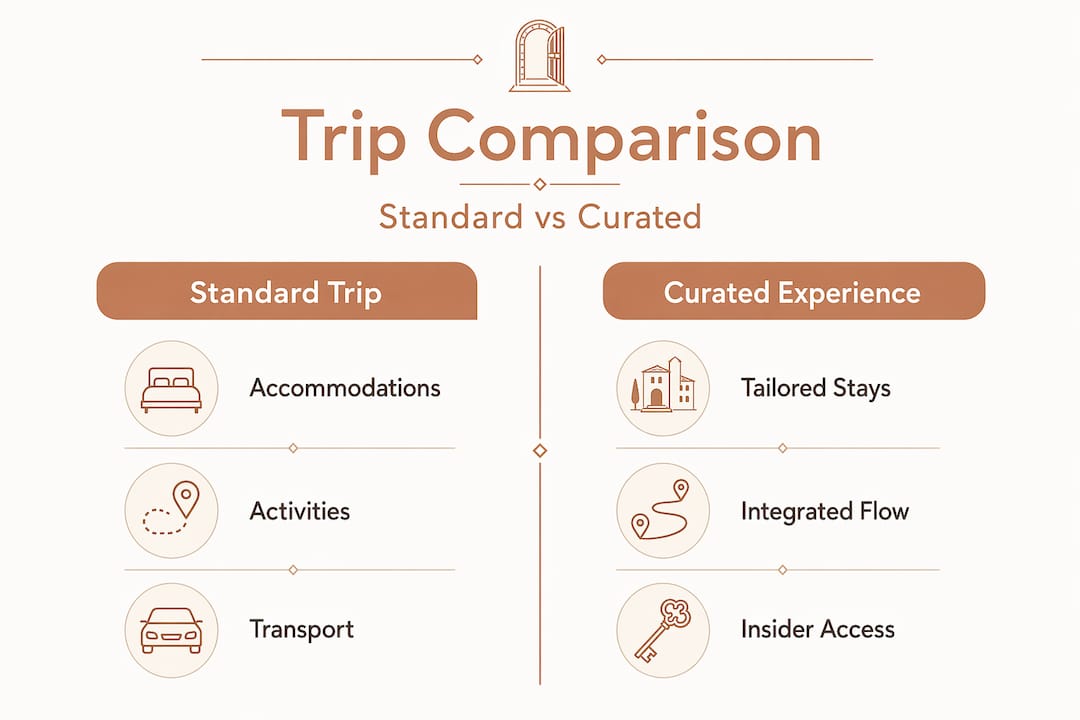
The comparison below shows how the same destination can be approached with or without genuine curation:
| Element | Standard trip | Curated experience |
|---|---|---|
| Accommodations | Chosen by location and price | Vetted for character, service, and thematic fit |
| Activities | Popular attractions | Sequenced experiences tied to a central theme |
| Meals | Top-rated restaurants | Chef relationships, market visits, regional pairings |
| Transport | Booked separately | Timed to support experience quality and flow |
| Outcome | You visited the destination | You understood it |
Benefits of curated travel you will actually feel
The practical benefits of choosing a curated approach go well beyond having a nicer trip. They change the quality of what you take home.
The most immediate benefit is reduced cognitive load. Planning a complex trip means hundreds of decisions: which neighborhoods, which hotels, which tours, which restaurants, how to sequence everything without losing days to logistics. A genuine curator absorbs that complexity and delivers a solution shaped by your interests. One example of this done well is the Oman Air and Alwan Travel partnership for a curated Hanoi package, which combines charter flights with immersive cultural programming and comfort-focused logistics into a single, coherent offering. That is simplicity with depth.
Beyond convenience, curated travel provides insider access that you cannot manufacture through standard booking platforms. Travel curators build deep local relationships and personally vet accommodations, guides, and experiences before you ever arrive. They have tasted the menu, walked the route, and checked whether the sunset view from that terrace actually lives up to its reputation. Online reviews cannot replicate that.
The most lasting benefit is memory quality. Experiences designed incrementally so guests engage more deeply create richer, more retained memories than isolated highlights. A trip that built toward something, where each day added a layer, stays with you years later in a way that a greatest-hits tour simply does not.
Pro Tip: After any trip, try to recall three specific moments in sensory detail. If you struggle with a standard itinerary but can easily do it after a curated one, that difference tells you everything about value.
How to spot genuinely curated travel services
Not every company that uses the word “curated” actually practices it. The term has been diluted by marketing. Here is what to look for when evaluating whether a service is offering real curation or just packaging.
- Ask for the experience arc. A genuine curator can explain what you will feel and know by the end of the trip, not just what you will see and do. If they cannot articulate progression, they are assembling, not curating.
- Look for evidence of on-the-ground vetting. Curators personally visit hotels, meet guides, taste menus, and check logistics directly. Ask whether the team has personally experienced what they are recommending.
- Check for local partnerships. Access to private experiences, local producers, and non-public venues signals genuine curatorial relationships rather than reselling standard inventory.
- Avoid “premium add-ons” disguised as curation. Business-class flights and five-star hotels are lovely. They are not, on their own, a curated experience. Real curation shows up in how the non-luxury elements are handled too.
- Evaluate the itinerary structure. Hyper-curated journeys reflect deeply held traveler values and personal pace. If a proposed itinerary looks like it could belong to anyone, it was not designed for you.
You are looking for evidence of thought, not just taste. The questions you ask before booking reveal as much about the service quality as any brochure.
My take on what curated travel really changes
Over the years working in this space, I have reviewed hundreds of itineraries. Some feel alive from the moment you read them. Others are just lists dressed up with nice photography.
The ones that feel alive share one quality: they were designed around a human story. Not a destination. Not a price point. A person’s specific curiosity, pace, and capacity for awe. I have seen a four-day culinary trip through Lyon that changed how a couple thought about food, their relationship, and what they want from the next decade of their lives. I have also seen a two-week “luxury” tour of Southeast Asia that left the travelers exhausted and vaguely disappointed, because every component was excellent in isolation and meaningless as a whole.
What I have learned is this. The future of meaningful travel is not about adding more or spending more. It is about designing more intentionally. Travel is moving toward human-centered story-driven journeys, and that shift rewards travelers who ask deeper questions before they book. If you are reading this, you are already asking the right ones. The next step is finding someone who can answer them with the same level of care you bring to the question.
— Michael
How Hiddendoortravel brings curated travel to life
Hiddendoortravel was built on exactly the philosophy described in this article. Every trip begins with a conversation about who you are as a traveler, what genuinely moves you, and what kind of story you want to bring home. From there, the team’s luxury travel experts apply years of on-the-ground experience to craft integrated itineraries where every detail serves the whole.
This is not a catalog of pre-built tours with your name added at the top. Hiddendoortravel designs bespoke travel itineraries with the kind of local access, logistical precision, and thematic depth that transforms a trip from impressive to unforgettable. Whether your passion is wine, culture, wellness, or pure discovery, the team knows how to build an arc around it.
If you are ready to experience what genuine curation actually feels like, explore trip inspiration ideas or reach out to start designing something made entirely for you.
FAQ
What is a curated travel experience?
A curated travel experience is an intentionally designed journey where flights, accommodations, transport, and activities are orchestrated to work together around a traveler’s specific interests and desired emotional arc. It goes well beyond personalization by integrating every element into a coherent, purposeful whole.
How is curated travel different from personalized travel?
Personalization adjusts surface-level details like seat preferences or dietary options. Curation designs the entire experience arc, sequencing activities and logistics so every component supports the traveler’s deeper purpose and builds progressively toward a meaningful outcome.
What are the main benefits of curated travel?
Curated travel reduces planning complexity, provides insider access to experiences unavailable through standard booking, and creates richer, longer-lasting memories by designing experiences that build on each other rather than sitting in isolation.
How do I know if a travel company is truly curating my trip?
Ask whether the team can describe the emotional or educational arc of your trip, not just the logistics. Genuine curators personally vet hotels, guides, and experiences on the ground and can explain why each element was chosen in relation to the others.
Can curated travel work for any type of trip?
Yes. The curated approach applies to any passion or travel style, from culinary and wine journeys to cultural immersions, wellness retreats, and educational expeditions. The design method is universal even when the destination and theme are entirely personal.