

Most people assume a travel advisor is just a fancier term for someone who books flights. That assumption costs travelers real money, real experiences, and real peace of mind. A travel advisor is something far more specific: a professional who designs your entire trip from the ground up, using industry relationships, destination knowledge, and personal insight to build an experience that a search engine simply cannot replicate. Understanding what this role actually involves changes how you plan every trip going forward.
Table of Contents
- Key takeaways
- What is a travel advisor, really?
- The real benefits of working with a travel advisor
- How travel advisors charge for their services
- How to choose a travel advisor that fits you
- My honest take on what travel advisors actually do
- Plan your next trip with Hiddendoortravel
- FAQ
Key takeaways
| Point | Details |
|---|---|
| Advisors design trips, not just book them | A travel advisor builds your full itinerary, not just tickets and hotels. |
| Their network unlocks real perks | Industry relationships translate to upgrades, credits, and exclusive access unavailable online. |
| Fees vary by complexity | Planning fees typically range from $50 to $500-plus, depending on trip scope and advisor model. |
| Disruption support is where they earn it | A great advisor manages flight changes, hotel issues, and emergencies while you are traveling. |
| Fit matters when choosing one | Match your advisor to your travel style, complexity, and budget before committing. |
What is a travel advisor, really?
The clearest way to understand a travel advisor is to separate what they do from what most people think they do. According to AAA, a travel advisor functions as a personal trip designer, building unique trips and managing real-time issues like rerouting flights or adjusting hotel stays when things go sideways. That is a meaningfully different job than processing a booking.
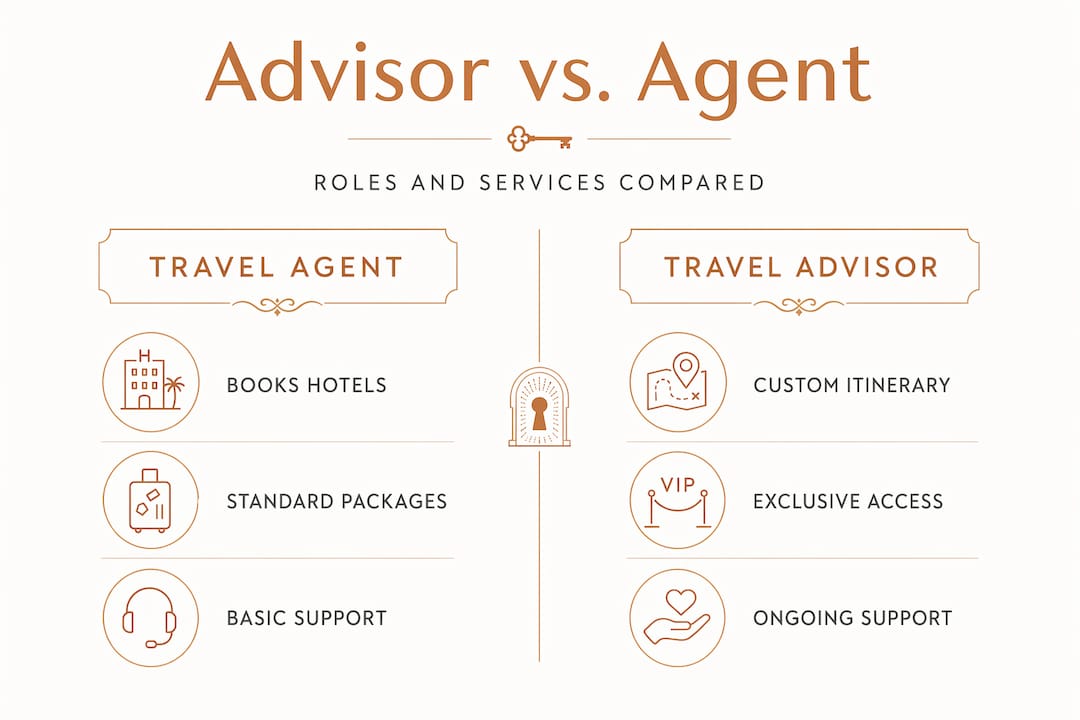
The confusion between travel advisors and travel agents runs deep, and it matters. A travel agent typically works within a defined set of products: packaged tours, standard hotel arrangements, set cruise itineraries. They find and book what already exists. A travel advisor starts from scratch with your specific preferences, constraints, and goals. They then use supplier relationships, destination expertise, and local contacts to construct something that fits you specifically.
Here is a direct comparison to make that concrete:
| Task | Travel agent | Travel advisor |
|---|---|---|
| Books flights and hotels | Yes | Yes |
| Creates custom itineraries from scratch | Rarely | Always |
| Arranges private tours or exclusive dinners | Rarely | Routinely |
| Provides in-trip support and problem solving | Limited | Full service |
| Leverages supplier relationships for added perks | Sometimes | Consistently |
| Advocates on your behalf during disruptions | Unlikely | Core part of the role |
AAA notes that advisors create unique experiences such as private tours or exclusive dinner reservations that a standard agent typically does not provide. The difference is not in the category of work. It is in the depth, personalization, and ongoing responsibility.
Pro Tip: Ask any advisor you are considering: “What happens when something goes wrong mid-trip?” Their answer tells you everything about whether they are actually an advisor or just a booking service with a better title.
The real benefits of working with a travel advisor
The case for using a travel advisor is not sentimental. It is practical. Here is what you actually get that you cannot get on your own.
Time savings and research quality. Planning a multi-country trip from scratch takes dozens of hours. An advisor with destination-specific knowledge compresses that process and eliminates the dead ends you would hit researching on your own. The Travel Institute points out that personalization and advocacy are core values advisors provide in ways that online booking tools simply cannot replicate.

Access through industry relationships. This is where the value becomes genuinely difficult to replicate independently. An advisor’s supplier and local network adds upgrades, credits, and exclusive experiences to trips that would look identical on paper to a self-booked version. Two people staying at the same property on the same dates can have completely different experiences depending on whether an advisor was involved.
24/7 support when it matters most. AARP notes that advisor support is often around the clock, either directly or through a professional network, and that this is especially valuable for complex or international travel. When your connection gets canceled in Frankfurt at 11 p.m., knowing someone is working the phones on your behalf is not a luxury. It is the whole point.
The full list of tangible benefits includes:
- Personalized itinerary design based on your travel style, not generic templates
- Priority access to sold-out properties, tours, and dining reservations
- A single point of contact managing every moving part of your trip
- Honest guidance on destinations, timing, and what is actually worth the money
- Real advocacy when airlines, hotels, or tour operators fall short of what was promised
- Stress reduction from knowing every detail has been handled by a professional
Pro Tip: For multi-destination trips, the value of an advisor multiplies with every additional location. The coordination complexity alone is worth the fee.
How travel advisors charge for their services
Pricing is where a lot of people hesitate, usually because they do not know what to expect. The model has evolved significantly. PTN Travel explains that pricing models include commission-only structures, flat planning fees, and hybrid combinations designed to fairly compensate advisors for the work they actually do.
Here is what those models look like in practice:
| Pricing model | How it works | Best for |
|---|---|---|
| Commission-only | Advisor earns from suppliers, no direct fee to client | Simple bookings, standard packages |
| Flat planning fee | One set fee for full trip design and coordination | Complex or custom itineraries |
| Hourly consultation | Fee charged per hour of planning time | Specific advice or partial planning |
| Hybrid | Commission plus service fee | High-touch trips with extensive logistics |
World Via Travel Network provides specific benchmarks for 2026: planning fees commonly range from $50 to $500 or more per trip, consultation fees from $100 to $300 per hour, and per-booking service fees from $25 to $250 depending on complexity.
PTN Travel also highlights that trip complexity drives fee structures. A simple resort booking may carry no direct fee because commission covers the advisor’s time. A custom three-week itinerary across multiple countries will almost always include a planning fee, and that fee is almost always worth it given the time and expertise involved.
One thing worth understanding: when an advisor charges you directly, it often means they are not constrained by which suppliers pay the highest commissions. That independence tends to produce better recommendations.
How to choose a travel advisor that fits you
Choosing an advisor is a matching exercise, not a shopping one. The right advisor for a family beach vacation is almost certainly not the right advisor for a private sailing trip through Croatia. Here is how to approach the selection with real criteria.
-
Identify their specialty first. Advisors who focus on luxury travel, adventure trips, honeymoons, or specific regions bring a depth of knowledge that a generalist cannot match. Ask directly: “What types of trips do you plan most often?” and evaluate whether that aligns with what you need.
-
Evaluate the consultation experience. AAA describes the advisor workflow as starting with an in-depth consultation before any research or proposal begins. If an advisor skips or rushes this step, they are not building your trip around you. They are fitting you into a template.
-
Ask about disruption management directly. AARP advises that when evaluating disruption support, you should understand whether support is direct or networked. If your flight gets canceled, do they personally handle it, or does the call go to a general support line?
-
Understand their supplier network. The advisor’s network of local contacts is often as valuable as the itinerary itself. Ask which hotel brands, tour operators, and destination management companies they work with regularly.
-
Assess transparency around fees. A professional advisor will tell you exactly how they are compensated before you commit. If pricing is vague or changes after the conversation, that is a red flag worth taking seriously.
Working with a full-service travel agency means you have access to advisors who cover all of these criteria and can demonstrate it clearly. The right fit feels like a conversation, not a transaction.
My honest take on what travel advisors actually do
I have spent years watching people plan extraordinary trips the hard way, and a pattern shows up every time. They spend weeks on research, piece together an itinerary from blog posts and forums, book everything themselves, and then spend the actual trip managing logistics instead of experiencing the destination.
What I have found is that the most underappreciated part of a travel advisor’s work is not the planning. It is the ongoing responsibility. When something breaks, they own it. That accountability is almost impossible to quantify until you actually need it and do not have it.
There is also a misconception I see constantly: that advisors are best suited for wealthy travelers with complicated tastes. That is not accurate. Advisors add the most value proportional to trip complexity and the personal significance of the trip. A honeymoon, a milestone anniversary, a once-in-a-decade family reunion trip, these are exactly the situations where getting it right matters most and where having a professional responsible for the outcome is worth every penny of whatever they charge.
My advice: do not evaluate an advisor by their fee. Evaluate them by what they know, who they know, and how they behave when things go wrong. The fee is almost never the real variable.
— Michael
Plan your next trip with Hiddendoortravel
If this article has made one thing clear, it is that the right travel advisor transforms a good trip into an exceptional one. At Hiddendoortravel, that is exactly what our team delivers for every client.

Hiddendoortravel specializes in bespoke luxury travel built around your preferences, timeline, and vision, not off-the-shelf packages. From the first consultation through real-time support during your trip, our luxury travel experts handle every detail with the kind of care and industry knowledge that only comes from years of doing this at the highest level. Whether you are planning a private villa retreat, a multi-country cultural tour, or a special occasion trip that has to go perfectly, we are the team to call. Start the conversation today.
FAQ
What is a travel advisor?
A travel advisor is a travel-planning professional who designs and coordinates end-to-end trips using industry knowledge, supplier relationships, and personalized guidance. Unlike a basic booking agent, they build customized itineraries and provide support before and during travel.
How is a travel advisor different from a travel agent?
A travel agent typically books existing packages and handles standard reservations. A travel advisor builds custom experiences from scratch, arranges exclusive access, and provides ongoing advocacy and support if disruptions occur.
How much does it cost to hire a travel advisor?
Planning fees typically range from $50 to $500 or more per trip, with hourly consultation fees between $100 and $300. Some advisors work on commission only, while complex trips often include a flat or hybrid fee structure.
When is a travel advisor most worth it?
Travel advisors deliver the most value for complex, high-stakes, or international trips where logistics are demanding and getting it right matters. AARP highlights that 24/7 support and streamlined planning are particularly critical for multi-destination and special-occasion travel.
What should I ask before hiring a travel advisor?
Ask about their specialty, how they handle mid-trip disruptions, what their supplier network includes, and how they charge. Transparency in all four areas is the clearest sign you are working with a true professional.