

A travel backstory service designs a bespoke trip anchored in your personal history, motivations, and meaningful memories rather than a generic destination checklist. The “backstory” here is yours: the family heritage you want to trace, the milestone you’re marking, the long-held fascination you’ve never had time to pursue. Hiddendoortravel builds exactly this kind of experience, pairing emotional resonance with flawless luxury logistics so the trip actually means something when you return home.
Table of Contents
- What a travel backstory service actually does
- How providers turn your backstory into a trip
- What you can expect to receive
- Who gets the most out of this kind of trip
- The practical and emotional benefits of a backstory-driven trip
- How pricing works and what agents earn
- What a backstory service is not
- What to look for when choosing a provider
- Why backstory-driven trips work, according to experts
- Key Takeaways
- The part that gets overlooked
- Start your backstory-driven trip with Hiddendoortravel
- Useful sources
What a travel backstory service actually does
Most people assume “backstory” means destination history. It doesn’t. The backstory is your story: why you want to go, what shaped that desire, and what you hope to carry home. As one travel storytelling guide puts it, backstory earns its place only when it connects directly to the traveler’s quest. Unrelated context just muddies the narrative.
A travel backstory service translates that personal “why” into a fully designed trip. The core components typically include:
- Discovery interview: A structured conversation that surfaces your motivations, formative memories, and travel aspirations.
- Narrative framing: The planner identifies the emotional arc of your trip, the thread that connects each destination or experience.
- Bespoke itinerary: Every hotel, excursion, and meal is chosen because it serves your story, not because it’s popular on a listicle.
- Logistical bookings: Flights, transfers, accommodations, private guides, and exclusive access, all handled.
- On-trip support: A point of contact available if plans shift or an opportunity arises.
- Keepsakes and deliverables: A travel memoir service or curated photo book that preserves the experience after you’re home.
Three quick examples show how this works in practice. A client whose grandparents emigrated from Sicily gets a trip built around the specific village, the church records, and a private dinner with a local family, not a standard Palermo city tour. A couple celebrating 30 years of marriage revisits the country where they first met, with the original guesthouse booked and a private guide who knows its history. A solo traveler with a lifelong interest in Japanese ceramics gets studio access and a master craftsman introduction that no booking app can arrange.
“Travel stories are brief, emotionally charged moments — what people actually remember from trips.” Pinaak
Pro Tip: When you first speak with a planner, notice whether they ask about you before they ask about destinations. That order tells you everything about whether they’re running a backstory service or a booking service.
How providers turn your backstory into a trip
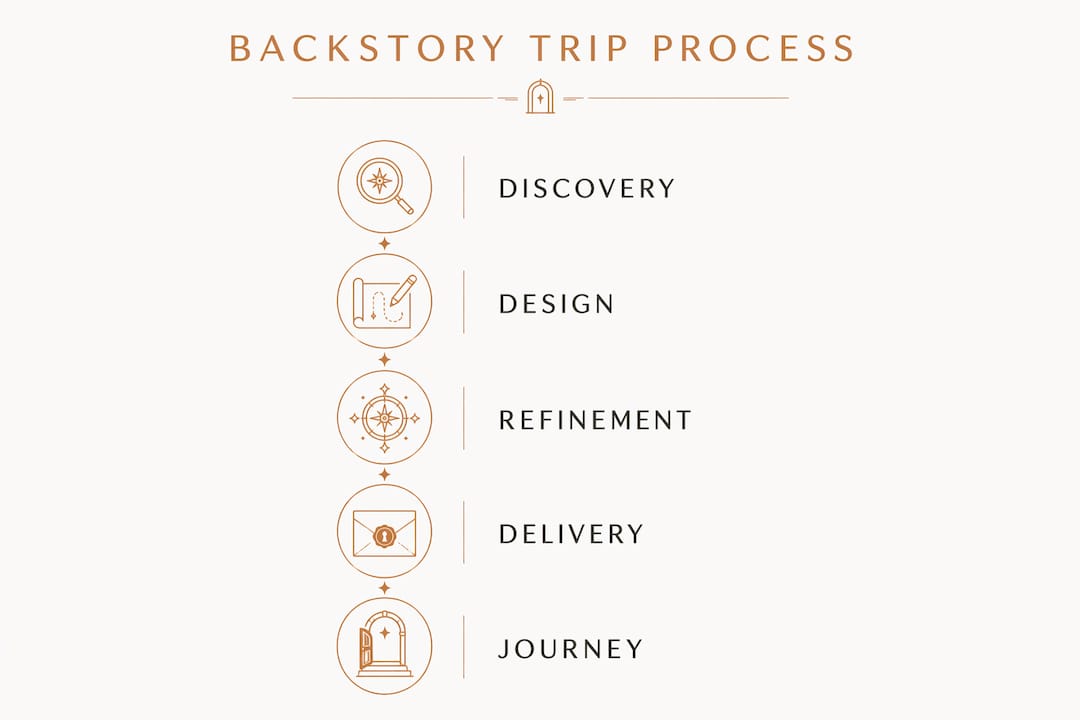
The process is more structured than most clients expect. Here’s a typical sequence:
- Initial discovery call (Week 1): The planner asks about your life, not your wish list. Questions cover formative experiences, family history, personal milestones, sensory preferences, and what you want to feel at the end of the trip.
- Narrative design (Weeks 2–3): The planner maps an emotional arc, then researches which destinations, properties, and experiences serve that arc. Storytelling techniques like sensory anchoring and narrative structure guide which moments get built into the schedule.
- Draft itinerary and first approval (Week 4): You receive a detailed draft. This is where you push back, add, or redirect. Good planners expect two or three revision rounds.
- Bookings and confirmations (Weeks 5–8): Reservations are made, deposits paid, and supplier contacts confirmed. For complex multi-destination trips, this phase runs longer.
- Pre-departure briefing (1–2 weeks before): You receive a full contact sheet, emergency protocols, and a day-by-day guide written in narrative form, not just a schedule.
- On-trip support: The planner stays reachable. If a private tour cancels or a restaurant closes, they fix it before you notice.
- Post-trip deliverable: The keepsake, whether a memoir, photo book, or curated journal, arrives within a few weeks of your return.
| Phase | Typical Duration | Key Deliverable | Client Action |
|---|---|---|---|
| Discovery | Week 1 | Intake notes | Attend interview |
| Narrative design | Weeks 2–3 | Emotional arc outline | Review and confirm |
| Draft itinerary | Week 4 | Full draft document | Approve or revise |
| Bookings | Weeks 5–8 | Confirmed reservations | Sign booking agreement |
| Pre-departure | 1–2 weeks prior | Contact sheet, briefing doc | Review and ask questions |
| Post-trip | 2–4 weeks after return | Memoir or photo book | Receive and enjoy |
What you can expect to receive
The deliverables from a backstory-driven service go well beyond a PDF itinerary. A complete engagement typically produces:
- A narrative itinerary written in prose, not bullet points, that explains the “why” behind each choice.
- All reservations confirmed in writing: hotels, private guides, transfers, restaurant bookings, and event access.
- A contact sheet with every supplier’s name, phone number, and local emergency contact.
- An emergency protocol covering medical, logistical, and weather contingencies.
- A keepsake deliverable, such as a travel memoir or curated photo book, produced after the trip.
- Optional concierge services for in-trip additions: last-minute dinner reservations, private transport upgrades, or exclusive event tickets.
For complex multi-destination trips, expect a planning window of 6–12 weeks from first call to departure. Simpler regional trips can move faster, sometimes in 3–4 weeks, but rushing the discovery phase usually shows in the final product.
| Trip Type | Planning Window | Typical Deliverables |
|---|---|---|
| Single-destination, 5–7 days | 3–4 weeks | Itinerary, reservations, contact sheet |
| Multi-destination, — | 6–12 weeks | Full package + emergency plan |
| Complex multi-country, 2+ weeks | 6–12 weeks | Full package + memoir or photo book |

Who gets the most out of this kind of trip
Not every traveler needs a backstory service. The clients who get the most from it tend to fall into a few recognizable profiles.
- Legacy seekers: Travelers who want to trace family roots, visit ancestral homelands, or document a heritage for the next generation.
- Milestone travelers: Marking a significant birthday, anniversary, retirement, or personal achievement with a trip that reflects its weight.
- Cultural reconnection travelers: People with a deep tie to a specific culture, language, or tradition who want immersive access, not tourist-level exposure.
- Privacy-focused luxury travelers: High-profile individuals who need discretion, private access, and a planner who anticipates problems before they surface.
- Surprise and celebration planners: Someone organizing a trip for a partner, parent, or group where the emotional impact is the entire point.
Consider a traveler who spent childhood summers hearing her grandmother’s stories about rural Provence. A standard agency books her a week in Aix-en-Provence. A backstory service finds the specific village, arranges a private lavender farm visit at harvest, and books a cooking lesson with a local chef who still makes the dish her grandmother described. The logistics are similar. The experience is entirely different.
Culinary experiences, in particular, are a powerful backstory anchor. Gastronomy and personal memory are tightly linked, and planners who understand that connection can build moments around food that resonate for years.

Legacy seekers and milestone travelers typically pay service fees directly. Cultural reconnection and celebration planners often work with a hybrid model where supplier commissions offset part of the planning cost.
The practical and emotional benefits of a backstory-driven trip
The practical case is straightforward. You save dozens of hours of research, gain access to experiences that aren’t publicly bookable, and travel with a safety net of professional support. The personalized travel benefits extend to pacing, too: a planner who knows your story knows when to schedule a full day with nothing on it.
The emotional case is harder to quantify but easier to feel. Trips anchored in personal meaning tend to produce stronger memories, a phenomenon National Geographic describes as the interplay between the outer journey (places, logistics) and the inner journey (personal growth and transformation). When both are designed together, the trip doesn’t just happen to you. It means something.
Specific benefits worth noting:
- Time saved: Research, vetting, and booking handled entirely by the planner.
- Exclusive access: Private tours, closed venues, and supplier relationships that aren’t available through booking apps.
- Narrative continuity: Each day connects to the next through a coherent personal story, not just geography.
- Memory preservation: The keepsake deliverable means the trip lives beyond your phone’s camera roll.
- Stronger legacy: For family trips, a documented narrative becomes something you pass on.
How pricing works and what agents earn
Travel backstory services use three common pricing models:
- Flat service fee: A fixed amount charged for the planning work, regardless of trip cost. Common for complex, time-intensive engagements.
- Percentage of trip cost: The planner charges a percentage of total bookings. This aligns their incentive with trip quality but means fees scale with spend.
- Hybrid fee plus commission: A modest flat fee covers planning time, while supplier commissions (typically paid by hotels, tour operators, and airlines) cover the rest.
A travel agent working on commission alone might earn a percentage of the trip cost, with additional service fees added, leading to total compensation that varies depending on supplier commissions and fee structures. Supplier commission rates can vary significantly by category, with luxury hotels often paying higher commissions than airlines, which may pay little or none.
Pro Tip: Ask any provider for a sample invoice or fee disclosure before signing. A reputable agency will show you exactly what they charge and how supplier commissions factor in. Opacity here is a red flag.
Avoid common luxury travel mistakes by confirming whether the service fee is refundable if the trip doesn’t proceed, and whether commissions are disclosed or embedded in marked-up prices.
What a backstory service is not
Four distinctions worth making explicit:
- Not destination history: The backstory is the client’s personal narrative, not a briefing on the place’s past. A planner who spends the discovery call describing the history of Tuscany has missed the point.
- Not a templated itinerary product: Pre-built “luxury Italy” packages with your name inserted are not backstory-driven. The itinerary should be unrepeatable.
- Not a concierge-only booking: Concierge services handle logistics. A backstory service handles meaning. The best providers do both, but they’re not the same thing.
- Not a travel writing course: Travel memoir services and travel writing workshops are related but distinct. A backstory service produces a trip; a memoir service documents it afterward. They complement each other well.
| Service Type | Core Focus | Produces |
|---|---|---|
| Travel backstory service | Client’s personal story and motivations | Bespoke trip + optional keepsake |
| Standard bespoke itinerary | Destination preferences and logistics | Custom itinerary and bookings |
| Concierge booking service | Logistics and reservations only | Confirmed bookings |
| Travel memoir service | Documenting a completed trip | Written memoir or photo book |
Travelers who want a well-organized trip to a specific destination without the narrative layer are better served by a bespoke itinerary service. The backstory model adds meaningful overhead, in time and cost, that only pays off when the personal story is genuinely central to the trip’s purpose.
What to look for when choosing a provider
A strong provider shows their work before you sign anything. The checklist:
- Sample itineraries: Real examples (anonymized) that show narrative depth, not just hotel names and transfer times.
- Case studies or client stories: Evidence that previous trips were shaped by client backstories, not just client preferences.
- “Meet the team” page: Named planners with visible credentials and experience. Anonymous agencies are harder to trust.
- References or testimonials: Specific, attributed feedback from real clients, not generic praise.
- Sample keepsakes: A preview of what a memoir or photo book actually looks like.
- Transparent pricing: Written fee disclosure before any commitment.
- Emergency support policy: A clear statement of what happens if something goes wrong mid-trip.
Questions worth asking on a discovery call:
- Can you walk me through a recent trip you designed around a client’s personal story?
- How do you handle the discovery process — what do you actually ask?
- What does your revision process look like, and how many rounds are included?
- How are your fees structured, and are supplier commissions disclosed?
- Who is my point of contact during the trip, and what’s the response time?
- What keepsake deliverables do you offer, and when do I receive them?
- How do you handle emergencies or last-minute changes on the ground?
The itinerary design approach a provider uses tells you a lot. If their sample itineraries read like a schedule, they’re a booking service. If they read like a story, you’re in the right place. An elite agency selection checklist can help you compare providers systematically before committing.
Why backstory-driven trips work, according to experts
National Geographic describes travel storytelling as the inseparable link between the outer journey (places, logistics, itinerary) and the inner journey (personal growth, emotional transformation). When a planner designs only for the outer journey, the trip is pleasant. When both are designed together, the trip is memorable in the way that actually changes you.
“Focus and vivid detail are what separate a travel story from a travel report.” — National Geographic
Experienced planners also know when not to fill the schedule. Meaningful moments tend to form in unplanned gaps: a conversation with a shopkeeper, a detour down a side street, an hour sitting in a square with no agenda. Deliberate under-programming is a skill, and it’s one that guest experience design in hospitality has recognized for years. The best itineraries build in space to wander precisely because that’s where the inner journey happens.
The role of personalization in luxury travel reinforces this: clients who feel their planner understood them, not just their destination preferences, report higher satisfaction and stronger memories of the trip.
Key Takeaways
A travel backstory service is the most direct way to turn a meaningful trip from an idea into a fully realized, personally resonant experience.
| Point | Details |
|---|---|
| What it is | A planning service that uses your personal history and motivations as the organizing principle for a bespoke trip. |
| Core deliverables | Narrative itinerary, confirmed reservations, contact sheet, emergency plan, and a keepsake such as a memoir or photo book. |
| Planning timeline | Expect 6–12 weeks for complex multi-destination trips; 3–4 weeks for simpler regional itineraries. |
| How to evaluate providers | Ask for sample itineraries, case studies, a “meet the team” page, and written fee disclosure before signing. |
| Hiddendoortravel | Offers backstory-driven bespoke trips including Travel Memoir Service and Travel Legacy Trip as named deliverables. |
The part that gets overlooked
Most conversations about travel backstory services focus on the logistics: the timeline, the deliverables, the fee structure. Those matter. But the thing that actually separates a backstory-driven trip from a well-organized vacation is something harder to put in a table.
It’s the moment a client realizes the planner understood something about them that they hadn’t fully articulated themselves. That the village on day three wasn’t chosen because it’s picturesque, but because it connects to a story the client told in passing during the discovery call. That the dinner on the last night was designed to feel like an ending, not just a meal.
That kind of design requires a planner who listens differently. Not for preferences, but for meaning. The practical framework matters, but it’s in service of that. Travelers who approach this as a logistics upgrade will get a good trip. Travelers who approach it as a collaboration around their own story tend to get something they talk about for the rest of their lives.
Start your backstory-driven trip with Hiddendoortravel
Hiddendoortravel works with clients whose trips need to mean something, not just go smoothly. The first step is a discovery call where a planner asks about your story before they ask about your destination. From there, you receive a narrative itinerary draft, a transparent fee disclosure, and a clear timeline from first conversation to departure.
Named offerings include the Travel Memoir Service and Travel Legacy Trip, both designed to preserve the experience long after you’re home. Typical engagements run 6–12 weeks for complex itineraries, with shorter windows available for regional trips. Fees are disclosed in writing before any booking agreement is signed.
To start, speak with a luxury travel expert at Hiddendoortravel, or visit the agency landing page to review services and begin your inquiry. You’ll hear back with a proposed discovery call within one business day.
Useful sources
The following sources informed this article and offer useful further reading:
| Source | What It Offers |
|---|---|
| National Geographic: The Art and Heart of Travel Storytelling | Theory of outer vs. inner journey; why narrative focus matters in travel planning. |
| Pinaak: What Is a Travel Story? | Explains what travel stories actually are: brief, emotionally charged moments. |
| School of Travel Journalism: Storytelling Techniques | Practical narrative tools used by planners to design memorable moments. |
| Writing from Near and Far: The Key to Your Travel Stories — Backstory | Clarifies what backstory means and when it belongs in a travel narrative. |
| Hiddendoortravel: Personalized Travel Service Benefits | Agency resource on emotional and practical benefits of personalized travel. |
| Hiddendoortravel: What Is a Travel Memoir Service? | Details on memoir and legacy trip deliverables offered by the agency. |
| Hiddendoortravel: The Role of Itinerary Design in Luxury Travel | How itinerary structure supports meaningful, story-driven travel moments. |
Recommended
- What Is a Travel Memoir Service? Your Complete Guide – Hidden Door Travel
- Personalized Travel Service Benefits That Transform Trips – Hidden Door Travel
- The Role of Anticipatory Travel Service in Luxury Trips – Hidden Door Travel
- Why Personalized Travel Matters for Real Satisfaction – Hidden Door Travel