

An ultra luxury cruise line is defined as a small-ship ocean experience built around all-suite accommodations, near 1:1 crew-to-guest ratios, and fares that bundle nearly every onboard cost into one price. The industry term used by travel professionals is “ultra luxury” or “ultra-premium,” sitting above standard luxury and premium cruise categories. These ships carry fewer than 750 passengers, which is the threshold that separates them from the mass-market ships carrying thousands. That small scale shapes everything: the ports they visit, the service they deliver, and the atmosphere on board.
The price reflects that exclusivity. Daily rates run $700 to $2,500 per person, with weekly costs reaching $12,000 to $40,000 for suites. That figure sounds steep until you account for what is bundled in. Most ultra luxury fares cover premium drinks, specialty dining, gratuities, and Wi-Fi as standard. Some lines go further and include unlimited shore excursions and round-trip airfare.
What distinguishes an ultra luxury cruise line from other cruise experiences?
The clearest difference is ship size. Ultra luxury ships carry 450 to 750 guests. A mainstream ship carries 3,000 to 6,000. That gap in scale is not just a number. It determines which ports the ship can enter, how quickly guests board and disembark, and whether the pool deck feels like a private retreat or a crowded resort.
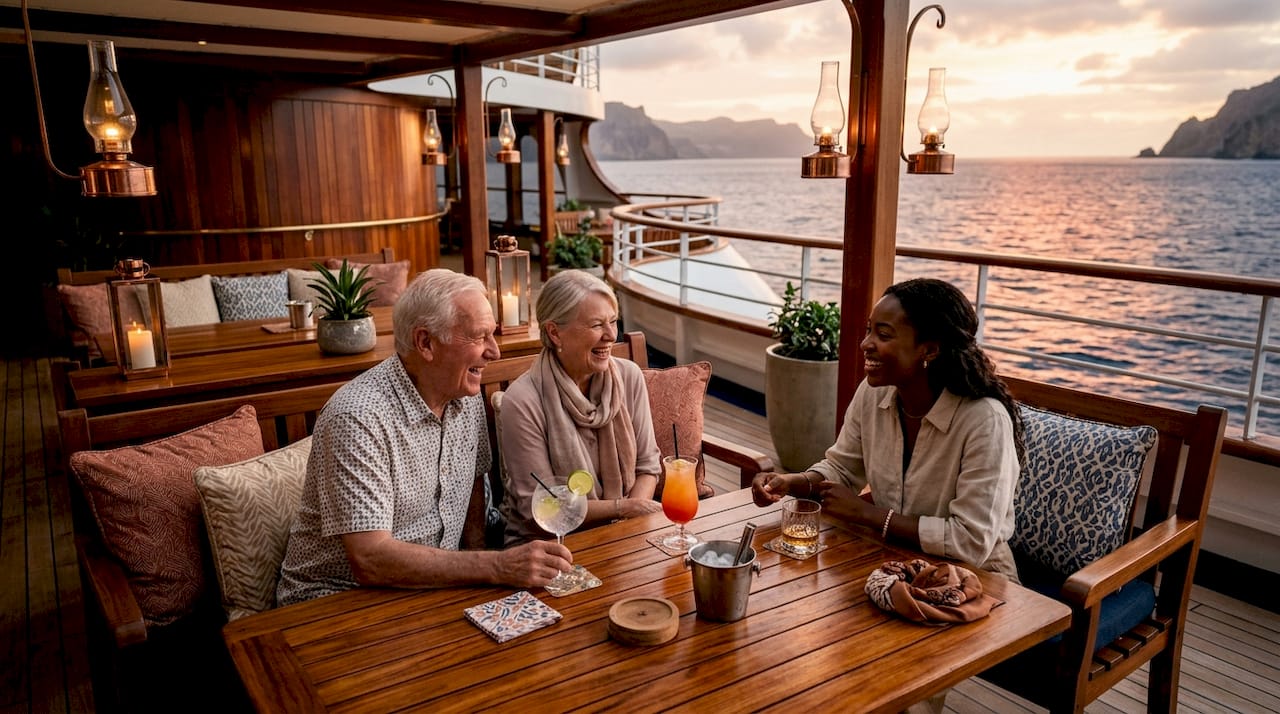
Crew ratios are the second major differentiator. Seven Seas Grandeur carries 746 guests with 548 crew members, approaching a near 1:1 ratio. On a mainstream ship, one crew member may serve four or five guests. The practical result is that requests get answered faster, preferences get remembered, and service feels personal rather than transactional.
The all-inclusive model is the third distinction, and it varies more than most travelers expect. The key differences across ultra luxury categories look like this:
| Feature | Standard luxury cruise | Ultra luxury cruise |
|---|---|---|
| Accommodation | Mix of cabins and suites | All-suite, all ships |
| Dining | Main dining room plus specialty surcharges | Multiple restaurants, no surcharges |
| Drinks | Basic package or add-on | Premium spirits and wine included |
| Gratuities | Added to bill | Included in fare |
| Shore excursions | Paid separately | Included on some lines |
| Airfare | Not included | Included on select lines |
The fourth differentiator is itinerary access. Because ultra luxury ships are small, they dock in ports that larger ships cannot reach. Think Dubrovnik’s old harbor, the Galápagos Islands, or remote Norwegian fjords. Selecting a luxury cruise itinerary that matches your interests is one of the most important decisions you will make, and the port list is a major factor.
Key features that separate ultra luxury from standard luxury at a glance:
- All-suite ships with private balconies on most categories
- Open-seating dining with no fixed times or assigned tables
- Crew-to-guest ratios approaching 1:1
- Access to smaller, niche ports unavailable to large ships
- Fares that include most or all onboard costs
What features and amenities define the ultra luxury cruise experience?
Suite design is the most visible marker of the category. Ultra luxury lines offer all-suite ships, with most suites featuring private balconies, marble bathrooms, and walk-in wardrobes. Top-tier suites on flagship ships include private solariums, grand pianos, and separate living and dining areas. The suite is not just a place to sleep. It functions as a private apartment at sea.
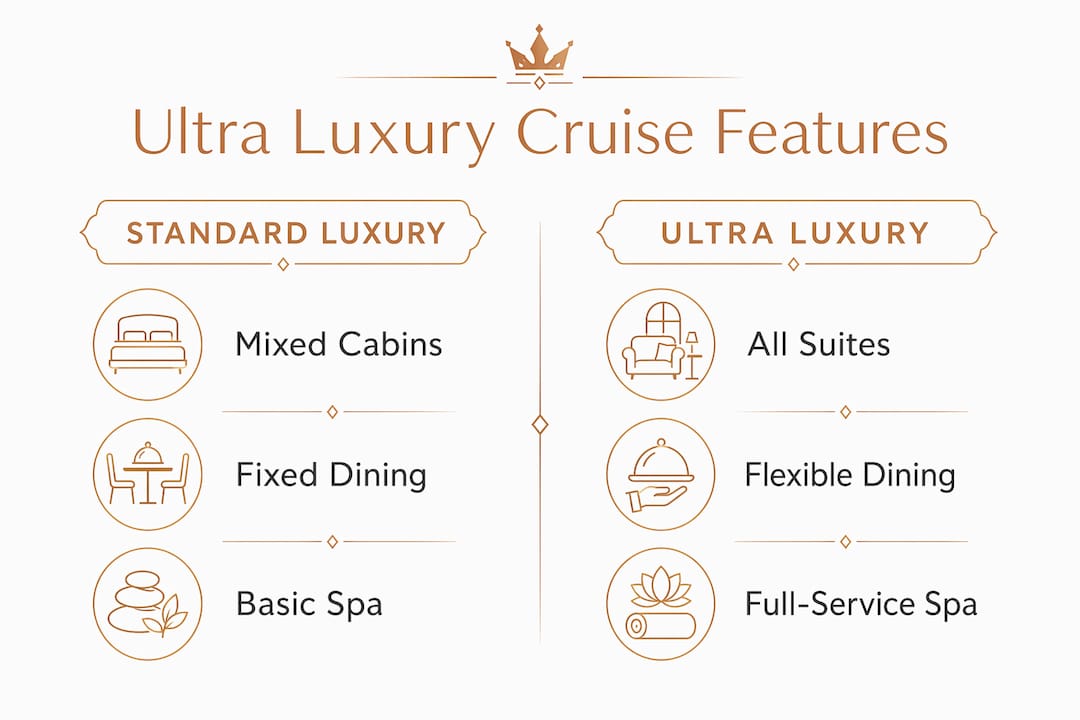
Dining on ultra luxury ships operates without fixed times or assigned tables. Guests choose when, where, and with whom to dine, across multiple restaurant concepts with no surcharges. A single ship might offer a French brasserie, a Japanese teppanyaki counter, a poolside grill, and a formal dining room. The culinary standard matches what you would expect at a Michelin-recognized restaurant on land.
Personalized service extends beyond the dining room. Most ultra luxury lines assign dedicated staff to each suite, whether that is a full butler or a senior suite attendant. Butlers handle everything from unpacking luggage and booking shore excursions to arranging in-suite dinners and pressing clothes before a formal evening. The personalized travel service model on these ships is closer to a private members’ club than a hotel.
Wellness and leisure facilities on ultra luxury ships punch well above their size. Expect full-service spas with thermal suites, fitness centers with personal trainers, and enrichment programs led by guest lecturers. Entertainment is curated rather than mass-produced. You are more likely to find a string quartet in the lounge than a Broadway-style production show.
Pro Tip: Book a spa treatment on the first sea day. Demand drops sharply after embarkation day crowds clear, and you often get better appointment times and attentive service.
The amenity list that defines the category:
- Private balconies on most suite categories
- Multiple specialty restaurants with no surcharges
- Butler or senior suite attendant service
- Full-service spa and thermal suite
- Enrichment lectures and destination-focused programming
- Open-seating dining with no dress code requirements on most nights
How does pricing work for ultra luxury cruises?
Ultra luxury cruise pricing runs $700 to $2,500 per person per day, depending on the ship, itinerary, and suite category. A seven-night voyage in an entry-level suite typically costs $12,000 to $20,000 for two people. A top-tier penthouse on a longer voyage can reach $40,000 or more. Understanding why luxury travel costs more helps frame these numbers against what is actually included.
What the fare covers varies by line. The most all-inclusive lines bundle flights, unlimited shore excursions, premium drinks, specialty dining, gratuities, and Wi-Fi into the base fare. Others include drinks and dining but charge separately for excursions and flights. Reading the inclusions list carefully before comparing prices across lines is the only way to make a fair comparison.
| Typical inclusion | Most ultra luxury lines | Most inclusive lines |
|---|---|---|
| Premium drinks | Yes | Yes |
| Specialty dining | Yes | Yes |
| Gratuities | Yes | Yes |
| Wi-Fi | Yes | Yes |
| Shore excursions | Varies | Unlimited |
| Round-trip airfare | Rarely | Yes |
Repositioning sailings offer the best value in the category. Rates on repositioning runs can drop as low as $408 per day, which is a fraction of peak pricing. These voyages move ships between regions at the start or end of a season, so itineraries are less port-intensive but the onboard experience is identical.
Pro Tip: Ask your travel advisor about back-to-back sailings. Booking two consecutive voyages on the same ship often unlocks a cabin credit, a complimentary night, or a reduced rate on the second leg.
What service models do ultra luxury cruise lines use?
Some ultra luxury lines provide a butler-for-all service model, where every guest in every suite has a dedicated butler. Others use a senior suite attendant model, where a highly trained attendant handles housekeeping and requests but does not take on the full personal assistant role. Selecting the right service model is one of the most consequential decisions you will make when choosing a line. It shapes your daily routine from morning coffee to evening plans.
The butler model suits travelers who want full assistance without lifting a finger. Your butler books restaurants, arranges private excursions, coordinates laundry, and anticipates preferences before you voice them. The attendant model suits travelers who value privacy and self-direction. You get exceptional housekeeping and responsive service, but you manage your own schedule.
Social atmosphere also varies significantly by line. Some ships attract a younger, more social crowd and program lively cocktail hours and group activities. Others draw guests who prefer quiet evenings and independent exploration. Choosing between ultra luxury cruise lines often comes down to what travelers disliked about previous cruise experiences, whether that was too much noise, too little privacy, or too rigid a schedule.
Questions to ask before choosing a service model:
- Do you want someone to manage your daily logistics, or do you prefer independence?
- Is a lively social scene important, or do you prefer a quieter atmosphere?
- Do you want a formal dress code on some evenings, or a fully relaxed environment?
- How important is it to recognize fellow guests by the end of the voyage?
What are the best booking strategies for ultra luxury cruises in 2026?
Travel experts identify 2026 as an ideal year for booking ultra luxury cruises, with competitive pricing and active efforts by lines to rebuild repeat guest loyalty after several disrupted seasons. Rates are more negotiable than in previous years, and lines are offering perks to attract new guests. That creates real opportunity for travelers who know how to position their booking.
The most effective booking strategies for 2026:
- Book through a specialized luxury travel advisor. Specialized travel advisors access promotions, upgrades, and loyalty offers that are not available on cruise line websites. The advisor fee, when charged, is almost always offset by the value of perks secured.
- Target newly launched ships. Lines introduce introductory pricing on new vessels to fill early sailings. The onboard product is at its freshest, and the pricing is often below what the same ship will command a year later.
- Consider shoulder-season sailings. April, May, September, and October offer the same ship and service at lower prices than peak summer or holiday departures.
- Ask about loyalty program stacking. Many lines allow past guests to combine loyalty discounts with current promotions. If you have sailed with a line before, that history has monetary value.
- Look at luxury expedition cruise destinations for 2026. Expedition-style ultra luxury itineraries to Antarctica, the Arctic, and remote Pacific islands are seeing strong demand, and early booking secures the best suite categories.
Key Takeaways
Ultra luxury cruise lines deliver a fundamentally different ocean travel experience through small-ship scale, near 1:1 crew-to-guest ratios, all-suite accommodations, and fares that bundle most costs into one price.
| Point | Details |
|---|---|
| Ship size defines the category | Ultra luxury ships carry fewer than 750 guests, enabling intimate service and access to niche ports. |
| Crew ratios drive service quality | Near 1:1 crew-to-guest ratios mean requests are answered faster and preferences are remembered. |
| Pricing reflects bundled value | Daily rates of $700–$2,500 per person typically include drinks, dining, gratuities, and Wi-Fi. |
| Service model shapes your trip | Choosing between butler-for-all and suite attendant service determines your daily autonomy and comfort level. |
| 2026 is a strong buyer’s market | Competitive pricing and advisor-exclusive perks make this year favorable for first-time ultra luxury bookings. |
What I’ve learned after years of booking ultra luxury cruises
The question I hear most often is: “Which line is the best?” The honest answer is that the best line is the one that matches your personality, not the one with the highest rating on a review site.
I have seen guests book the most decorated ship in the category and feel underwhelmed because the social atmosphere was too formal for their taste. I have seen others choose a smaller, less-publicized line and call it the best trip of their lives because the onboard culture felt exactly right. The ship’s hardware matters far less than the human experience it creates.
The biggest misconception I encounter is that ultra luxury cruising is passive. Guests assume they will be pampered into a comfortable stupor. The reality is that the best ultra luxury experiences are deeply active. You are in Dubrovnik at 7:00 AM before the crowds arrive. You are snorkeling in the Galápagos with a marine biologist. You are eating a private dinner on your balcony as the ship anchors off a Greek island at sunset. The luxury is not the thread count. It is the access.
My practical advice: before you compare prices or amenities, write down the two or three things that have frustrated you most on previous trips. Use those frustrations as your filter. The right ultra luxury line solves those specific problems. Everything else is a bonus.
— Michael
Planning your ultra luxury cruise with Hiddendoortravel
Booking an ultra luxury cruise involves more variables than most travelers expect, from service model selection to suite category strategy to timing the market correctly.
Hiddendoortravel specializes in exactly this kind of planning. As a luxury travel agency with deep relationships across the ultra luxury cruise sector, Hiddendoortravel accesses upgrades, cabin credits, and advisor-exclusive promotions that are not listed on any cruise line website. The team matches each traveler to the line and itinerary that fits their preferences, not just their budget. Whether you are booking your first ultra luxury voyage or refining a preference built over years of sailing, working with Hiddendoortravel’s travel experts means you arrive on board already ahead.
FAQ
What is an ultra luxury cruise line?
An ultra luxury cruise line is a small-ship ocean experience defined by all-suite accommodations, near 1:1 crew-to-guest ratios, and fares that include most onboard costs. Ships in this category carry fewer than 750 passengers.
How much does an ultra luxury cruise cost per day?
Daily rates typically run $700 to $2,500 per person, with weekly costs ranging from $12,000 to $40,000 for suites, depending on the line, itinerary, and suite category.
What is typically included in an ultra luxury cruise fare?
Most ultra luxury fares include premium drinks, specialty dining, gratuities, and Wi-Fi. The most all-inclusive lines also cover unlimited shore excursions and round-trip airfare.
What is the difference between a butler and a suite attendant on a cruise?
A butler manages all personal logistics including restaurant bookings, excursion arrangements, and in-suite dining. A suite attendant handles housekeeping and requests but leaves daily scheduling to the guest.
Is 2026 a good year to book an ultra luxury cruise?
Travel experts identify 2026 as a strong buyer’s market, with competitive pricing and advisor-exclusive perks available due to lines actively rebuilding guest loyalty after several disrupted seasons.