

Travel intelligence services are defined as systems that collect, analyze, and deliver real-time data insights to help travel professionals make faster, better-informed decisions across trip planning, risk management, and traveler safety. The role of travel intelligence services has shifted from a back-office reporting function to an operational core that shapes every stage of the travel lifecycle. Organizations using these services gain measurable advantages: compliance rates jump from 62% to 89% when AI-powered intelligence is embedded at the point of booking. Travel analytics, predictive modeling, and duty-of-care frameworks now define the standard for any serious travel program. Hiddendoortravel integrates these principles into every bespoke itinerary it builds for discerning clients.
How do travel intelligence services enhance trip planning and traveler experience?
Travel intelligence services shift booking decisions from gut instinct to probability-based forecasting. Rather than locking in the lowest fare available today, smarter booking decisions use predictive models to anticipate fare trends, availability windows, and demand cycles. That shift alone changes how travel professionals advise clients and structure itineraries.

The financial case for data-driven personalization is clear. Predictive analytics for dynamic pricing yields revenue increases of 15–25%, while personalization efforts deliver 40% higher revenue compared to competitors who rely on static offerings. Those numbers reflect a structural advantage, not a marginal improvement.
Sentiment analysis adds another layer of precision. Sentiment analysis and review analytics improve positive customer reviews by 12% and boost customer retention by 30%. Travel professionals who feed this data back into itinerary design create a feedback loop that continuously raises the quality of the experience.
The benefits of travel analytics also extend to emerging travel patterns. Bleisure travel, where business and leisure overlap, and sustainability-conscious itineraries both require nuanced data to execute well. Intelligence services identify which destinations, properties, and routing options align with a traveler’s stated preferences and behavioral history. The result is a personalized travel experience that feels considered rather than assembled.
- Dynamic pricing models use historical booking data and demand signals to recommend optimal booking windows.
- Behavioral profiling maps past trip preferences to future recommendations, reducing friction in the planning process.
- Sentiment monitoring tracks reviews and social signals in near real time, flagging property or destination quality shifts before they affect a client.
- Sustainability scoring layers carbon footprint data onto routing options, giving eco-conscious travelers a basis for comparison.
Pro Tip: Set up automated sentiment alerts for your top 10 most-booked properties. A sudden drop in review scores often precedes a service decline by four to six weeks, giving you time to reroute clients before problems surface.
In what ways do travel intelligence services improve risk management and duty of care?
Risk management is where travel intelligence delivers its most time-critical value. Real-time disruption identification now takes under 60 seconds with AI-powered platforms, compared to 45 minutes using manual monitoring. That compression in response time is the difference between proactive rerouting and reactive damage control.
Effective travel risk management operates across four distinct threat categories:
- Geopolitical threats. Intelligence platforms monitor government advisories, civil unrest indicators, and border status changes continuously. Alerts reach travel managers before mainstream news cycles pick up the story.
- Health and environmental risks. Disease outbreak tracking, air quality indices, and natural disaster forecasting feed into traveler advisories that update in real time rather than on a publication schedule.
- Operational disruptions. Flight cancellations, airport capacity issues, and ground transport failures are flagged automatically, triggering rebooking workflows without waiting for traveler reports.
- Policy compliance. Point-of-booking policy enforcement prevents out-of-compliance bookings from completing, rather than catching violations in a post-trip audit.
The last point deserves emphasis. Passive auditing after travel has occurred does nothing to protect the traveler or the organization during the trip. Active enforcement at booking is now the gold standard.
AI extends travel managers’ reach by automating high-volume event monitoring, freeing human judgment for complex crisis decisions that require context and experience. The machine handles volume; the expert handles nuance.
Pro Tip: Build a duty-of-care escalation matrix before you need it. Define who receives which alert type, at what severity threshold, and through which channel. AI can trigger the alert in seconds, but a poorly designed escalation path wastes that speed advantage.
Stat callout: Organizations using AI-powered travel intelligence at the point of booking see compliance rates climb from 62% to 89%, with a median 23% reduction in travel costs and ROI payback periods averaging 8.5 months.
What technologies and data sources underpin effective travel intelligence services?
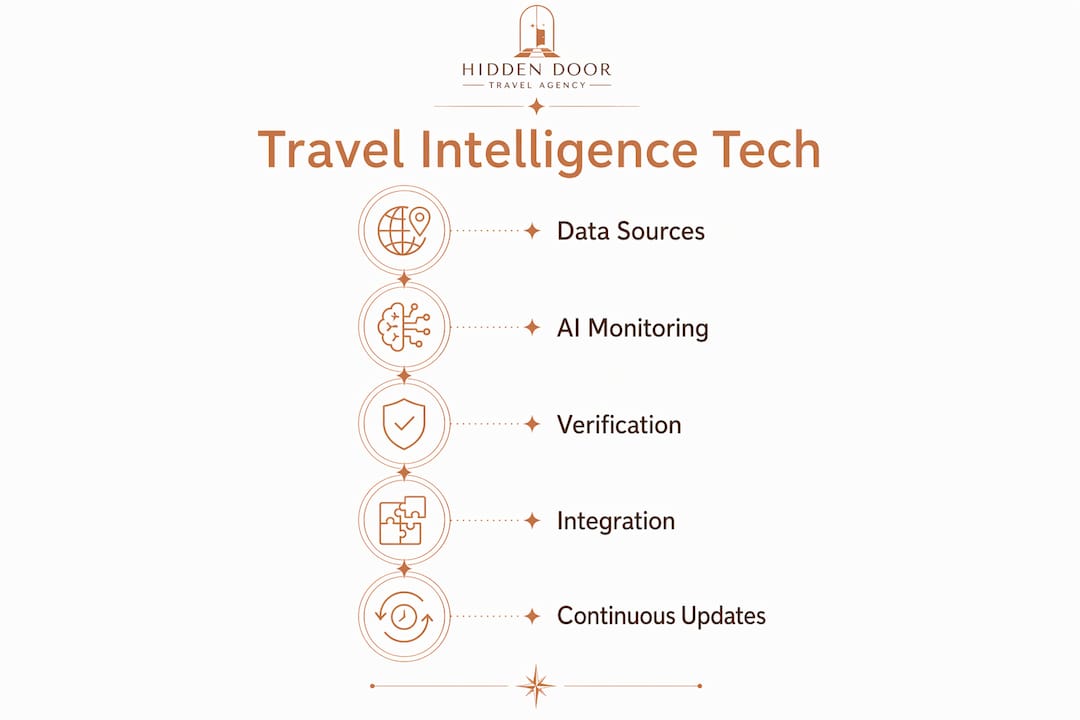
The reliability of any travel intelligence service depends entirely on the quality and diversity of its data inputs. A platform drawing only from booking databases produces a narrow picture. The most effective services integrate multiple data streams simultaneously.
| Data source | What it provides | Why it matters |
|---|---|---|
| Global booking databases | Fare trends, availability patterns, demand cycles | Foundation for pricing and itinerary forecasting |
| Geopolitical intelligence feeds | Government advisories, conflict indicators, border status | Enables proactive risk alerts before mainstream reporting |
| Weather and environmental data | Storm tracking, air quality, natural disaster forecasts | Supports rerouting decisions and traveler safety advisories |
| Social sentiment and review data | Real-time property and destination quality signals | Catches service declines before they affect clients |
| Health surveillance systems | Disease outbreak tracking, vaccination requirements | Feeds duty-of-care compliance and traveler health advisories |
AI sits at the center of this data architecture. It monitors incoming feeds continuously, identifies anomalies, and forecasts disruptions before they become crises. The human travel professional then interprets those forecasts and applies judgment that no algorithm can replicate.
One underappreciated challenge is misinformation. Verification workflows and trusted source frameworks must be established before crises occur. During a fast-moving event, there is no time to evaluate source credibility from scratch. Organizations that build verification protocols into their normal operating procedures make confident decisions under pressure. Those that improvise verification during a crisis make expensive mistakes.
Integrated platforms consistently outperform siloed, legacy systems. When booking tools, risk monitoring, and traveler communication operate from a single data layer, information flows without delay. Fragmented systems create gaps where travelers fall through during disruptions.
How can travel professionals practically implement travel intelligence services?
Implementation quality determines whether an organization captures the full benefit of travel analytics or pays for a system that sits underused. The most common failure mode is purchasing a capable platform and then deploying it as a passive reporting tool rather than an active decision support system.
Push-based intelligence delivery embedded directly into booking workflows produces higher compliance and awareness than systems that require travelers or managers to log into a separate portal. The information must arrive where decisions are being made, not in a dashboard that requires a separate login.
Practical implementation follows a clear sequence:
- Embed intelligence at the booking point. Policy rules, risk flags, and pricing recommendations should appear during the booking process, not after. This is where elite travel agency advantages become visible: an expert who sees the same data as the traveler and can interpret it in context.
- Build cross-department alignment. Travel, security, HR, and finance teams each have a stake in travel intelligence outputs. A shared data layer eliminates the situation where the security team knows about a risk that the travel manager has not yet heard about.
- Establish real-time traveler visibility. Knowing where every traveler is at any given moment is not surveillance. It is the operational foundation for duty of care. Without location visibility, crisis response is guesswork.
- Evaluate vendors on adoption metrics, not feature lists. A platform with 200 features that 30% of users engage with delivers less value than a focused tool with 90% adoption. Ask vendors for usage data, not capability slides.
- Review and iterate quarterly. Travel patterns, risk environments, and organizational needs change. Intelligence programs that are set and forgotten drift out of alignment with operational reality.
Pro Tip: Pilot your travel intelligence platform with one high-frequency travel corridor before rolling it out organization-wide. Measure compliance rates, alert response times, and traveler satisfaction scores over 90 days. Real data from a controlled pilot beats any vendor benchmark.
Key Takeaways
Travel intelligence services deliver measurable operational value only when embedded into booking workflows, supported by verified data sources, and backed by human expertise that interprets what the data means.
| Point | Details |
|---|---|
| Compliance drives ROI | AI at point-of-booking lifts compliance from 62% to 89%, cutting costs by a median 23%. |
| Speed defines risk value | Real-time disruption identification takes under 60 seconds versus 45 minutes manually. |
| Personalization grows revenue | Predictive analytics and personalization deliver 15–25% revenue gains and 40% higher returns. |
| Verification must be pre-built | Trusted source frameworks must exist before a crisis, not be improvised during one. |
| Push beats pull | Intelligence embedded in booking workflows outperforms passive portal-based delivery every time. |
What I’ve learned about travel intelligence after years in the field
The most common mistake I see travel professionals make is treating intelligence as a reporting layer rather than an operational one. They buy a platform, configure a dashboard, and then wait for the data to tell them something. That is the wrong posture entirely.
The organizations that extract real value from travel intelligence treat it the way a surgeon treats diagnostic imaging: as a tool that sharpens judgment, not one that replaces it. AI can flag a geopolitical risk in under a minute. What it cannot do is weigh that risk against a client’s specific travel history, risk tolerance, and the strategic importance of the trip. That judgment belongs to the expert.
The other thing I have become convinced of is that verification workflows are the most underinvested part of any travel intelligence program. Every organization I have seen struggle during a crisis struggled because they had no pre-established process for determining which information to trust. When a fast-moving event generates conflicting reports across news feeds, social media, and government advisories simultaneously, the team without a verification protocol freezes. The team with one acts.
Proactive intelligence is not a luxury for large travel programs. It is the baseline competency for any organization that takes duty of care seriously. The gap between reactive and proactive is not a technology gap. It is a process and culture gap. Technology can close it, but only if the organization decides to use it that way.
— Michael
Hiddendoortravel: where intelligence meets bespoke travel
Hiddendoortravel builds every itinerary on the same principles that define effective travel intelligence: real-time data, verified sources, and expert judgment applied at every decision point. The difference between a standard booking and a bespoke luxury trip is not just the quality of the hotels. It is the depth of knowledge behind every choice, from routing to timing to contingency planning.

Hiddendoortravel’s team monitors risk environments, pricing windows, and destination conditions continuously, so clients travel with confidence rather than uncertainty. For travel professionals who want to see what intelligence-backed planning looks like in practice, Hiddendoortravel’s luxury travel experts are available to consult on any itinerary, from a single complex trip to a full corporate travel program redesign.
FAQ
What is a travel intelligence service?
A travel intelligence service is a system that collects and analyzes global travel data, including booking trends, geopolitical events, weather, and traveler sentiment, to deliver real-time insights that support smarter trip planning and risk management decisions.
How does travel intelligence improve duty of care?
Travel intelligence improves duty of care by providing real-time traveler location visibility, automated risk alerts, and point-of-booking policy enforcement that prevents non-compliant bookings before they complete rather than flagging them after travel occurs.
What is the financial impact of travel analytics?
Organizations that implement travel analytics see a median 23% reduction in travel costs, with ROI payback periods averaging 8.5 months, driven primarily by compliance improvements and dynamic pricing optimization.
How does AI support travel risk management?
AI automates continuous monitoring of high-volume event feeds, compressing disruption detection from 45 minutes to under 60 seconds, and frees travel managers to focus on complex decisions that require human context and judgment.
Why does verification matter in travel intelligence?
Misinformation spreads rapidly during crises, and organizations without pre-established verification frameworks make costly decisions based on inaccurate data. Verification protocols must be built into normal operations before a crisis occurs, not improvised during one.