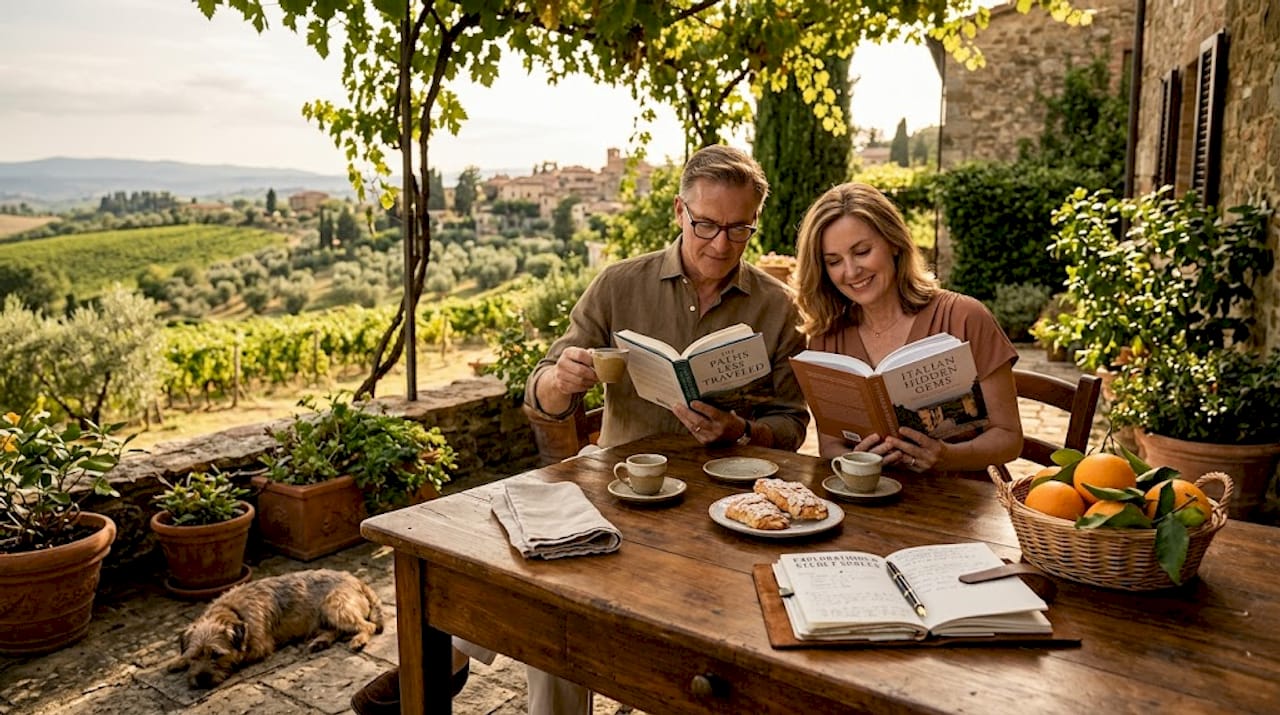
Luxury travel used to be measured in airports cleared, suites checked in, and cities photographed. The more ground you covered, the more successful the trip felt. What is slow luxury travel, then? It’s the deliberate rejection of that model. It means choosing one region over a ten-country tour, staying three weeks instead of three nights, and letting a destination actually change you rather than just impress your Instagram feed. Experiential luxury travel grows at 15% CAGR, and the travelers driving that growth aren’t chasing more. They’re chasing deeper.
Table of Contents
- Key takeaways
- What is slow luxury travel, really?
- The modes and experiences that define slow luxury
- The benefits of slow luxury travel
- How to plan and travel slow luxury
- Common misconceptions about slow luxury travel
- My take on why slow luxury is the future
- Travel deeper with Hiddendoortravel
- FAQ
Key takeaways
| Point | Details |
|---|---|
| Depth over distance | Slow luxury travel means fewer destinations, longer stays, and significantly richer experiences than fast-paced luxury itineraries. |
| Time is the real currency | Affluent travelers increasingly treat unhurried, undivided time as the most exclusive resource money can buy. |
| Sustainability is built in | Fewer flights and support for local economies make slow luxury travel lower impact without sacrificing comfort. |
| Expert planning is non-negotiable | The effortless feel of slow luxury travel depends entirely on sophisticated, invisible logistics managed by specialists. |
| Higher daily cost, greater total value | Per-day spend in slow luxury is higher, but the transformation and satisfaction returned far exceed standard itineraries. |
What is slow luxury travel, really?
The slow travel definition traces back to the Slow Food movement born in Italy in the 1980s, which pushed back against fast food culture by celebrating deliberate, high-quality, locally rooted consumption. Slow travel borrowed that same philosophy and applied it to movement across the world. Slow luxury travel goes one step further, layering in exclusivity, craftsmanship, and the kind of seamless personal service that removes every friction point while keeping every sensory detail intact.
At its core, slow luxury travel is built on five principles:
- Unhurried pace: No more than one or two destination regions per trip, with stays of seven to fourteen or more days
- Cultural immersion: Engaging with local artisans, chefs, historians, and communities rather than viewing them as a backdrop
- Mindful presence: Scheduling real downtime and protecting it as deliberately as any activity
- Sustainability: Choosing accommodations and transport that support local economies and minimize environmental harm
- Exclusivity through access: Gaining entry to experiences that are genuinely rare, not just expensive
“Slow luxury is active custodianship of time, cultivating deep connections with culture, self, and nature.” — Belmond
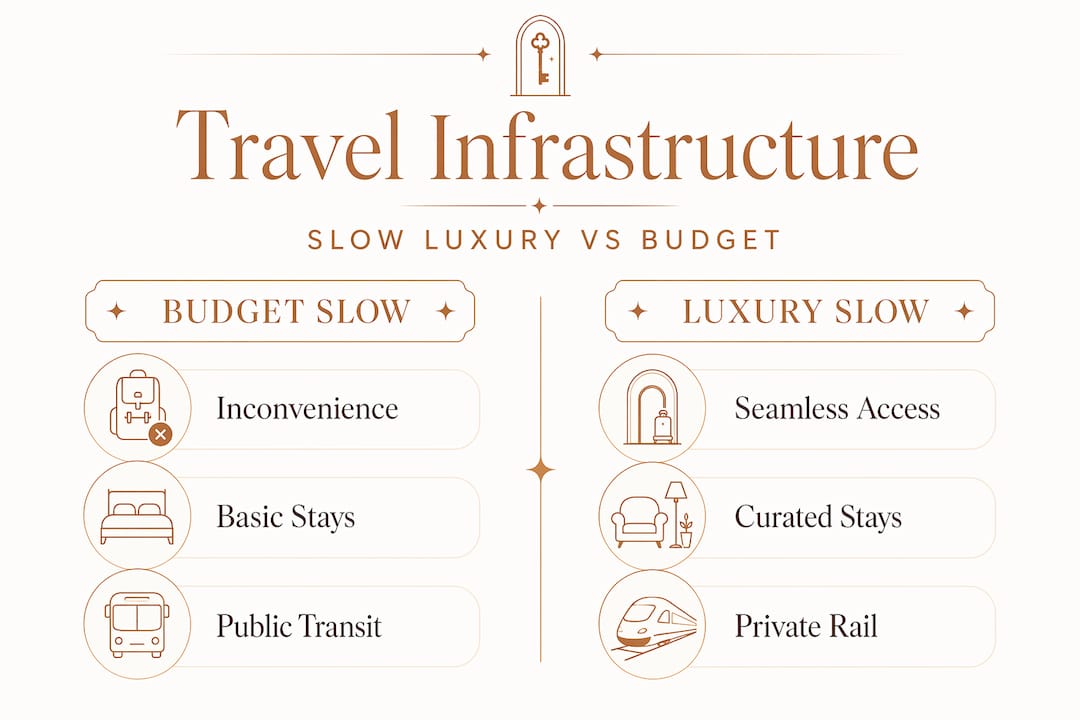
What separates slow luxury from ordinary slow travel is the infrastructure. Budget slow travel means tolerating inconvenience in exchange for authenticity. Slow luxury eliminates inconvenience entirely while deepening authenticity. Private transfers are arranged before you think to ask. Dinner reservations at the right table exist before you land. The experience feels spontaneous because an expert has made sure nothing will interrupt the flow.
The modes and experiences that define slow luxury
The meaning of slow luxury comes alive most clearly in how you actually move through the world. And increasingly, affluent travelers are choosing modes of transport and accommodation that turn the journey itself into the destination.
Private rail is perhaps the clearest expression of this philosophy. Requests for ultraluxe private rail experiences increased 45% in 2026, driven by travelers who want the visual poetry of passing through countryside without the sterility of airports. High-end rail travel offers privacy, silence, and mental space that no business class seat can replicate. You wake up somewhere new having traveled through the night in genuine comfort, with no security lines, no connection anxiety, no noise.
Beyond the train, the experiences in slow luxury follow a consistent logic: depth over spectacle. Consider the contrast below.
| Mode or experience | Fast luxury version | Slow luxury version |
|---|---|---|
| Accommodation | Five-star city hotel, 2 nights | Historic estate or private villa, 10+ nights |
| Wine region visit | Curated tasting at a famous château | Three days with a single winemaker, harvest included |
| Transportation | Business class between five cities | Private rail through one region over four days |
| Cultural engagement | Museum tour with an audio guide | Private access with a regional historian |
| Dining | Michelin-starred restaurant, two visits | Weekly market with a local chef, meals cooked together |
Tuscany is often cited as the benchmark for slow luxury destinations precisely because of its layered infrastructure. Sophisticated quiet infrastructure absorbs every logistical complexity so travelers can be fully present without ever feeling managed. The Amalfi Coast, the Alentejo region in Portugal, Kyoto, and the Scottish Highlands share this quality. They reward long stays with new layers of meaning, and they have the hospitality maturity to support that length of visit without friction.
Pro Tip: When selecting a slow luxury destination, ask your travel specialist whether the region has what experts call “destination tethering” capacity: the ability to build daily rituals, local relationships, and a sense of personal belonging over a two-week stay. Not every beautiful place can do that.
The benefits of slow luxury travel
The case for slow luxury travel is not just philosophical. It’s backed by real outcomes for travelers, local communities, and the environment.
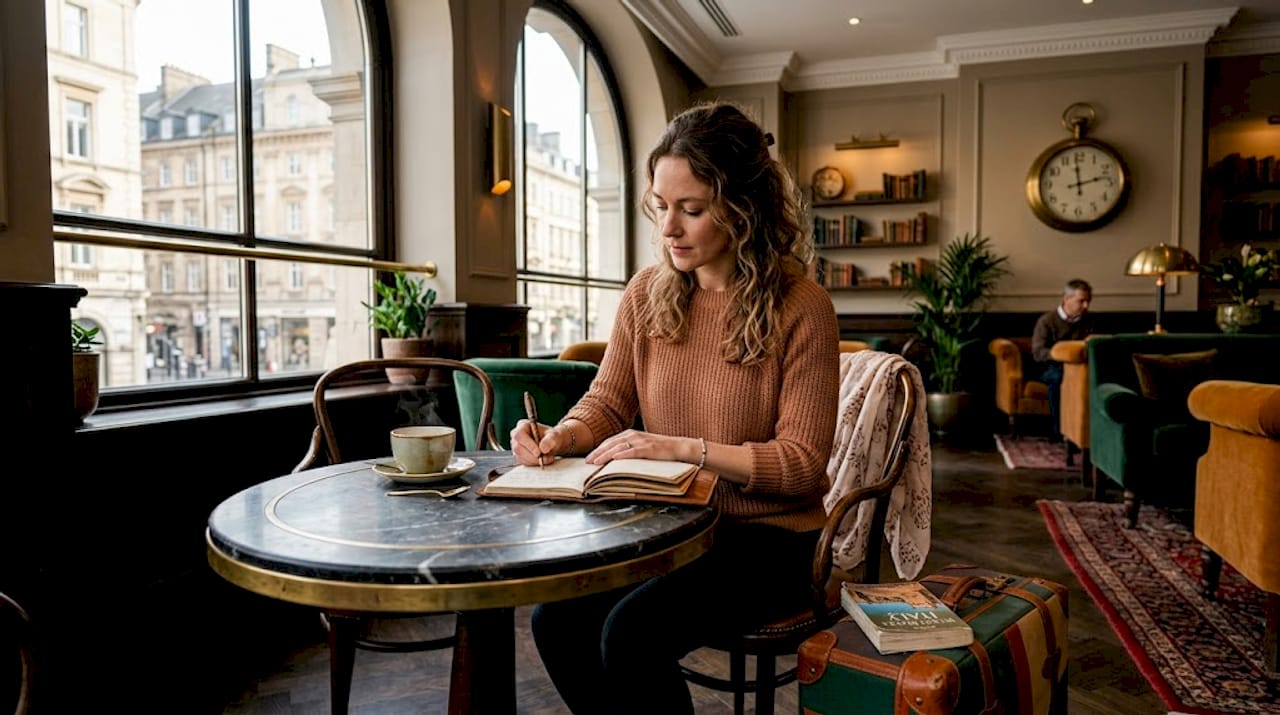
For the traveler, the most documented benefit is psychological. Slow travelers report higher satisfaction and lower post-vacation burnout compared to those who cover multiple destinations in short succession. There is a physiological reason for this. The stress response activated by constant movement, new environments, and logistical vigilance never fully resolves on a fast-paced trip. Slow luxury gives the nervous system time to genuinely decompress.
Modern affluent travelers pursue transformation and personal resonance rather than status signaling. That shift matters because it changes what counts as a successful trip. A week living inside a working Umbrian farm, learning to read weather patterns with the estate manager and tasting the difference between morning and evening harvests, creates a memory and a changed perspective. Photographing five cities in seven days simply does not.
The benefits extend well beyond the individual traveler:
- Local economic impact: Long stays concentrate spending with small businesses, local guides, regional restaurants, and family-owned properties rather than international hotel chains
- Environmental footprint: Slow travel reduces environmental impact by reducing the number of flights taken and supporting sustainable accommodation practices
- Community preservation: When travelers stay long enough to become temporary residents rather than visitors, they develop genuine respect for local culture and infrastructure
40% of affluent travelers willingly pay a 30 to 50% premium for sustainable luxury travel features. That premium is no longer a niche consideration. It has become a mainstream expectation among discerning travelers who understand that real luxury does not come at someone else’s expense.
How to plan and travel slow luxury
Planning is where most slow luxury trips either succeed brilliantly or quietly fail. The instinct to fill every day is the enemy of this style of travel. Here is how to approach it correctly.
- Choose one or two regions, not countries. The Dordogne is not France. Puglia is not Italy. Commit to a region and give it the attention it deserves over ten to fourteen days minimum.
- Collaborate with a specialist from the start. Personalized planning involving private transfers, vetted local guides, and bespoke activity design is not something to assemble from review sites. Planning slow luxury travel requires deliberate, collaborative design with specialists who know the destination intimately.
- Schedule genuine white space. Reserve at least two to three days per week with no fixed activities. These unallocated hours are where the best discoveries happen. A conversation with a ceramicist in her studio, an unplanned afternoon on a particular hillside, a second visit to a restaurant because the first was so good. None of that happens on a packed itinerary.
- Verify the destination’s hospitality infrastructure. Mature local infrastructure is necessary for slow luxury success, particularly for solo travelers who want privacy and autonomy without isolation. Ask your specialist whether the region can sustain a long visit without feeling repetitive.
- Budget for higher daily costs. Per-day spend in slow luxury is higher because exclusive accommodations, private access, and bespoke services are priced accordingly. The total trip cost may be comparable to a fast multi-destination trip, but the value returned is not remotely comparable.
Pro Tip: Ask your Hiddendoortravel specialist to build what insiders call “destination tethering” into your itinerary. This means structuring the first two days of any long stay so you quickly develop rituals and local touchpoints, a morning coffee spot, a market visit, a preferred walking route. Those rituals are what make two weeks feel like a genuine life lived rather than an extended hotel stay.
Common misconceptions about slow luxury travel
The biggest misunderstanding is that slow means unplanned or budget-conscious. It is neither. Slow luxury travel is among the most deliberately designed and financially significant travel category available.
A few misconceptions worth addressing directly:
- “Slow travel is what you do when you can’t afford to go everywhere.” In reality, the opposite is closer to the truth. Staying in a private estate in the Luberon for twelve nights costs significantly more than two nights each at six different properties. Exclusivity of access, not exclusivity of location count, drives the price.
- “It’s just a longer vacation.” Duration is one element, but the philosophy matters more. You can spend two weeks moving between luxury hotels and still miss the point entirely. Slow luxury requires genuine immersion, not just extended presence.
- “You’ll get bored.” This reflects a dependency on stimulation that slow luxury is specifically designed to address. Travelers who commit to the approach consistently report that boredom never arrives. Curiosity does.
The contrast with fast luxury travel is sharpest when you look at what each approach actually produces. Fast luxury delivers photographs, brand associations, and a certain kind of social proof. Slow luxury delivers experiences in slow luxury that alter how you see the world. One is consumption. The other is transformation.
Solo travelers deserve a particular note here. Solo travelers increasingly embrace slow luxury for the privacy, autonomy, and intentional solitude it affords. A single traveler in a well-chosen region with expert local support is not isolated. They are free in a way that group itineraries rarely allow.
My take on why slow luxury is the future
I’ve spent years watching clients return from fast-paced luxury trips describing exhaustion more than joy. They’d seen incredible things, but they hadn’t felt them. The itinerary had worked as designed, and something essential had still been missed.
The clients whose trips genuinely changed them were nearly always the ones who stayed in one place long enough to stop being tourists. They became familiar faces. They got the unrequested second glass because the sommelier remembered what they’d ordered last Tuesday. That level of connection doesn’t happen in 48 hours. It requires time and the willingness to stop treating travel as performance.
What I’ve learned from building these itineraries is that the planning paradox is real. Slow luxury requires more careful preparation than any rushed multi-destination trip, not less. The effortless presence it creates is entirely manufactured by invisible expertise working behind the scenes. Get the planning wrong and the white space feels empty rather than restorative.
My belief is that sustainability and authenticity are no longer differentiators in luxury travel. They are becoming the baseline expectation among travelers who have done the fast version and found it hollow. Slow luxury is not a trend. It is where serious travel is going.
— Michael
Travel deeper with Hiddendoortravel
At Hiddendoortravel, we specialize in exactly this kind of travel. Our team builds slow luxury itineraries from the ground up, starting with your interests, your pace, and the kind of transformation you’re looking for. We select private estates, heritage rail routes, and culturally embedded experiences that you won’t find through a search engine.
Every itinerary includes private transfers, vetted local specialists, and deliberately designed white space. We work with destination partners who share our commitment to sustainable, community-focused hospitality. If you’re ready to stop collecting destinations and start genuinely experiencing them, our luxury travel agency team is ready to design something exceptional. Your next trip should be the one you talk about for a decade.
FAQ
What is the slow travel definition in simple terms?
Slow travel means spending more time in fewer places, prioritizing immersion and connection over covering maximum ground. In the luxury context, it adds exclusivity, bespoke service, and sophisticated logistics to that philosophy.
How long should a slow luxury trip typically last?
Most specialists recommend a minimum of seven to fourteen days per destination region. Stays shorter than a week rarely allow enough time for the rituals and local relationships that make slow luxury distinctive.
Is slow luxury travel more expensive than traditional luxury travel?
Per-day costs are typically higher due to exclusive accommodations and private access experiences. However, the total trip cost is often comparable to fast multi-destination itineraries, while the depth of experience is significantly greater.
What are the best slow travel destinations for luxury travelers?
Tuscany, the Luberon in Provence, Kyoto, Puglia, the Alentejo region of Portugal, and the Scottish Highlands consistently rank among the strongest slow luxury destinations due to their mature hospitality infrastructure and layered cultural depth.
Can solo travelers enjoy slow luxury travel?
Absolutely. Solo travelers are among the fastest-growing segments in slow luxury, drawn by the privacy, autonomy, and intentional solitude it offers. The key is choosing destinations with hospitality infrastructure built to support independent long-stay travelers without isolation.