

Experiential travel is one of the most overused phrases in modern tourism, yet most people who use it can’t precisely explain what separates it from any other kind of trip. It’s not simply “doing things” on vacation. What is experiential travel, really? At its core, it means active, immersive engagement with a place, its people, and its culture, in a way that produces genuine meaning rather than just memories. This article breaks down the real experiential travel definition, explains why it’s reshaping how discerning travelers spend their time and money, and gives you a clear framework for planning trips that actually change you.
Table of Contents
- Key takeaways
- What is experiential travel, exactly?
- Why experiential travel is growing so fast
- Real experiential travel examples and activities
- How to plan experiential trips that actually deliver
- My honest take on what experiential travel really means
- Plan your next immersive trip with Hiddendoortravel
- FAQ
Key takeaways
| Point | Details |
|---|---|
| More than sightseeing | Experiential travel requires active participation and cultural engagement, not passive observation. |
| Authenticity is co-created | Genuine experiences are shaped by your openness and interaction, not just the destination’s “realness.” |
| Demand is rising fast | 60% of Europeans plan to increase participation in live experiential activities in 2026. |
| Planning makes the difference | Researching local communities and booking through trusted experts separates authentic trips from tourist traps. |
| Mindset over itinerary | The most meaningful experiential trips start with curiosity and cultural sensitivity, not a packed schedule. |
What is experiential travel, exactly?
The experiential travel definition sounds simple until you try to apply it. Experiential travel is travel centered on active, meaningful participation in the culture, environment, or community of a destination. You are not watching the world from a bus window or ticking off landmarks. You are cooking with a family in Oaxaca, learning traditional weaving techniques in Kyoto, or tracking wildlife with a local conservationist in Botswana.
What makes this different from regular tourism? Mass tourism is organized around access. You go, you see, you photograph, you leave. Experiential travel is organized around engagement. The difference is not always about budget or luxury. It’s about intention and depth.
There’s also a distinction worth making between experiential travel and transformative travel, two terms that often get used interchangeably. According to academic research published in MDPI’s tourism journals, transformative travel involves deeper identity recalibration and moral reorientation, not just affective immersion. In plain terms: experiential travel can move you, but transformative travel rewires you. Both are valuable. They are not the same thing.
One more nuance that most travel content ignores: authenticity in experiential travel is not a fixed property of a place. Research confirms that authenticity is co-constructed, shaped by the interaction between traveler and host, the stories exchanged, and the relational depth of the encounter. A “traditional” ceremony can feel hollow if you observe it from behind a rope. The same ceremony can feel profound if you are invited to participate, ask questions, and share your own story in return.
“Authenticity is not something a destination has or doesn’t have. It’s something that gets built between people.”
The experiential travel definition, then, is not just about what you do. It’s about how present and open you are while doing it.
Why experiential travel is growing so fast
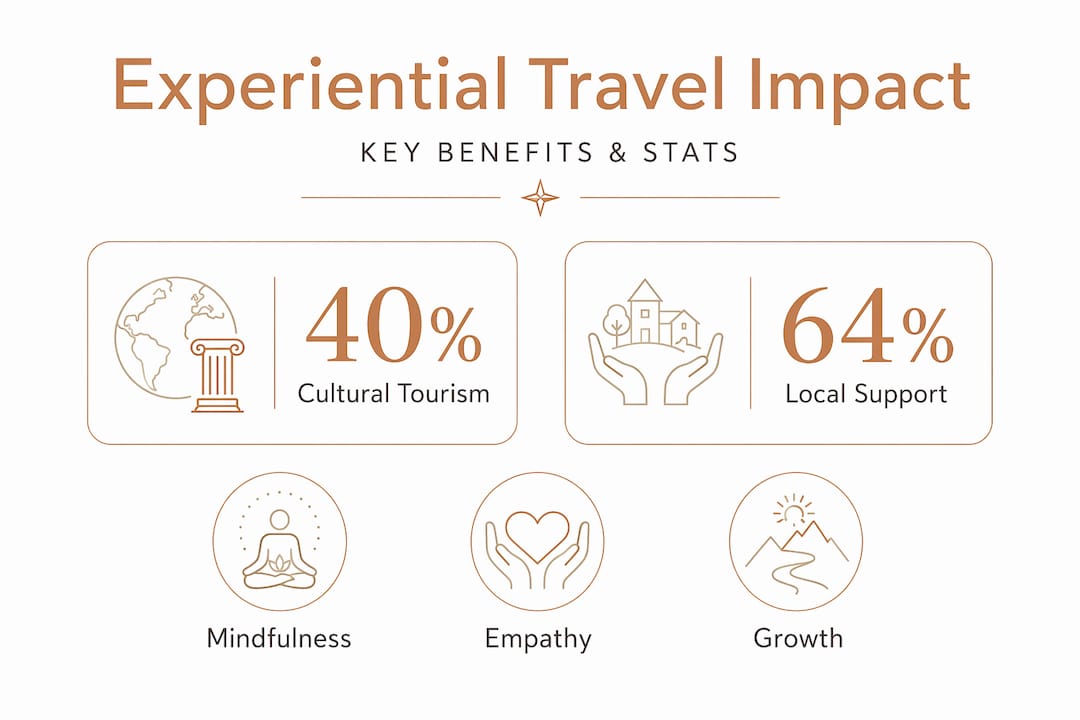
The numbers are hard to ignore. Cultural tourism accounts for roughly 40% of all global tourism as of 2025, according to UNESCO and UN Tourism data. That’s not a niche. That’s nearly half the industry.

Among Europeans specifically, 64% are willing to pay more for experiences that contribute to local communities. Travel and tourism top the list of experiential spending priorities at 79%, followed by gastronomy at 70% and outdoor activities at 69%. People are not just choosing experiences over souvenirs. They are choosing experiences over almost everything else.
Why? Travel psychologists point to something specific. Experiential travel functions as enforced mindfulness, placing you in unfamiliar roles and environments that heighten sensory awareness and force cognitive reframing. You can’t scroll your phone when you’re learning to make mole from scratch or navigating a souk without a guide. The unfamiliarity demands your full attention. That attention is where personal breakthroughs happen.
The benefits of experiential travel extend beyond the individual traveler as well:
- Cultural understanding: Direct engagement breaks down stereotypes and builds genuine cross-cultural empathy.
- Local economic impact: Spending with local guides, artisans, and family-run restaurants keeps money in the community rather than with international hotel chains.
- Environmental connection: Nature-based experiential activities build a personal stake in conservation that no documentary can replicate.
- Personal growth: Traveling for personal growth is not a marketing slogan. Discomfort, novelty, and human connection are the conditions under which people actually change.
As Michelle Meyer, Chief Economist at Mastercard Economics Institute, noted in 2026, travelers now adapt timing, destination, and budgets to prioritize meaningful experiences over traditional sightseeing. The shift is structural, not seasonal.
Real experiential travel examples and activities
Knowing the definition is one thing. Seeing it in practice is what makes it click. Here are the main categories of experiential travel activities, with examples that go beyond the generic:
- Culinary experiences: Not a cooking class at a tourist school, but a morning spent at a local market with a home cook, followed by preparing and eating a meal in her kitchen in Bologna or Chiang Mai.
- Cultural immersion: Participating in a traditional craft workshop, learning a regional musical instrument, or spending time with an indigenous community on their terms, not yours.
- Nature and conservation: Joining a marine biologist on a coral reef survey in the Maldives, or assisting with elephant care at an ethical sanctuary in northern Thailand.
- Adventure with context: Trekking the Rwenzori Mountains with a guide who grew up in the foothills and knows every plant by its local name, not just its Latin classification.
- Community engagement: Volunteering with a local organization for a portion of your trip, whether that means building infrastructure, teaching, or supporting a women’s cooperative.
Pro Tip: When evaluating whether an experience is genuinely immersive or staged for tourists, ask one question: does this activity exist when tourists aren’t here? If the answer is no, it’s performance. If the answer is yes, and you’re being invited in, that’s the real thing.
Here’s a quick comparison to help you distinguish experiential travel activities from conventional tourist options:
| Activity type | Conventional tourism | Experiential travel |
|---|---|---|
| Food | Hotel buffet or tourist restaurant | Cooking with a local family or market tour |
| Culture | Museum visit | Craft workshop with an artisan |
| Nature | Guided bus safari | Conservation work with local researchers |
| Adventure | Packaged group trek | Small-group route with a local expert guide |
| Community | Observation only | Participation in a local project or event |
Research on luxury resort programming adds an interesting wrinkle here. Studies applying the elaboration likelihood model found that ambiance and peripheral cues drive guest satisfaction more effectively than cognitively intensive educational programs. This means that even in high-end settings, how an experience feels matters as much as its educational content. The best experiential travel activities combine sensory richness with genuine human connection.
How to plan experiential trips that actually deliver
Planning is where most people get it wrong. They book a flight, find a hotel, and then search for “things to do” three days before departure. That approach produces conventional tourism, not experiential travel.
Here’s how to plan experiential trips with intention:
- Start with the community, not the attraction. Research who lives in your destination, what they make, grow, celebrate, and protect. Your itinerary should grow from that research, not from a top-ten list.
- Book local first. Seek out local guides, family-run accommodations, and community-based operators before turning to international platforms. Local experts carry knowledge no algorithm can replicate.
- Go smaller and slower. Two weeks in one region will teach you more than two weeks across five countries. Depth beats breadth every time.
- Prepare culturally before you arrive. Read a novel set in your destination, learn ten phrases in the local language, and understand basic customs around dress, food, and greetings. This preparation signals respect and opens doors.
- Address the booking friction early. Streamlined booking significantly improves the quality of experiences travelers access. Working with a specialist agency that has vetted local operators removes the guesswork and the risk of landing in a staged tourist trap.
Pro Tip: Ask your accommodation host for one recommendation that isn’t in any guidebook. That single question has produced some of the most memorable experiences for travelers who use it consistently.
Cultural sensitivity is not optional. It’s the foundation of the whole endeavor. Showing up curious, humble, and genuinely interested in learning is the single most important thing you can bring to any experiential trip. You can find trip inspiration that’s built around this philosophy, with destinations chosen for depth of cultural access rather than Instagram appeal.
My honest take on what experiential travel really means
I’ve watched “experiential travel” become a marketing term, and that bothers me. Every resort with a cooking class now calls itself experiential. Every tour operator with a local guide slaps the label on their brochure. The word has been stretched so thin it barely holds meaning.
Here’s what I’ve actually observed after years of working with travelers who come back genuinely changed versus those who come back with great photos and nothing more. The difference is almost never the destination. It’s the willingness to be uncomfortable. The travelers who get the most from immersive experiences are the ones who accept that they will feel confused, awkward, or out of their depth at some point, and they stay curious anyway.
What I’ve learned is that the most powerful experiential moments rarely come from the planned activity. They come from what happens around it. The conversation you have while waiting for the cooking class to start. The detour your guide suggests because the road is flooded. The meal you share with strangers because there was no other table.
My advice: stop trying to optimize your experiential travel itinerary and start practicing openness before you leave home. Read widely about your destination. Talk to people who’ve been there. Work with travel experts who understand the difference between access and immersion. Then let go of the plan a little once you arrive.
Experiential travel is a mindset before it’s an activity. The travelers who understand that come home with something no souvenir can hold.
— Michael Patton
Plan your next immersive trip with Hiddendoortravel
If this article has clarified what experiential travel means and made you want more of it, the next step is working with people who have built careers around designing exactly these kinds of trips.

Hiddendoortravel specializes in luxury experiential travel that goes far beyond booking flights and hotels. The team designs bespoke itineraries built around genuine cultural access, vetted local operators, and the kind of behind-the-scenes connections that take years to cultivate. Whether you want to spend a week with a master ceramicist in Japan, explore the food culture of a single Peruvian valley, or work with conservationists in southern Africa, Hiddendoortravel’s experts know how to make it real. Reach out to discuss your next trip and discover what immersive travel looks like when it’s planned by people who take it seriously.
FAQ
What is the experiential travel definition?
Experiential travel is a style of travel focused on active, meaningful participation in a destination’s culture, environment, or community, rather than passive sightseeing. It prioritizes depth of engagement over breadth of coverage.
How is experiential travel different from transformative travel?
Experiential travel centers on immersive cultural engagement and heightened awareness, while transformative travel involves deeper identity change and moral reorientation. Both are meaningful, but they operate at different levels of personal impact.
What are some common experiential travel activities?
Common experiential travel activities include cooking with local families, joining conservation projects, learning traditional crafts, trekking with local expert guides, and participating in community-based cultural events.
What are the main benefits of experiential travel?
The benefits of experiential travel include heightened mindfulness, personal growth, stronger cross-cultural empathy, and direct support for local economies. Research confirms it functions as enforced mindfulness that enables genuine personal breakthroughs.
How do I start planning an experiential trip?
Start by researching the local community rather than the top attractions, book local guides and operators first, and consider working with a specialist agency that has existing relationships with vetted cultural partners in your chosen destination.