

Off-peak luxury travel is defined as visiting premier destinations during shoulder or low seasons, when demand drops enough to unlock better pricing, superior service ratios, and a fundamentally different quality of experience. The case for why off-peak luxury travel makes sense in 2026 goes well beyond saving money on flights. Fall bookings for luxury travel have increased roughly 30% year over year, rivaling peak summer demand in several markets. That shift signals something deeper: affluent travelers are choosing shoulder seasons not as a compromise, but as a deliberate upgrade.
Why off-peak luxury travel outperforms peak season
The financial case for traveling off-peak is real, but it requires precision rather than assumption. Off-season airfare savings to Europe have dropped from 64% to 37% since 2023 due to dynamic pricing and demand smoothing by airlines. That compression matters. It means the era of blanket off-peak discounts is fading, and travelers who treat “off-season” as a guaranteed bargain will be disappointed.
The smarter approach targets specific date windows rather than entire seasons. Flights can cost nearly $200 less per person when booked during shoulder-period dates versus peak holidays, as concrete examples like Orlando departures demonstrate. That saving per person adds up fast across a party of four traveling business class. Hotels compound the advantage: premium room categories that sell out weeks in advance during peak periods become available, and properties compete harder for occupancy.
The key benefits of off-peak travel savings include:
- Airfare: Shoulder-season fares on transatlantic routes regularly undercut peak pricing by 20% to 37%, even after dynamic pricing adjustments.
- Accommodations: Suite and villa categories at properties like Four Seasons and Aman resorts carry lower rack rates and higher upgrade probability during low-demand windows.
- Activities and dining: Coveted restaurant reservations at Michelin-starred venues and private guided tours become accessible without months of lead time.
- Package leverage: Luxury travel agencies can negotiate added-value inclusions, such as spa credits and airport transfers, more effectively when hotels have inventory to fill.
Pro Tip: Target the first two weeks of November or the last two weeks of April for European destinations. These windows sit squarely in shoulder season but avoid school holidays, giving you the financial advantage without sacrificing weather or cultural programming.
In 2026, affluent travelers should treat off-peak scheduling as a service-design challenge. Combining date-window targeting with market-specific booking behaviors produces better outcomes than waiting for a fixed discount to appear.

How does off-peak travel enhance the luxury experience beyond savings?
Cost reduction is the entry point. The real argument for off-peak luxury travel is experiential. Shoulder season travel allows better availability for premium rooms, easier upgrades, and more personalized service as staff have more time for individual attention. At a property like Mayacama in California’s wine country, off-peak periods translate directly into unhurried rounds of golf, uncrowded tasting rooms, and staff who genuinely have time to customize your stay.
The crowd dynamic at iconic destinations shifts dramatically outside peak season. The Amalfi Coast in October, Kyoto in late November, and the Greek islands in early May each offer the same visual grandeur with a fraction of the foot traffic. You move through these places at your own pace rather than being managed through them. That distinction matters enormously when the quality of presence is what you are paying for.
“The best luxury experiences are not the ones with the most amenities. They are the ones where nothing interrupts your attention.” This principle applies directly to off-peak travel, where reduced crowds remove the single biggest disruptor of high-end experiences.
Climate discomfort during peak summer drives a growing share of demand toward shoulder seasons, not just for cost but for physical comfort. Traveling the Mediterranean in July means 95-degree heat and gridlocked port towns. Viking’s quiet-season Mediterranean cruises in early spring, late fall, and winter demonstrate the alternative: relaxed port visits, pleasant temperatures, and the kind of unhurried exploration that peak-season itineraries cannot deliver.
Additional experiential advantages of off-peak luxury getaways include:
- Personalized service: Lower occupancy means concierge teams, sommeliers, and guides focus on fewer guests, producing noticeably better interactions.
- Flexibility: Itinerary adjustments, last-minute dinner reservations, and room changes that would be impossible in August become routine requests in October.
- Authentic local engagement: Restaurants, markets, and cultural sites revert to serving local communities rather than tourist volumes, producing a more genuine version of the destination.
- Wellness access: Spa facilities at properties like Mayacama’s exclusive spa are bookable without weeks of advance planning, and the atmosphere is calmer throughout.
What are the trends shaping off-peak luxury travel in 2026?
The industry has moved from reactive to proactive on shoulder seasons. Airlines, hotel groups, and cruise lines now build dedicated promotions and new capacity for these months rather than simply discounting unsold inventory. That structural shift changes the planning calculus for luxury travelers.
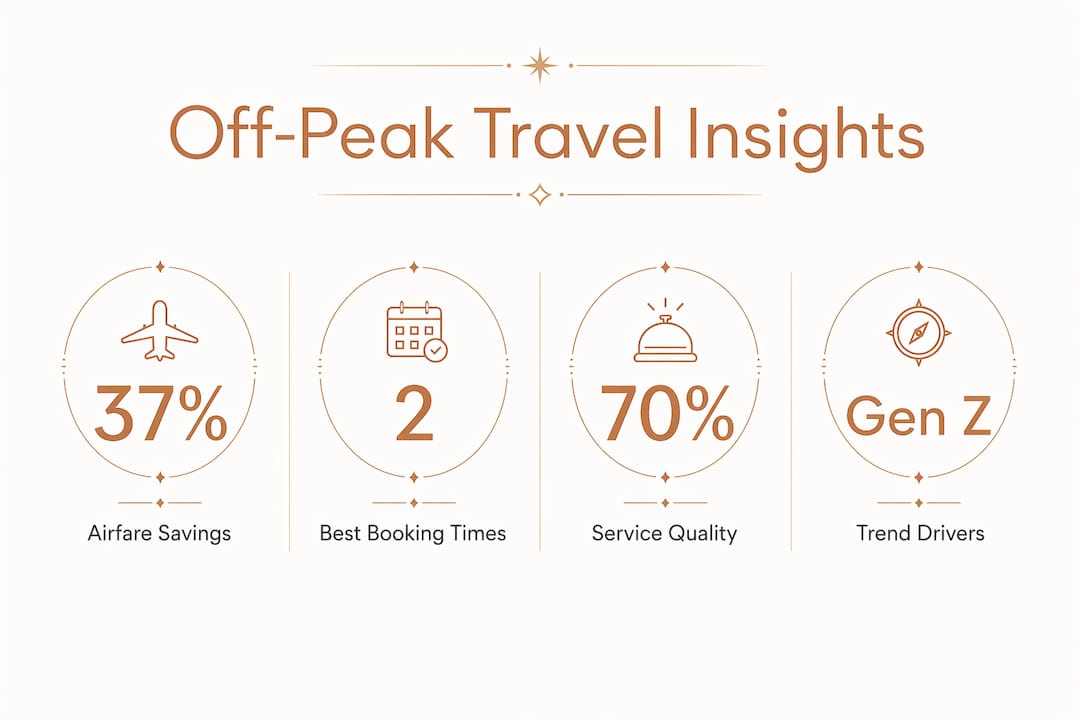
Gen Z travelers are driving off-peak bookings through social media content that showcases quieter, more authentic experiences. When a destination looks better in October than in August on Instagram, the aspirational pull shifts. Older affluent segments are following, motivated by a combination of climate comfort, overtourism fatigue, and the recognition that peak-season travel at luxury price points no longer guarantees a premium experience.
| Trend | What it means for luxury travelers |
|---|---|
| Shoulder season now rivals peak demand | Book early. Availability at top properties tightens as off-peak becomes mainstream. |
| Dynamic pricing compresses savings | Target specific date windows, not entire seasons, for the best financial outcome. |
| Airlines building shoulder-season capacity | More premium cabin options available on key routes during off-peak windows. |
| Climate driving seasonal shifts | Mediterranean and Southeast Asian itineraries increasingly favor spring and fall over summer. |
| Gen Z normalizing off-peak travel | Destination reputations are being reshaped by shoulder-season content, expanding options. |
The disappearance of the traditional off-season in some markets is the most consequential development. Popular European cities like Barcelona, Lisbon, and Amsterdam now see meaningful tourist volumes year-round. The practical implication is that elite travel planning in 2026 requires destination-specific analysis rather than relying on calendar assumptions.
Pro Tip: Ask your travel advisor to pull occupancy data for your target property across a 12-month window. The gap between peak and shoulder pricing at the property level often exceeds what aggregate market data suggests.
How to strategically plan your off-peak luxury trip
Effective off-peak planning starts with understanding your booking window. 46% of U.S. travelers book more than 90 days in advance for shoulder-season travel, while over a third of Chinese travelers book within 29 days. If you are departing from a U.S. market, early commitment secures the best suite categories and flight combinations. If your travel party includes guests from multiple origin markets, align booking timing to the most constrained segment.
Follow this sequence for maximum benefit:
- Define your date window precisely. Identify the two to three weeks within your target shoulder season that avoid local public holidays, school breaks, and major regional events. These micro-windows carry the best combination of pricing and experience quality.
- Audit destination-specific conditions. Verify weather patterns, local festival calendars, and any overtourism mitigation measures that affect access. Santorini in late October and Bali in September are shoulder-season options with very different climate profiles.
- Confirm operational schedules. Luxury off-peak travel requires proactively verifying entertainment and excursion schedules, especially for cruises where “quiet season” does not mean inactive. Some shore excursion operators and resort amenities run reduced programs outside peak months.
- Engage a specialist agency early. The advantages of working with an elite travel agency are amplified during shoulder seasons, when insider relationships unlock room categories, dining reservations, and experiences that are not publicly available.
- Build in flexibility buffers. Off-peak itineraries benefit from slightly looser scheduling. Weather variability and reduced transport frequency in some destinations reward travelers who have not over-programmed every hour.
Pro Tip: For multi-destination luxury trips, sequence your itinerary so the most weather-sensitive destination falls in its optimal shoulder window rather than forcing all legs into a single calendar block.
Key takeaways
Off-peak luxury travel delivers superior experiences and meaningful savings when planned with destination-specific precision rather than seasonal generalizations.
| Point | Details |
|---|---|
| Savings require precision | Target specific date windows, not entire seasons, as dynamic pricing has compressed blanket discounts. |
| Experience quality improves | Lower occupancy produces better service ratios, upgrade availability, and authentic local access. |
| Climate drives the shift | Heat and crowds during peak summer push luxury travelers toward spring and fall for comfort. |
| Book early from U.S. markets | 46% of U.S. travelers book 90-plus days out for shoulder travel to secure premium inventory. |
| Verify operational schedules | Confirm that resort amenities, excursions, and dining programs run at full capacity during your dates. |
Why I think peak season luxury travel is the most overpriced product in travel
I have spent years watching affluent travelers pay a significant premium to have a worse experience. The Amalfi Coast in August is genuinely beautiful. It is also genuinely miserable if you are trying to move between towns, get a table at a restaurant that deserves your attention, or simply sit on a terrace without 200 other people doing the same thing. The luxury price tag does not buy you exclusivity during peak season. It buys you access to the same overcrowded destination as everyone else, at a higher cost.
What I find more interesting in 2026 is how the conversation has shifted from “off-peak as budget strategy” to “off-peak as quality strategy.” The travelers I respect most are not choosing October in Tuscany because it is cheaper. They are choosing it because the olive harvest is happening, the light is extraordinary, the restaurants are cooking for locals again, and the whole experience feels like it belongs to them rather than to a crowd.
The one honest caveat: off-peak planning requires more work. You need to verify what is actually open, understand the climate trade-offs, and work with advisors who know the difference between a property that thrives in shoulder season and one that goes into maintenance mode. That due diligence is the price of admission. For travelers willing to pay it, the return is a version of luxury that peak season simply cannot replicate. Exploring regenerative luxury travel principles alongside off-peak timing produces the most satisfying trips I have seen clients take.
— Michael
Plan your off-peak luxury trip with Hiddendoortravel
Hiddendoortravel specializes in exactly this kind of precision planning. The agency’s advisors know which properties deliver their best service in shoulder season, which date windows produce the strongest combination of pricing and experience, and how to secure room categories and experiences that are not available through standard booking channels.
Whether you are considering a quiet-season Mediterranean cruise, a fall villa stay in Tuscany, or a spring safari in East Africa, Hiddendoortravel builds itineraries around your specific travel window rather than a generic calendar. The agency’s luxury travel experts bring the kind of destination-specific knowledge that turns a good off-peak trip into an exceptional one. Reach out to discuss your 2026 travel dates and discover what shoulder-season luxury actually looks like when it is planned properly.
FAQ
What is off-peak luxury travel?
Off-peak luxury travel means visiting premier destinations during shoulder or low seasons when tourist demand drops, producing better pricing, improved service quality, and less crowded experiences at high-end properties and attractions.
How much can you save on luxury travel off season?
Airfare savings of 20% to 37% are realistic on key routes, and flights can cost nearly $200 less per person compared to peak holiday dates. Hotel savings vary by property, but suite and villa categories often carry lower rates and higher upgrade probability.
Is off-peak travel worth it for luxury travelers?
Off-peak travel is worth it for luxury travelers who prioritize service quality, privacy, and authentic experiences alongside cost savings. Lower occupancy produces better staff-to-guest ratios, easier access to premium rooms, and more genuine local engagement.
When is the best shoulder season for European luxury travel?
The first two weeks of November and the last two weeks of April consistently offer the strongest combination of shoulder-season pricing and favorable conditions for European destinations, avoiding school holidays while maintaining cultural programming and reasonable weather.
How far in advance should you book off-peak luxury travel?
U.S.-based travelers should book more than 90 days in advance to secure premium inventory during shoulder seasons. Booking windows differ significantly by origin market, so aligning your timeline with the most constrained traveler in your group produces the best results.