

A villa wedding buyout means renting an entire property exclusively for your wedding, usually across a multi-night stay, so no other guests, events, or staff schedules compete with yours. Starting investments run from roughly $5,000 for small two-night packages to well into six figures for premier estates. The trade-off is real: total privacy and schedule control in exchange for tighter sleeping capacity and more logistics to manage yourself.
TL;DR:
- The total cost of a villa buyout depends heavily on the season, length of stay, property prestige, staffing, and travel logistics, often ranging from around $5,000 to over $60,000.
- Many properties with a starting rate of $6,350 for onsite lodging still require additional hotel blocks, shuttle services, and catering, which can significantly increase the total event budget.
- The main planning challenge is accurately assessing sleeping capacity versus event capacity, as many villas host fewer guests overnight than are invited for the ceremony and dinner.
- A well-negotiated contract should specify room-by-room sleeping arrangements, staffing hours, outside vendor access, and clear damage deposit and cancellation terms to prevent disputes.
- Hiring an experienced planner streamlines negotiation, reduces logistical stress, and ensures proper vendor, staff, and travel arrangements, especially for larger or more complex buyouts.
Table of Contents
- What Does a Villa Wedding Buyout Actually Include?
- What Drives the Price of a Villa Buyout?
- The Guest Count Problem Nobody Warns You About
- How Long Should a Villa Wedding Buyout Run?
- How Do You Vet and Negotiate a Villa Buyout Contract?
- Three Real-World Budget Scenarios
- How an Experienced Planner Changes the Math
- When Is a Villa Buyout Actually Worth It?
- Let Hidden Door Travel Negotiate Your Villa Buyout
- Sources
- FAQ
What Does a Villa Wedding Buyout Actually Include?
A villa wedding buyout gives you exclusive use of the entire property, not just a ballroom or garden for a few hours. Every room, every outdoor space, and every hour of the weekend belongs to your wedding party alone. That distinction separates a buyout from a standard venue rental, where a hotel might book your reception in one wing while running a corporate conference in another.
Buyouts routinely bundle services that a day-rate venue charges separately. Villa Valentín’s private buyout packages list onsite staff, chef-led meals, and curated guest experiences as standard inclusions rather than add-ons. What you’re paying for typically covers:
- Exclusive access to the entire property for the full contracted period
- Onsite lodging for a portion of your guest list, usually the wedding party and immediate family
- Dedicated staff, housekeeping, and often security for the duration of the stay
- Weekend-long access with no hourly cutoffs or overtime penalties
That last point matters more than couples expect. Hourly rentals nickel-and-dime you for every extra 30 minutes past the contracted end time. A buyout removes that clock entirely, so a toast that runs long or a first dance that goes into overtime costs nothing extra. The catch: you’re now managing meal service, staff shifts, and vendor access across two or three days instead of one, which is exactly why so many couples hire a planner for this format.
What Drives the Price of a Villa Buyout?
Pricing for an exclusive villa wedding buyout spans a wide range, and the gap between the low end and the high end comes down to a handful of variables you actually control.
Statistic Callout: Two-night buyout packages start as low as $5,000 on some venue marketplaces, while premier boutique hotels and villas featured in Vogue’s roundup of top wedding buyout properties can command rates that climb into the mid six figures.
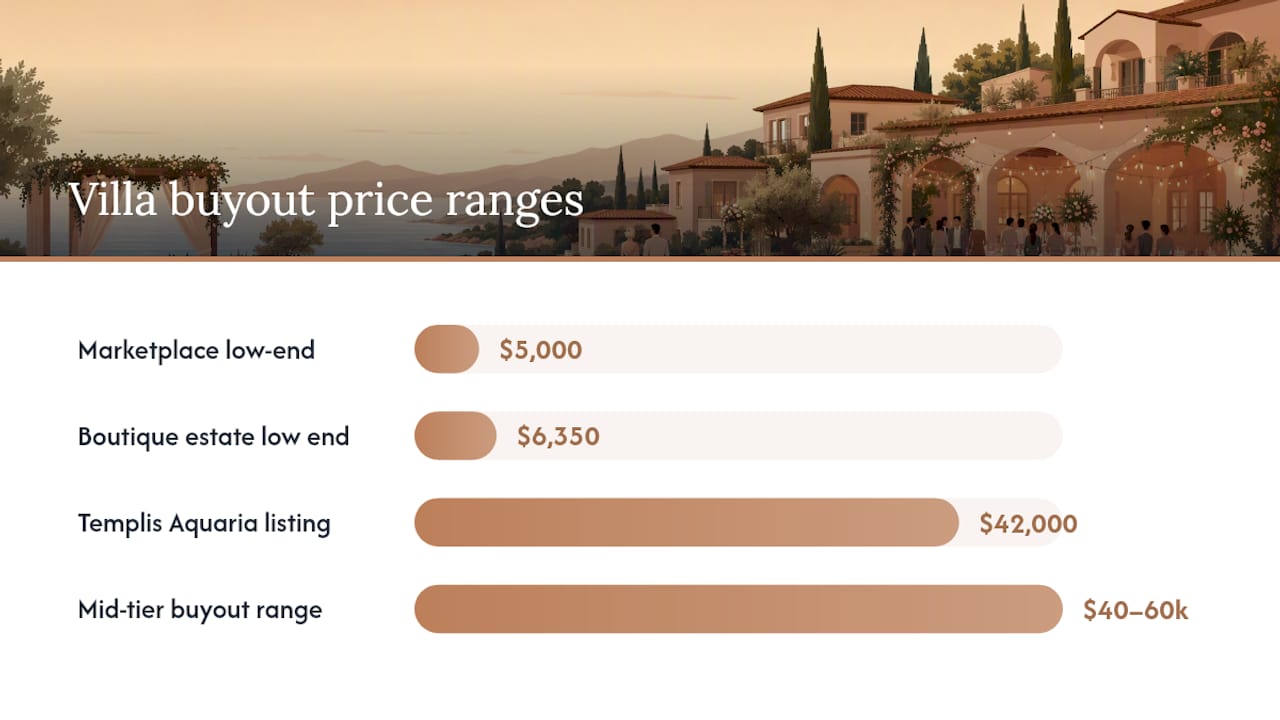
Between those two extremes sits a middle tier. Villa Valentín advertises private 4-night buyouts starting around the mid-thousands of USD, and sanctuary-style estates like Templis Aquaria list fully curated buyouts starting near $42,000 for small, highly inclusive weekends. The spread between $6,350 and $42,000 for properties in roughly the same “boutique estate” category tells you pricing isn’t just about square footage.
Here’s what actually moves the number:
- Season and date demand. Peak wedding months and Saturday dates in high season can push rates 30 to 50% above shoulder-season pricing at the same property.
- Length of the buyout. A 2-night minimum costs less than a 4-night VIP weekend, but longer stays often lower the per-night rate.
- Property prestige and amenities. A historic estate with a name recognized in editorial coverage charges a premium a newer property can’t.
- Staffing and catering choices. Chef-led tasting menus and a higher staff-to-guest ratio add cost fast.
- Travel logistics. Remote or island properties add charter transport, freight for vendors, and higher supplier travel fees.
One thing worth knowing before you compare a buyout to a traditional venue-plus-hotel-block approach: when you add up a ballroom rental, catering minimums, and a contracted hotel block for 80 guests, a mid-tier villa buyout at $40,000 to $60,000 often lands in the same range, sometimes lower, once you account for the lodging and staffing it already includes.
The Guest Count Problem Nobody Warns You About
The single biggest planning trap in villa buyouts is confusing event capacity with sleeping capacity. A property that comfortably hosts 100 guests for a ceremony and dinner might only have beds for 20 to 30 people onsite overnight. Marketing photos rarely make that distinction clear, and it’s the detail that catches even experienced planners off guard.
This gap is the reason so many buyout weekends need a secondary lodging plan from day one. Here’s how to solve it before it becomes a problem:
- Get the exact sleeping number, not the event capacity. Ask for a bedroom-by-bedroom floorplan with confirmed bed counts, not a marketing brochure’s “sleeps up to X” figure.
- Reserve onsite rooms for your VIP tier first. Wedding party, parents, and anyone flying internationally should get first pick of onsite beds.
- Calculate total lodging need for your full guest list early. Once you know the onsite shortfall, you know exactly how many rooms to block elsewhere.
- Negotiate a contracted hotel block with guaranteed release dates. A nearby property with a shuttle arrangement written into the contract prevents last-minute scrambling as your RSVP count firms up.
- Build shuttle logistics into the budget now, not later. Staggered arrivals and a reliable shuttle schedule keep a multi-property weekend from feeling disjointed.
Pro Tip: Ask the venue for its sample floorplan and room-assignment sheet before you sign anything. If they can’t produce one, that’s a sign the sleeping-capacity math hasn’t been worked out on their end either.
How Long Should a Villa Wedding Buyout Run?
Most villa buyouts follow one of two formats. The 2-night core weekend covers arrival and welcome dinner on night one, ceremony and reception on night two, and a farewell brunch the following morning. It’s the format behind most of the $5,000-to-$6,350 starting packages you’ll see advertised.
The extended format runs 3 to 4 nights and adds a rehearsal day, additional guest programming, and more breathing room between events. This is the structure Villa Valentín and similarly positioned properties build their published rates around, and it’s typically where couples land once they add welcome parties or activity days for out-of-town guests.
Minimum-stay requirements are generally enforced at many properties during peak season. A venue that will do a single night in November might require a 3-night minimum for a June Saturday. Build your booking timeline around that reality:
- 12 to 18 months out: Lock the venue and confirm minimum-night requirements for your target date.
- 9 to 12 months out: Book your core vendor team (photographer, caterer if not included, band or DJ) and secure any hotel block for overflow lodging.
- 6 to 9 months out: Finalize group travel arrangements, including any charter transport for remote properties.
- 3 to 4 months out: Confirm final headcount, room assignments, and shuttle logistics.
Working backward from a peak-season date is smart planning either way, and a structured destination wedding timeline helps make sure nothing critical gets locked in too late.
How Do You Vet and Negotiate a Villa Buyout Contract?
Before you sign anything, ask for specifics that go well past the marketing copy. A vague “exclusive use” clause can mean different things depending on how the property defines shared spaces, staff hours, and vendor access.
Bring this checklist to every venue call:
- Confirmed sleeping capacity with a room-by-room breakdown, not an event capacity number
- Full inclusions list: staffing hours, housekeeping frequency, security coverage, and whether taxes and service fees are already built into the quote
- Vendor access rules, including whether outside caterers or florists are permitted
- Damage deposit amount and the exact process for how deductions get calculated and disputed
- Cancellation policy and payment schedule, including what happens to your deposit if the date changes
Ask directly about local noise ordinances if the property sits near residential neighbors. Ask whether the quoted staff-to-guest ratio is fixed or scales with your final headcount. Ask for a sample contract before you’re emotionally attached to the property, because a venue that stalls on that request is telling you something.
Red flags worth walking away from: inclusions described in vague language like “full staffing” with no hours or headcount attached, unexplained fees that appear only in the final invoice, and any venue unwilling to put damage deposit remediation terms in writing. A thorough buyout contract review before signing catches most of these before they become a dispute during the event itself.
Pro Tip: Push for a written staff-to-guest ratio in the contract itself, not just a verbal assurance. This single clause prevents more day-of disputes than any other line item.
Three Real-World Budget Scenarios
Seeing the numbers laid out against an actual guest count makes the pricing guidance above easier to apply to your own situation.
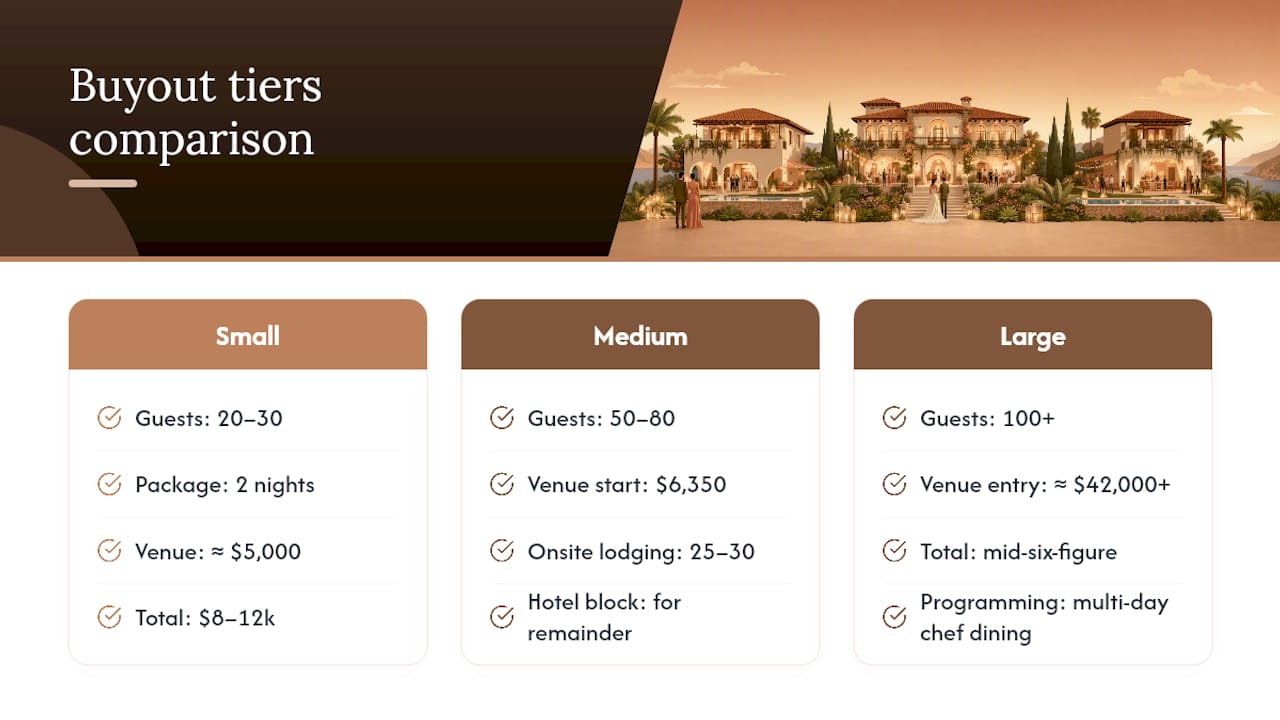
Small buyout, 20 to 30 guests: A 2-night package near the $5,000 starting point covers venue exclusivity, basic onsite staffing, and simple catering. Add guest transport from a nearby airport and you’re typically looking at $8,000 to $12,000 total for an intimate, low-overhead weekend.
Medium buyout, 50 to 80 guests: This is where the sleeping-capacity gap bites hardest. A property advertising a $6,350 starting rate for onsite lodging of 25 to 30 guests still leaves you covering a hotel block for the remaining 20 to 50 attendees. Once you add that block, shuttle service, and elevated catering, total spend commonly lands in the tens of thousands of USD range.
Large luxury estate, 100+ guests: Multi-day programming, a full service staff, chef-driven dining across three or four nights, and the kind of property featured in editorial buyout roundups pushes costs into the high price tiers. Templis Aquaria’s fully curated buyouts starting near $42,000 represent the entry point to this tier, not the ceiling.
Statistic Callout: The gap between a $6,350 starting rate and a mid-six-figure premier estate buyout isn’t really about square footage. It’s staffing depth, catering complexity, and how many nights of programming the property is built to support.
How an Experienced Planner Changes the Math
Negotiating a villa buyout without prior experience means learning the sleeping-capacity trap, the contract red flags, and the seasonal pricing swings in real time, usually during your own booking process. An agency that has already negotiated dozens of these contracts knows which clauses matter before the first phone call happens.
The value shows up in specifics: pushing back on vague staffing language, catching a damage deposit clause with no clear remediation process, and consolidating guest travel so 60 people arriving from four different cities land on a coordinated schedule instead of a chaotic one. A seasoned planner also knows to ask about liability coverage and insurance requirements upfront, since contract clauses around staff ratios and damage deposits are exactly where disputes tend to surface later.
Concierge-level touches, like pre-negotiated shuttle contracts or a confirmed vendor access list before you sign, come from having done this before, not from reading a single venue’s brochure.
When Is a Villa Buyout Actually Worth It?
A buyout earns its premium in three specific situations: when privacy matters more than guest count, when you want a multi-day celebration instead of a single evening, and when your guest list is small enough that the sleeping-capacity math actually works in your favor.
The trade-off to go in clear-eyed about is operational load. Running a private property for two to four nights means managing staff schedules, meal timing, and guest logistics that a single-day hotel ballroom simply hands to the venue’s event manager. If your wedding involves more than 60 guests across multiple lodging locations, that complexity is exactly where a bespoke planner earns their fee.
— Michael
Let Hidden Door Travel Negotiate Your Villa Buyout
Hidden Door Travel handles the parts of a villa buyout that cost couples the most time and money when done alone: venue negotiation, group travel coordination, and vendor scheduling across a multi-day weekend. Instead of calling five properties yourself to compare vague inclusions lists, you get one point of contact who already knows which contract clauses to push back on and which properties actually deliver on their sleeping-capacity numbers.

Clients working with the agency get a clear planning timeline, a documented list of contract deliverables before signing, and fee information to ensure transparency before the final invoice arrives. For a weekend-long booking strategy that also helps beyond the wedding itself, this guide to booking weekend stays covers useful tactics for negotiating multi-night rates. If you’re weighing a villa buyout against a traditional venue and hotel block, start a conversation with Hidden Door Travel’s luxury travel experts and get a realistic quote for your guest count before you sign anything.
Sources
- Estate & Villa Wedding Buyout Pricing | WedStay
- Wedding Packages | Villa Valentín
- 13 of the Best Boutique Hotels for a Wedding Buyout — Vogue
- Templis Aquaria
FAQ
What Is the 50/20/30 Rule for Weddings?
It’s a budget-allocation guideline suggesting roughly 50% of your wedding budget go to venue and catering, 20% to attire and beauty, and 30% to entertainment, photography, and other details.
Is $5,000 a Reasonable Budget for a Wedding?
For an entire wedding, $5,000 is tight but achievable with a small guest list and minimal frills. As a villa buyout starting price, $5,000 typically covers only a 2-night package at the lowest end of the market, with catering, staffing upgrades, and guest lodging as separate costs on top.
How Much Does It Cost to Get Married at a Villa for One Day and One Night?
A single night at a private villa buyout typically starts near the low end of published packages, roughly $5,000, though the exact rate depends heavily on the property, season, and guest count. Most villa operators actually push couples toward 2-night minimums rather than true one-night bookings, since a single night rarely allows enough setup and breakdown time.
What Is the 30-Minute Rule for Weddings?
It’s a scheduling guideline suggesting no single wedding-day segment (cocktail hour, dinner, speeches) should run longer than 30 minutes without a transition, to keep guest energy from lagging. In a multi-day villa buyout format, this rule matters less for any single event and more for pacing an entire weekend so guests aren’t fatigued before the main ceremony.