

Designing a multi destination luxury trip sounds like the ultimate privilege until you’re staring down a 14-country wishlist, three time zones, and a packing window that doesn’t account for a single recovery morning. The complexity is real. Fragmented bookings, rushed transitions, and mismatched service levels can quietly erode what should be an extraordinary experience. But when planned with precision and genuine expertise, a multi-stop luxury itinerary becomes something else entirely: a cohesive, deeply personal narrative that moves you through the world’s best destinations without a single rough edge.
Table of Contents
- Key takeaways
- Designing your multi destination luxury trip: the prerequisites
- How to structure a seamless luxury itinerary
- Common pitfalls that degrade the luxury experience
- Maintaining luxury standards across every destination
- My honest take on what actually makes these trips work
- How Hiddendoortravel designs your multi-destination experience
- FAQ
Key takeaways
| Point | Details |
|---|---|
| Preparation shapes everything | Define your trip objectives, pace, and budget before selecting a single destination or hotel. |
| Pacing beats prestige | Minimum three-night stays and built-in transition days protect the luxury feel better than five-star upgrades. |
| Routing reduces friction | Geography-based sequencing cuts transit time and prevents the fatigue that fragments a high-end experience. |
| Unified communication is non-negotiable | A single point of contact across all destinations prevents service gaps and logistical breakdowns. |
| Proactive planning defines ultra-luxury | Anticipating every client need before it arises separates elite travel from merely expensive travel. |
Designing your multi destination luxury trip: the prerequisites
Before you open a single hotel website or call a private aviation broker, you need clarity on what this trip is actually for. That sounds obvious. It rarely is.
Start with purpose. Is this a milestone celebration, a restorative wellness retreat, a cultural deep-dive, or a combination? The answer shapes every decision that follows, from the pace of the itinerary to the style of accommodation at each stop. A couple celebrating an anniversary in Tuscany and Tokyo wants something fundamentally different from a family seeking adventure across Patagonia and the Maldives.
Next, map your time honestly against your destination count. This is where most travelers go wrong.
| Consideration | What to define |
|---|---|
| Trip purpose | Celebration, wellness, cultural immersion, adventure, or hybrid |
| Available travel days | Total days minus arrival, departure, and recovery time |
| Destination count | Realistically one destination per three to five nights minimum |
| Budget allocation | Flights, transfers, accommodations, experiences, and a contingency reserve |
| Traveler preferences | Privacy level, dietary needs, wellness requirements, activity intensity |
| Advisor involvement | Whether to use a specialist agency, DMC partners, or both |
Your budget conversation needs to include contingencies. Private aviation rerouting, last-minute suite upgrades, and medical travel insurance are not optional line items for a trip of this caliber. Build at least 15 percent flexibility into your total spend.
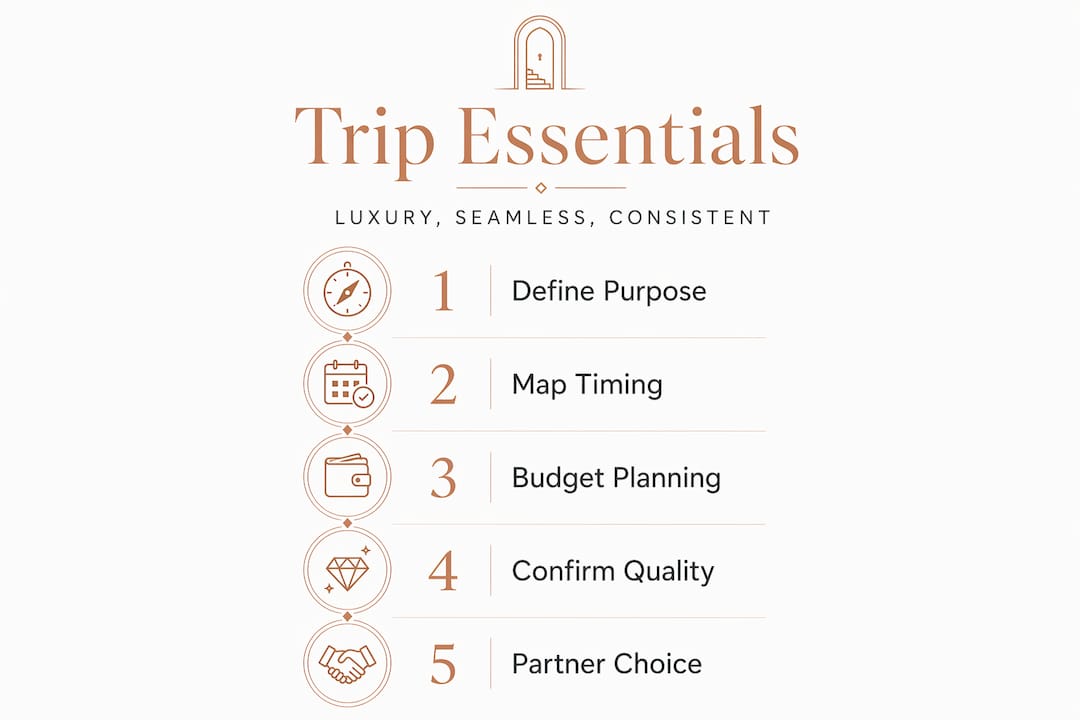
Finally, consider whether you want to work with a specialist. For multi-destination itineraries involving more than three countries, the coordination complexity alone justifies bringing in experienced luxury advisors who already have vetted relationships on the ground.
How to structure a seamless luxury itinerary
The single most useful reframe for any multi destination itinerary is this: stop thinking in stops and start thinking in chapters. Each destination should have a distinct character, purpose, and emotional arc within the larger story of the trip.
Here is a practical sequence for building that structure:
- Define the narrative arc. Decide how the trip should feel as it unfolds. Many travelers prefer to move from high-energy cultural cities toward quieter, more restorative settings. Others want the opposite. Either way, the sequence should feel intentional, not arbitrary.
- Route geographically. Efficient routing balances geography and logistics with the traveler’s pace, avoiding excessive airports and connections that break flow. A trip through Southeast Asia should not ping-pong between Bangkok, Bali, and Tokyo in random order.
- Set minimum stay durations. Research consistently shows that short stays limit immersion because unpacking, orientation, and preparation eat the first day. Three nights is the floor. Five nights is the ideal for any destination you genuinely want to experience.
- Build transition days. Transition day buffers allow travelers to reset and avoid accumulated fatigue that quietly undermines the luxury experience. A half-day buffer between a long-haul flight and a scheduled dinner is not wasted time. It is what makes the dinner enjoyable.
- Choose transport by friction, not just prestige. Private jets offer ultimate flexibility and privacy, but business class on a premium carrier often maximizes comfort on long-haul segments. The goal is to arrive refreshed, not simply to arrive expensively.
- Match accommodations to trip phase. Accommodation style shapes the experience as much as location does. An urban design hotel suits a city chapter. A private villa suits a restorative chapter. A wellness retreat suits a decompression chapter. Forcing the same property type across different destinations flattens the entire journey.
| Transport mode | Best use case | Luxury advantage |
|---|---|---|
| Private jet | Remote destinations, tight schedules | Maximum privacy and flexibility |
| Business class (premium carrier) | Long-haul intercontinental legs | Comfort, service, and time optimization |
| High-speed rail | Short city-to-city routes in Europe or Japan | Scenic, stress-free, often faster than flying |
| Private transfer (ground) | Airport arrivals and hotel-to-hotel moves | Personalized, vetted, and seamless handoffs |
Pro Tip: Destination Management Companies (DMCs) are your most underused asset on complex itineraries. A good DMC in each region holds vetted local relationships, handles ground logistics, and communicates in real time with your central advisor. They are the reason a transfer in Marrakech feels as smooth as one in Monaco.
Common pitfalls that degrade the luxury experience
The most expensive mistake in multi-destination luxury travel is not overspending. It is overloading. Too many stops, too many experiences per day, and too little breathing room transform a high-end trip into an exhausting checklist.
Here are the pitfalls that most frequently break a well-intentioned itinerary:
- Too many destinations. Six countries in ten days sounds impressive. It produces exhaustion, not memories. Cut ruthlessly and go deeper.
- Ignoring transition time. Late dinners followed by early flights cause accumulated fatigue that no five-star hotel can fix. Recovery time is not a luxury. It is a requirement.
- Fragmented bookings. When flights, hotels, and transfers are booked independently without coordinated communication, gaps appear at the seams between destinations. A delayed flight with no one managing the downstream hotel and transfer creates a cascade of stress.
- Defaulting to private cars everywhere. On the French Riviera, for example, short hops are often faster by rail or vetted taxis due to traffic congestion. Flexibility in transport mode is a sign of sophisticated planning, not a compromise.
- Overlooking entry requirements. Visa chains, passport validity, and health documentation need to be mapped as a single connected sequence, not handled destination by destination.
- Assuming luxury is self-managing. Even the best hotels and private operators need clear, advance communication about your preferences. Dietary requirements, pillow preferences, and arrival time expectations should travel ahead of you.
“The best luxury travel experiences are not the ones where nothing goes wrong. They are the ones where the traveler never knows anything could have gone wrong.”
Pro Tip: Proactive detail management means answering your traveler’s questions before they think to ask them. Driver contacts, terminal maps, transfer durations, and restaurant confirmation numbers should all be in their hands before departure.
Maintaining luxury standards across every destination
Designing a great itinerary is one thing. Maintaining consistent quality across four countries and eight service providers is another challenge entirely.

Destination Management Companies centralize communication and align timelines across regions, which is exactly why they exist. Without a unified operational structure, travelers feel like they are managing multiple separate trips rather than one cohesive experience.
| Verification method | What it protects |
|---|---|
| Pre-trip property inspection or vetting | Confirms accommodation meets actual luxury standards, not just star ratings |
| Single point of contact for all regions | Prevents communication gaps between vendors and ensures preference continuity |
| Coordinated transfer confirmation 48 hours out | Catches scheduling conflicts before they become problems |
| Contingency planning (medevac, rerouting) | Vetted security and medical evacuation plans provide peace of mind without disrupting the trip’s tone |
| Guided and free time balance | Overpacked days reduce enjoyment; scheduled white space allows genuine luxury immersion |
The subtler luxury touches matter more than most travelers expect. Tailored wellness programming at each stop, discreet security arrangements, curated local access, and pre-stocked villa preferences are the details that generate the feeling of being truly looked after. These do not happen by accident. They require a planner who treats the entire trip as one seamless experience, not a series of independent bookings.
A global travel agency with established local partnerships is often the difference between a trip that looks luxurious on paper and one that actually feels that way on the ground.
My honest take on what actually makes these trips work
I have seen travelers spend extraordinary amounts of money on multi-destination itineraries that left them exhausted and vaguely disappointed. And I have seen more modest budgets produce trips that people talk about for years. The difference is almost never the hotel brand.
In my experience, pacing and transition time are the two most undervalued elements in luxury travel planning. Travelers fixate on where they are staying and what they are doing. The best planners obsess over how the trip moves. A morning with no agenda in Kyoto after a long flight from Europe is not wasted. It is what makes the afternoon tea ceremony feel sacred rather than rushed.
What I have learned about transport choices is equally counterintuitive. The most sophisticated travelers I have worked with do not automatically reach for private aviation. They ask which mode of transport will make them feel best when they arrive. Sometimes that is a private jet. Sometimes it is a first-class train compartment through the Swiss Alps. The goal is arrival quality, not arrival optics.
The other lesson I keep coming back to is the cost of fragmentation. When bookings are spread across multiple operators without a single coordinating voice, the seams show. A driver who does not know about a flight delay. A hotel that was not told about a dietary restriction. A transfer that was booked for the wrong terminal. None of these are catastrophic individually. Together, they erode the feeling of being cared for, which is the entire point of a high-end travel experience.
Work with people who anticipate your needs before you voice them. That is the clearest signal you have found the right partner.
— Michael Patton
How Hiddendoortravel designs your multi-destination experience
At Hiddendoortravel, designing a multi destination luxury trip is not a template exercise. Every itinerary begins with a detailed conversation about how you want to feel at each stage of the journey, not just where you want to go. Our advisors hold deep relationships with vetted DMCs, private villa operators, and ground logistics providers across every major luxury destination. That means your preferences travel ahead of you, your transfers are confirmed before you land, and your contingencies are already in place. Whether you are planning a three-country cultural circuit or a seven-stop global itinerary, our luxury travel experts handle every detail so you arrive as a guest, not a coordinator. Explore our bespoke luxury agency services to begin designing your trip.
FAQ
What is the ideal number of destinations for a luxury trip?
For a genuinely immersive high-end travel experience, three to four destinations over two to three weeks is the sweet spot. More stops compress stay durations below the three-night minimum needed for real immersion.
How do transition days improve a multi-destination itinerary?
Transition days with buffer time prevent accumulated fatigue and preserve the relaxed, unhurried tone that defines true luxury travel. Even a half-day buffer between a long transfer and a scheduled activity makes a measurable difference in how travelers feel.
When should I use a DMC for a multi-destination luxury trip?
Use a Destination Management Company any time your itinerary crosses more than two regions or involves complex ground logistics. DMCs centralize communication and align service standards across vendors, which prevents the fragmented experience that undermines luxury travel.
Is private jet travel always the best option for luxury trips?
Not always. On short regional routes, high-speed rail or vetted private transfers often reduce stress more effectively than private aviation. The best transport choice is the one that delivers you most refreshed and least disrupted, regardless of mode.
How far in advance should I plan a multi-destination luxury trip?
For complex multi-destination itineraries involving private villas, exclusive experiences, or peak-season travel, six to twelve months of lead time is standard. This secures the best properties and allows thorough coordination with all vendors and DMC partners.