

Most people assume elite travel is just about spending more. Book a five-star hotel, fly business class, and you’ve arrived. That assumption misses almost everything that actually defines elite travel planning explained in its modern form. True luxury travel today is about emotional depth, radical personalization, and access that money alone cannot buy off a shelf. This guide breaks down exactly how elite travel planning works in 2026, what separates it from conventional luxury, and how you can use these principles to design experiences that genuinely change how you see the world.
Table of Contents
- Key Takeaways
- Elite travel planning explained: the 2026 shift
- Core components of elite travel planning
- Traditional luxury vs. modern elite travel planning
- Practical tips for planning elite travel
- Future trends shaping elite travel
- My take on where elite travel planning is heading
- Plan your next elite experience with Hiddendoortravel
- FAQ
Key Takeaways
| Point | Details |
|---|---|
| Personalization drives modern luxury | Elite itineraries are built around psychographic data and personal preferences, not standard packages. |
| Experience over status | 70% of luxury executives now identify experiential travel as the dominant trend, replacing status-led acquisition. |
| Timing is a strategic tool | Off-peak travel is preferred by most elite travelers to access authentic, crowd-free experiences. |
| Wellness is a core pillar | Mental health, sleep therapy, and medical recovery programs are now standard requests in elite travel planning. |
| Sustainability requires guidance | Information gaps, not price, are the primary reason travelers hesitate on sustainable choices. |
Elite travel planning explained: the 2026 shift
The phrase “elite travel” used to conjure images of marble lobbies and Michelin-starred dining. That picture is not wrong, but it is incomplete. The real transformation happening right now is a shift from product-centric luxury to experience-centric living. Travelers are no longer collecting status symbols. They are collecting moments.
Experiential luxury is the dominant trend for 2026, with luxury moving firmly from acquisition to meaning-led exploration focused on emotional depth and lifestyle immersion. What this means in practice is that the most sought-after itineraries are not the most expensive ones. They are the most resonant ones.
Several forces are reshaping what elite travelers actually want right now:
- Selective confidence: Travelers in 2026 want comfort, safety, and emotional connection. One-size-fits-all luxury no longer works. Strategies must balance desire and credibility by individual market segment.
- Privacy as a baseline expectation: High-net-worth travelers now treat discretion as non-negotiable. Private entrances, restricted access areas, and dedicated staff are standard requests, not upgrades.
- Authentic cultural access: The goal is not to observe a culture from behind a tour bus window. It is to participate in it at a level most travelers never reach.
- Flexibility built into the itinerary: Rigid day-by-day schedules feel like work. Elite planning builds in spontaneity and real-time adjustments.
“The new luxury traveler is not asking what the best hotel is. They are asking what experience will make them feel most alive.” This shift demands that planners think like life designers, not booking agents.
Core components of elite travel planning
Understanding the building blocks of a genuinely elite itinerary separates good travel from transformative travel. Here is how the best plans are constructed.
1. Psychographic itinerary design
The most sophisticated itineraries go far beyond “client likes beaches and fine dining.” Ultra-personalized itineraries now incorporate psychographic data, time-of-year mood analysis, and real-time experience refinements. Properties like Mandarin Oriental and Four Seasons use guest preference mapping at micro-behavioral levels, tracking everything from preferred pillow firmness to the pace at which a guest likes to move through a day. Your planner should be doing something similar, even without the hotel’s data infrastructure.
2. Wellness as a travel anchor
Wellness tourism has moved from a niche add-on to a central pillar of elite travel. Luxury resorts now offer mental health programs, sleep therapy, and medical recovery retreats that combine genuine clinical rigor with high privacy. A week in a Swiss longevity clinic or a Bali sleep-optimization retreat is now as common a request as a private villa.
3. Security and privacy architecture
For high-net-worth travelers, private aviation and discreet accommodations are not luxuries. They are security decisions. Elite planning accounts for private terminal access, vetted ground transportation, and accommodations with controlled entry points. This layer of the plan is often invisible to the traveler, which is exactly the point.
4. Sustainable travel with real transparency
Sustainability has become a genuine priority, not a marketing checkbox. The key barrier is not cost. Only 10% of clients cite price as a hesitation when it comes to sustainable choices. The real gap is information. Advisors who can explain exactly how a property manages its carbon footprint or supports local communities convert sustainable intent into sustainable action.
Pro Tip: Ask your travel advisor to provide specific, verifiable details about a property’s sustainability practices before booking. If they cannot answer with specifics, that tells you something important about the depth of their expertise.
Traditional luxury vs. modern elite travel planning
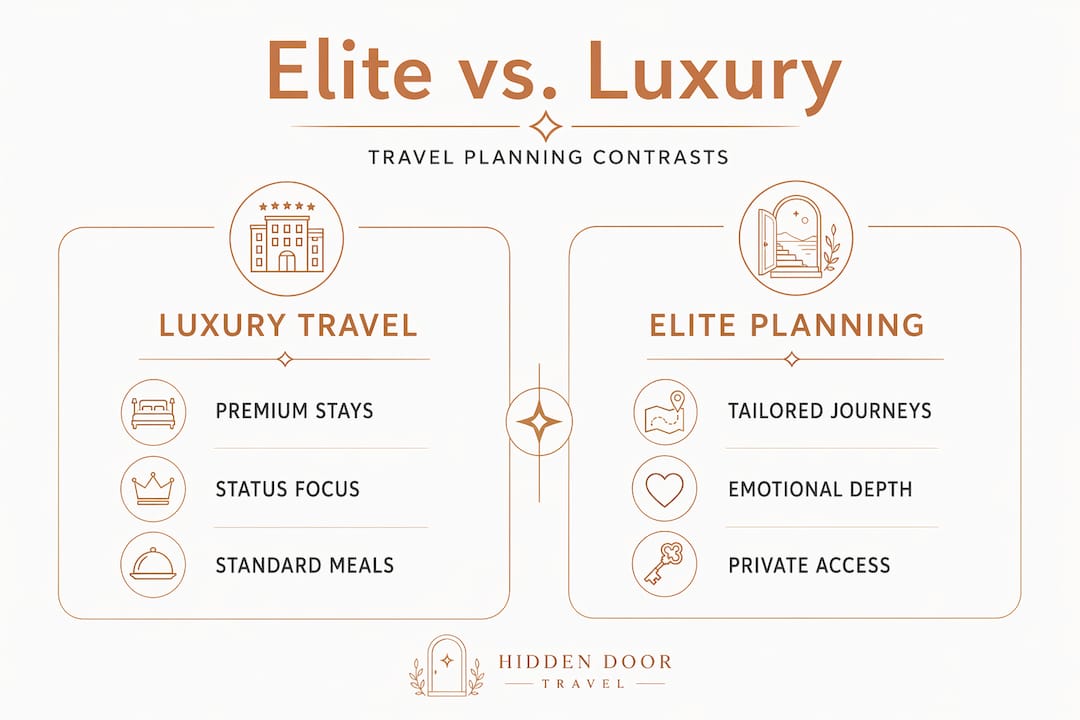
The difference between booking a luxury trip and planning an elite one is not always obvious from the outside. This comparison makes it concrete.
| Dimension | Traditional luxury travel | Modern elite travel planning |
|---|---|---|
| Core focus | Premium products and status markers | Emotional resonance and personal meaning |
| Itinerary style | Fixed packages with standard inclusions | Fully custom, built around individual preferences |
| Experience type | Sightseeing, fine dining, spa days | Arctic expeditions, private Himalayan meditation, curated cultural events |
| Privacy approach | Standard hotel service | Private entrances, dedicated staff, restricted access |
| Wellness integration | Spa as an add-on | Wellness as a central itinerary pillar |
| Sustainability | Greenwashing-level claims | Transparent, advisor-verified practices |
| Flexibility | Rigid day-by-day schedule | Real-time adjustments and built-in spontaneity |
Exclusive experiences over sightseeing now define what elite travelers seek. The shift is not subtle. It is the difference between visiting a place and genuinely inhabiting it, even briefly.
Practical tips for planning elite travel
Knowing the philosophy is one thing. Applying it to your actual planning process is another. These luxury travel planning tips are drawn from how the most experienced advisors approach bespoke itinerary creation.
- Map your travel DNA before you do anything else. Write down the three experiences from past trips that genuinely moved you, not the most expensive ones. The pattern in those answers tells you more about what you actually want than any destination list.
- Work with a specialist, not a generalist. A full-service travel advisor who focuses on elite travel has relationships that unlock access no booking platform can replicate. Private museum after-hours tours, chef’s table seats that never appear online, reserved conservation experiences. These come through relationships.
- Use timing as a design tool. 79% of luxury travel advisors report that their clients prefer off-peak travel. The motivation is not just avoiding crowds. It is accessing a more authentic version of a destination, one that locals actually recognize.
- Incorporate wellness intentionally. Do not treat a spa day as a default add-on. Decide in advance whether you want active recovery, mental health focus, or physical performance, and build the itinerary around that specific goal.
- Demand transparency on sustainability. Use your advisor to get specifics. Which properties have third-party certifications? Which local operators are genuinely community-owned? This is where a knowledgeable advisor earns their fee.
- Build in white space. The best elite itineraries are not packed. They have room for the unexpected conversation, the spontaneous detour, the afternoon that turns into the highlight of the trip.
Pro Tip: When briefing a travel advisor, share the experiences you have hated as much as the ones you have loved. Knowing what drains you is as valuable as knowing what excites you, and the best advisors will use both.
Future trends shaping elite travel
The following shifts are already influencing how the best travel ideas and itineraries are being designed for 2026 and beyond.
| Trend | What it means for your planning |
|---|---|
| AI-driven personalization | Predictive itinerary tools will anticipate preferences before you articulate them |
| Phygital experiences | Physical destinations enhanced by digital layers, such as augmented heritage sites |
| Rare access demand | Closed archaeological sites, private conservation reserves, invitation-only cultural events |
| Demographic shift | Younger high-net-worth travelers prioritize meaning and community over prestige |
| Community engagement | Stays that contribute directly to local economies are increasingly preferred |
| Sustainability accountability | Third-party verified environmental reporting becomes a booking standard |
The demographic shift is worth watching closely. Younger wealthy travelers bring different values to the table. They are less interested in the traditional markers of luxury and more focused on genuine connection and authentic local stays that reflect the actual character of a destination. Advisors who understand this are already designing very different itineraries than they were five years ago.
My take on where elite travel planning is heading
I have spent years watching the luxury travel space evolve, and the single biggest mistake I see travelers make is confusing access with experience. You can have every door opened for you and still come home feeling like you missed something. The difference is almost always in the depth of the planning behind the trip.
What I have learned is that empathy is the most underrated skill in this industry. The best itineraries I have seen are not the most expensive or the most logistically complex. They are the ones where the advisor clearly understood what the traveler actually needed, sometimes before the traveler could articulate it themselves. That requires real conversation, not a preference form.
The balance between comfort and emotional depth is genuinely tricky. Some travelers want to be challenged. Others want to be held. Most want both at different points in the same trip. Getting that calibration right is what separates a good advisor from a great one.
My advice is simple: do not treat your travel advisor like a booking service. Treat them like a collaborator. The more honestly you share what you are looking for, including the things that feel hard to say out loud, the better the result will be.
— Michael
Plan your next elite experience with Hiddendoortravel
If this guide has clarified what elite travel planning actually involves, the next step is working with advisors who practice it at the highest level.
Hiddendoortravel specializes in exactly this kind of work. The team builds bespoke itineraries grounded in deep personal understanding, not templated packages. From private wellness retreats to rare cultural access experiences, every trip is designed around who you are and what genuinely matters to you. The advisors at Hiddendoortravel also provide transparent, verified guidance on sustainable travel options, closing the information gap that holds most travelers back. If you are ready to move from standard luxury to something that actually stays with you, connect with the luxury travel experts at Hiddendoortravel and start the conversation.
FAQ
What does elite travel planning actually involve?
Elite travel planning goes far beyond booking premium hotels and flights. It involves psychographic profiling, custom itinerary design, wellness integration, privacy architecture, and sustainability verification to create deeply personal travel experiences.
How is elite travel different from regular luxury travel?
Regular luxury travel focuses on premium products and status markers. Elite travel planning centers on emotional resonance, exclusive access, and personalization built around the individual traveler’s values and preferences.
Why do elite travelers prefer off-peak travel?
79% of luxury advisors report clients prefer off-peak travel primarily to access more authentic, crowd-free experiences rather than simply to save money.
How do I find the right advisor for elite travel planning?
Look for a specialist with verifiable relationships at the destinations you want to visit, a track record of custom itinerary work, and the ability to provide specific, third-party verified information on sustainability practices.
What role does wellness play in elite travel itineraries?
Wellness is now a central pillar rather than an optional add-on. Elite travelers regularly request programs covering mental health, sleep optimization, and medical recovery, all delivered within high-privacy, luxury settings.