

The search for genuinely exclusive travel has never been more competitive. Affluent travelers are moving past five-star resorts with crowded pools and looking for luxury remote destination examples that offer something rarer: real privacy, untouched environments, and service so personalized it feels designed for one. The challenge is knowing which destinations actually deliver on that promise and which ones simply market seclusion. This guide cuts through the noise with specific properties, honest criteria, and the practical details you need to make a confident choice.
Table of Contents
- Key takeaways
- How to evaluate luxury remote destination examples
- Island sanctuaries: the gold standard of exclusive remote retreats
- Mountain lodges, safaris, and wilderness retreats
- Side-by-side comparison of featured destinations
- How to choose the right destination for your next getaway
- My honest take on what actually separates great from average
- Plan your exclusive escape with Hiddendoortravel
- FAQ
Key takeaways
| Point | Details |
|---|---|
| Exclusivity starts with capacity | The best hidden luxury getaways cap guests at 11 to 18 people, guaranteeing genuine privacy. |
| Sustainability is now standard | Top exclusive remote retreats operate on solar energy, zero-waste systems, and active conservation programs. |
| Logistics define the experience | Private charters and expert transfers are what separate true luxury from an inconvenient trip to a beautiful place. |
| Price varies by format | Full private island buyouts start around $25,000 per night; individual suites in remote reserves run $2,000 to $3,200. |
| Expert planning pays off | Working with a specialist agency unlocks access, pricing, and experiences that independent booking cannot match. |
How to evaluate luxury remote destination examples
Before you commit to any destination, five criteria separate the genuinely elite from the merely remote.
Privacy and capacity limits. A property that accepts 200 guests is not a premium secluded destination regardless of its price point. Look for hard caps. Islas Secas and Ithaafushi both cap guests at 18, which is the standard worth measuring others against.
Sustainability credentials. Eco-consciousness is not a compromise at this level. It is a quality signal. Properties that run on renewable energy, manage waste responsibly, and participate in conservation programs tend to operate with more care across every department, including hospitality.
Bespoke service ratios. Guest-to-staff ratios matter more than thread counts. The best off-the-beaten-path resorts maintain ratios that allow staff to anticipate needs rather than react to them.
Arrival logistics. Seamless private charters and expert transfers are not a bonus feature. They are part of the experience. A destination that requires four commercial connections and a two-hour speedboat ride in rough water is not delivering luxury regardless of what awaits at the end.
Unique natural or cultural context. The environment should be irreplaceable. A luxury property that could exist anywhere is worth less than one that could only exist exactly where it is.
Pro Tip: Ask every property for their actual guest-to-staff ratio before booking. A ratio below 1:2 is a red flag at the ultra-luxury level.
Island sanctuaries: the gold standard of exclusive remote retreats
Private islands remain the clearest luxury remote destination examples because geography enforces the exclusivity that other properties have to manufacture.
Islas Secas, Panama. This 14-island archipelago in the Gulf of Chiriquí accepts a maximum of 18 guests across the entire reserve. Islas Secas runs entirely on solar energy, produces zero waste, sources food from organic gardens, and runs active marine conservation programs. The result is a property that feels genuinely responsible rather than performatively green. Activities center on world-class diving, sport fishing, and guided kayaking through mangroves that most travelers will never see.
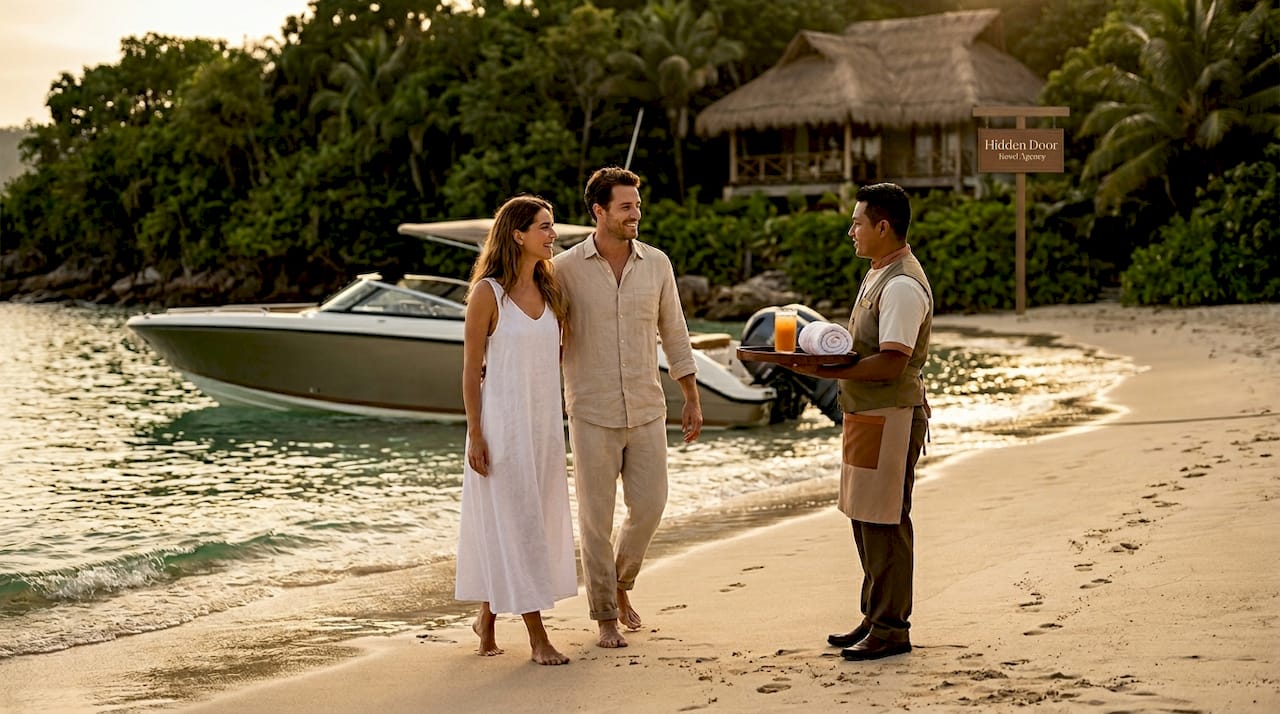
Ithaafushi Private Island, Maldives. Part of the Waldorf Astoria portfolio, Ithaafushi accommodates up to 18 guests with a dedicated concierge team, a world-class culinary team, and experiences that go far beyond what the main resort offers. Think private overwater cinema, custom diving programs, and menus built around your preferences rather than a fixed offering. This is the Maldives without the Maldives crowd.
Pelorus Private Island, Great Barrier Reef, Australia. For groups of up to 11, Pelorus offers exclusive island use with a private chef, a dedicated host team, and curated reef experiences that include snorkeling, diving, and marine biology briefings. Full-island bookings start around $25,000 to $26,500 per night, with individual suite rates between $2,000 and $3,200. The Great Barrier Reef location means the underwater experience is unmatched anywhere in the Southern Hemisphere.
Denis Private Island, Seychelles. Denis is the destination for travelers who want to truly disconnect. No mobile signal or internet exists on the island by design, which makes it one of the most radical luxury honeymoon destination examples available. The focus is conservation, with guests encouraged to participate in turtle monitoring and bird surveys alongside the resident naturalist. Architecture blends with the landscape rather than imposing on it, and private dining options range from beach bonfires to candlelit tables under the stars.
Pro Tip: For luxury honeymoon destination planning, Denis Private Island and Islas Secas both offer dedicated honeymoon programs with private dining and curated excursions. Request these specifically at the time of inquiry, not after arrival.
Mountain lodges, safaris, and wilderness retreats
Not every premium secluded destination sits on water. Some of the most memorable wealthy travel spots are found in mountains and savannahs.
Dunton Hot Springs, Colorado. This restored ghost town in the San Juan Mountains operates as a fully exclusive retreat with a handful of hand-restored cabins, natural hot spring pools, and access to some of the most dramatic backcountry terrain in North America. Dunton Hot Springs offers exceptional privacy in a setting that combines rugged authenticity with serious comfort. Winter access requires snowcat transport, which adds to the sense of genuine remoteness.
Xigera Safari Lodge, Botswana. Located in the Okavango Delta, Xigera is one of Africa’s most art-forward safari properties. The lodge features original works from over 100 African artists throughout the suites and common areas. Xigera combines seclusion with curated wilderness experiences that include mokoro canoe excursions, walking safaris with expert trackers, and helicopter transfers over the delta. The wet season transforms the landscape into a flooded paradise that supports extraordinary wildlife density.
Both properties share a trait common to the best inland luxury vacation islands equivalents: the environment itself is the activity. You are not choosing between a pool and a spa. You are choosing between a walking safari at dawn and a private game drive at dusk.
Side-by-side comparison of featured destinations
| Destination | Max guests | Nightly rate (approx.) | Key feature | Sustainability |
|---|---|---|---|---|
| Islas Secas, Panama | 18 | From $3,500/suite | 14-island marine reserve | Solar, zero waste, conservation |
| Ithaafushi, Maldives | 18 | From $10,000 | Fully private island, Waldorf service | Marine protection programs |
| Pelorus, Great Barrier Reef | 11 | From $25,000 (full island) | Exclusive reef access, private chef | Reef conservation focus |
| Denis Private Island, Seychelles | 20 | From $2,500/villa | No internet, turtle conservation | Eco-retreat, no single-use plastic |
| Dunton Hot Springs, Colorado | 30 | From $2,000/cabin | Restored ghost town, hot springs | Low-impact mountain operation |
| Xigera Safari Lodge, Botswana | 24 | From $2,200/suite | Art-forward, Okavango Delta | Carbon-neutral operations |
How to choose the right destination for your next getaway
Matching a destination to your priorities sounds straightforward. In practice, most travelers underestimate two things: travel time and the gap between what a property markets and what it delivers.
-
Define your non-negotiables first. Complete digital disconnection? Underwater experiences? Cultural immersion? Identifying one or two absolute priorities narrows the field faster than any other method.
-
Calculate total travel time honestly. A property that requires 22 hours of travel each way is a different trip than one requiring 10. For shorter getaways, proximity matters as much as prestige.
-
Match the environment to the season. The Okavango Delta floods between June and August, which is spectacular but changes the experience entirely. The Maldives has a dry season from November to April. Timing affects what you will actually see and do.
-
Work with a specialist. Luxury travel experts have access to room categories, rates, and experiences that are never listed publicly. They also know which properties are overdue for renovation and which ones are at their peak. That knowledge is worth more than any amount of independent research.
-
Set a total budget, not a nightly rate. Private charter flights, transfers, and curated excursions can double the cost of a stay. A clear total budget prevents surprises and allows your travel advisor to optimize the full experience.
Pro Tip: The best time to plan a luxury remote trip is six to twelve months in advance. Properties like Pelorus and Denis Private Island book out entire seasons. Waiting until three months out means accepting whatever is left.
My honest take on what actually separates great from average
I’ve worked with high-net-worth clients long enough to know that the most common mistake in this space is confusing price with quality. Some of the most expensive properties I’ve seen are also the most disappointing, because they sell the idea of seclusion without engineering the reality of it.
What I’ve found consistently is that the destinations worth returning to share one trait: they are designed around a specific environment rather than a generic luxury template. Denis Private Island works because the no-internet policy is a feature, not a limitation. Islas Secas works because the marine reserve is the product, not the backdrop.
I’ve also seen clients underestimate logistics until it goes wrong. Seamless remote access requires coordination that most travelers cannot manage independently. A missed private charter in the middle of the Pacific is not a minor inconvenience.
My honest advice: spend as much time evaluating the arrival experience as you do the accommodation itself. The best luxury remote destination examples make you feel like the trip has already begun the moment you leave home.
— Michael
Plan your exclusive escape with Hiddendoortravel
Ready to move from inspiration to an itinerary? Hiddendoortravel specializes in exactly this: translating your priorities into a fully coordinated experience at the world’s most exclusive remote retreats.
From private charter coordination to bespoke dining experiences and conservation-focused stays, the team at Hiddendoortravel has the relationships and expertise to access properties and experiences that are simply not available through standard booking channels. Whether you are planning a luxury honeymoon or a private group escape, connect with the luxury travel agency team to start building your itinerary. Explore trip inspiration to see what is possible before your first consultation.
FAQ
What makes a destination a true luxury remote retreat?
A true luxury remote retreat combines strict capacity limits, high staff-to-guest ratios, unique natural settings, and seamless arrival logistics. Properties that cap guests at 18 or fewer, like Islas Secas and Ithaafushi, represent the clearest standard.
What are the best luxury honeymoon destination examples?
Denis Private Island in the Seychelles and Ithaafushi Private Island in the Maldives are among the strongest luxury honeymoon destination examples, offering complete privacy, bespoke dining, and curated experiences for couples.
How much does a private island stay cost per night?
Full private island bookings start around $25,000 to $26,500 per night, while individual suites in remote reserves typically range from $2,000 to $3,200 per night depending on the property and season.
How far in advance should I book exclusive remote retreats?
Six to twelve months in advance is the standard for the most sought-after properties. Peak seasons at destinations like Pelorus Private Island and Denis Private Island book out entirely, leaving no availability for last-minute requests.
Is sustainability important at high-end remote destinations?
Yes, and it is increasingly a quality indicator. Islas Secas operates on solar energy with zero-waste systems and marine conservation programs, which reflects the operational care that defines the best properties at this level.