

American passport holders do not need ETIAS to enter Europe right now. As of August 16, 2026, ETIAS is not yet in operation, and US citizens can still travel to the 30 participating countries for short stays using just a valid passport. Your one job today: bookmark the official ETIAS site, skip anything the European External Action Service hasn’t published, and check that your passport won’t expire mid-trip.
Key Takeaways
ETIAS is not yet operational, so American travelers can enter Europe visa-free today, but preparation now saves headaches once the system launches.
| Point | Details |
|---|---|
| No ETIAS needed yet | As of August 16, 2026, US citizens can travel to the 30 participating countries visa-free for up to 90 days. |
| Watch official sources only | Monitor the official ETIAS site directly; third-party “early application” sites are scams. |
| Fee will be EUR 20 | Most adults pay EUR 20 once applications open, with exemptions for under-18s, over-70s, and some family members of EU nationals. |
| Passport renewal voids approval | ETIAS ties to one passport number, so a new passport always requires a new application. |
| Hidden Door Travel manages the details | Hiddendoortravel builds passport checks and ETIAS timing into bespoke itinerary planning for clients. |
Official Pages Worth Bookmarking
Track launch updates at the official ETIAS site, the EEAS travel guidance, and the US State Department’s Schengen area page.
This article is general information, not a substitute for advice from a qualified lawyer. Consult a qualified legal professional about your own circumstances before acting on anything here.
Table of Contents
- What Is ETIAS for Americans and Who Will Need It?
- Which European Countries Require ETIAS and How Long Can Americans Stay?
- Do US Citizens Need ETIAS Now, and When Will That Change?
- How Do You Apply for ETIAS Once It Opens?
- What Happens After ETIAS Approval, and Does It Guarantee Entry?
- How Does ETIAS Compare to the US ESTA System?
- Sources
What Is ETIAS for Americans and Who Will Need It?
ETIAS is not a visa. It’s a pre-travel screening system, closer in spirit to a security questionnaire than a consulate appointment, designed for travelers who currently enter Europe visa-free. Once it launches, that includes US citizens.
Here’s who will need to apply:
- Holders of a biometric US passport traveling to any of the 30 participating European countries
- Visitors making short tourist, business, or transit trips under the 90-day stay limit
- Travelers who currently need no visa for Europe (ETIAS replaces that visa-free entry with a lightweight screening, not a full consulate process)
The EU frames ETIAS as an authorization tied directly to your passport rather than a stamp or sticker, according to its official guidance. A traditional Schengen visa requires paperwork, sometimes an in-person interview, and can take weeks. ETIAS is designed to run in minutes online, once it’s live.
Which European Countries Require ETIAS and How Long Can Americans Stay?
ETIAS will cover 30 European countries, the full Schengen area plus a few associated states, and you can check the current full list on the official ETIAS site rather than relying on a third-party summary. The rule that matters most for planning is that short stays in ETIAS countries are limited within a certain period, counted across all participating countries combined, not per country.
That distinction trips people up constantly. Spend three weeks in Portugal, two in Italy, and ten days in Greece, and it all draws from the same 90-day pool. There’s a second wrinkle worth flagging now: ETIAS approval attaches to the specific passport number you applied with. Renew your passport after approval, and the authorization becomes void. Official EU guidance confirms the validity runs up to three years or until the passport expires, whichever comes first, so a mid-cycle renewal always means reapplying.

Do US Citizens Need ETIAS Now, and When Will That Change?
Not yet, and there’s no confirmed launch date to plan around. The EU has been explicit that ETIAS remains not in operation and that a start date will be announced several months in advance, rather than dropped without warning.
That timeline has already slipped more than once since the program was first proposed, which is exactly why chasing rumors online wastes your time. The EU’s own guidance says notice will come well ahead of launch, giving travelers a real runway to prepare rather than a scramble.
Practical advice for right now: don’t apply anywhere, because there’s nowhere legitimate to apply yet. Check the official ETIAS page every few months if you have European trips planned for later in 2026 or beyond, and treat any site offering to “pre-register” you or “guarantee early approval” as a red flag, not a shortcut.
How Do You Apply for ETIAS Once It Opens?
When the system does go live, the process is built to be fast. Here’s what to expect, step by step:
- Gather your documents. You’ll need a valid biometric passport (with at least three months of validity remaining past your planned departure from Europe, per official guidance) and a payment card.
- Go to the official ETIAS website or mobile app. No other portal will be authorized to process applications.
- Fill out the form. Expect fields for personal details, passport information, travel plans, and a set of background questions covering health, criminal history, and prior travel to conflict zones.
- Pay the fee. The standard charge is EUR 20, waived for applicants under 18 or over 70, and for some family members of EU nationals under specific conditions.
- Submit and wait for confirmation. Most approvals are expected quickly, though some applications may need extra review time, so don’t book non-refundable travel for the day after you apply.
Be extremely wary of third-party websites and fraud attempts claiming to accept ETIAS applications before the official system is live. Only the EU’s official ETIAS website or mobile app will ever be legitimate, and Frontex has already flagged scam sites trying to charge travelers for a process that doesn’t exist yet.
Pro Tip: Set a calendar reminder to recheck the official ETIAS site roughly three to six months before any planned European trip once the program is confirmed live. That’s the window the EU says it will use to give travelers notice, and it lines up well with when you’d start finalizing flights anyway.
What Happens After ETIAS Approval, and Does It Guarantee Entry?
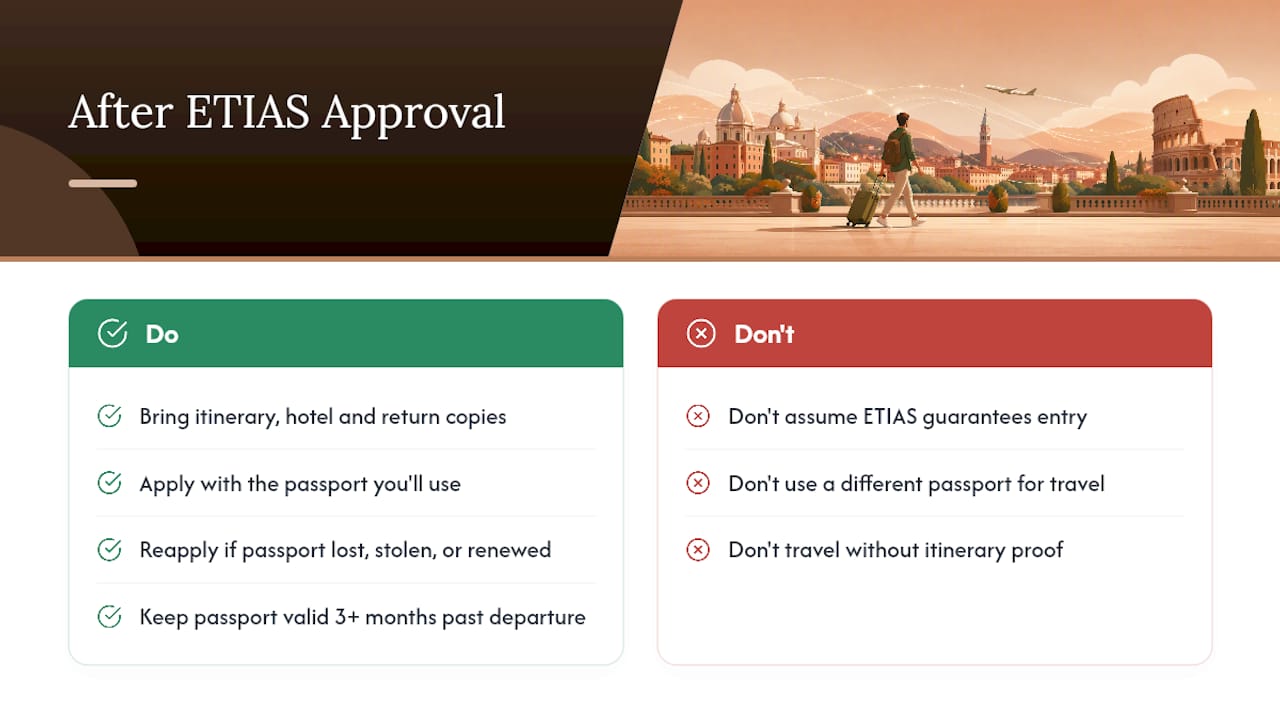
Approval means you’ve cleared the screening, not that a border agent has to let you in. ETIAS is valid for up to three years or until your passport expires, whichever hits first, and it stays locked to the exact passport you applied with. Get a new passport for any reason, lost, stolen, expired, or simply renewed early, and you’ll need a fresh application, since the old authorization dies with the old document.
Border guards still do their job at the checkpoint. They’ll ask about your purpose of travel, your return ticket, proof of funds, and where you’re staying, the same questions asked of visa-exempt travelers today. ETIAS clears you to board and to approach the border. It doesn’t override the officer standing there.
Pro Tip: Travel with printed or digital copies of your itinerary, hotel confirmations, and return flight, even with ETIAS approved. And always double-check that your passport has at least three months of validity left past your departure date from Europe, well before you leave home.
How Does ETIAS Compare to the US ESTA System?
If you’ve used ESTA to enter the United States or watched foreign visitors go through it, ETIAS will feel familiar:
- Purpose: Both screen visa-exempt travelers before they board a flight, not a visa in either case.
- Coverage: ESTA applies to the US Visa Waiver Program; ETIAS covers the 30 European countries.
- Fee: ESTA runs $21; ETIAS is set at EUR 20.
- Validity: Both generally last up to three years or until the passport expires.
- Structure: ETIAS is explicitly modeled on systems like ESTA, an automated background check layered on top of an existing visa-free arrangement, not a replacement for it.
How Hidden Door Travel Prepares Clients for ETIAS
I’ve watched enough European trip plans unravel over a mismatched passport date or a missed form field to know that the paperwork stage deserves the same attention as the itinerary itself. At Hiddendoortravel, our team builds passport and document checks into the planning timeline from day one, well before ETIAS even factors in.
For clients running larger group trips or multi-country itineraries, we flag potential complications early, passport renewals, family member exemptions, layered travel dates, so nothing surfaces the week before departure.
Pro Tip: If you’re planning a multi-generational trip or a large group booking, get everyone’s passport expiration dates checked together, months out. One expiring passport can complicate an entire group’s ETIAS timeline once the system opens.
Let Hidden Door Travel Handle the Paperwork While You Plan the Trip
Reading government guidance and tracking a launch date that keeps shifting isn’t how you want to spend the run-up to a European vacation. Hiddendoortravel builds document readiness directly into your itinerary planning, so passport timing, ETIAS applications once they open, and travel logistics move together instead of becoming a last-minute scramble.

Our luxury travel document preparation service checks passport validity, flags renewal timing against your travel dates, and keeps your group’s paperwork organized from booking to boarding. If you’re weighing options for a short European stay, smart weekend-trip booking tactics can help with timing too, but for a fully coordinated trip where someone else tracks the ETIAS rollout for you, start a conversation with our luxury travel experts about your next itinerary.
Sources
- EEAS — Coming visa-free country and travelling to Europe
- What is ETIAS – ETIAS – Travel to Europe
- What you need to apply – ETIAS
- Frontex — Beware of risks posed by unofficial ETIAS websites
- ETIAS — Travel to Europe
Recommended
- The Role of Travel Intelligence Services in 2026 – Hidden Door Travel
- Private Archipelago Access Explained: What Travelers Need to Know – Hidden Door Travel
- Why Use a Travel Agency: Benefits Worth Knowing in 2026 – Hidden Door Travel
- Elite Travel Planning Explained: Your 2026 Guide – Hidden Door Travel