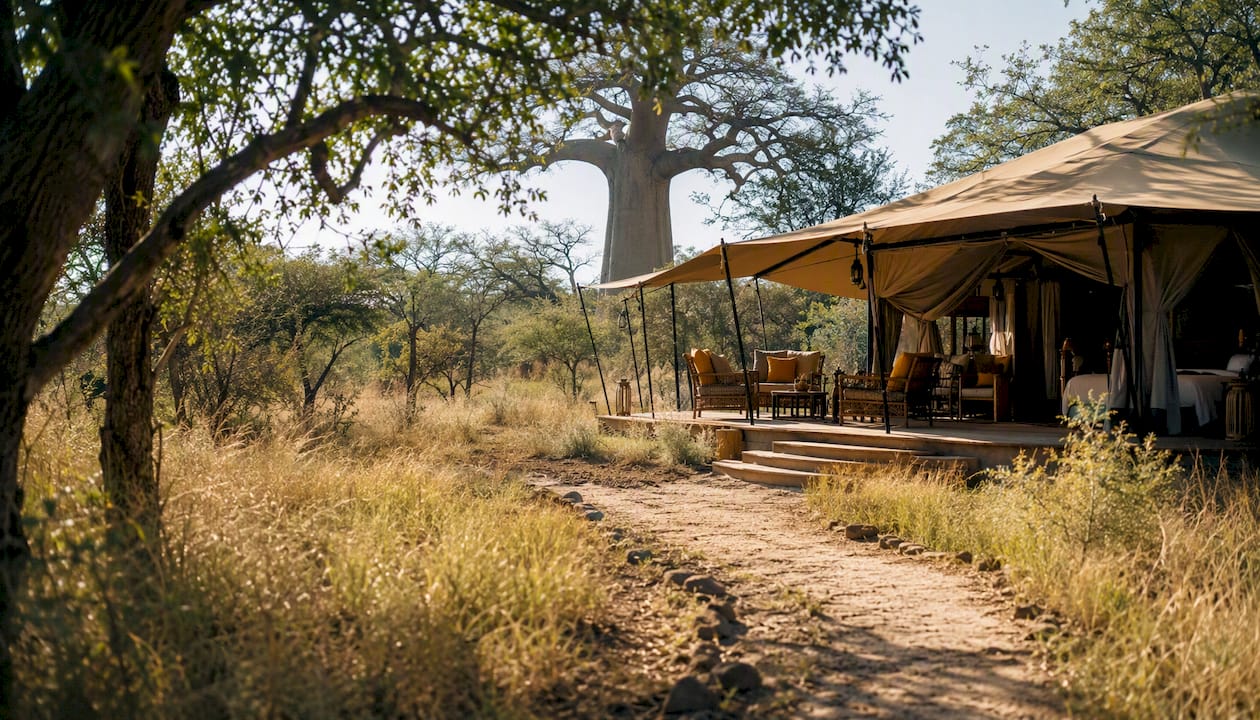
A bespoke safari camp is a tailor-made, private or small-scale safari base built around one guest’s preferences for timing, privacy, activities, and service, rather than a fixed itinerary sold to dozens of strangers at once. It is the difference between booking a room and commissioning an experience.
Three things separate it from a standard safari booking:
- Exclusivity. You get a private camp, a private-use villa, or a camp so small that six tents feels like the whole property is yours.
- Customization. Private guides, a vehicle that goes where you want when you want, and activities built around what you actually came to see.
- Timing and access. The camp positions itself, sometimes literally moving, to put you where the wildlife is during the weeks that matter most.
Think of the Great Wildebeest Migration rolling through the Serengeti and Maasai Mara, or the flooded channels of the Okavango Delta drawing elephant herds each dry season. A bespoke camp follows those rhythms instead of asking you to fit your trip around a lodge’s permanent address. Agencies like Hidden Door Travel build entire itineraries around exactly that kind of positioning, matching guest priorities to the camps and seasons that deliver on them.
Table of Contents
- What Defines a Bespoke Safari Camp on the Ground
- Types of Bespoke Camps: Mobile, Permanent, and Private-Use
- How a Bespoke Safari Camp Experience Gets Designed
- Seasonality and Migration: Why Timing Drives Camp Choice
- What Bespoke Safari Camps Actually Cost
- Sustainability and Community Engagement at Bespoke Camps
- A Day at a Bespoke Safari Camp: What to Expect
- Booking a Bespoke Camp: Timeline and Questions to Ask
- Why Work With a Luxury Travel Agency for a Bespoke Safari
- Start Designing Your Bespoke Safari With Hidden Door Travel
- Sources
What Defines a Bespoke Safari Camp on the Ground
“Tailor-made” sounds good in a brochure. On the ground, it means specific, checkable things.
Operational markers come first. A genuinely bespoke camp offers private-vehicle and private-guide allocation, meaning you are never sharing a Land Cruiser with another family’s kids and their questions. Many offer exclusive-use booking, where you take over the entire camp, not just a room in it. Guest capacity tends to stay small, often under a dozen tents, and pacing stays flexible: if you want to skip the 5:30 AM wake-up call for a slower morning, a bespoke operation can rearrange the day around you. Activities extend beyond the standard game drive into private night drives, photography-focused outings with a specialist guide, and cultural visits arranged around your specific interests rather than a group consensus.
Service markers separate good camps from great ones. Look for private butler or dedicated-host arrangements, menu customization that goes beyond a token vegetarian option, personalized arrival and transfer logistics, and flexible room or bed configurations for families or groups traveling together. Some properties, like Jao Camp in the Okavango Delta, pair a handful of private villas with solar power and dedicated guiding, proof that high design and genuine wilderness access can coexist.
Access and logistics markers matter more than most travelers realize. A bespoke camp’s real advantage is often its flexibility to reposition itself near seasonal wildlife activity, whether that means a fully mobile setup or a semi-permanent camp that opens and closes with the season. Private airstrip access or charter flight arrangements, and park permits that route you away from the tour-bus circuit, are what actually deliver the sense of having a wilderness area to yourself.
The fastest way to separate real customization from marketing language: ask a planner exactly how many other guests will share your guide and vehicle on a given day. If the answer is vague, the “bespoke” label is doing more work than the itinerary is.
Pro Tip: On your first call with a planner, ask them to walk you through one full day, drive by drive, meal by meal. A team that has actually built these trips before will answer in specifics. A team reselling packaged inventory will answer in generalities.
Types of Bespoke Camps: Mobile, Permanent, and Private-Use
Not all bespoke camps solve the same problem, and picking the wrong type is the most common regret affluent travelers report after the fact.
Mobile and seasonal camps move with the wildlife. These low-footprint setups follow migrations and seasonal game concentrations, prioritizing proximity over permanent infrastructure. Standard mobile camps trade some modern convenience, think tank-fed hot water and generator-powered electricity, for genuinely close wildlife access and a leave-no-trace footprint. Premium mobile camps close that gap considerably: operators increasingly offer serviced tents with en-suite bathrooms and gourmet meals, giving guests the movement without the full compromise on comfort.
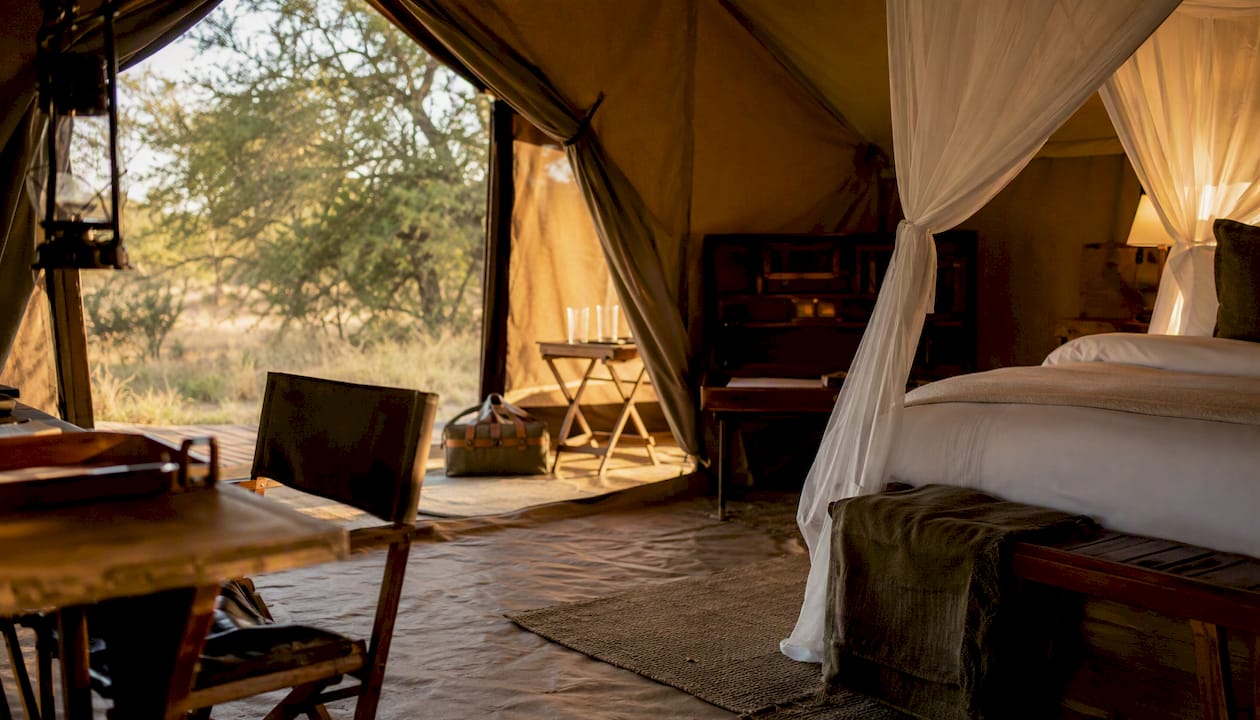
Permanent tented camps stay in one place year-round and often rival five-star lodges for bedding, food, and guiding while keeping the canvas-and-bush atmosphere that makes a safari feel like a safari rather than a resort stay. A tented camp built for permanence can add infrastructure a mobile camp never could: proper plumbing, temperature control, spa facilities, and consistent Wi-Fi for guests who need to stay half-connected.
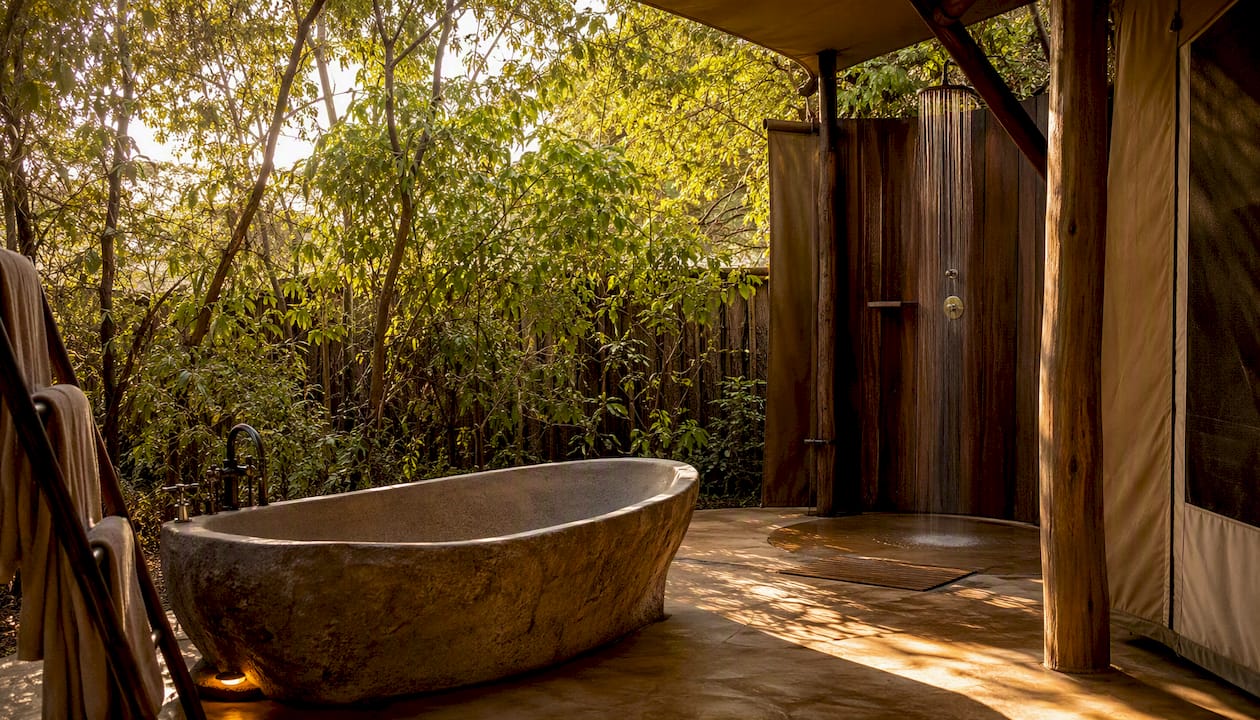
Semi-permanent camps split the difference, staying up for a full season, sometimes six to nine months, before coming down. They give you more comfort than a fully mobile setup with more seasonal specificity than a permanent lodge.
Private-use villas and camps are the top of the pyramid: an entire property, staff included, booked exclusively for one party. No shared common areas, no other guests at the sundowner deck, and full control over the daily schedule.
| Camp type | Best for | Trade-off |
|---|---|---|
| Mobile/seasonal | Migration photography, peak immersion | Fewer modern conveniences |
| Premium mobile | Guests who want movement without giving up comfort | Higher cost than standard mobile setups |
| Permanent tented | Families, older travelers, longer stays | Fixed location, less wildlife-chasing flexibility |
| Private-use villa/camp | Milestone trips, total privacy | Highest cost, most advance planning required |
A useful way to picture the trade-off: a photographer chasing the wildebeest crossing at the Mara River wants a mobile camp positioned within twenty minutes of the action, hot showers be damned. A family bringing grandparents on a first African trip wants a permanent tented camp with a plunge pool, a spa tent, and reliable hot water on demand. Neither traveler is wrong. They simply need different tools.
- Mobile camps: best wildlife proximity, most seasonal, least fixed infrastructure.
- Permanent tented camps: best comfort-to-immersion ratio for repeat or multigenerational travel.
- Private-use properties: best for total control and privacy, at the highest price point.
How a Bespoke Safari Camp Experience Gets Designed
A good bespoke trip does not start with a camp. It starts with a conversation.
- Initial consultation and brief. A specialist gathers your dates, priorities, mobility considerations, dietary needs, and must-see species or experiences. This is where vague wishes (“somewhere remote, somewhere special”) get turned into a workable brief.
- Route and camp selection. The planner matches your brief against camps that fit, weighing season, wildlife patterns, and comfort level rather than pushing whatever inventory is easiest to book.
- Guide and vehicle assignment. Private guiding gets locked in, and if photography or a specialist interest is central to the trip, a guide with that specific expertise gets matched to your dates.
- Add-on experiences. Private dinners under the stars, community visits, research-camp days, or a helicopter transfer between properties get layered in.
- Approvals and booking. Camps confirm availability, contracts get reviewed, and deposit schedules get set.
- Pre-departure logistics. Visas, vaccinations, packing guidance, and a final briefing round out the process before wheels-up.
A well-run bespoke planning process treats the brief and the refinement as two distinct stages: build the trip around the client first, then let a specialist tighten every detail before anything gets booked. The best planners also surface non-negotiables early, mobility limits, a specific species you’re determined to photograph, an anniversary dinner that has to happen on a specific night, so nothing becomes a surprise once you’re already in-country.
Before that first call, come prepared with:
- Your travel dates and any flexibility around them.
- A ranked list of priorities: privacy, wildlife species, photography, family suitability, or celebration milestones.
- Mobility needs, dietary restrictions, and any medical considerations worth flagging early.
- A rough sense of how many camps or regions you want to combine versus staying in one place.
Seasonality and Migration: Why Timing Drives Camp Choice
Bespoke camps live and die by timing. A camp that is extraordinary in July can be underwhelming in February, and the whole point of paying for bespoke design is having someone who tracks that calendar for you.
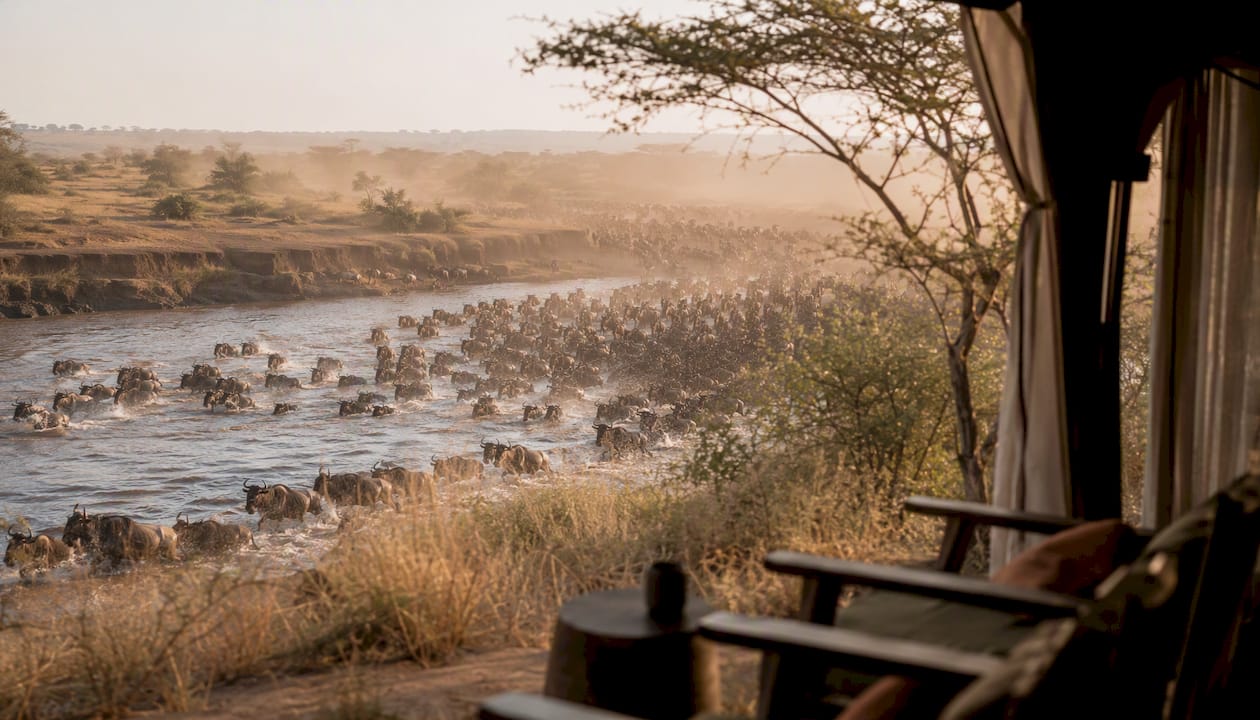
Mobile camps exist specifically to solve this problem. They follow herds through the Serengeti and Maasai Mara ecosystem across the year, positioning guests near river crossings and calving grounds as the migration moves. Elsewhere, camps in South Luangwa open seasonally for walking safaris when the bush is dry enough for foot access, then close during the wet months when trails flood and game disperses.
Timing affects more than wildlife odds. Dry seasons generally mean easier roads and denser game sightings around remaining water sources; wet seasons bring dramatic green landscapes, newborn animals, and lower rates, but also muddier tracks and more dispersed wildlife. A good planner weighs all of it against your specific goals rather than defaulting to “peak season” as a blanket answer.
| Region | Best months | Wildlife highlight |
|---|---|---|
| Serengeti and Maasai Mara | July through October | River crossings, peak Great Wildebeest Migration |
| Okavango Delta | May through September | Flood-season elephant and predator concentrations |
| South Luangwa | June through October | Walking safaris, dry-season leopard sightings |
| Ngorongoro Crater | June through March | Year-round density, calving season January–February |
- Dry season generally favors easier game viewing and firmer roads.
- Wet season generally favors lower rates, greener scenery, and newborn wildlife.
- Mobile camps track these patterns directly; permanent camps absorb the seasonal swings in place.
What Bespoke Safari Camps Actually Cost
Quotes for bespoke safaris can range from generous to eye-watering, and the gap usually comes down to a short list of variables rather than mystery markup.
Exclusive-use pricing versus per-person pricing is the biggest lever. Booking an entire camp privately costs considerably more than paying per person to share a property with other guests, but it buys total control over the schedule and who you share meals with. Private guides and vehicles add cost over shared game drives, sometimes substantially, because the camp is dedicating staff and equipment to one party instead of pooling them across guests. Remote-location logistics, especially charter flights into bush airstrips, can rival the cost of the accommodation itself once you’re flying between three or four camps. Seasonality and park permit fees shift pricing too: peak migration months in the Serengeti command premium rates, while shoulder-season bookings in the same camps can run notably lower. Specialist staff, a dedicated photography guide or a researcher-led walking safari, adds a line item most standard packages don’t include at all.
| Cost driver | Typical impact |
|---|---|
| Exclusive-use booking | Highest overall cost, full property control |
| Private guide and vehicle | Meaningful premium over shared game drives |
| Charter flights between camps | Can rival nightly camp rates on multi-stop itineraries |
| Peak-season timing | Premium pricing during migration or calving windows |
| Specialist guiding (photography, research) | Added line item, usually quoted separately |
Treat any range you’re given as a starting point for a conversation, not a guarantee, since remote logistics and last-minute availability can move numbers in either direction.
Pro Tip: Ask every planner to break a quote into its component parts: camp rate, charter flights, park and conservation fees, and any service charge. A transparent breakdown tells you exactly what you’re paying for and makes it far easier to compare two proposals that look identical on the surface.
Sustainability and Community Engagement at Bespoke Camps
Affluent travelers increasingly ask whether “luxury” and “low-impact” can coexist in the same camp, and the honest answer is that the good ones make it a design principle, not an afterthought.
Common sustainability features worth expecting: leave-no-trace mobile setups that pack out everything they bring in, solar power systems replacing diesel generators, careful water management in areas where every liter has to be trucked or pumped in, composting and waste-reduction practices, and direct financial support for anti-poaching units operating in the surrounding concession.
- Genuine conservation partnerships with named trusts or research organizations operating in the area.
- Owner-run properties where the people setting policy are also the people on-site day to day.
- Clear disclosure of what percentage of fees, if any, goes directly to conservation or community projects.
- Local staffing and visible community development work, schools, clinics, or water projects tied to the camp.
Before booking, ask the planner or camp directly: which conservation organization do you partner with, and what does that partnership actually fund? What percentage of community-facing claims are verifiable versus marketing copy? Hidden Door Travel’s guide to luxury eco lodge examples is a useful starting point for seeing what credible sustainability commitments look like in practice.
A Day at a Bespoke Safari Camp: What to Expect
A typical day starts before sunrise, but not because anyone is forcing you out of bed. Coffee arrives quietly at your tent, followed by an early game drive timed to catch predators still active from the night. Breakfast happens either back at camp or as a full spread set up in the bush, depending on what the morning delivered. Midday brings a rest period, often the hottest and least active hours for wildlife anyway, followed by an optional guided walk, a spa treatment, or simply time at a plunge pool. Late afternoon brings a second game drive that runs into sundowners, and the day closes with a private dinner, sometimes under a thorn tree lit by lanterns, sometimes on a deck under an open sky.
What varies most by camp type is the density of service touches. Look for:
- Private chefs and butler-style service, most common at permanent and private-use camps.
- Ensuite tents with proper plumbing, standard at premium mobile and permanent camps alike.
- Plunge pools and spa tents, typically limited to permanent or semi-permanent properties.
- Tailored photography support, a guide who knows light, angles, and animal behavior specifically for image-making.
Health and safety arrangements deserve real attention, not an afterthought glance at the fine print. Reputable camps maintain medical evacuation agreements with regional air-ambulance services, and most safari regions require or strongly recommend malaria prophylaxis. Ask specifically what emergency protocol exists if a guest needs evacuation from a remote airstrip at night, and confirm that travel insurance with medical evacuation coverage is arranged before departure, not assumed.
Pro Tip: Confirm your evacuation plan in writing before you travel, including which hospital you’d be flown to and roughly how long that flight takes from the camp’s airstrip. It’s a five-minute question that matters far more than the thread count on the sheets.
Booking a Bespoke Camp: Timeline and Questions to Ask
Peak-season bespoke bookings, especially for migration windows or ultra-exclusive private-use properties, fill up far in advance of when most travelers start looking.
- Six to twelve months out: begin planning for peak-season travel (Serengeti migration months, Okavango flood season). Camps with only a handful of tents book out fastest.
- Twelve or more months out: start earlier for full private-use bookings, milestone celebrations, or trips combining multiple ultra-exclusive camps.
- Deposit and contract stage: once a camp is selected, expect a deposit schedule tied to specific milestones, plus a contract outlining cancellation terms.
- Final logistics window: three to four months before departure, finalize visas, vaccinations, and any medical documentation.
- Pre-departure briefing: in the final weeks, confirm packing needs, final itinerary details, and emergency contacts.
Bring this checklist to any planner call:
- How exclusive is this camp, exactly, shared with other parties or fully private?
- What is the guide-to-guest ratio, and is the vehicle private to my group?
- What charter or transfer logistics are included, and what costs extra?
- What is the cancellation policy, and does it flex around weather or political disruption?
- What medical evacuation and insurance arrangements are already in place?
- What community engagement or conservation partnerships can you document?
- What sustainability credentials does the camp hold, and how are they verified?
Why Work With a Luxury Travel Agency for a Bespoke Safari
The value of a specialist agency shows up most clearly at the moments a DIY itinerary breaks down.
Access is the first advantage. Many of the best small camps, the six-tent, owner-run properties that define real bespoke travel, work primarily through established agency relationships rather than public booking channels. Hidden Door Travel’s approach to bespoke design centers on exactly this kind of curated supplier access paired with contract negotiation on the guest’s behalf, so pricing and terms get reviewed by someone who has seen a hundred similar contracts, not just this one.
Problem-solving is the second. Consider a mobile camp scenario: a migration crossing shifts unexpectedly, and a family booked at a camp twenty miles from the new action needs to move, fast, without losing days of their trip. An agency with existing camp relationships can often arrange that shift within hours. A traveler booking independently is often stuck waiting on hold with a call center in a different time zone.
The real test of an agency isn’t how polished the initial proposal looks. It’s what happens on day four, when weather or wildlife or logistics throw the plan sideways, and someone with local relationships has to fix it fast.
- On-ground contact and 24/7 support during the trip itself, not just during booking.
- Curated access to owner-run and small-capacity camps outside standard distribution channels.
- Contract review and transparency on what’s included versus billed separately.
- Bespoke add-ons: private events, specialist guiding, milestone-trip logistics.
Hidden Door Travel’s luxury travel expert services reflect this same model: curated supplier relationships and private-charter logistics built specifically for travelers who want the design work handled by people who’ve done it before.
A brief note on why bespoke wins the emotional argument, too
There’s a particular quiet that settles over a private camp at dusk, no other vehicles idling nearby, no queue for the best photo angle at a river crossing, that a packaged group safari simply cannot replicate. It isn’t just about thread count or private chefs. It’s about the freedom to linger fifteen extra minutes with a leopard because nobody else on the vehicle has a flight to catch, or to swap tomorrow’s plan entirely because today’s sighting changed what you want to see next. Choose bespoke when privacy and flexibility matter more to you than price, and choose a well-run group safari when budget and simplicity matter more than either. Neither choice is wrong. But if you’ve read this far, bespoke is probably the one you’re actually after.
Start Designing Your Bespoke Safari With Hidden Door Travel
Hidden Door Travel is the alternative to piecing a safari together from scattered camp websites and third-party booking portals: one design consultation replaces weeks of comparing mobile camps, permanent lodges, and private-use villas on your own, with someone who already knows which properties deliver on their marketing and which don’t.
A bespoke consultation starts with a conversation about your dates, priorities, and non-negotiables, exactly the brief described earlier in this guide, and moves into curated camp selection, private-guide and charter arrangements, and add-on experiences like private dinners or specialist photography guiding. Hidden Door Travel’s approach to bespoke itinerary design lays out what to expect from that process step by step, including realistic timelines for peak-season bookings.
On fees: initial proposals typically outline camp rates, guiding and vehicle costs, charter logistics, and any applicable service fees separately, so there are no buried surcharges once you’re reviewing a final contract. Specialist add-ons, private chefs, milestone dinners, photography guides, get quoted individually rather than folded invisibly into a base rate.
If a specific culinary experience matters to your trip, from private bush dinners to a camp’s approach to sourcing, this guide to defining culinary experiences is worth a look before your consultation.
Ready to move forward? Visit Hidden Door Travel’s luxury travel agency page to request a bespoke safari proposal and get a realistic timeline based on your travel dates.
Key Takeaways
A bespoke safari camp succeeds when privacy, timing, and personalized guiding align with a traveler’s specific priorities rather than a fixed group itinerary.
| Point | Details |
|---|---|
| Definition | A bespoke camp is tailor-made around one guest’s timing, privacy, activity, and service preferences. |
| Camp type drives the experience | Mobile camps maximize wildlife proximity; permanent camps maximize comfort and consistency. |
| Timing shapes everything | Migration and seasonal patterns determine which camps and regions make sense for your dates. |
| Costs scale with exclusivity | Private guides, charter flights, and exclusive-use booking are the biggest price drivers. |
| Book early for peak season | Plan six to twelve months ahead for migration windows, longer for full private-use properties. |
| Work with a specialist | Hidden Door Travel curates small-camp access and handles contract review, logistics, and on-trip support. |
Sources
- What is a mobile safari camp? — Explorers Against Extinction
- Game Lodge vs Safari Camp: Understanding the Difference Before You Book in Southern Africa — Rex Clarke Adventures