

Managing risk on a family trip comes down to three things done before you leave: a destination-specific risk plan, insurance sized to your actual exposure, and a concierge or 24/7 assistance line already on file. Skip the plan and buy insurance at the last minute, and you’re relying on luck. Hidden Door Travel builds all three into every bespoke itinerary, with coverage benchmarks running $250,000 or higher for medevac on remote trips. The checklist below shows exactly where to start.
TL;DR:
- Families should purchase comprehensive travel insurance and confirm medevac coverage of at least $250,000 before departure, especially for remote destinations.
- Risk assessment prioritizes destination proximity to pediatric care, with lower risks assigned to locations with hospital access within two hours.
- Pre-trip rehearsals of contingency plans and clear role assignments significantly improve response times during emergencies.
- Concierge and assistance services provide essential support, including medical referrals, document replacement, and schedule rebooking during crises.
- Hidden Door Travel offers customized risk audits and coordinated contingency planning to address coverage gaps and streamline emergency responses.
Table of Contents
- The Pre-Trip Checklist Every Family Should Complete
- How Do You Assess Trip-Specific Travel Risks?
- What Insurance Coverage Do Families Actually Need?
- Building an On-Trip Contingency Plan
- What Do Concierge and Assistance Services Actually Do?
- How Hidden Door Travel Handles Risk for Family Trips
- What Most Families Get Wrong About Travel Risk
- Book a Family Travel Risk Audit
- Sources
The Pre-Trip Checklist Every Family Should Complete
Most family travel emergencies trace back to something that could have been handled in the ten minutes before departure. Work through this order.
- Gather documents into two places. Scan passports, insurance summaries, and prescriptions into a shared digital vault, then pack a printed folder. Include a signed child medical consent form if a parent won’t be present at every activity.
- Buy insurance now, not next week. Early purchase locks in pre-existing condition waivers and lets you schedule high-value jewelry or watches before you fly.
- Assign roles. Decide who manages the kids during transit delays and who handles logistics calls, then name a home-base contact back home who holds copies of everything.
- Confirm pediatric access and pack accordingly. Verify the nearest children’s hospital and carry an emergency cash reserve alongside a fully stocked med kit.
Pro Tip: Put a laminated card in each adult’s wallet listing the insurance policy number, the 24/7 assistance line, and blood types for every family member. In a crisis, nobody wants to search a phone for that information.
How Do You Assess Trip-Specific Travel Risks?
Risk assessment starts with distance, not destination glamour. A private island six hours from the nearest pediatric ICU carries a different risk profile than a European capital with world-class hospitals fifteen minutes away, even if both cost the same per night. Choosing destinations with pediatric care within roughly a two-hour transfer window meaningfully lowers your exposure and can justify a lower medevac limit.
From there, sort planned activities into tiers:
- Low risk: museum tours, private dining, standard sightseeing.
- Medium risk: skiing, sailing, horseback riding, activities that need a policy rider or exclusion check.
- High risk: heli-skiing, deep-sea diving, remote trekking, anything an insurer might flag outright.
Multigenerational trips add another layer. Grandparents traveling with young grandchildren often need separate medical thresholds, and if your trip includes household staff or a nanny, check whether your liability or workers’ compensation coverage actually extends to them abroad, a gap family office travel planning specialists flag constantly. If a destination’s medevac infrastructure or pediatric coverage can’t meet your family’s needs, that’s a decision point to change the itinerary, not a risk to accept and hope around.
What Insurance Coverage Do Families Actually Need?
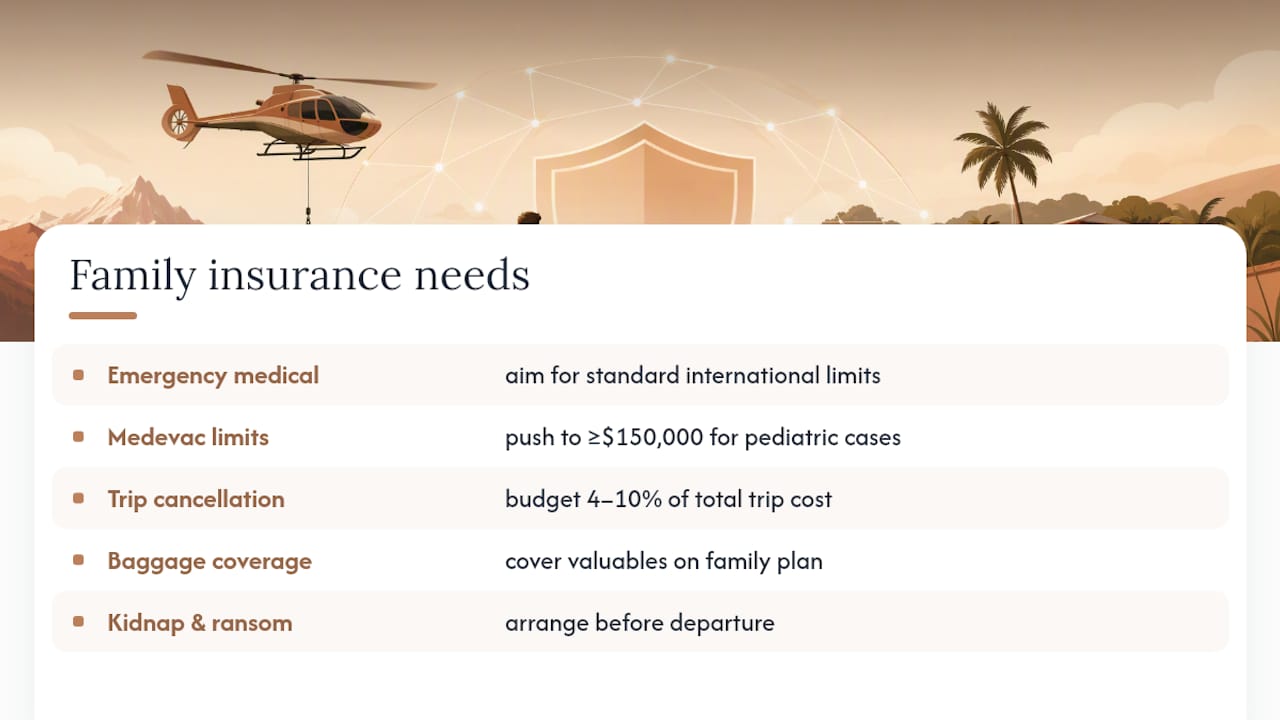
Four policy types matter for a bespoke family trip: emergency medical, medical evacuation and repatriation, trip cancellation/interruption, and baggage or valuables coverage. Families with elevated visibility or net worth sometimes add kidnap and ransom coverage, which needs to be arranged before departure, not after a security concern surfaces.
On numbers: aim for emergency medical coverage per traveler in the range commonly recommended for international trips, and push medevac limits to a level recommended for remote or pediatric-exposure trips, since pediatric evacuation from a remote luxury destination can easily top $150,000 on its own.
Budget roughly 4% to 10% of total trip cost for a family insurance plan covering medical, cancellation, and baggage. On a $5,000 family trip, that’s about $200 to $500; scale that percentage up for a six-figure bespoke itinerary and the number gets serious fast.
Look for family-specific features: children covered free on a parent’s policy, coverage for a parent who must accompany an evacuated child, waivers for pre-existing conditions, and cancel-for-any-reason upgrades for trips with nonrefundable deposits. Domestic trips near strong hospital networks need less medical coverage and more emphasis on cancellation protection, since the bigger financial risk there is a lost deposit, not a medical bill. Programs like Passport 360 SM from Chubb illustrate what a comprehensive plan looks like: 24/7 assistance, evacuation coordination through professional case managers, and a trip risk intelligence portal bundled into two tiers. Read more on how travel insurance actually functions on luxury trips before you buy.
Building an On-Trip Contingency Plan
A plan only works if it’s rehearsed, not just written down; for detailed planning steps, consult this Ultimate Family Vacation Planning guide to help assign roles and prepare contingencies. Here’s the sequence to walk through with everyone traveling, adults included.
- Confirm roles before wheels-up. One parent owns child supervision during transit, the other owns logistics and paperwork.
- Set your document routine. Digital vault, printed folder, and a wallet card with policy numbers, plus sharing itinerary and passport copies with your home-base contact so someone off-site can act if local communication fails.
- Pack the med kit for kids specifically. EpiPens if needed, a working thermometer, pediatric fever and allergy medication, and backup prescriptions in original labeled bottles.
- Know the assistance call script. When you call your insurer’s 24/7 line, have your policy number, the traveler’s name and location, and a brief description of the situation ready. Most assistance providers can arrange direct billing or a guarantee of payment with a hospital, which avoids the family fronting tens of thousands of dollars on the spot.
Pro Tip: Do a five-minute “what if” drill with older kids before you leave: what do you do if you get separated from us at the airport, and what’s the one phone number you memorize? It sounds excessive until it isn’t.
What Do Concierge and Assistance Services Actually Do?
A 24/7 assistance line is not just a hotline for emergencies. It’s an operational layer that removes friction at exactly the moment friction is most dangerous. In practice, that means:
- Medical referrals to vetted local providers and case managers who coordinate care.
- On-the-spot translation during a hospital visit or police interaction.
- Emergency document replacement when a passport is lost or stolen.
- Rebooking flights and accommodations when a medical issue forces a schedule change.
Destination monitoring and travel intelligence services add a proactive layer, flagging political unrest, disease outbreaks, or weather risk before you land, not after. When a situation escalates, that assistance team is also the one coordinating medevac logistics or looping in an embassy, which is why insurance and concierge coordination working together matters more than either service alone.
How Hidden Door Travel Handles Risk for Family Trips
Every bespoke family itinerary at Hidden Door Travel starts with a pre-trip risk audit: destination medical infrastructure, activity classification, and insurer coordination matched to your family’s specific exposure. We schedule valuables ahead of departure and confirm evacuation pathways before you book a single night.
What you get as a deliverable:
- A written policy summary in plain language, not insurance jargon.
- Local medical contacts and the nearest pediatric facility for every stop.
- Confirmation calls to staffed villas or resorts on security and medical protocols.
We function as the single point of contact managing insurance, concierge, and contingency execution, so you’re not juggling three vendors mid-crisis.
What Most Families Get Wrong About Travel Risk
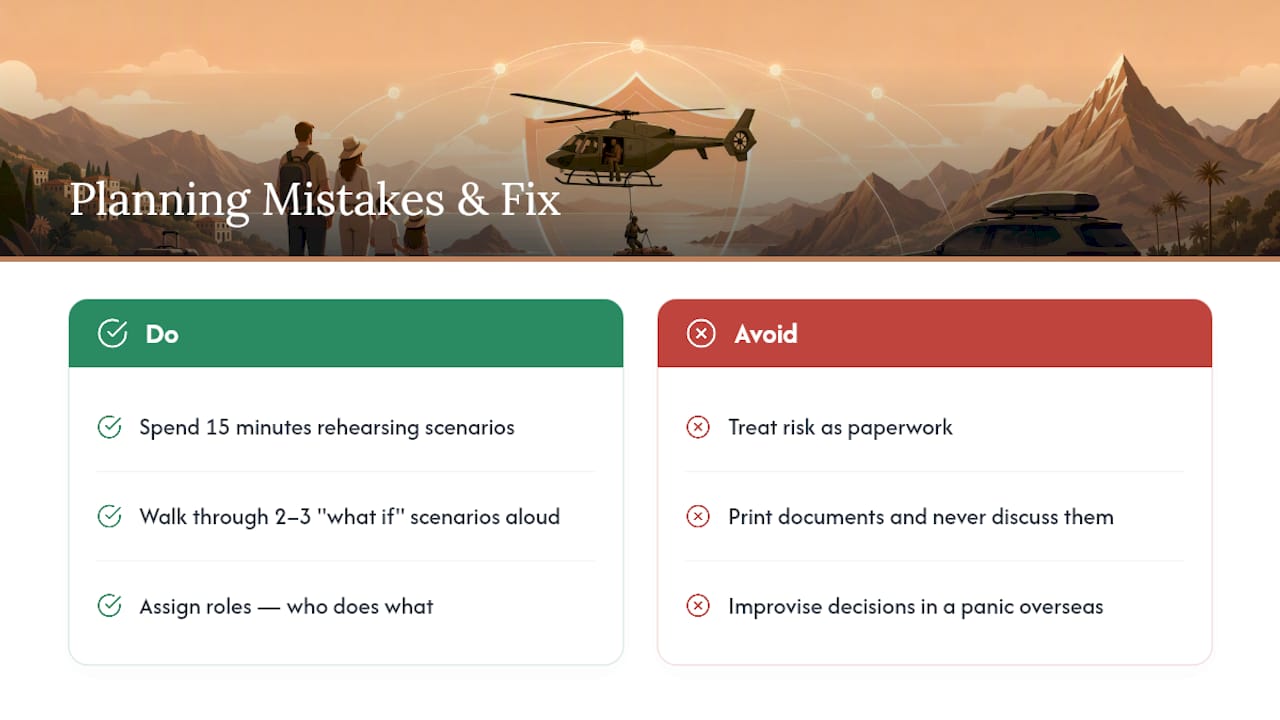
The biggest mistake I see isn’t underinsuring. It’s treating risk planning as a paperwork exercise instead of a rehearsal. Families buy a solid policy, print the documents, and never actually talk through who does what if a child gets separated at a crowded market or a parent needs emergency surgery abroad.
The fix is almost embarrassingly simple: spend fifteen minutes at the kitchen table before you pack, walking through two or three specific “what if” scenarios out loud. Families who do this respond faster and calmer when something actually goes wrong, because the decision was already made at home, not improvised in a panic overseas.
— Michael
Book a Family Travel Risk Audit
You’ve seen the checklist, the coverage benchmarks, and the roles a real contingency plan requires. The work of actually coordinating it, insurer conversations, evacuation pathways, staffed villa checks, is where most families run out of time. Hidden Door Travel is the alternative to piecing this together yourself: one planner manages your insurance coordination, your concierge escalation path, and your on-the-ground contacts as a single package, built around your itinerary instead of a generic template.

If you’re booking a bespoke family trip in the next few months, request a risk-audit consultation with our luxury travel experts and we’ll map your coverage gaps and contingency plan before you commit to a single reservation.
Sources
- Passport 360 SM brochure — Chubb
- Family Travel Insurance & Emergency Prep (2026)
- How to Build a Family Travel Contingency Plan